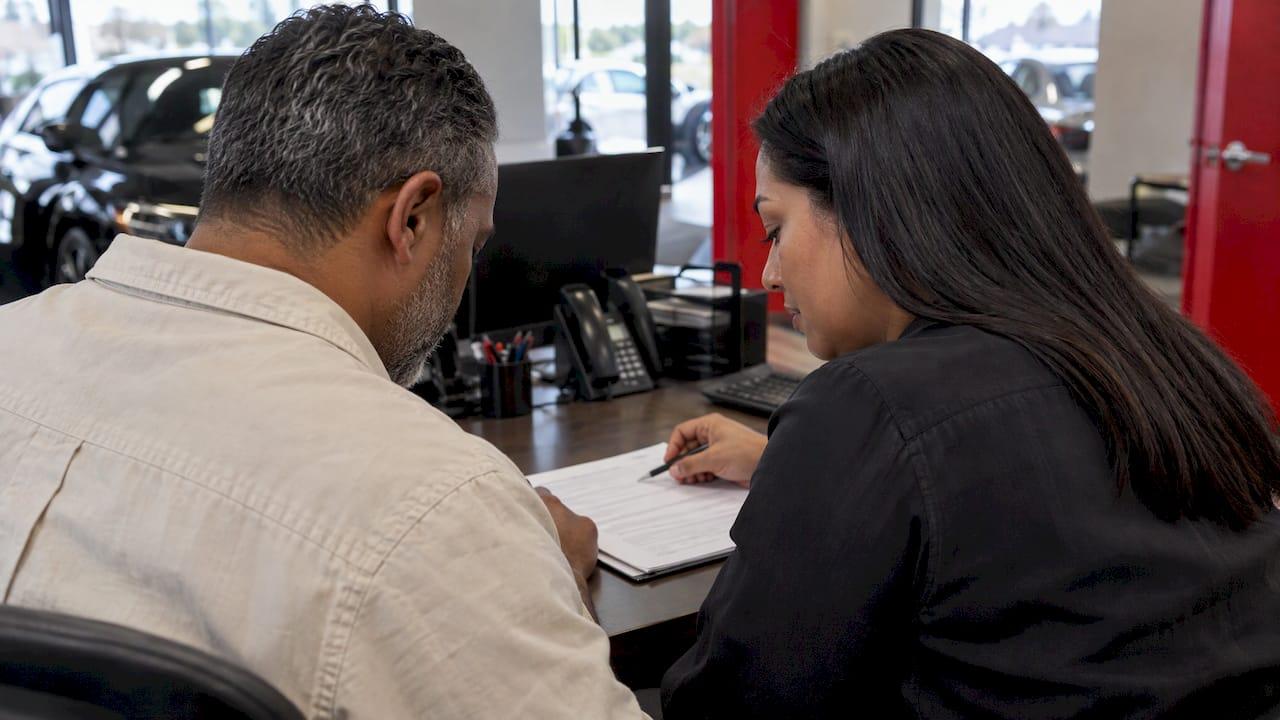
A weekly car payment at a buy here, pay here (BHPH) dealership is a small amount due every week or two, paid straight to the dealer that sold you the car, because that dealer is also your lender. The smaller number is easy to like. To judge it well, turn it into a yearly figure, read the written loan disclosures, and know your rights if a payment is ever late. At Elmwood Auto Sales in Providence, RI, we offer buy here, pay here solutions as part of tailored financing for a range of credit histories, and this guide gives you the same math and checklist we would want any buyer to have in hand.
TL;DR
- In BHPH financing the dealer funds the loan and you pay the dealer directly, often weekly or biweekly, according to the Consumer Financial Protection Bureau (CFPB).
- Multiply a weekly payment by 52 to see what you pay in a year, then divide by 12 to compare it with a monthly payment.
- Focus on the total cost of the loan (amount financed plus finance charge), not only the payment size.
- Federal law requires written disclosures, including APR and total of payments, before you are obligated. Read them before you sign.
- Rhode Island gives you a right-to-cure notice before repossession. Know the timeline before you need it.
Table of Contents
- How do weekly payments work at a buy here, pay here dealer?
- What does "guaranteed auto financing" really mean?
- How do you turn a weekly payment into a real cost?
- Why does total cost matter more than the payment?
- Which disclosures should you read before you sign?
- Does a BHPH loan help your credit?
- What happens if a weekly payment is late or missed?
- How do you choose a reliable vehicle for the payment you can carry?
- What does a good BHPH purchase look like?
- Where does Elmwood fit in?
- FAQ
- Sources
How do weekly payments work at a buy here, pay here dealer?
In a traditional purchase, the dealer sells you the car and a separate bank or lender holds the loan. At a BHPH dealership, one business does both jobs. The CFPB describes these dealers as financing auto loans in-house for borrowers with no credit or low credit scores, and notes that you make your payments to the dealership itself. You can read our own plain-language explainer on the buy here pay here meaning if the term is new to you.
The payment schedule often follows your paycheck. Many BHPH buyers are paid weekly or every two weeks, and a payment due on a pay-cycle basis can feel easier to manage than one large bill at month's end. A Credit Acceptance explainer is one of several pages that describe payments as often weekly or biweekly, but the schedule in your contract is the one that matters, so confirm it in writing.
Because the dealer is the lender, approval usually looks at your ability to pay. That means income, how long you have been employed and whether you can keep up with the payment, rather than a deep review of past credit problems. Our guide to documents that speed up buy here pay here approval lists what to bring.

What does "guaranteed auto financing" really mean?
You will see "guaranteed approval" and "no credit, no problem" in many ads. The CFPB notes that BHPH and "no credit check" dealers tend to advertise to people with no credit history or poor credit. The practical meaning is that the dealer is willing to look past a low score and base the decision on your situation today.
That is a good reason to apply with the details of your income and job ready. Approval is still tied to the vehicle, the down payment, and your ability to make the payment. The strongest approach is to see your options, then look at the contract terms line by line. Our no credit check car loan guide covers how thin-file buyers get started.
How do you turn a weekly payment into a real cost?
A weekly number is hard to compare with the monthly payments you see everywhere else. Two quick conversions solve that.
- Yearly cost: weekly payment × 52.
- Monthly equivalent: yearly cost ÷ 12.
A month is not four weeks. It is a little over four and a third, so a weekly payment adds up to more than four times the weekly amount each month.
Here is an illustrative example with round numbers (not a quote from any dealer):
| Item | Figure |
|---|---|
| Weekly payment | $90 |
| Payments in one year | 52 |
| Cost per year | $4,680 |
| Monthly equivalent | $390 |
| Term of 104 weekly payments (2 years) | $9,360 total of payments |
Once you know the monthly equivalent, check it against your budget. If you are paid weekly, line the payment date up with payday. If you are paid biweekly, ask whether the schedule can match, and have the answer written into the contract. Our comparison of biweekly vs. monthly car payments shows how the schedule changes what you pay over time, and the monthly car payment formula works through the underlying math.
Why does total cost matter more than the payment?
The CFPB explains that the total cost of a loan equals the amount financed (the vehicle price, taxes, government fees and any optional add-ons, minus your down payment and trade-in) plus the finance charge (the interest and certain fees over the life of the loan). Its auto loan guide advises focusing on that total rather than only the monthly payment.
The same weekly payment can hide very different deals. A lower weekly amount stretched across more weeks can cost more overall than a slightly higher payment over a shorter term. Always ask for these numbers together:
- The vehicle price and the amount financed
- The APR (annual percentage rate, the yearly cost of the loan as a percentage)
- The number of payments and the payment amount
- The total of payments
- Any fees, such as documentation or late fees
- Whether optional add-ons, like a warranty, are included in the amount financed
BHPH rates tend to be higher than bank or credit union rates, which the CFPB states plainly. Our overview of what to expect on buy here pay here rates gives a realistic range so the number in your contract does not come as a surprise.
Which disclosures should you read before you sign?
The federal Truth in Lending Act requires lenders to give you written disclosures before you are legally obligated. The CFPB lists them: the APR, the finance charge, the amount financed, the total of payments, the number of payments, the payment amount, late fees, whether the rate is variable, and whether you can prepay without a penalty. In its guidance on what to know before you finalize an auto loan, the CFPB says the disclosures should be fully filled out before you sign, and that you can ask to receive them earlier or take them home.
That last point is worth using. A short checklist on pre-approval versus approval makes the same underlying point for any large purchase: a preliminary yes is not final terms, so read the final paperwork before committing.
When you review the paperwork, do these things in order:
- Find the APR and the total of payments, and compare the total with the car's price.
- Multiply the weekly payment by the number of payments and confirm it matches the total of payments.
- Read the late-fee terms and the grace period, if any.
- Check whether prepayment is penalty-free, so extra payments can shorten the loan.
- Confirm which add-ons are included, and what each one adds to the amount financed.
- Ask where the payment is made, such as in person, online or by phone, and how you get a receipt.
If a number does not match what you were told, ask for it to be corrected before you sign. That is a normal request at any dealership.
Does a BHPH loan help your credit?
It depends on whether the dealer reports your payments. The CFPB says BHPH dealers often report negative information, such as late payments, to credit bureaus, and often do not report on-time payments. The agency also advises that you can ask the dealer to put in writing that it will report your on-time payments to the credit reporting companies.
If building credit is one of your goals, make that request part of your first conversation, and have the answer in the contract. Our bad credit car buying options guide and low income car financing guide cover the other steps that help a score recover.
What happens if a weekly payment is late or missed?
Weekly schedules leave less time between due dates, so it pays to know the rules before you sign.
Devices in the car. The CFPB's auto loan guide says BHPH dealers and other lenders serving buyers with no or poor credit are permitted to put devices in the vehicle that help them repossess or disable it if you miss a payment. Ask whether the car has one and what the policy is for a late payment, and get the answer in writing.
Rhode Island notice rights. Under Rhode Island General Laws § 6-51-3, after a default the lender may not accelerate the loan, sue or repossess until it gives you a right-to-cure notice, which may be sent after 10 days in default. You then have at least 21 days to cure. If the vehicle is repossessed, you may reinstate within 20 days by paying the full debt plus reasonable expenses. The right to cure applies once in any 12-month period.
If you think you might miss a payment, contact the dealer before the due date and ask what options exist. If you receive a default notice or a dispute arises, a Rhode Island attorney or the state's consumer protection office is the right person to consult about your specific situation.

How do you choose a reliable vehicle for the payment you can carry?
A payment is only worth making on a vehicle that runs well, so start with the car. Our used vehicles go through thorough inspections so that they meet high safety and reliability standards, and our sales team does not work on commission, so there is no one steering you toward a more expensive vehicle than you need.
When you shop, match the vehicle to your life:
- First-time buyers: a compact car, such as a Honda Civic, is a straightforward first vehicle.
- Families: look at a three-row or midsize SUV, such as the Toyota Highlander or Toyota RAV4.
- Work and hauling: a pickup such as the RAM 1500 Classic Crew Cab gives you bed space and seating for a crew.
Always ask for the vehicle history report, and test drive before you commit. You can book a test drive with us online.
If you do not see the right vehicle, our Car Finder helps you look for it. If you already own a car, the trade-in page explains how to put its value toward your next one. A larger trade-in or down payment lowers the amount financed, which lowers the finance charge too.
What does a good BHPH purchase look like?
A sound deal has a few features you can verify on paper:
- The weekly payment, converted to a monthly figure, fits comfortably in your budget with room for insurance and fuel.
- The total of payments is a number you understand and accept.
- The vehicle has been inspected, and you have seen the history report.
- The contract states how payments are reported to credit bureaus.
- The late-fee, grace period and repossession terms are written down and match what you were told.
- Add-ons, such as warranties, are optional items you chose, with their price visible.
If all six are true, you have a clear picture of what you are signing. For a broader view of how dealer-arranged loans are put together, read how dealer financing works and our types of car financing options.
Where does Elmwood fit in?
If you are in Providence or nearby and want a vehicle with financing built around your situation, start with our used car financing application. We offer tailored in-house and third-party financing, including buy here, pay here, for buyers with a range of credit histories, and our approach is low-pressure and commission-free, so you can go through the numbers at your own pace.
Browse the used cars, trucks, SUVs and vans on our lot, and bring the checklist from this page with you.
Our view on weekly payments
We think a payment plan is only as good as the buyer's understanding of it. A weekly payment can fit the way many people are paid, and that is the real reason buy here, pay here financing exists: it lets us look at your income and your ability to pay instead of closing the door on a low score.
That is why we do not rely on commission-based sales tactics. When nobody at the dealership earns more for a bigger sale, the conversation can stay on what you need, what you can carry and what the vehicle should be. We also inspect our vehicles thoroughly, because a payment, however small, is a poor deal on a car that does not hold up.
Our advice is to bring your pay stubs, decide your weekly limit before you walk in, and read the written terms together with us. Ask every question you have. We would rather you leave with a clear contract than a quick signature.
Elmwood
FAQ
Is a weekly payment cheaper than a monthly payment?
Not by itself. A weekly payment is smaller because it covers a shorter period, but 52 weekly payments a year add up to more than 12 monthly payments of four times the weekly amount. Multiply by 52, divide by 12, and compare the monthly equivalent. The total of payments in the contract is the number that tells you what the loan costs.
Can I get approved with bad credit or no credit?
BHPH dealers typically focus on your income, employment and ability to make payments rather than on an in-depth credit history. You can start with our online financing application. Having recent pay stubs and proof of residence ready tends to make the process smoother.
Will on-time weekly payments improve my credit score?
Only if the dealer reports them. The CFPB says BHPH dealers often report late payments but not on-time ones, and recommends asking for a written commitment to report your on-time payments to the credit reporting companies. Ask before you sign.
Can the dealer repossess my car right after a missed payment?
In Rhode Island, a lender generally must send a right-to-cure notice first, which may go out after 10 days in default, and you then have at least 21 days to cure. After a repossession, you may reinstate within 20 days by paying the full debt plus reasonable expenses. Read your contract's default terms and contact the dealer early if a payment will be late.
Can I lower my weekly payment?
A larger down payment or a trade-in reduces the amount financed, which can reduce the payment. Our trade-in page is the place to start if you have a vehicle to put toward the purchase.
Sources
- CFPB: Take control of your auto loan, a step-by-step guide
- CFPB: What should I know before I finalize a car or auto loan?
- Rhode Island General Laws § 6-51-3
- Credit Acceptance: What is a buy here pay here dealer?
- Pre-approval vs. approval buyer checklist