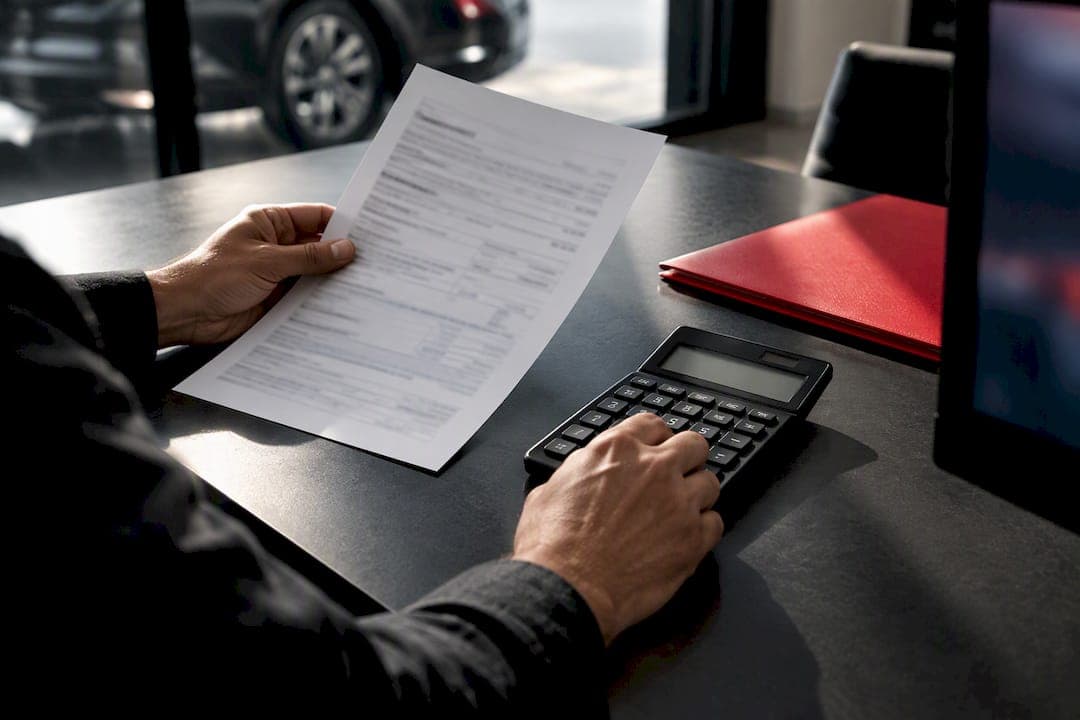
Expect roughly 15% to 20% APR on many buy here pay here deals, with some contracts reaching 29% or higher, compared to around 10% at banks for similar subprime borrowers. The gap exists because dealers carry the loan themselves and take on more risk over shorter terms. Before signing anything, ask the dealer to put the APR in writing and compare it line by line against the total of payments.
TL;DR:
- Buy here pay here APRs typically range from 15% to over 20%, with some reaching 29% or higher, which is significantly above bank loan averages of around 10%.
- Factors influencing the rate include credit history, down payment size, vehicle age, and loan term length, with higher risk leading to higher interest.
- Federal law requires clear disclosure of APR, total of payments, and financing charges, making line-by-line contract review crucial before signing.
- State laws set usury limits that often determine the maximum dealer interest rate, causing variation across different locations.
- A $10,000 loan over 36 months at 10% APR costs roughly $1,628 in interest, while at 20%, interest nearly doubles to approximately $3,392.
Table of Contents
- Typical rate ranges and what affects your BHPH APR
- How APR is disclosed and the TILA essentials to check on your contract
- State variation and legal caps: why rates vary widely by place
- Money examples: comparing total cost at different APRs and terms
- Pros, cons, and the practical risks of choosing BHPH financing
- How to shop and lower your total cost
- Payments, missed payments, and what happens after repossession
- Elmwood Auto Sales: how we handle in-house financing and protect buyers
- The real cost conversation buyers should be having
- If you want local help: Elmwood Auto Sales financing and next steps
- Sources
- FAQ
Typical rate ranges and what affects your BHPH APR
Buy here pay here financing tends to cost more than a bank loan, and the numbers back that up. According to the CFPB's comparison of subprime auto loans, banks average close to 10% APR for subprime borrowers, while finance companies and BHPH dealerships typically land between 15% and 20%. A separate CFPB subprime auto data report confirms that finance companies and BHPH lenders show both higher average interest rates and higher delinquency rates than banks or credit unions.
Several factors decide where your rate lands within that range:
- Credit score and payment history: thinner or damaged credit files usually mean a rate closer to the top of the range.
- Down payment size: a larger down payment lowers the amount financed and can soften the rate a dealer offers.
- Vehicle age and value: older, higher-mileage vehicles often carry higher rates because they represent more risk to the lender.
- Loan term length: shorter terms can mean lower total interest even when the APR itself looks similar.
Dealers also work with something called a buy rate, which is the base rate a lender or the dealer's own financing arm assigns based on your credit profile. Some dealers add a markup on top of that buy rate, and the difference becomes part of your final APR. That markup is legal, but it is also negotiable, and understanding it helps explain why two buyers with similar credit can walk away from the same lot with different numbers. Our guide to how dealer financing works breaks this down in more detail.
How APR is disclosed and the TILA essentials to check on your contract
Federal law spells out exactly what a dealer has to show you before you sign. Under the Truth in Lending Act, also known as Regulation Z, closed-end auto loans must disclose the APR, the finance charge, the amount financed, and the total of payments. Advertising a periodic rate without also showing the APR can violate federal disclosure rules, and dealers have faced enforcement action for exactly that kind of omission.
Before you sign, work through this checklist:
- Confirm the APR appears clearly, not just a monthly or weekly rate.
- Check that the finance charge and total of payments are itemized separately from the vehicle price.
- Look for add-ons like warranties or GPS devices folded into the loan without a separate line item.
- Compare the amount financed against the actual price you agreed to for the vehicle.
Federal enforcement records, including a CFPB consent order against a dealer for disclosure failures, show these are not hypothetical risks. Dealers have been cited for hiding finance charges inside add-on products, which is exactly why line-by-line comparison matters.
Pro Tip: Ask for a copy of the retail installment contract before you sign, and read the APR and total of payments out loud to the dealer to confirm they match what you were quoted verbally.
State variation and legal caps: why rates vary widely by place
BHPH rates are not the same everywhere, and that is largely a function of state law. Each state sets its own usury limits and regulatory framework for auto lending, which creates a practical ceiling on how high a dealer can legally price a loan. In practice, many dealers price near whatever the local maximum allows, so two buyers in different states with identical credit profiles can end up with meaningfully different offers.
A few things worth checking before you negotiate:
- Your state's usury cap or interest rate ceiling for retail installment contracts.
- Whether your state requires a separate license for dealers who offer in-house financing.
- Any state-specific disclosure rules that go beyond the federal TILA minimums.
Your state's financial regulator or attorney general's office typically publishes this information, and it is worth a quick search before you sit down at the dealership. Knowing the local ceiling gives you a benchmark for whether an offer is reasonable or pushing the legal limit.
Money examples: comparing total cost at different APRs and terms
Numbers make the APR gap concrete. Say you finance $10,000 over 36 months. At 10% APR, your payment lands around $323 a month, and you pay roughly $1,628 in total interest. At 20% APR, the same $10,000 over the same 36 months costs about $372 a month, and total interest climbs to roughly $3,392.

That's more than double the interest cost for the same loan amount and term, purely from the APR difference. The math behind this comes from a standard amortization formula that spreads interest across your remaining balance each month, and our monthly payment calculator guide walks through it step by step if you want to run your own numbers.
A few things to keep in mind as you compare offers:
- Payment frequency, whether weekly, biweekly, or monthly, changes your cash flow but not the APR itself.
- Many BHPH dealers use weekly or biweekly schedules timed to a buyer's paycheck, which can make budgeting easier even though the total cost stays the same.
- Always ask for the total of payments figure, not just the monthly number, since that is the true cost of the loan.
Shorter terms at a high APR can sometimes cost less in total interest than a longer term at a lower APR, so run both numbers before you decide.
Pros, cons, and the practical risks of choosing BHPH financing
BHPH financing exists because it solves a real problem: it gets buyers with limited or damaged credit into a vehicle when a bank might say no. Approvals tend to happen fast, often the same day, and underwriting is more flexible than at a traditional lender.
That flexibility comes with tradeoffs:
- Higher APR compared to bank or credit union financing for similar borrowers.
- Vehicles often sold as-is, with limited warranty coverage.
- Add-on products, such as service contracts, that can raise the total cost if not itemized clearly.
- Repossession can happen quickly after a missed payment, depending on the contract terms.
- Some dealers do not report positive payment history to credit bureaus, which limits the credit-building benefit buyers expect.
Pro Tip: Ask the dealer directly whether they report payment history to the major credit bureaus, and get the answer in writing if it matters to your credit-building plans.
Before you sign, confirm any warranty coverage in writing, request an itemized list of every add-on cost, and ask how the dealer handles credit reporting.
How to shop and lower your total cost
Shopping BHPH financing well means comparing more than just the sticker price. Line up these figures side by side for every offer you consider:
- APR and total of payments, not just the monthly payment amount.
- Loan term length and how it affects total interest.
- Any add-on products and their individual costs.
- Repossession terms, including grace periods and notice requirements.
- Whether the dealer reports payments to credit bureaus.
Bringing the right paperwork speeds up negotiation and can improve your terms. Pay stubs, recent bank statements, proof of residence, and personal references all help a dealer assess your ability to pay, which sometimes translates into a better rate. Our checklist of documents for faster BHPH approval covers what to gather ahead of time.
If BHPH feels like your only option, it is worth exploring alternatives first. A credit union often extends more competitive rates to members with thin credit files, and a co-signer with stronger credit can sometimes unlock bank financing you would not qualify for alone. Some buyers also start with BHPH and plan to refinance once their credit improves, which can lower the rate on the remaining balance. Refinancing makes the most sense once you have built several months of on-time payments and your credit score has moved up meaningfully. For a deeper look at reducing your rate as a first-time buyer, see our guide to avoiding high APR financing.
Payments, missed payments, and what happens after repossession
Missing a payment on a BHPH loan can trigger consequences faster than with a traditional bank loan, since many contracts allow repossession after just one missed payment. Late fees typically apply first, but the contract language determines how much grace period you actually get.
If a vehicle is repossessed, you may still owe money afterward. This is called a deficiency balance, and it is the difference between what you owed and what the lender recovers when the vehicle is resold, often at auction for less than its market value. According to FTC guidance on missed car payments, you can remain liable for that difference even after losing the vehicle.
If you think you might fall behind:
- Contact the lender before you miss a payment, not after.
- Get any modified payment plan or hardship agreement in writing.
- Understand whether a voluntary surrender changes your deficiency liability compared to a contested repossession.
- Ask directly whether your state allows reinstatement after repossession begins.
Verbal promises from a lender carry real risk. Only a written agreement protects you if a dispute comes up later.
Elmwood Auto Sales: how we handle in-house financing and protect buyers
At Elmwood Auto Sales, every vehicle goes through a thorough inspection before it reaches the lot, and our sales team works without commission, which keeps the focus on what actually fits your budget and credit situation. We offer tailored financing options, including buy here pay here solutions, for buyers across a range of credit histories.
We disclose APR, total payments, and any add-on costs clearly and in writing before you sign anything, and we help buyers think through refinance timing once their credit position improves. Whatever dealer you work with, always verify the APR, the total of payments, and every itemized add-on before you commit.
The real cost conversation buyers should be having
The APR headline gets attention, but total of payments is the number that actually matters, and too many buyers skip straight to the monthly payment without asking what they will pay overall. A loan with a lower monthly bill can still cost more in the end if the term stretches long enough, and dealers know that stretching the term makes a high-APR loan feel affordable month to month.
The bigger gap in most advice on this topic is that it treats BHPH as a last resort to avoid entirely, when the more useful framing is that it is a tool with a real cost, best used deliberately and for a limited time. If you need BHPH to get into a reliable vehicle now, use it, but treat the first year as a bridge toward refinancing once your payment history improves. Ask about credit reporting before you sign, not after, since that single detail decides whether the loan helps your credit or just gets you a car.
— Elmwood
If you want local help: Elmwood Auto Sales financing and next steps
Choosing a used car with financing you understand matters more than choosing the lowest sticker price. At Elmwood Auto Sales, we skip commission-based pressure tactics and put every vehicle through a full inspection before it goes up for sale, so you know what you are buying before you talk financing.
- We offer tailored financing, including buy here pay here options, for a range of credit backgrounds.
- Every inspected vehicle comes with clear documentation on condition and history.
- Our Car Finder tool helps you narrow down inventory before you visit.
- We disclose APR, total payments, and add-on costs in writing, upfront.
Bring a recent pay stub, a bank statement, and proof of residence to speed up your approval. Ready to see what you qualify for? Apply online or schedule a test drive to get started.
This article is general information, not a substitute for advice from a qualified financial advisor. Consult a qualified financial professional about your own circumstances before acting on anything here.
Sources
- Comparing auto loans for borrowers with subprime credit scores — CFPB
- Subprime auto loans data point — CFPB
FAQ
What is the $3,000 rule for cars?
This is not a formal regulation covered by federal auto lending disclosures, and definitions vary depending on where you encounter the term. If you have seen it referenced as a rule of thumb for down payments or trade-in value, treat it as informal advice rather than a legal requirement, and confirm any such figure directly with your lender or dealer.
What is the average payment on a $30,000 car?
The payment depends entirely on your APR and loan term, so there is no single average that applies to every buyer. Using the amortization approach shown earlier for a $10,000 loan, a larger loan amount at a similar rate and term would scale up proportionally, and you can run your own numbers with our monthly payment calculator guide.
Is 4.99% APR good for a new car?
A rate well below the 15% to 20% range typical of BHPH financing and below the roughly 10% average banks charge subprime borrowers, so it generally reflects strong credit and favorable market conditions. Whether it counts as good for your situation depends on your credit profile and the lender you are comparing it against.
What are the pros and cons of buy here pay here financing?
The main advantage is access: BHPH dealers often approve buyers with limited or damaged credit quickly, sometimes the same day. The tradeoffs include higher APR, vehicles frequently sold as-is, potential add-on costs, and repossession terms that can trigger faster than with a bank loan, so reviewing your contract's disclosures matters before you sign.