
Qualifying for buy here pay here financing comes down to five things: a valid photo ID, verifiable income, proof of residence, a down payment, and proof of insurance or the ability to bind coverage before you drive off the lot. Credit score usually matters far less than steady income and stability. Dealers still screen for open judgments and recent repossessions, and exact rules shift by dealer and state licensing.
TL;DR:
- Having a valid photo ID, recent proof of income, and proof of residence are essential for quick approval, regardless of credit score.
- Documenting steady income through recent pay stubs, bank statements, or tax forms is critical, especially for self-employed or gig workers.
- Down payments are based on vehicle price and income verification, with trade-in value potentially reducing the amount needed upfront.
- Proof of insurance with comprehensive coverage is mandatory, and some dealers install GPS or starter interrupt devices that may activate after missed payments.
- Many dealers perform a soft credit check mainly to spot red flags, but approval primarily relies on income stability and documentation quality.
Table of Contents
- Buy Here Pay Here Requirements: The Full Document Checklist
- How Do Dealers Verify Income and Employment?
- What Proof of Residence and Contact Info Do You Need?
- What Down Payment Should You Expect?
- What Insurance Do You Need Before Driving Off the Lot?
- How Do Dealers Decide What You Can Afford?
- Licensing, Disclosures, and Consumer Protections to Know
- How to Prepare for Your Buy Here Pay Here Application
- Elmwood Auto Sales: How We Work With Buyers on BHPH Financing
- Does Legal Eligibility Depend on Your Age?
- Do Buy Here Pay Here Dealers Run a Credit Check?
- What Documentation Do Co-Signers or Guarantors Need?
- Are Vehicles Inspected Before Sale?
- What Fees Come Up Beyond the Down Payment?
- What This Article Actually Tells You to Prioritize
- Ready to Apply for Financing at Elmwood Auto Sales?
- Sources
- FAQ
Buy Here Pay Here Requirements: The Full Document Checklist
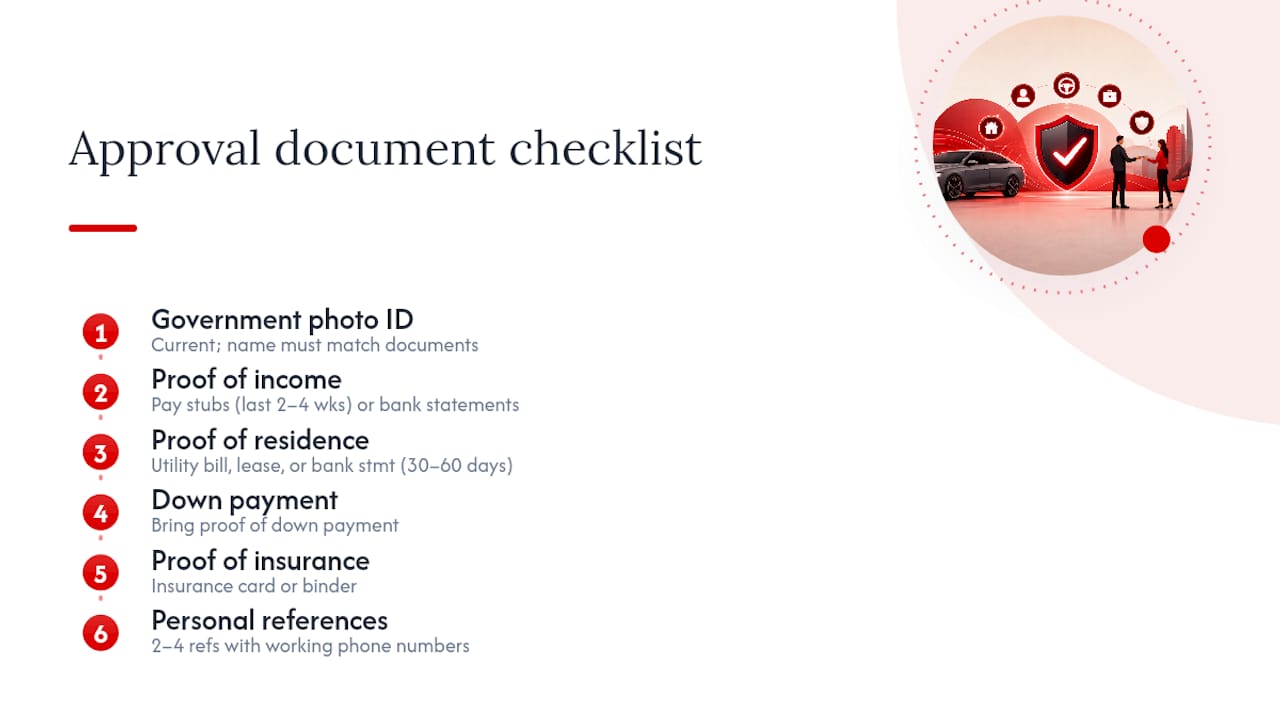
Gathering paperwork before you walk onto the lot is the single fastest way to move from application to approval. Buy here pay here requirements documents fall into five categories, and most dealers want originals plus one photocopy of each.
Identification. A state-issued driver's license or a government photo ID works in almost every case. The finance office checks two things: does the name on the ID match the name on your pay stubs and bank statements, and is it current? An expired license is a common, easily avoidable rejection reason.
Proof of income. What counts depends on how you're paid, covered in detail below, but the recency window matters everywhere. Dealers generally want pay stubs from the last two to four weeks or bank statements covering the last two to three months.
Proof of residence. A utility bill, signed lease, or bank statement with your current address dated within the last 30 to 60 days satisfies most dealers. If you recently moved and don't have a bill in your name yet, a signed landlord letter or a move-in receipt usually fills the gap.
Trade-in paperwork, if you're bringing a vehicle to the deal. Bring the title, current registration, and, if there's an outstanding loan, the lien release or payoff statement from your lender. Missing a lien release doesn't kill the deal, but it does slow it down while the dealer confirms payoff figures with your lender.
References. Most dealers ask for two to four personal references with working phone numbers, typically not people living in your household.
A typical document checklist for approval includes a government-issued photo ID, recent pay stubs or bank statements, proof of residence, a down payment, proof of insurance, and personal references, and having all of it organized in one folder before your visit often shaves a real amount of time off the approval process. If you're still weighing whether buy here pay here is even the right lane for your credit situation, it helps to first understand what buy here pay here actually means and how it differs from traditional financing.
How Do Dealers Verify Income and Employment?
Verifiable income is the backbone of buy here pay here approval, and dealers built their entire underwriting process around confirming you can actually make the payment. BHPH underwriting centers on verifiable current income, employment stability, and the customer's ability to make frequent payments rather than leaning primarily on a three-digit credit score.
For W-2 employees, the gold standard is two or three recent, consecutive pay stubs showing year-to-date totals. YTD figures tell the finance manager your income is consistent over months, not just on the days you happened to get paid.
Self-employed and gig workers document income differently, and dealers know it. Acceptable substitutes include:
- Two to three months of bank statements showing regular deposits from clients or platforms.
- 1099 forms paired with recent bank statements that match the reported figures.
- Previous-year tax returns combined with current deposit history to bridge the gap.
Benefit or fixed-income recipients (Social Security, disability, pension) typically show an award letter alongside two to three months of deposit history confirming the amount lands on schedule.
Underwriters also watch for red flags. Large, unexplained cash deposits that don't match your stated job or platform activity raise questions fast, since consecutive bank statements, 1099s, invoices, or benefit letters work far better as a pattern than as a single document.
Pro Tip: If you're paid weekly through a gig app, print or screenshot your last 8 to 12 weeks of deposits and highlight the recurring pattern. Dealers processing dealers often prefer two or three consecutive pay stubs for hourly workers will apply the same logic to gig income once they can see the rhythm.
What Proof of Residence and Contact Info Do You Need?
A dealer needs to know where to find you if a payment is missed, so proof of residence gets scrutinized almost as closely as income. A recent utility bill, a signed lease, or a bank statement showing your current address, dated within the last 30 to 60 days, satisfies most lots. PO boxes almost never work, since they don't confirm where you actually live.
If you just moved and don't have a bill in your name, a landlord letter or a move-in receipt is a reasonable stand-in. Living with family or roommates? A bank statement or piece of mail addressed to you at that address, even without a lease in your name, generally clears the bar.
Beyond your address, dealers want:
- A current, working phone number you actually answer.
- Two to four personal references, ideally not people who live with you.
Stale contact information is one of the quieter reasons approvals stall.
What Down Payment Should You Expect?
Down payment amounts vary by dealer, but most buy here pay here lots calculate the required down based on the vehicle's price and your documented income, not a flat number. Advertised figures like "$500 down" are marketing signals rather than guaranteed amounts, and the actual required down payment can run higher and is often non-refundable once the deal is signed.
Trade-in equity frequently reduces the cash you need to bring. If your trade is paid off or close to it, that equity can cover part or all of the down payment, which is one more reason to bring the title, registration, and any lien release paperwork with you.
Payment schedules matter as much as the down payment itself. Weekly and biweekly payment plans are common in buy here pay here financing, and aligning your payment date with your payday makes a real difference in whether payments get missed. At signing, dealers typically accept:
- Cashier's checks
- Verified bank transfers
- Debit card payments
Personal checks are rarely accepted for the initial down payment.
What Insurance Do You Need Before Driving Off the Lot?
You cannot leave a buy here pay here lot without proof of insurance, and most dealers require more than your state's bare liability minimum. Comprehensive and collision coverage is standard, on top of your state's liability requirements, because the dealer financing your loan has a real financial stake in the vehicle.
Dealers commonly require comprehensive and collision insurance with the lender listed as loss payee, and they'll ask to see the declarations page or a binder confirming the VIN and effective dates before handing over keys. Naming the lender as loss payee protects both sides: if the car is totaled or stolen, the insurance payout goes toward the loan balance first.
Many buy here pay here vehicles also come with security devices, most often a GPS tracker or a starter interrupt device that can remotely disable the ignition after a missed payment. Ask directly what device is installed and what triggers it.
Pro Tip: Ask specifically whether a missed payment triggers a warning period before the starter interrupt activates. Some dealers give a 24 to 48-hour grace window; others don't.
Letting insurance lapse is a serious problem. Dealers can force-place their own coverage on the loan, and that coverage is almost always more expensive than a policy you'd buy yourself, with the added cost simply rolled into your loan.
How Do Dealers Decide What You Can Afford?
The payment-to-income ratio, or PTI, is the calculation most buy here pay here dealers use to set an affordable payment, and it matters more than your credit score ever will. A workable PTI guideline runs roughly 10 to 20% of net income, depending on your pay frequency and other monthly obligations.
Here's how that plays out in practice. Dealers run this math for nearly every applicant, so knowing your own number before you sit down at the finance desk puts you in a stronger negotiating position.
A handful of issues reliably trigger denials or require workarounds:
- Income that can't be verified through any document
- Open civil judgments on file
- A repossession within the last several months
- Multiple recent hard inquiries suggesting active loan shopping elsewhere
None of these are automatic dead ends. A co-signer with verifiable income, a larger down payment, or simply documenting irregular income more thoroughly, through the bank statement and 1099 combination covered earlier, can move a marginal application into approved territory.
Licensing, Disclosures, and Consumer Protections to Know
Buy here pay here dealers operate under real regulatory oversight, even though the financing itself is arranged in-house. Most states require a motor vehicle dealer license, and in many cases a separate consumer-lending or finance license for any dealer extending payment over time. State licensing rules vary, so what applies in Texas, Florida, or California won't necessarily match your own state's requirements, and it's worth a quick check with your state regulator before signing anything.
Federal frameworks including the Truth in Lending Act and the Equal Credit Opportunity Act require dealers to disclose loan terms clearly and evaluate applicants without discrimination. At signing, you're entitled to see:
- The annual percentage rate (APR)
- The total cost of the loan over its full term
- Repossession terms and any related fees
- All processing or administrative fees
- Whether payments get reported to the credit bureaus
That last point matters more than most buyers realize. Not every buy here pay here dealer reports payments to credit bureaus, so ask directly if building credit is part of your goal. You can verify a dealer's license status through your state's motor vehicle or consumer protection agency, and file a complaint there if something feels off.
How to Prepare for Your Buy Here Pay Here Application
A little preparation the day of your visit can be the difference between a same-day approval and a frustrating second trip. Work through this order:
- Gather every document from the checklist above, ID, income proof, residence proof, and trade-in paperwork, into one folder.
- Confirm your insurance binder is ready to show, or call your provider ahead of time to bind coverage on the specific vehicle you're considering.
- Verify your funds for the down payment are in a cashier's check or accessible via bank transfer, not tied up somewhere you can't reach same-day.
- Ask about payment frequency and grace periods before you sign anything, not after.
- Ask directly about GPS or starter interrupt devices, what triggers them, and what the repossession process looks like.
- Confirm whether payments are reported to credit bureaus, since this affects whether the loan helps rebuild your credit at all.
If your income comes from gig work or self-employment, bring annotated bank statements with client deposits circled or highlighted, plus any invoices that back up the amounts. That small step of annotation does more to build underwriter confidence than handing over an unmarked statement and hoping they connect the dots themselves.
Pro Tip: Negotiate the down payment size and loan term before discussing add-ons like extended warranties. Buyers who negotiate structure first typically get a clearer view of their real monthly cost before extras get layered in.
Elmwood Auto Sales: How We Work With Buyers on BHPH Financing
Elmwood Auto Sales built its buy here pay here program around one idea: a fair shot regardless of your credit history. There's no commission-based sales pressure here, and every vehicle on our lot goes through a thorough inspection before it's ever offered for sale.
Buyers with thin credit files or a rough recent history deserve a financing conversation that starts with their actual income and stability, not a three-digit number that doesn't reflect where they are now.
On the day you visit, bring the documents outlined above. We'll walk through the inspection report on your vehicle, review financing terms in plain language, and answer questions about payment structure before you sign anything.
Does Legal Eligibility Depend on Your Age?
Yes. You must be at least 18 years old, the legal age of majority in nearly every state, to sign a binding auto loan contract. Buy here pay here dealers verify this directly from your government-issued ID at the time of application, and there's no workaround for a buyer under that threshold acting alone.
Beyond age, legal eligibility also touches on contractual capacity more broadly. You need to be entering the agreement of sound mind and not under a legal guardianship that restricts your ability to sign binding financial contracts. This rarely comes up in practice, but it's part of why dealers require a valid, unexpired photo ID rather than accepting a name and birthdate verbally.
If you're under 18, the path forward typically runs through a parent or legal guardian who co-signs and takes on legal responsibility for the loan. That person's income and credit history get evaluated as part of the application, essentially in addition to yours, and their name appears on the title and loan documents alongside or instead of your own.
One nuance worth knowing: some states allow emancipated minors to enter contracts independently, but this is the exception, not the rule, and a dealer will still want documentation proving that legal status before treating you as an adult signer.
Do Buy Here Pay Here Dealers Run a Credit Check?
Many buy here pay here dealers run a soft credit check, but it typically plays a supporting role rather than a deciding one. The core question underwriters are answering isn't "what's your score," it's "can you verify enough income to make this payment reliably." That's a meaningfully different filter than what a bank or traditional lender applies.
A soft inquiry usually doesn't affect your credit score the way a hard inquiry from a traditional auto lender would. Dealers use it mainly to check for red flags: open judgments, active bankruptcies, or a pattern of very recent repossessions that suggest a higher risk of default regardless of current income.
This is exactly why buy here pay here financing exists as a category in the first place. If your credit history includes a bankruptcy, multiple late payments, or simply no credit file at all because you've never financed anything before, the income-first approach opens a door that a traditional lender's score-based model would likely close. For a deeper look at how this compares to other paths, alternative financing options for buyers with thin credit lay out the tradeoffs in more detail.
What Documentation Do Co-Signers or Guarantors Need?
A co-signer needs to bring essentially the same documentation package as the primary applicant: valid photo ID, proof of income, and proof of residence. The dealer is underwriting two people's financial pictures at once, so incomplete paperwork from a co-signer slows the process just as much as missing paperwork from the buyer.
Co-signers make the most sense in a specific scenario: a buyer with verifiable but modest income, or a thin credit history, paired with someone whose income and stability strengthen the application. Adding a co-signer with steady employment can shift a marginal PTI calculation into approved range, or unlock a lower down payment requirement.
It's worth being direct about the stakes here. A co-signer is legally responsible for the full loan if the primary borrower misses payments, and any missed payments can affect both people's credit and payment history with the dealer, depending on whether that dealer reports to the bureaus in the first place. This isn't a favor with no downside for the person signing on, and both parties should treat it as a shared financial commitment, not a formality.
Are Vehicles Inspected Before Sale?
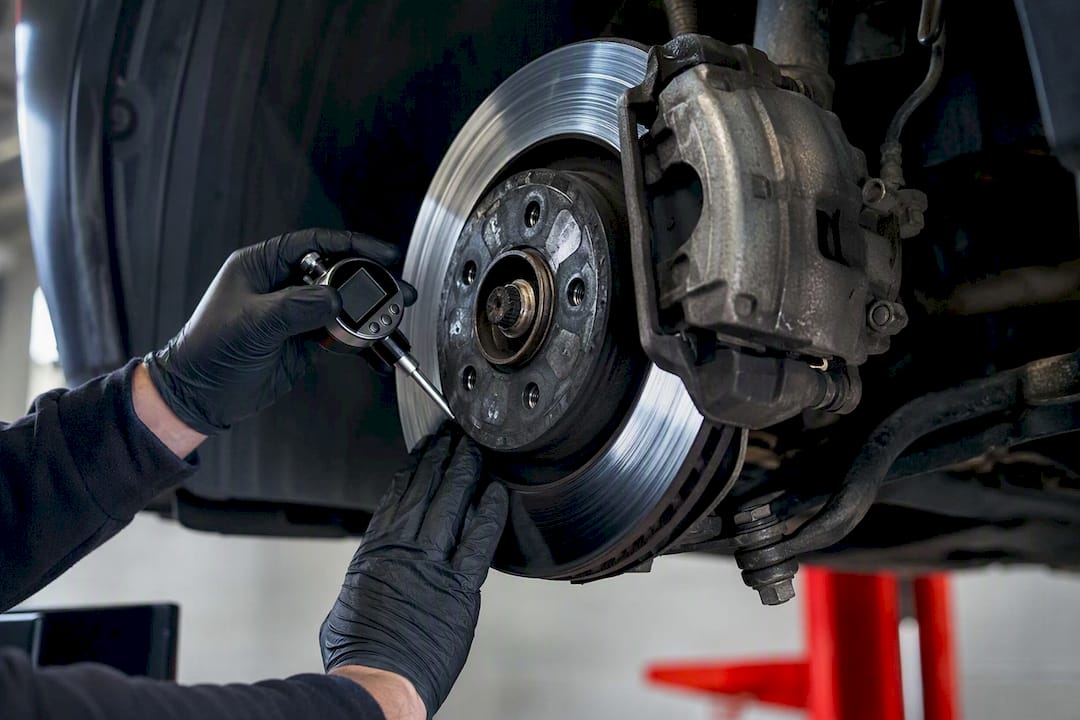
Reputable buy here pay here dealers inspect every vehicle before it's offered for sale, though the depth of that inspection varies significantly from lot to lot. A thorough inspection typically covers the engine, transmission, brakes, tires, electrical systems, and frame condition, catching problems before a buyer drives off rather than after.
This matters more in buy here pay here financing than in a typical used car purchase, because the vehicles on these lots often sit at a lower price point and higher mileage than dealership-certified inventory elsewhere. A weak inspection process means a buyer with limited credit options, and often limited cash reserves for surprise repairs, ends up carrying both a car payment and a repair bill in the same month.
Ask specifically whether the dealer performs a multi-point inspection and whether you can see a written report. A dealer confident in its inventory will hand that report over without hesitation. Some dealers inspect every vehicle before it reaches the lot, which can be a meaningful part of what a low-pressure, transparent buying experience means in practice, not just as a slogan.
What Fees Come Up Beyond the Down Payment?
The down payment is rarely the only cost due at signing. Processing or documentation fees are standard across nearly every dealer, covering the paperwork and administrative work tied to titling and registering the vehicle in your name.
Sales tax applies to the purchase price in every state that levies one, and the rate depends on where you live and register the vehicle, not where the dealer is located. Title and registration fees are separate line items set by your state's motor vehicle agency, not the dealer.
Some dealers also charge for optional add-ons: extended warranties, GPS tracking device fees, or gap insurance. None of these are legally required in most states, which means they're negotiable, or you can decline them outright if they don't fit your budget. The disclosures covered earlier, APR, total loan cost, and all fees, should list every one of these charges in writing before you sign, so read that document line by line rather than skimming to the signature line.
What This Article Actually Tells You to Prioritize
The conventional advice around buy here pay here financing spends too much time on credit scores and not nearly enough on documentation quality. That's backwards. A buyer with a 480 credit score and three months of clean, consistent bank deposits is in a stronger position than a buyer with a 580 score and unverifiable cash income, because dealers are underwriting your ability to pay, not your history of paying someone else.
The most overlooked lever isn't the down payment size, it's aligning your payment date with your payday. A weekly earner locked into a monthly payment schedule is set up to struggle regardless of income level. Ask about payment frequency before you negotiate price.
If you take one thing from this: organize your income documentation like you're building a case, not filling out a form. Annotated bank statements, consistent deposit patterns, and a clear paper trail do more for your approval odds than any single number on a credit report ever will.
— Elmwood
Ready to Apply for Financing at Elmwood Auto Sales?
Elmwood Auto Sales built its buy here pay here program around buyers whose income tells a better story than their credit score does. No commission-based pressure, no score-based gatekeeping, just a straightforward look at what you actually earn and what payment fits your budget.
If you've gathered your documents from the checklist above, the fastest next step is to apply online and get a read on your financing options before you even step onto the lot. Prefer to see the inventory first? Use our Car Finder to narrow down vehicles that fit your budget, or schedule a test drive to bring your paperwork in person. Have questions about which documents apply to your specific income situation, gig work, self-employment, or benefits? Call us or mention it on your online application, and we'll walk you through exactly what to bring before your visit.
Sources
- Buy-here pay-here underwriting guide for dealers — DealerVLO
- Buy Here Pay Here Requirements: Checklist for Fast Approval — Carfect
- Buy-here, pay-here: what to know — Credit Karma
FAQ
What disqualifies you from a car loan at a buy here pay here dealer?
Unverifiable income is the top disqualifier, since dealers can't approve what they can't confirm. Open civil judgments and a repossession within the last several months also raise red flags, though a co-signer or larger down payment can often offset these issues.
What do you need to get a car at a buy here pay here dealer?
You need a valid photo ID, proof of income, proof of residence, a down payment, and proof of insurance or the ability to bind coverage before delivery. A typical checklist also includes two to four personal references.
What is the "$3,000 rule" for buying a car?
This isn't an official regulation, it's informal shorthand some buyers use for the idea that a meaningful down payment, often cited around this range, helps secure better loan terms and lower monthly payments. Actual required down payments vary by dealer and vehicle price, so treat any fixed number as a rough guideline rather than a rule.
Do you have to have good credit at a buy here pay here dealer?
No. BHPH underwriting centers on verifiable income and employment stability rather than credit score, which is the entire reason this financing model exists for buyers with poor or no credit. Dealers still check for judgments or recent repossessions, but a low score alone rarely blocks approval.
Do buy here pay here payments build your credit?
Sometimes, but not always. Not every dealer reports payments to the credit bureaus, so ask directly before signing if building credit history is one of your goals.