
You can get vehicle financing without a traditional credit score, and options exist across the U.S. right now. The honest caveat: most "no credit check" paths carry higher costs and may not help you build credit at all. Before you visit any lot advertising in-house financing, take three steps first.
- Check your credit reports for free at AnnualCreditReport.com, which pulls from Equifax, Experian, and TransUnion. You may have more history than you realize.
- Contact local credit unions and ask about second-chance auto programs or manual underwriting. Credit unions routinely approve thin-file borrowers that banks turn away.
- Gather your documents before any appointment: pay stubs, bank statements, proof of residence, and a government-issued ID. Lenders who skip the credit bureau still verify income.
Elmwoodautosalesri in Providence, RI offers tailored financing options, including in-house arrangements, for buyers across the credit spectrum. The Consumer Financial Protection Bureau (CFPB) also provides free guidance on your rights as a borrower before you sign anything.
Table of Contents
- What "no credit check" and buy-here-pay-here actually mean
- Real financing options for people with no credit history
- What lenders actually look for when you have no credit score
- How to improve your approval odds and lower your rate
- Costs, traps, and red flags to watch for
- A step-by-step checklist for getting financed with no credit
- When does it make more sense to wait and build credit first?
- How do interest rates and terms compare across loan sources?
- How do you verify that a lender or dealer is legitimate?
- How do "no credit check" loans affect your credit score?
- What are your options if no credit check financing does not work for you?
- Key Takeaways
- What Elmwood actually sees from thin-file buyers
- Elmwoodautosalesri can help you find the right financing path
- Useful sources and further reading
What "no credit check" and buy-here-pay-here actually mean
"No credit check" is a marketing phrase, not a legal standard. In practice, it covers three distinct situations: a dealer who finances the vehicle directly from their own lot (buy-here-pay-here), a third-party subprime lender who runs only a soft pull, and dealer-arranged financing where the dealer shops your application to lenders who may do limited bureau checks.
What none of these arrangements eliminate is income verification. Lenders who skip the bureau pull still want proof you can repay. They evaluate pay stubs, bank statements, and employment history. The credit bureau check is replaced by other risk signals, not by blind trust.
CFPB guidance is clear: "No credit check" dealers are not required to report your payments to the three major credit bureaus. If a dealer does not report, every on-time payment you make is invisible to Equifax, Experian, and TransUnion. You pay the loan, but your credit score does not improve.
The reporting gap is the most underappreciated risk in buy-here-pay-here financing. Many buyers assume that making payments builds credit automatically. With many in-house dealers, it does not. Always ask for the dealer's credit-reporting policy in writing before signing.
Real financing options for people with no credit history
Not all paths to a car loan carry the same risk or cost. Here is how the main options compare, with a quick read on when each one makes sense.
| Option | Best For | Typical APR Signal | Reports to Bureaus? |
|---|---|---|---|
| Credit union (manual underwriting) | Thin-file borrowers with stable income | Lower than subprime average | Yes, typically |
| Co-signer loan (bank or credit union) | Borrowers with a creditworthy family member | Near-prime rates possible | Yes |
| Captive/manufacturer financing | New buyers with documented income | Varies; promotional rates exist | Yes |
| Buy-here-pay-here dealer | Emergency need, no other option | High double digits common | Often no |
| Private-party purchase + personal loan | Buyers who can qualify for an unsecured loan | Moderate to high | Yes |
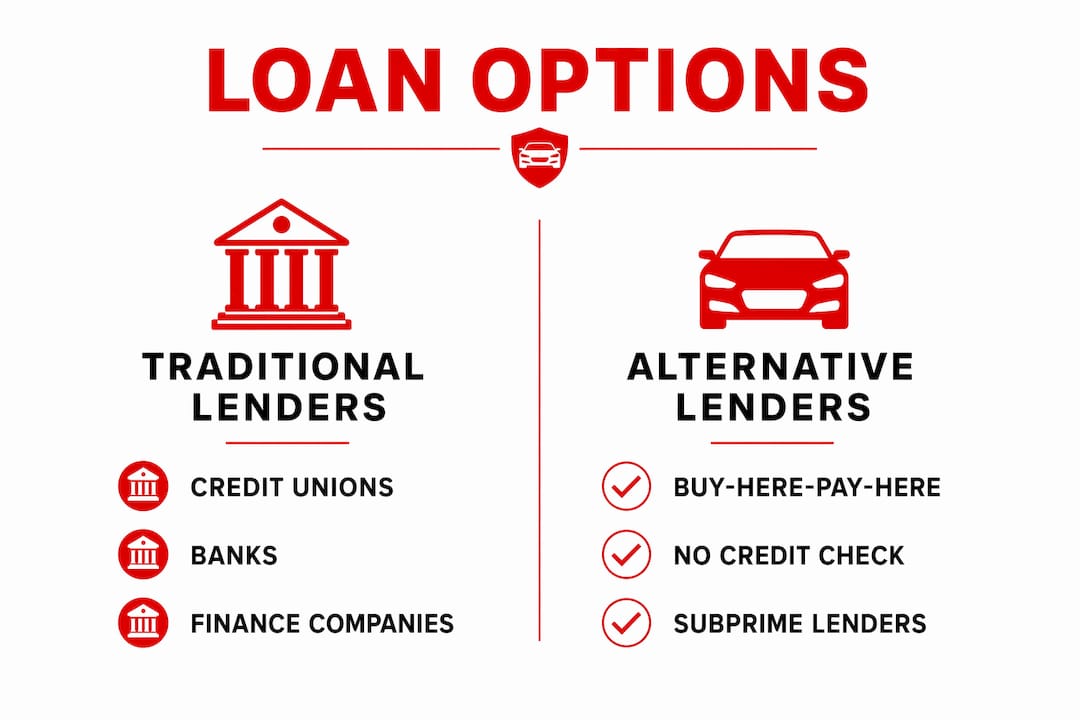
Credit unions are the strongest starting point for most thin-file borrowers. They use manual underwriting, which means a loan officer reviews your full financial picture rather than relying solely on a score. Some credit unions also accept ITIN numbers, making them accessible to newcomers without a Social Security number. Membership requirements vary, but many are open to anyone in a geographic area or employer group.
Co-signer loans work because the lender evaluates the co-signer's credit history alongside yours. CFPB guidance notes that lenders cannot require a co-signer unless it is a joint credit application, but voluntarily adding one with strong credit can unlock approval and meaningfully lower your rate. The co-signer takes on full legal liability if you miss payments, so this arrangement requires real trust.
- Captive lenders (manufacturer-affiliated financing arms) occasionally run programs for newcomers or first-time buyers with documented income. These are worth asking about at franchised dealerships.
- Buy-here-pay-here is the option of last resort. Convenience is real, same-day approval is common, but APRs can reach high double digits and non-reporting to bureaus is frequent.
- Private-party purchases funded by an unsecured personal loan can work if you qualify, but personal loan rates for thin-file borrowers are also elevated. The advantage is that reputable online lenders do report to bureaus.
For a broader look at car financing channels, Elmwoodautosalesri's buyer guide covers each route in detail.
What lenders actually look for when you have no credit score
When a credit score is absent, lenders shift their attention to income stability and financial behavior. Knowing exactly what they want lets you walk in prepared.
Documents to bring to any financing appointment:
- Two to three recent pay stubs showing gross income and employer name
- W-2 from the most recent tax year, or an offer letter if you are newly employed
- Two to three months of bank statements showing regular deposits and no chronic overdrafts
- Proof of residence (utility bill, lease agreement, or bank statement with your address)
- Government-issued photo ID (driver's license or passport)
- ITIN letter if you do not have a Social Security number
Beyond documents, lenders look at employment tenure. A borrower who has held the same job for 12 or more months signals lower risk than someone who started last month. Regular direct deposits on bank statements reinforce that income is consistent, not sporadic.
Down payment size matters more than almost any other factor. Experts recommend a down payment of 10–20% or more of the vehicle price for buyers without an established credit history; this reduces lender exposure and often makes the difference between approval and denial for thin-file applicants.

For detailed guidance on income verification documents, Elmwoodautosalesri's resource explains exactly what pay stub formats lenders accept.
Timeline note: A buy-here-pay-here dealer can approve you the same day with these documents. A credit union preapproval typically takes one to three business days. A full bank underwriting process can run one to two weeks.
How to improve your approval odds and lower your rate
The single most powerful move for a thin-file borrower is a larger down payment. Experts recommend 10–20% or more for buyers without an established credit history. It reduces the loan-to-value ratio, which directly lowers lender risk and can bring the offered rate down.
| Factor | Recommended Target | Effect on Approval |
|---|---|---|
| Down payment | 10–20%+ of vehicle price | Strongest single lever for thin-file borrowers |
| Inquiry window | 14–45 days for all applications | Multiple inquiries treated as one event |
| Co-signer credit score | 670+ preferred | Can shift rate from subprime to near-prime |
Adding a co-signer is the second-fastest lever. Because the lender evaluates the co-signer's history, a co-signer with a score above 670 can shift your offered rate significantly. Document the arrangement carefully: both parties should understand that missed payments affect both credit files.
Preapproval from a credit union or bank before you visit a dealership is the move Consumer Reports consistently recommends. It gives you a rate benchmark and prevents dealers from steering you into higher-cost financing. When you shop multiple lenders, keep all applications within a 14–45 day window so scoring models treat them as a single inquiry event.
If you can wait three to six months, building even a short on-time payment history can yield a real APR improvement. Newcomers and thin-file borrowers who build three to six months of on-time card history before applying typically qualify for better terms than those who apply immediately with no file at all.

Costs, traps, and red flags to watch for
Buy-here-pay-here and subprime dealer financing carry specific risks that go beyond a high interest rate. Knowing the warning signs before you sign protects you from deals that cost far more than they appear.
Common financial traps:
- APRs in the high double digits that make a modest vehicle cost significantly more over the loan term
- Loan terms that extend beyond the vehicle's expected mechanical life, creating negative equity before the car needs major repairs
- Balloon payments buried in contract language that require a large lump sum at the end
- Rollover offers that fold unpaid balances into a new loan, compounding the debt
- Add-on fees for GPS tracking devices, extended warranties, or credit insurance that inflate the purchase price
Subprime borrowers with FICO scores at or below 580 face the highest exposure to these practices. The combination of urgency, limited options, and complex contracts creates conditions where predatory terms can slip through.
Before signing any buy-here-pay-here contract, ask these four questions out loud and get the answers in writing: Does this dealer report payments to Equifax, Experian, and TransUnion? What is the total cost of the vehicle including all fees? Is there a prepayment penalty? What is the exact repossession process and timeline?
Non-reporting is a specific financial harm: you pay faithfully for two or three years and your credit score stays flat. Buy-here-pay-here dealers also tend to use GPS tracking and starter-interrupt devices, and their repossession timelines are often faster than traditional lenders. One or two missed payments can trigger repossession without the grace periods a bank or credit union typically extends.
For a full list of things to know before financing, Elmwoodautosalesri's checklist covers contract terms and dealer questions in plain language.
A step-by-step checklist for getting financed with no credit
If you need a vehicle within the next two to four weeks:
- Pull your free credit reports from AnnualCreditReport.com and check for any existing history.
- Contact two or three local credit unions and ask specifically about thin-file or second-chance auto programs.
- Gather all documents: pay stubs, bank statements (two to three months), proof of residence, and government ID.
- Get a written preapproval from at least one credit union before visiting any dealership.
- Identify a co-signer if one is available and willing; have their ID and contact information ready.
- Save a down payment of at least 10–20% of your target vehicle price before shopping.
- Visit the dealership with your preapproval letter in hand and compare any dealer offer against it.
- Ask for the dealer's credit-reporting policy in writing before signing.
If you can wait three to six months:
- Open a secured credit card with a low credit limit at a bank or credit union.
- Use it for one small, recurring purchase each month (a streaming subscription works well).
- Pay the full balance before the due date for three to six consecutive months.
- During this period, save aggressively toward a 10–20% down payment.
- After three to six months, apply for credit union preapproval and compare offers from multiple lenders within a 14–45 day window.
- Bring all documents, your preapproval letter, and your down payment to the dealership.
Timeline summary: same-day approval is possible at buy-here-pay-here lots with documents in hand. Credit union preapproval typically takes one to three business days. Building a short credit history before applying adds three to six months but can save a meaningful amount over the loan term.
When does it make more sense to wait and build credit first?
The answer depends on how urgently you need the vehicle and how much the rate difference will cost you over time. A thin-file or subprime borrower moving to a fair-credit tier after three to six months of on-time history can see a real reduction in their offered APR. On a multi-year loan, that difference adds up to hundreds or thousands of dollars in total interest paid.
- Wait if you have access to reliable transportation now (public transit, rideshare, a family vehicle) and can save a larger down payment while building credit history.
- Act now if losing transportation means losing your job or your ability to meet essential obligations. In that case, pursue a credit union first, then a co-signer loan, and treat buy-here-pay-here as a last resort.
- Consider alternatives while waiting: many cities have transit options, and rideshare apps can cover short-term gaps. A short-term vehicle loan from a family member, documented in writing, is another bridge that costs nothing in interest.
For buyers with limited income, low-income financing strategies can help identify which path fits your budget before you commit.
The three-to-six-month window is not a long time. If your situation allows it, the financial case for waiting is strong. If it does not, the credit union and co-signer routes give you the best chance at a fair deal without waiting.
How do interest rates and terms compare across loan sources?
The rate you pay depends heavily on which channel you use. Credit unions, because of their cooperative structure and manual underwriting, tend to offer the lowest rates available to thin-file borrowers. Bank financing for the same borrower profile typically runs higher. Dealer-arranged subprime financing through third-party lenders sits above bank rates. Buy-here-pay-here in-house financing sits highest of all, with APRs that can reach high double digits on used vehicles.
Loan terms also vary. Traditional lenders typically offer 36–72 month terms with clear amortization schedules. Some buy-here-pay-here contracts extend to 84 months or longer on vehicles that may not last that long mechanically, which creates negative equity risk. Shorter terms cost more per month but less overall. Always ask for the full amortization schedule, not just the monthly payment.
Shopping multiple lenders and using prequalification tools that run soft pulls lets you compare offers without damaging your credit. The rate spread between the best and worst options for a thin-file borrower can be substantial, which is why comparison shopping matters more at this credit tier than at any other.
How do you verify that a lender or dealer is legitimate?
Start with the state. Every auto dealer in the U.S. must be licensed by the state in which they operate. You can verify a dealer's license through your state's motor vehicle or consumer protection agency website. In Rhode Island, the Division of Motor Vehicles maintains dealer licensing records.
For lenders, check registration with the CFPB's complaint database at consumerfinance.gov and with your state's banking regulator. Legitimate lenders provide a written loan agreement before you sign, disclose the APR clearly, and do not pressure you to sign the same day without reviewing the contract.
Red flags that suggest a predatory or unlicensed operation: no physical address, pressure to sign immediately, refusal to provide a written contract, fees that are not itemized, and verbal promises that contradict the written agreement. If a lender cannot or will not answer the four questions listed in the risks section above, walk away.
The CFPB's complaint portal at consumerfinance.gov/complaint also lets you check whether a lender has a pattern of consumer complaints before you engage.
How do "no credit check" loans affect your credit score?
The effect depends entirely on whether the lender reports to the three major bureaus. If they do report, a "no credit check" loan can actually help build your credit, provided you make every payment on time. Payment history is the largest factor in most credit scoring models.
If the lender does not report, the loan has zero effect on your score in either direction. You are not penalized for taking it, but you gain nothing credit-building from it either. This is the core problem with many buy-here-pay-here arrangements.
A soft pull (used by some prequalification tools and subprime lenders) does not affect your score at all. A hard pull, which traditional lenders use, causes a small, temporary dip. Keeping all hard-pull applications within a 14–45 day window limits the impact because most scoring models treat clustered auto inquiries as a single event.
What are your options if no credit check financing does not work for you?
If every financing route leads to terms you cannot afford, transportation alternatives exist while you build toward a better loan.
- Public transit: In many U.S. cities, monthly transit passes cost a fraction of a car payment plus insurance. This is the lowest-cost option while you save and build credit.
- Rideshare apps: Uber and Lyft work well for irregular or shorter-distance needs, especially if you do not commute daily by car.
- Employer or community programs: Some employers offer transportation stipends or van pools. Local nonprofits in some areas provide low-cost vehicle loans or car-sharing programs for working adults.
- Family vehicle arrangements: Borrowing a family member's vehicle temporarily, with a written agreement and added insurance coverage, can bridge a gap without any financing cost.
For buyers with very limited budgets, bad credit car buying options from Elmwoodautosalesri outline additional routes that go beyond standard financing.
None of these alternatives are permanent solutions, but three to six months of using them while building credit history can mean the difference between a high-cost loan and a manageable one.
Key Takeaways
Credit unions and preapproval are the two most protective steps any thin-file borrower can take before visiting a dealership, and a 10–20% down payment is the single strongest lever for approval.
| Point | Details |
|---|---|
| Prioritize credit unions | Manual underwriting and lower APRs make credit unions the best first stop for thin-file borrowers. |
| Bring 10–20% down | A down payment of 10–20% or more of the vehicle price reduces lender risk and improves approval odds significantly. |
| Confirm bureau reporting in writing | Ask every dealer or lender whether they report to Equifax, Experian, and TransUnion before signing. |
| Use a co-signer before buy-here-pay-here | A creditworthy co-signer can unlock near-prime rates; buy-here-pay-here should be a last resort. |
| Elmwoodautosalesri financing options | Elmwoodautosalesri offers tailored in-house and partner financing for thin-file buyers in Providence, RI. |
What Elmwood actually sees from thin-file buyers
Most thin-file buyers who come through Elmwoodautosalesri's doors are not in as difficult a position as they fear. The most common situation is a buyer with no U.S. credit history, not bad credit, and that distinction matters. A clean income record, a solid down payment, and a co-signer willing to sign alongside them opens more doors than most people expect.
Elmwoodautosalesri evaluates thin-file applicants by looking at the full picture: employment stability, bank statement patterns, and down payment readiness. The dealership's in-house financing arrangements and partner lender relationships are built to serve buyers who do not fit the standard bank mold. Every vehicle goes through a thorough inspection before it reaches the lot, so buyers are not taking on a mechanical risk on top of a financial one.
The single piece of advice Elmwoodautosalesri gives every thin-file buyer before signing: ask for a written credit-reporting clause and a full payoff schedule on the same day you receive the contract. If a dealer hesitates on either, that hesitation is the answer.
Elmwoodautosalesri can help you find the right financing path
Thin-file buyers in Providence and across Rhode Island have a local resource that does not rely on commission pressure or one-size-fits-all financing. Elmwoodautosalesri works with buyers at every credit level, including those with no U.S. credit history, through a combination of in-house financing options and vetted partner lenders.
Before your appointment, bring your two most recent pay stubs, two to three months of bank statements, proof of residence, and your government-issued ID. If you have a co-signer, bring their contact information. A down payment of 10–20% or more of your target vehicle price puts you in the strongest position. The team at Elmwoodautosalesri will walk you through every financing option available, explain the credit-reporting policy for each, and give you a full payoff schedule before you commit to anything.
Schedule a test drive or a financing consultation at Elmwoodautosalesri today, and ask specifically for a written credit-reporting policy when you arrive.
Useful sources and further reading
The sources below back the key claims in this guide. Bookmark the CFPB links in particular: they are free, authoritative, and updated regularly.
- CFPB: What is a "no credit check" or "buy here, pay here" auto loan? — Defines buy-here-pay-here, explains reporting practices, and outlines borrower rights. Start here if you are uncertain about any dealer's contract language.
- CFPB: What should I know before I shop for an auto loan? — Covers co-signer rights, the inquiry-window guidance (14–45 days), and preapproval strategy.
- Consumer Reports: Where to shop for a car loan — Supports the recommendation to get preapproval before visiting a dealership and explains why credit unions often beat banks for thin-file borrowers.
- Zolve: How to finance a car with no credit in the U.S. — Source for the 10–20% down payment recommendation for thin-file and no-credit borrowers.
- CreditPoints: How to get a car loan as a newcomer with no U.S. credit history — Covers the three-to-six-month credit-building timeline and newcomer-specific lender options.
- Credit Karma: Car loans for bad credit — Explains prequalification tools and how to compare lenders without hard pulls.
- CNBC Select: Best car loans for bad credit — Details the subprime risk tier (FICO 580 and below) and the higher APRs and predatory practices associated with it.
Keep a printed copy of any written dealer commitment about credit bureau reporting. If a dispute arises later, that document is your primary evidence.
This article provides general consumer information, not legal or financial advice. Verify current rules, rates, and lender policies with the CFPB, your state's consumer protection agency, or a qualified financial professional before making any financing decision.