
Your monthly car payment comes from one formula: the amount you finance, multiplied by your monthly interest rate adjusted for compounding, divided across your loan term. Lenders call this amortization, and once you know the four inputs, you can check any dealer quote in under a minute.
Those four inputs are the amount financed (price minus down payment, plus taxes and fees), the APR, the loan term in months, and whether taxes and fees are rolled into the loan or paid upfront.
Here's a quick example: finance $25,000 at 6% APR for 60 months, and you land at roughly $480 a month. Change the term to 72 months and the payment drops to about $415, but you'll pay more total interest.
- Amount financed (not the sticker price)
- APR (not the "buy rate" some dealers quote separately)
- Loan term in months
- Tax and fee treatment (financed or paid at signing)
Pro Tip: If a dealer's monthly number doesn't match what you calculate by hand, ask them to show the amount financed and APR separately. That's usually where the difference hides.
Key Takeaways
Calculating your monthly car payment accurately requires knowing the amount financed, APR, and term, then applying the amortization formula lenders use.
| Point | Details |
|---|---|
| Know your four inputs | Amount financed, APR, term in months, and tax/fee treatment determine your payment. |
| Use the amortization formula | Monthly Payment = Loan × [i × (1 + i)^n] ÷ [(1 + i)^n − 1], where i is APR ÷ 12. |
| Compare terms and rates side by side | Longer terms lower monthly payments but raise total interest paid. |
| Budget beyond the payment | Insurance, fuel, and maintenance should factor into your affordability math. |
| Confirm loan type before prepaying | Simple-interest loans reward early extra payments; precomputed loans may not. |
This article is general information, not a substitute for advice from a qualified financial advisor. Consult a qualified financial professional about your own circumstances before acting on anything here.
Table of Contents
- Calculate Monthly Car Payment Guide: Gathering Your Inputs First
- The Monthly Payment Formula: A Step-by-Step Example
- How Do You Use an Online Auto Loan Calculator?
- How Do Term, Rate, and Down Payment Change Your Payment?
- What Should You Budget Beyond the Loan Payment?
- What Can You Do to Lower Your Monthly Payment?
- What Dealer Financing Red Flags Should You Watch For?
- Simple Interest vs. Precomputed Interest: What's the Difference?
- How Does Prepayment Affect Your Payment and Loan Length?
- How Do Balloon Payments and Residual Values Work?
- Elmwood's Approach: Transparent Numbers, Every Time
- Sources
Calculate Monthly Car Payment Guide: Gathering Your Inputs First
Before you touch a calculator, you need six numbers, and getting even one wrong throws off your entire estimate.
- Vehicle price — the negotiated price, not the sticker price.
- Down payment — cash you're putting down at signing.
- Trade-in value minus remaining loan balance — if you owe more than your trade is worth, that negative equity gets added to your new loan.
- Sales tax — based on your local rate, and in some states calculated only on the amount after your trade-in credit.
- Fees — title, registration, and documentation fees, which vary widely by dealer.
- APR — always use the annual percentage rate, not a "flat rate" or "buy rate," since APR reflects the true cost of borrowing.
Add the price, subtract your down payment and any positive trade equity, then add taxes, fees, and any negative equity. That total is your amount financed, the number your monthly payment actually depends on. Some calculators also ask about rebates, extended warranties, or gap insurance. Roll those in only if you're financing them.
The Monthly Payment Formula: A Step-by-Step Example
The amortization formula lenders use looks intimidating until you break it into pieces:
Monthly Payment = Loan × [i × (1 + i)^n] ÷ [(1 + i)^n − 1]
Here, i is your monthly interest rate (APR ÷ 12), and n is your loan term in months. Common terms run 48, 60, or 72 months.
Let's work through $30,000 financed at 6% APR over 60 months:
| Step | Calculation | Result |
|---|---|---|
| Monthly rate (i) | 6% ÷ 12 | 0.06 ÷ 12 |
| (1 + i)^n | (1 + 0.06 ÷ 12)^60 | (1 + 0.06 ÷ 12)^60 |
| Numerator | 0.06 ÷ 12 × (1 + 0.06 ÷ 12)^60 | 0.006745 |
| Denominator | (1 + 0.06 ÷ 12)^60 − 1 | 0.3489 |
| Monthly payment | $30,000 × (0.006745 ÷ 0.3489) | $580 |
That $580 figure should land within a few dollars of what a reliable auto loan calculator shows you, since these tools use the same amortization formula behind the scenes.
- Verify your monthly rate math first, since a decimal error here throws off everything downstream.
- Expect early payments to be mostly interest, with the principal share growing every month.
- Cross-check the total interest figure, not just the monthly number, before signing anything.
How Do You Use an Online Auto Loan Calculator?
A good auto loan calculator walks through the same six inputs you gathered earlier, in this order:
- Enter the vehicle price.
- Enter your down payment.
- Enter trade-in value and any remaining loan balance owed on it.
- Enter sales tax, based on your state's rate.
- Enter fees (title, registration, documentation).
- Enter APR and term in months.
Whether taxes and fees get financed or paid upfront changes your amount financed, and therefore your monthly payment, so pay attention to which fields the calculator lets you toggle. Good calculators return three outputs: the monthly payment, total interest paid over the life of the loan, and a full amortization schedule showing principal versus interest for every month.
Pro Tip: Run the same loan amount through two or three term and rate combinations before you commit. Seeing the total interest side by side often changes which term looks "affordable."
How Do Term, Rate, and Down Payment Change Your Payment?
The same $30,000 loan produces very different outcomes depending on three levers: term, APR, and down payment.
Stretching from 60 to 72 months lowers your monthly payment but increases the total interest paid over the life of the loan. Rate changes also significantly affect monthly payments and total interest costs.
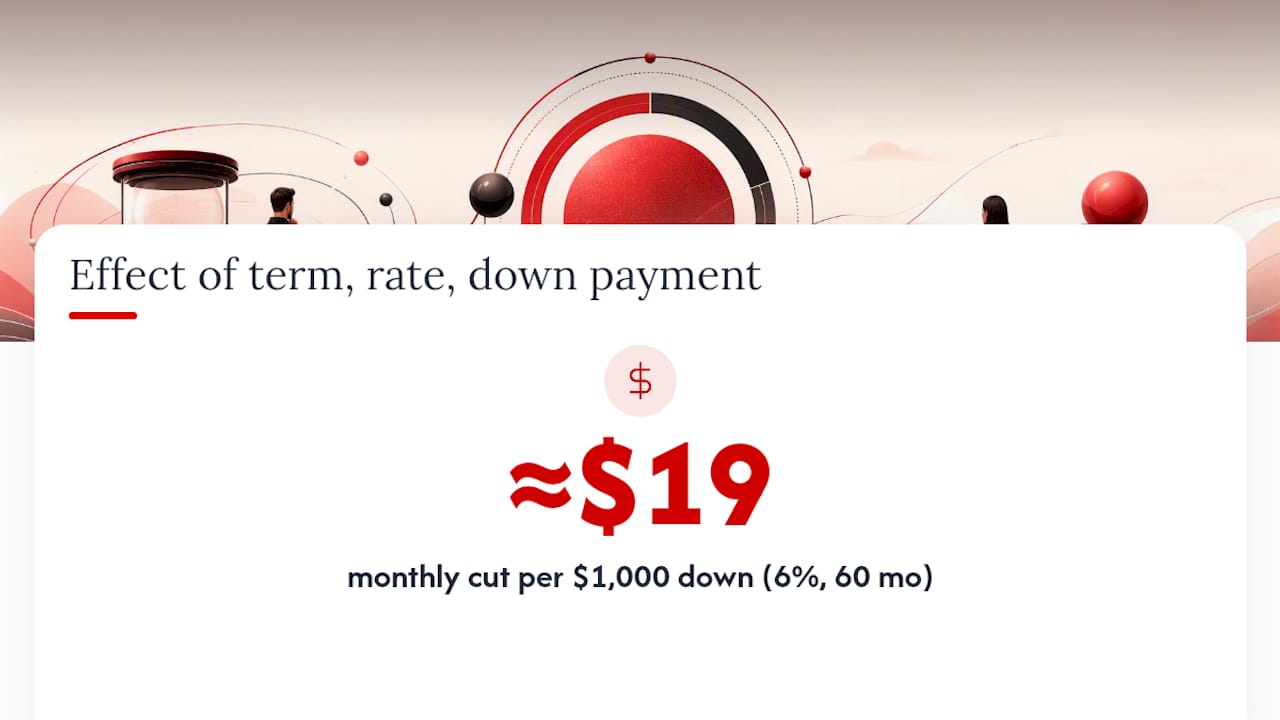
Every extra $1,000 you put down at 6% over 60 months trims your payment by about $19 a month. Longer terms can make sense if they're the only way to fit an urgent purchase into your budget, but longer loans increase your risk of owing more than the car is worth, especially once depreciation kicks in.
What Should You Budget Beyond the Loan Payment?
A monthly payment that fits your budget on paper can still strain your finances once insurance, fuel, and repairs enter the picture.
- Keep your car payment at or under 10% of take-home pay, a common benchmark from Kelley Blue Book's affordability guidance.
- Cap total transportation costs, including insurance and gas, at 15% to 20% of take-home pay.
- Add a rough monthly estimate for insurance and routine maintenance before you finalize a budget, since focusing on the payment alone hides the real cost of ownership.
- Watch depreciation on longer loans. If your car's value falls faster than your loan balance, you can end up owing more than it's worth if you need to sell or trade it early.
Routine upkeep costs add up fast, and a maintenance advice resource can help you estimate realistic service intervals and costs for the specific vehicle you're considering.
What Can You Do to Lower Your Monthly Payment?
A few moves reliably bring your payment down without pushing you into a risky loan term.
- Increase your down payment, even by a few hundred dollars.
- Negotiate the purchase price itself, separately from any financing discussion.
- Decline add-ons like extended warranties unless you've priced them independently.
- Shop your loan with multiple lenders, including credit unions, which often beat dealer-arranged financing.
Pro Tip: If your loan is simple interest, paying extra toward principal early cuts the interest you'll owe for every remaining month, sometimes more effectively than refinancing later.
Extending your term should be a last resort, and only if you have a clear plan to pay it off early or refinance once your credit improves.
What Dealer Financing Red Flags Should You Watch For?
Some financing tactics are designed to distract you from the total cost of the deal.
- Ask for an itemized finance worksheet showing price, taxes, fees, and APR separately.
- Refuse to accept vague "processing" or "documentation" fees without a written explanation.
- Compare APR, not just the monthly payment, across offers, since a lower payment can hide a longer term or higher rate.
- Check for add-ons quietly rolled into your financed amount, like extended warranties you didn't request.
Dealers sometimes market the monthly payment to obscure the actual negotiated price and financing terms. Insist on seeing the vehicle price and APR listed separately before you sign anything.
If a charge on your worksheet doesn't make sense, federal consumer-protection guidance backs your right to ask questions, and pausing the deal costs you nothing. Our guide on financing mistakes to avoid covers more of these tactics in detail.
Simple Interest vs. Precomputed Interest: What's the Difference?
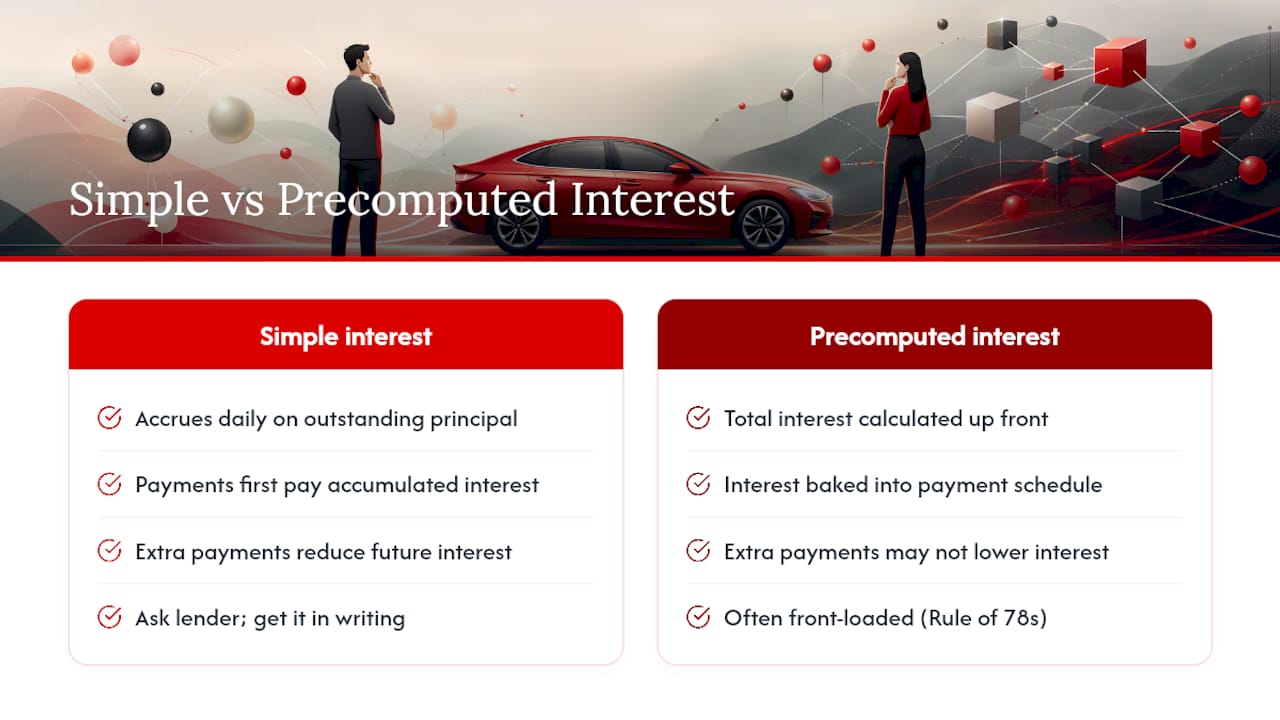
Most auto loans today use simple interest, meaning interest accrues daily on your outstanding principal balance. Every payment you make first covers the interest that's accumulated since your last payment, and whatever's left reduces your principal. Pay early or pay extra, and you shrink the balance interest gets calculated on going forward, which lowers what you owe in future months.
Precomputed interest loans work differently. The lender calculates total interest for the entire loan term upfront and bakes it into your payment schedule using a method called the Rule of 78s in older contracts, though this practice is now restricted or banned in many states. With a precomputed loan, paying extra early doesn't always reduce your interest the way it would with a simple-interest loan, because the interest allocation was front-loaded into the schedule from day one.
This distinction matters enormously if you're planning to pay off your loan ahead of schedule. Before you sign, ask your lender directly: "Is this a simple-interest or precomputed-interest loan?" If they can't answer clearly, ask for it in writing. Extra principal payments only guarantee interest savings on simple-interest loans, so knowing which type you have changes whether an aggressive payoff strategy actually saves you money. Most credit unions and major banks issue simple-interest loans, but some buy-here-pay-here arrangements and smaller finance companies still use precomputed structures, so read your contract's interest section, not just the payment amount, before you assume how prepayment will behave.
How Does Prepayment Affect Your Payment and Loan Length?
Prepayment means putting extra money toward your loan beyond the scheduled monthly payment, and on a simple-interest loan, it's one of the most effective ways to cut what you'll pay overall.
Here's the mechanic: your scheduled payment stays fixed unless you ask your lender to re-amortize it, but extra principal payments shrink the balance that future interest gets calculated on. That means every dollar of extra principal you pay in month three saves you interest in months four, five, six, and every month after, for the life of the loan. Pay $2,000 extra toward principal on that $30,000, 6%, 60 month loan from earlier, and you could shave several months off your payoff date and save several hundred dollars in interest, depending on when you make the payment.
Two things to check before you prepay aggressively. First, confirm your loan doesn't carry a prepayment penalty, though these are uncommon on standard auto loans and more common on some buy-here-pay-here contracts. Second, tell your lender explicitly that extra payments should apply to principal, not to future scheduled payments, since some servicers default to the latter unless instructed otherwise.
Biweekly payment plans work on the same principle. Splitting your monthly payment into two biweekly payments effectively adds one extra full payment per year, which chips away at principal faster without requiring a lump sum.
How Do Balloon Payments and Residual Values Work?
A balloon payment loan structures your monthly payments artificially low by deferring a large lump sum, the "balloon," to the end of the term. Your monthly amount only covers a portion of the principal plus interest, and the remaining balance comes due all at once when the loan matures.
Residual value is the related concept you'll see in lease agreements: it's the car's estimated worth at lease-end, and it's subtracted from the vehicle's price before your monthly payment gets calculated. A higher residual value means a lower monthly payment, because you're only financing the depreciation, not the full price.
If you're evaluating a balloon loan, run the numbers two ways. Calculate the standard monthly payment using the full amortization formula over your term, then compare it to the balloon structure's lower payment plus the lump sum you'll owe at the end. Ask yourself honestly whether you'll have that lump sum available, whether through savings, a trade-in, or refinancing, when the loan matures. Balloon structures make sense for a narrow set of buyers, often those planning to trade in or sell before the balloon comes due, but they carry real risk if your plans change or the car's value falls short of what you still owe.
Elmwood's Approach: Transparent Numbers, Every Time
We believe you should be able to verify every number on your finance worksheet, which is why Elmwoodautosalesri provides itemized quotes alongside our full vehicle inspection reports. We offer both in-house financing and lender-arranged options, recommending each based on your credit history and goals. Run the formulas from this guide, then book a test drive once you're confident in the numbers.
— Elmwood
Sources
- How Are Car Loans Calculated: Formula and Costs - CLIMB
- Auto Loan Calculator: Estimate Your Car Payment - NerdWallet
- Auto Loan Calculator - Bankrate
- FTC consumer warning on dealer bogus fees