
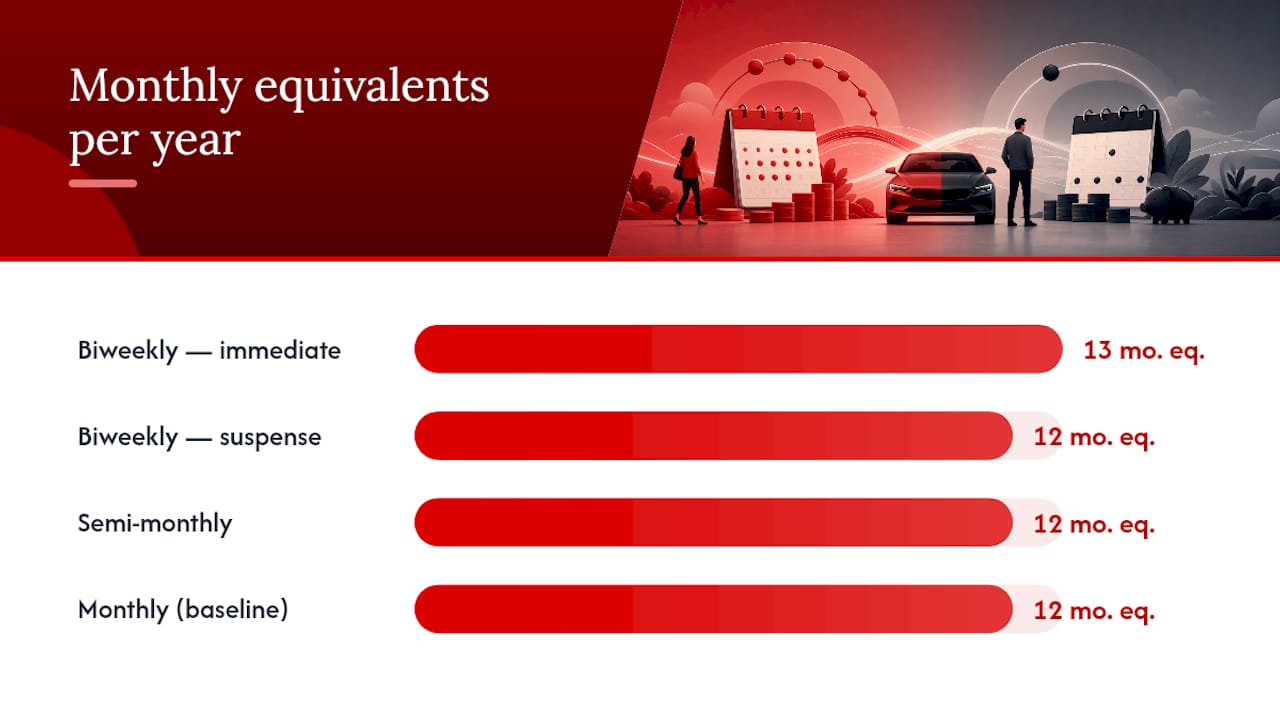
Biweekly car payments save more money for most borrowers. The math is straightforward: making a payment every two weeks produces 26 payments per year, which equals 13 full monthly payments instead of 12. That extra payment each year chips away at your principal faster, which reduces the interest that accrues on your remaining balance. The catch is that savings depend entirely on whether your lender credits each payment immediately to your principal or holds partial payments in a suspense account until a full monthly amount accumulates.
Key Takeaways
Biweekly car payments save interest and shorten payoff by producing one extra annual payment, but only when your lender credits each payment immediately to principal rather than holding it in a suspense account.
| Point | Details |
|---|---|
| Extra payment per year | 26 biweekly payments equal 13 monthly payments, reducing principal faster than a standard schedule. |
| Savings depend on lender crediting | If your lender holds partial payments, the interest benefit disappears entirely — confirm in writing. |
| DIY alternative works just as well | Adding 1/12 of your monthly payment each month replicates biweekly math with no fees or enrollment. |
| Savings scale with loan size and rate | A $48,000 loan at 7.8% APR saved $858 and eight months; smaller or lower-rate loans save proportionally less. |
| Elmwoodautosalesri financing support | Elmwoodautosalesri documents payment application terms and connects buyers with lenders that support flexible schedules. |
Table of Contents
- How biweekly vs. monthly car payments actually work
- A reproducible example showing real dollar savings
- How to set up biweekly payments without getting burned by fees
- Pros and cons of switching to biweekly payments
- Who actually benefits most from biweekly car payments
- Practical alternatives when biweekly payments are not the right fit
- What to ask your lender before changing your payment rhythm
- If you used dealer or in-house financing: what to watch for
- What to realistically expect if you try biweekly payments
- Transparent financing help from Elmwood Auto Sales
- Sources
How biweekly vs. monthly car payments actually work
Interest on a standard auto loan accrues daily on your outstanding principal balance. Every time you reduce that balance, you reduce the interest that builds before your next payment. Monthly payments reduce the principal 12 times a year. Biweekly payments do it 26 times, and that frequency is what creates the savings.
The numbers break down like this:
- 26 biweekly payments per year = 13 full monthly equivalents (one extra payment annually)
- 24 semi-monthly payments (twice a month on fixed dates) = exactly 12 monthly equivalents, no extra payment, no savings
- 12 monthly payments = the standard baseline with no acceleration
The distinction between biweekly and semi-monthly trips up a lot of borrowers. Every two weeks is not the same as twice a month.
The critical lender caveat: many lenders do not process true biweekly payments. Instead, they hold your half-payment in a suspense account and apply it only once a full monthly amount arrives. When that happens, you gain zero interest advantage because the principal reduction timing is identical to a standard monthly schedule. Before assuming biweekly payments will save you money, confirm exactly how your lender credits partial payments. Loans on simple daily interest benefit most from faster crediting; precomputed interest loans may show little or no savings regardless of payment frequency.
A reproducible example showing real dollar savings
These are round numbers chosen to make the math reproducible in any spreadsheet or online calculator.
Estimated interest savings: roughly $520, and payoff arrives about five months early. Scale those numbers up: Bankrate's worked example on a $48,000 loan at 7.8% APR saved $858 in interest and cut eight months from the term. Larger principal and higher APR amplify every dollar of early principal reduction.
To run this calculation yourself:
- Gather your loan details: current principal balance, APR, and remaining term in months.
- Open a biweekly auto loan calculator such as the one at CarPaymentCalculator or MortgageCalculator.org.
- Enter your monthly payment as the "monthly payment" field; the calculator will halve it for the biweekly figure.
- Compare the "total interest" and "payoff date" outputs between the monthly and biweekly columns.
- Note the assumptions: the calculator assumes your lender credits each biweekly payment immediately to principal. If your lender holds payments, the savings column drops to zero.
Pro Tip: Build the same comparison in a spreadsheet using the PMT function for monthly payments, then model 26 payments per year manually. It takes about 10 minutes and shows you exactly what your lender's crediting behavior costs or saves you.
How to set up biweekly payments without getting burned by fees
Two paths exist: a formal lender biweekly program or a DIY approach. Each has trade-offs.
Formal lender biweekly plan:
- Call your lender and ask whether they offer a biweekly payment program.
- Ask specifically whether each half-payment is applied to principal immediately or held in suspense (see the lender checklist below).
- Request the fee schedule in writing. Setup fees and monthly processing fees can erase the interest savings on smaller loans.
- If the program looks clean, enroll and confirm the first payment date in writing.
DIY method (no fees, same math):
- Keep your standard monthly payment schedule.
- Divide your monthly payment by 12 and add that amount to each monthly payment as an extra principal contribution.
- Label the extra amount as "principal only" in your payment portal or check memo line.
- Alternatively, make one full extra payment per year, applied entirely to principal.
Adding 1/12 of a payment each month replicates the biweekly math exactly, costs nothing to set up, and works even when lenders lack biweekly processing infrastructure. Setup or service fees on formal programs can negate interest savings on smaller loans, which makes the DIY route the default recommendation unless your lender's program is genuinely fee-free and credits payments immediately.
Check your loan contract for prepayment penalties before making any extra payments. Most auto loans do not carry them, but some dealer-arranged contracts do.
Pros and cons of switching to biweekly payments
Advantages:
- One extra full payment per year reduces principal faster than any other schedule change
- Lower total interest paid over the life of the loan
- Faster payoff, which frees up cash flow sooner
- Aligns naturally with biweekly paychecks, making budgeting easier for many borrowers
Disadvantages:
- Some lenders hold partial payments in suspense, eliminating the benefit entirely
- Formal biweekly programs often carry setup or processing fees
- Budgeting becomes slightly more complex when payment dates shift away from monthly billing cycles
- Savings can be modest on low-rate or short-term loans, where the extra payment has little time to compound
The net assessment: biweekly payments deliver meaningful, real savings on loans with larger balances, higher APRs, and longer remaining terms.
Who actually benefits most from biweekly car payments
Biweekly paychecks help too, since the payment rhythm matches the income rhythm without requiring extra planning.

Benefits shrink quickly in a few situations. If you have fewer than 18 months remaining on your loan, the principal is already low enough that the interest savings are negligible. Precomputed interest loans, which are common in some buy-here-pay-here arrangements, calculate total interest at origination and do not reduce it when you pay early.
Pro Tip: If your income varies month to month, skip the automated biweekly plan entirely. Make flexible extra principal payments when cash flow allows. You get the same mathematical benefit without committing to a fixed schedule that could strain your budget in a slow month.
Readers exploring financing options for every credit profile will find that loan type matters as much as payment frequency when calculating true payoff cost.
Practical alternatives when biweekly payments are not the right fit
Not every borrower needs a formal biweekly plan. These alternatives often deliver equal or better results with less complexity:
- Add 1/12 to each monthly payment: Mathematically identical to biweekly, fee-free, and works with any lender.
- Make one extra payment per year: Lump it in January or whenever a bonus arrives. Same annual principal reduction as biweekly.
- Round up monthly payments: Paying $650 instead of $594 adds $672 in extra principal per year with zero setup.
- Refinance to a lower APR: When a materially lower rate is available, refinancing often outperforms any payment frequency strategy. A 2-percentage-point rate reduction on a $30,000 balance saves more than biweekly payments ever could.
RateGenius recommends comparing biweekly strategies against refinancing and rounding-up because fees or a meaningfully lower APR can change the optimal choice entirely. One more consideration: if you carry high-interest credit card debt alongside your auto loan, directing extra cash toward the higher-rate debt first will save more total interest than accelerating your car loan.
Readers weighing a refinance should review car loan preapproval basics before approaching lenders.
What to ask your lender before changing your payment rhythm
Get clear answers to these questions before enrolling in any biweekly program or making extra payments:
- Do you accept biweekly payments, or will you hold half-payments in a suspense account?
- Will each payment be applied to principal immediately upon receipt?
- Are there setup fees, enrollment fees, or monthly processing fees for a biweekly program?
- Does my loan carry any prepayment penalties for extra principal payments?
- How will biweekly payments appear on my monthly statement so I can verify correct application?
Get every answer in writing, whether through a confirmation email, a loan account note, or a signed disclosure. Verbal assurances about payment crediting are not enforceable. The FDIC's consumer resources provide general guidance on loan disclosures and your rights as a borrower if a lender's practices do not match what was promised. Avoid common financing contract mistakes by reading every term before signing.
If you used dealer or in-house financing: what to watch for
Dealer-arranged and buy-here-pay-here loans carry a few specific risks that standard bank loans do not.
- Ask whether the contract uses precomputed interest. Buy-here-pay-here loans frequently do, which means extra payments reduce your balance but not your total interest obligation.
- Confirm whether the dealer's payment processing system supports biweekly crediting. Many in-house systems are built for monthly billing only.
- Request written contract language that specifies how extra payments are applied: to principal first, or to future scheduled payments.
- Compare the dealer's terms against a third-party lender if the contract language is vague or restrictive. A bank or credit union loan with clear simple-interest terms and no prepayment penalty is often the cleaner starting point for any payment acceleration strategy.
Elmwoodautosalesri can walk you through how its financing partners apply payments and help you document agreed payment terms before you sign. Readers with non-standard credit histories can also explore bad credit car buying options to find loan structures that support flexible payment strategies.
What to realistically expect if you try biweekly payments
The savings are real, but they are not dramatic for most borrowers. On a typical used car loan, you might save a few hundred dollars in interest and finish the loan four to eight months early. That is genuinely useful, especially if it frees up a monthly payment before a major expense arrives. The behavioral benefit is underrated too: the forced rhythm of paying every two weeks keeps the loan top of mind and tends to prevent the "I'll catch up later" drift that leads to extended terms.

Set realistic expectations going in. The borrowers who feel the clearest impact are those who started with a longer-term, higher-rate loan and switched early in the repayment schedule, when the principal is still large enough for each extra payment to matter.
Transparent financing help from Elmwood Auto Sales
Choosing the right payment schedule starts with choosing the right loan. Elmwoodautosalesri works with a range of financing partners to match buyers in Providence and surrounding areas with loan structures that support flexible payment strategies, including clear simple-interest terms and documented payment application rules.
The finance team at Elmwoodautosalesri can explain exactly how each lender in its network credits payments, help you compare in-house and third-party loan options side by side, and put agreed payment terms in writing before you sign. There are no commission-driven upsells and no pressure to accept terms that do not fit your budget. If you want to discuss payment scheduling, compare lender options, or simply ask the checklist questions above with a knowledgeable team behind you, schedule a visit at Elmwood Auto Sales today.
Sources
Use these resources to verify assumptions and run scenarios with your own loan numbers. When entering data into any calculator, state your assumptions clearly: current principal balance (not original loan amount), your actual APR, remaining term in months, and whether your lender credits payments immediately or holds them.
- How To Pay Your Car Loan Off Faster & When To Wait | Bankrate
- Should You Do Bi-Weekly Car Loan Payments? Here's What Experts Say | GOBankingRates
- Bi-weekly Auto Loan Calculator
- Biweekly Car Loan Calculator: Calculate Biweekly Vehicle Loan Payments
- Biweekly vs Monthly Car Loan Payments - RateGenius
This article is general information, not a substitute for advice from a qualified financial advisor. Consult a qualified financial professional about your own circumstances before acting on anything here.