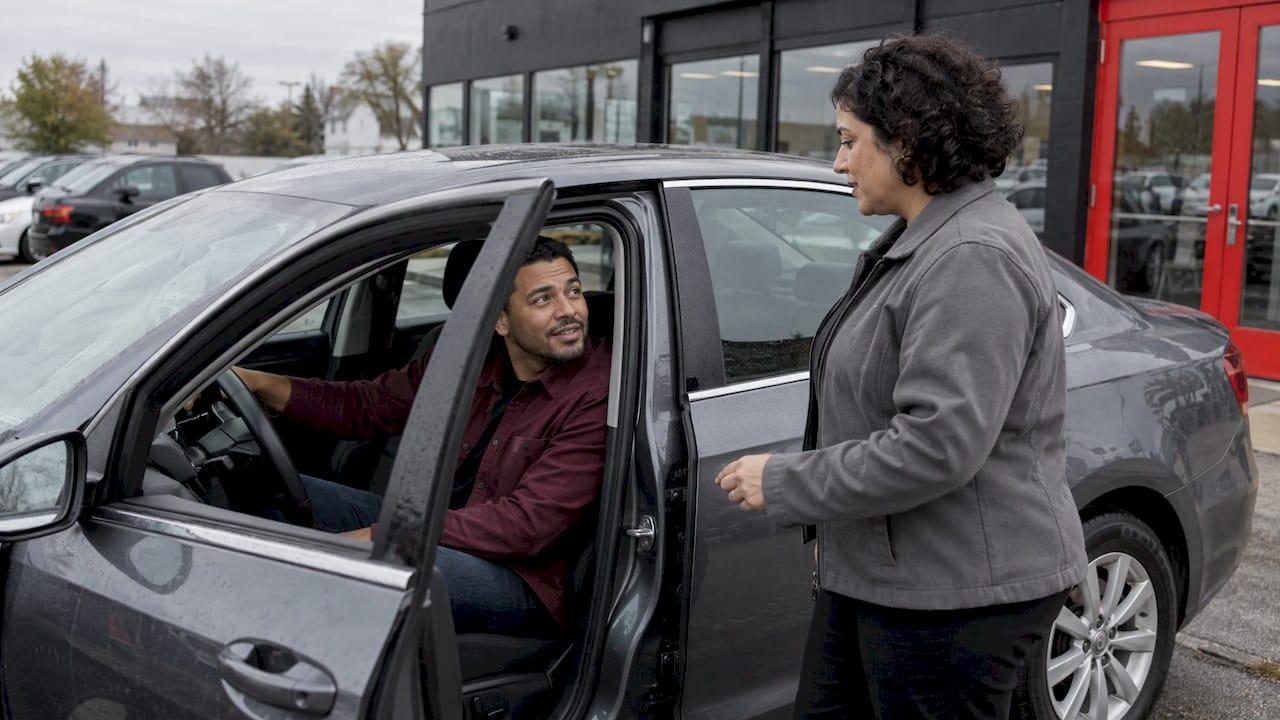
A spot delivery car is a vehicle you drive off the lot before the lender has finished approving your loan. The deal can feel final, but the paperwork often says it is not, and that gap is where buyers get hurt. The safest way to buy is to have the financing settled, in writing, before the keys change hands. At Elmwood Auto Sales in Providence, RI, you can start that step ahead of time through our online financing application, which is built for a range of credit histories.
TL;DR
- Spot delivery (also called conditional financing) means you take the car home before the loan is fully approved by a lender, according to the Consumer Financial Protection Bureau (CFPB).
- If the financing falls through, the dealer may ask you to sign a new deal with a higher rate, a longer term or a bigger down payment. This is often called "yo-yo" financing.
- You are not required to accept different terms. You can walk away and ask for your down payment back.
- Before you drive off, get a signed copy of every document, check that no blanks remain, and find out in writing what happens to your trade-in.
- "Guaranteed" financing is never a promise without conditions, so read what the approval depends on.
Table of Contents
- What is a spot delivery at a car dealership?
- Why do dealers use spot delivery?
- What is yo-yo financing, and what does it look like?
- What are your rights if the dealer asks you to sign new terms?
- What should you check before you take a spot-delivered car home?
- What happens to your trade-in in a spot delivery?
- Does guaranteed auto financing really guarantee approval?
- How do you avoid the problem altogether?
- How can Elmwood help you buy with confidence?
- Our perspective: why we say read first, drive second
- FAQ
- Sources
What is a spot delivery at a car dealership?
In a spot delivery, you sign the paperwork, pick the car and drive it home the same day, while the dealer is still waiting for a bank or finance company to buy your loan. The CFPB describes it as letting a customer take the vehicle home before the loan is finalized or fully approved by the lender.
The Georgia Attorney General's Consumer Protection Division describes the same pattern: the buyer takes possession "on the spot" after committing to buy or lease on installments, without a definite financing arrangement in place. For a buyer with strong credit, the lender usually confirms within a few days. The Georgia office notes that dealers can often confirm terms within 72 hours for creditworthy buyers, but that buyers without excellent credit may not be approved, and may not have been told that the written contract is not binding until financing is approved (Georgia AG).
That last point matters most for the readers who search for guaranteed auto financing. If your credit is thin or bruised, you are the buyer most likely to be called back.
Why do dealers use spot delivery?
Dealers do not arrange most auto loans from their own funds. In the usual setup, the dealer collects your application and sends it to one or more lenders, then sells your signed contract to the one that accepts it. Until a lender accepts, the deal is conditional.
Spot delivery lets a dealer close a sale quickly while that process finishes. For an honest dealer with a clear, written conditional agreement, it can be a convenience. The trouble starts when the buyer does not realize the deal is conditional at all. The Federal Trade Commission's staff report on auto sales and financing found that some consumers were surprised that financing they expected to be final was not, some had never heard the term "spot delivery," and some did not know they had signed forms describing it (FTC, "Buckle Up," July 2020).
What is yo-yo financing, and what does it look like?
Yo-yo financing is what happens when a spot delivery goes wrong. You drive home thinking the deal is done. Days or weeks later, the dealer calls and says the financing did not go through and you need to come back.
According to the CFPB, most auto loan contracts include a clause or separate agreement that lets the dealer renegotiate if it decides the deal is not to its liking. If the dealer then offers only a higher interest rate, a longer term or a larger down payment, that is yo-yo financing.
The Center for Responsible Lending describes the pressure that can follow. Dealers may say they have already deposited your down payment or sold your trade-in at auction, and push you toward a higher rate, a bigger down payment or a co-signer, sometimes adding "rental," "excessive mileage" or "restocking" fees (Center for Responsible Lending). The same research notes that a dealer can usually get a financing decision through automated systems in under 30 minutes, so a claim that financing "fell through" days later deserves a close look.
A typical sequence looks like this:
- You agree on a price, a monthly payment and an interest rate, and sign the contract.
- You hand over a down payment and, perhaps, your trade-in.
- You drive home.
- The dealer calls: the lender "turned it down," and you must sign a new contract at a higher payment.
What are your rights if the dealer asks you to sign new terms?
Start with the federal guidance. The CFPB states that you are not required to agree to different financing, and that you can walk away if you do not accept the new deal. The dealer should refund your down payment. If it was not clear to you that the deal was not final, you may have a right to keep the car and keep making the original payments. You can file a complaint with the FTC, or with the CFPB for problems with buy here pay here dealers (CFPB).
The FTC report explains what a proper spot delivery form is supposed to say: that financing is pending third-party approval, that either side can cancel if financing is rejected, and that on cancellation without new agreed terms you return the car in the same condition (less normal wear and tear) while the dealer returns your down payment, all fees and charges, and any trade-in. Some states require such forms.
State rules differ a great deal, and this is where location matters:
- Michigan. The state dealers' association, citing the state insurance regulator's position, says that once the loan is closed and the buyer takes possession, the dealer generally cannot rescind the contract or demand the car back, with a limited exception for documented fraud on the credit application (Michigan Automotive Dealers Association).
- New Mexico. A dealer commits an unfair trade practice by refusing to void the contract if financing is not finalized within 20 calendar days of delivery, and the rule requires a bold 12-point notice of the buyer's right to void (12.2.13 NMAC).
- Georgia. If a sale depends on final financing, the dealer must keep the title and possession of your trade-in until financing is actually approved, and must immediately return the trade-in or down payment if you decline a new agreement (Georgia AG enforcement policies).
In Rhode Island, Chapter 6-13.1 of the General Laws covers deceptive trade practices and includes sections on a motor vehicle dealer's duty when selling a used vehicle and on displaying the term and interest rate of motor vehicle financing (Rhode Island General Laws, Chapter 6-13.1). Because the rules vary by state and change over time, our guide to consumer protection in auto sales is a good place to read more. If a dealer has already pressed you to sign something you do not understand, contact the Rhode Island Attorney General's consumer protection unit or an attorney before you sign.
What should you check before you take a spot-delivered car home?
The contract is your protection, so slow down at the desk. The CFPB advises that you check all the information, including the interest rate and loan terms, make sure every blank is filled in and the paperwork is signed by you and the dealer, and leave with a copy of everything you signed.
The Georgia Attorney General adds practical steps worth following anywhere:
- Arrange financing from a bank or credit union before you shop, if you can.
- Consider waiting until financing is approved before taking possession.
- Take time before signing instead of deciding under pressure.
- Read every provision and have the dealer complete all blanks first.
- Pay in a way that leaves a record, not in cash, and keep the receipts.
- Get written assurance that your deposit and trade-in will be returned if financing fails or terms change.
If you are handed a conditional or spot delivery agreement, it should answer four questions in plain language:
| Question | What a clear answer looks like |
|---|---|
| What financing are you being approved for? | The interest rate, monthly payment and loan length stated in the contract |
| How long does the dealer have to confirm? | A specific deadline in days |
| What happens to your trade-in? | It is held, not sold, until financing is final, and returned if the deal is cancelled |
| What if you decline new terms? | You return the car and get back your down payment and fees |
If any row is blank or vague, do not leave with the car until it is fixed in writing. Our list of auto loan documents to bring can speed up approval, and our article on used car financing mistakes covers other traps worth knowing.
A few other items belong on the same checklist. Confirm you have insurance in place before you drive, since you are typically expected to insure a car you are driving even while the title is not yet in your name. Ask whether the vehicle has been inspected and what the dealer's return policy is in writing. A simple car safety inspection checklist also helps you walk around the vehicle methodically before you sign, and the same discipline applies to reading the loan paperwork: one line at a time, with nothing left blank.
What happens to your trade-in in a spot delivery?
This is the part many buyers overlook. If you trade in a car and the deal later unwinds, you need to know where your old car is. The Center for Responsible Lending has documented cases where a trade-in was sold before the deal was final, which leaves a buyer with no car to get back and little leverage in a renegotiation. Georgia's rules address this directly by requiring dealers to hold a trade-in until financing is approved when the sale is conditional.
If you are trading in a car with a loan on it, the payoff amount matters as well. Get the figure and the out-the-door price in writing, as we explain in getting a written payoff before trading in. If you are trading in a leased vehicle, the same logic applies, and our guide to trading in a leased car walks through it.
Does guaranteed auto financing really guarantee approval?
No lender approves every application without conditions. A lender's published guidelines make this clear. Consumer Portfolio Services, a subprime auto finance company, states in its 2025 dealer guidelines that it reserves the right to approve or turn down any application, that credit decisions are at its sole discretion, that proof of income dated within 30 days is required unless waived on final approval, and that it will not buy contracts on vehicles with a total loss, stolen status or unresolved accidents (CPS Guidelines Schedule A).
So when you see "guaranteed approval," read it as a signal that a dealer works with buyers across credit profiles, not as a contract term. What protects you is the written, final financing agreement, not the advertising. That is true whether the loan comes from an outside lender or from a dealer that finances the car itself.
Buy here, pay here dealers are regulated too. New Hampshire, for example, now requires entities that make or take assignments of motor vehicle loans, including buy here pay here operations that create payment plans, to be licensed as sales finance companies under provisions that took effect on August 2, 2024 (New Hampshire Banking Department). Rules in your own state will differ, which is another reason to keep every document.

How do you avoid the problem altogether?
The cleanest approach is to remove the "conditional" from the deal before you leave with the car. You can do that in a few ways:
- Apply before you visit. Submitting a financing application ahead of time gives you time to read the terms without a salesperson waiting. You can start with our used car financing application.
- Gather your documents. Proof of income, ID and proof of residence typically speed things up. See the documents list.
- Know your financing options. Our guide to types of car financing explains how different loans work so the terms on the page are not a surprise.
- Get the final numbers in writing. Rate, term, payment, down payment, trade-in value and fees, all on paper, all signed.
- Take your time. If you feel rushed, that is a reason to pause. A fair deal is still there tomorrow.
How can Elmwood help you buy with confidence?
Elmwood Auto Sales is a used car dealership in Providence, RI built around a low-pressure buying experience. Our sales team does not work on commission, so the conversation at the desk can stay honest and straightforward. Every vehicle we sell goes through a thorough inspection, and we offer tailored financing, including buy here, pay here options, for customers with a range of credit histories.
If you are a first-time buyer, a family looking for an SUV or truck, or someone with a trade-in, you can start in a few places: browse our used cars, trucks, SUVs and vans, apply through used car financing, or ask us to look for a specific vehicle with the Car Finder.
If you have a car to trade, our trade-in and sell page is the place to begin.
Our perspective: why we say read first, drive second
We built Elmwood around a simple idea: a car purchase should not feel like a negotiation you lose by being tired or hurried. Our team is not paid on commission, so no one at our dealership has a reason to rush you through a contract.
Spot delivery is a symptom of a rushed sale. The excitement of a new car and the clock on a salesperson's day push buyers to sign first and understand later. We would rather you understand first. That is why we put inspections, honest conversation and tailored financing at the center of what we do, and why we encourage buyers to start with an application and a clear set of numbers.
Buyers with bruised or limited credit deserve the same clarity as anyone else. Our financing programs, including buy here, pay here, are designed to serve a range of credit histories, so you do not have to accept a confusing deal out of fear that no one else will approve you.
Elmwood
FAQ
Is a spot delivery the same as a regular car purchase?
Not necessarily. In a regular purchase, financing is approved and final when you sign. In a spot delivery, you take the car while the lender is still deciding, so the deal can be changed or cancelled if financing is not approved. Always ask whether your contract is final or conditional.
Can a dealer take the car back after I drive it home?
It depends on your state and your paperwork. Michigan's regulator position, as described by the state's dealers' association, is that a closed loan generally cannot be rescinded. Other states allow cancellation under a conditional agreement with specific protections. If a dealer asks for the car back, ask for the reason in writing, and speak with your state attorney general's office or an attorney.
Do I have to accept a higher interest rate if the first financing falls through?
No. The CFPB says you are not required to agree to different financing and can walk away, and the dealer should refund your down payment. Do not sign a new contract until you have read the new rate, term and payment, and compared them with your original agreement.
Can I get a car with bad credit without a spot delivery?
Yes. Many dealers work with buyers across credit profiles, and the safest path is to complete the financing before you take the car. At Elmwood, you can begin with our online application and ask us about our tailored financing options, including buy here, pay here.
Sources
- CFPB: Can the dealer increase the interest rate after I drive the vehicle home?
- Georgia Attorney General: Spot Delivery Pitfalls
- FTC: Buckle Up, Navigating Auto Sales and Financing
- Center for Responsible Lending: Auto Lending Abuses in Dealer-Financed Loans
- Michigan Automotive Dealers Association: Spot Delivery
- New Mexico 12.2.13 NMAC
- Georgia Attorney General: Auto advertising and sales practices enforcement policies
- Rhode Island General Laws, Chapter 6-13.1
- Consumer Portfolio Services: Guidelines Schedule A
- New Hampshire Banking Department: Motor Vehicle Retail Sellers and Sales Finance Companies