
Consumer protection in auto sales is the legal framework that shields car buyers from fraud, deceptive pricing, and unfair practices at dealerships and private sales. The Federal Trade Commission, the Magnuson-Moss Warranty Act, and state lemon laws form the backbone of these protections. Together, they set clear rules on warranty disclosures, pricing transparency, and your right to recourse when a dealer acts dishonestly. Knowing what is consumer protection auto sales means knowing exactly which laws apply to your purchase and what you can do when a dealer crosses the line.
What federal laws protect consumers in auto sales?
Federal consumer protection laws in auto sales operate through two primary channels: warranty regulation and pricing enforcement. The Magnuson-Moss Warranty Act requires any dealer offering a written warranty to disclose its terms clearly and completely. Dealers cannot deny warranty repairs without a valid reason, and vague or buried warranty language violates the Act. This protection applies whether you buy new or used, as long as a written warranty is offered at the point of sale.
The FTC plays an equally direct role in policing auto dealer conduct. In march 2026, the FTC warned 97 dealership groups that advertised prices must include all mandatory fees. That warning signals that hidden charges, unexpected add-ons, and ads for vehicles that do not exist are illegal under federal regulations, not just bad practice. The FTC's Used Car Rule also requires dealers to post a Buyers Guide on every used vehicle, disclosing whether the car is sold as-is or with a warranty.
Federal law prohibits several specific practices that buyers often encounter:
- Advertising a vehicle at a price that excludes mandatory dealer fees
- Listing vehicles for sale that are not actually available
- Denying warranty repairs without cause under a written warranty
- Misrepresenting financing terms or interest rates in advertisements
Pro Tip: Request the Buyers Guide from the dealer before you test drive any used vehicle. It is a federally required document, and a dealer who cannot produce it is already operating outside the rules.
The FTC's enforcement actions carry real consequences, including civil penalties and required corrective advertising. That enforcement pressure gives buyers a concrete avenue for reporting violations. You can file a complaint directly with the FTC at ReportFraud.ftc.gov, and the agency uses those reports to identify patterns across dealership groups.
How do state laws supplement federal auto sales protections?
State consumer protection laws fill the gaps that federal statutes leave open, and they often go further than federal minimums. Massachusetts is one of the clearest examples: state law requires dealers to provide a written Limited Used Vehicle Warranty at the point of sale, with coverage defined by mileage brackets. A vehicle with under 40,000 miles on the odometer carries a longer mandatory warranty period than one with higher mileage. That kind of specificity does not exist at the federal level.
Lemon laws are another area where states carry most of the weight. Most lemon laws favor new vehicles and require manufacturers to repair, replace, or refund a car that has a substantial defect after a reasonable number of repair attempts. Used vehicles generally receive less lemon law protection, but many states impose implied warranty of merchantability standards that give buyers recourse when a used car fails shortly after purchase.
| Protection Type | Federal Level | State Level |
|---|---|---|
| Written warranty disclosure | Required by Magnuson-Moss Act | May impose additional specificity |
| Used vehicle warranty mandate | Not required | Required in states like Massachusetts |
| Lemon law coverage | Not applicable | Primarily covers new vehicles |
| Implied warranty of merchantability | Not mandated | Available in most states |
| Complaint enforcement authority | FTC | State Attorney General offices |
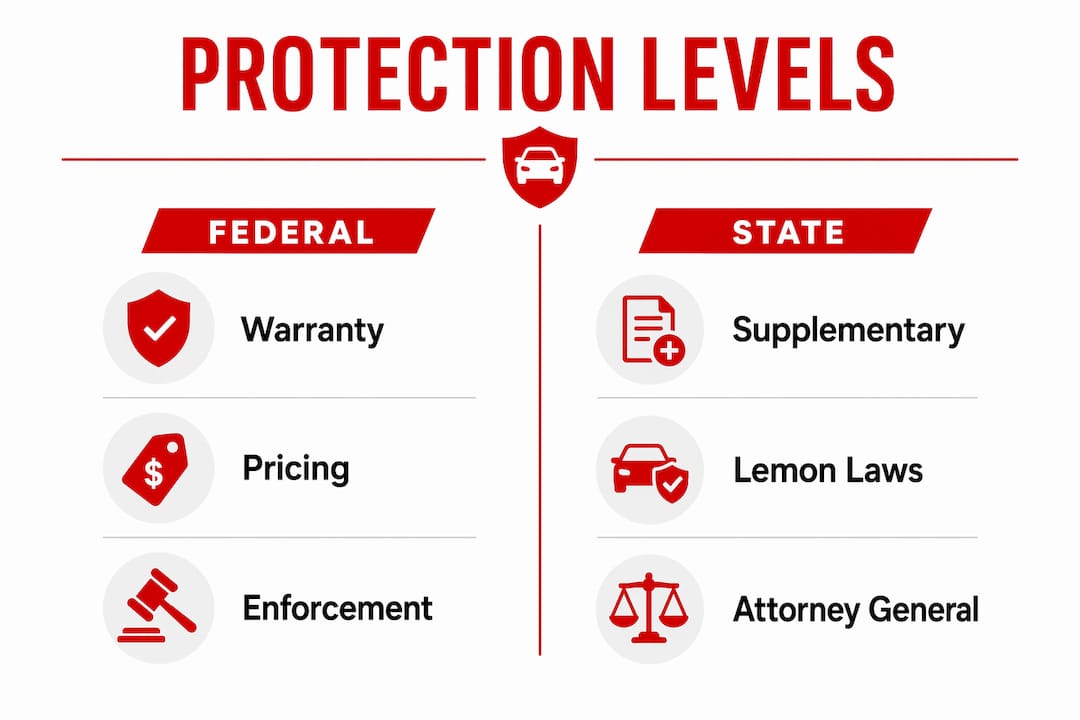
State Attorneys General run consumer protection divisions that investigate dealer fraud. Filing a complaint with an AG office can trigger a systemic investigation, not just a response to your individual dispute. That distinction matters because AG offices have subpoena power and can compel records that individual buyers cannot access on their own.
Rhode Island buyers should check the Rhode Island Attorney General's consumer protection division for state-specific rules. Remedies available under state law typically include vehicle repair at dealer expense, full replacement, or a refund of the purchase price. The exact remedy depends on the defect, the mileage, and the specific state statute that applies.
What deceptive sales practices should you watch for?
The most common deceptive practices in auto sales fall into a few clear categories, and recognizing them before you sign protects you far more than disputing them afterward. The "as-is" sale label is the most misunderstood. Dealers legally sell vehicles as-is, which shifts repair liability to the buyer. However, as-is language does not protect a dealer who knowingly hides defects or misrepresents the vehicle's condition. Intentional fraud voids the as-is shield entirely.

Spot delivery, also called yo-yo financing, is a less visible but equally serious risk. A dealer lets you drive the car home before financing is finalized. Days later, the dealer calls to say the financing fell through and demands you return the vehicle or sign a new contract at a higher rate. Spot delivery disputes often trap buyers who have already traded in their old vehicle, leaving them with no transportation and a worse deal than they agreed to.
Other red flags to watch for during the buying process:
- Bait-and-switch advertising where the advertised vehicle is "no longer available"
- Add-on fees for products like paint protection or VIN etching that were not disclosed upfront
- Pressure to sign a contract before reviewing all line items
- Verbal promises about vehicle condition or included repairs that never appear in writing
Pro Tip: Never take delivery of a vehicle until financing is fully approved and documented in writing. If a dealer pressures you to drive home "tonight" before paperwork is complete, that is a warning sign, not a favor.
Bait-and-switch tactics and hidden fees are the practices the FTC targeted in its march 2026 enforcement sweep. Knowing these tactics by name helps you identify them in real time, before you are committed to a contract.
How can you protect yourself and enforce your rights?
The single most effective protection you have is a complete paper trail. Verbal promises have no legal standing in most auto sales disputes. Every commitment a dealer makes, whether about repairs, included accessories, or financing terms, must appear in the written contract before you sign. If it is not in writing, treat it as nonexistent.
Follow these steps to protect your purchase from the start:
- Request and review the Buyers Guide on every used vehicle before negotiating.
- Get a vehicle history report using the VIN to check for accidents, title issues, and odometer discrepancies.
- Have an independent mechanic inspect the vehicle before purchase, especially for as-is sales.
- Read every line of the purchase contract, including the financing terms, add-on fees, and warranty coverage.
- Confirm the dealer's licensing status with your state's motor vehicle authority before signing anything.
- Keep copies of every document you sign, including the Buyers Guide, warranty, and financing agreement.
One misconception costs buyers significantly: the belief that a cooling-off period lets you return a vehicle after purchase. Federal law grants no such right in auto sales. Some states and individual dealers offer return windows, but you must confirm this in writing before you buy. Assuming you can return a car is one of the most expensive assumptions a buyer can make.
When a dispute does arise, start by filing a written complaint with the dealership's management. If that produces no resolution, escalate to your state's Attorney General consumer protection division. For warranty disputes, the Magnuson-Moss Warranty Act allows you to pursue legal action, and many consumer protection attorneys work on contingency in these cases, meaning no upfront cost to you.
Key Takeaways
Consumer protection in auto sales is built on federal warranty law, FTC pricing enforcement, and state-specific statutes that together give buyers clear rights and real remedies against fraud and deception.
| Point | Details |
|---|---|
| Federal warranty law | The Magnuson-Moss Warranty Act requires clear written warranty terms and prohibits unjust denial of repairs. |
| FTC pricing enforcement | Dealers must include all mandatory fees in advertised prices; violations carry federal penalties. |
| State law fills the gaps | States like Massachusetts mandate written used vehicle warranties beyond federal minimums. |
| As-is does not cover fraud | As-is language shifts repair liability but does not protect dealers who knowingly misrepresent vehicle condition. |
| Paper trail is your defense | Every promise must be in writing; verbal commitments have no legal standing in most auto sales disputes. |
What I've learned about consumer protection that most buyers miss
Most buyers walk into a dealership focused on the monthly payment. That single-minded focus is exactly what makes deceptive practices so effective. The real exposure is not in the sticker price. It is in the contract terms, the financing structure, and the warranty language that buyers skim or skip entirely.
The as-is label is the most misunderstood concept in used car sales. Buyers see it and assume they have no recourse at all. That is wrong. A dealer who sells a vehicle as-is while knowing the transmission is failing and says nothing has committed fraud, and the as-is sticker does not protect them. The legal distinction between shifting liability and concealing known defects is real, and it is worth understanding before you buy.
Spot delivery is the practice I see cause the most financial harm to buyers who thought they had a done deal. The safest rule is simple: do not take the keys until the financing contract is signed, finalized, and in your hands. No exceptions.
Regulatory enforcement is getting sharper. The FTC's march 2026 action against 97 dealership groups shows that federal agencies are actively monitoring pricing practices, not just responding to individual complaints. That trend benefits buyers, but only if you know your rights well enough to recognize when they are being violated.
— Elmwood
Buying with confidence at Elmwoodautosalesri
Elmwoodautosalesri operates without commission-based sales tactics, which removes the pressure that makes deceptive practices possible in the first place. Every vehicle on the lot goes through a thorough inspection before it is offered for sale, so you know the condition of what you are buying.
Transparent pricing means no hidden fees added at signing. Elmwoodautosalesri also offers financing options built for buyers across a range of credit histories, including buy here, pay here solutions for those who need flexible terms. You can review inventory, check pricing, and start the financing process with full visibility into every cost. That is what buying a car with your consumer rights intact actually looks like.
FAQ
What is consumer protection in auto sales?
Consumer protection in auto sales is the set of federal and state laws that prohibit deceptive pricing, false advertising, and unfair warranty practices by dealers. Key statutes include the Magnuson-Moss Warranty Act and FTC regulations on pricing transparency.
Does an as-is sale mean I have no rights?
An as-is sale shifts repair liability to the buyer but does not protect a dealer who knowingly conceals defects or misrepresents the vehicle's condition. Intentional fraud voids the as-is designation entirely.
Can I return a car after I sign the contract?
Federal law does not grant a right to return a vehicle after signing. Some states and individual dealers offer return windows, but you must confirm this in writing before purchase.
What should I do if a dealer commits fraud?
File a written complaint with your state's Attorney General consumer protection division, which has authority to investigate dealer fraud and compel records. You can also report the dealer to the FTC at ReportFraud.ftc.gov.
What is yo-yo financing and how do I avoid it?
Yo-yo financing occurs when a dealer lets you take delivery before financing is finalized, then demands you return the vehicle or accept worse loan terms. Avoid it by refusing delivery until the financing contract is fully signed and in your possession.