
The quickest way to overpay at the dealership is agreeing to anything without an itemized out-the-door (OTD) price in writing. The most common hidden car buying costs include the documentation fee, dealer prep, advertising fee, market adjustment markup, VIN etching, paint protection, GAP insurance, extended warranties, and dealer-inflated APR on financing. Edmunds is direct on this point: negotiate the total OTD price first, and never discuss monthly payments until that number is locked in writing.
Before you sign anything, these quick wins can save you $500–$3,000:
- Demand a printed, itemized OTD quote and compare every line item against the Monroney (window) sticker.
- Get preapproved financing from your bank or credit union before visiting any dealership, so you have a rate benchmark the dealer must beat.
- Refuse any add-on not listed on the Monroney sticker until you have reviewed it separately and agreed to it in writing.
Pro Tip: Ask the finance officer for the "buy rate" on your loan — the rate the lender actually approved — before they present you with the dealer's marked-up rate. That single question can save hundreds in interest.
Table of Contents
- What are the most common hidden fees when buying a car?
- How do dealers slip extra charges into your contract?
- What should you say and do to remove unwanted fees?
- How does dealer financing hide real costs?
- What hidden costs are unique to used cars?
- What are your rights, and what can you do if a dealer overcharges you?
- What should you check on the final contract before signing?
- Key TakeawaysAvoiding hidden car buying costs comes down to one discipline: get every number in writing before you agree to anything, and never let a monthly payment substitute for a clear OTD total.
- Why transparent pricing is the only honest way to sell cars
- Elmwood Auto Sales: transparent pricing, inspected vehicles, no pressure
- Useful sources to verify facts and state-specific details
What are the most common hidden fees when buying a car?
Every fee on a car contract falls into one of two categories: legally required or dealer-discretionary. Knowing which is which before you sit down at the finance desk is the foundation of smart car buying. Consumer Reports draws a clear line between fees you should accept and fees you should contest or remove entirely.
| Fee | Required or Optional | Typical U.S. Range | Negotiability | How to Verify | Avoidance Tactic |
|---|---|---|---|---|---|
| Documentation (doc) fee | Optional (state-capped in some states) | $300–$1,500 | Possible | Finance contract line item | Ask for a reduction; cite your state's cap |
| Dealer prep fee | Optional | $200–$500 | Easy | Not on Monroney — red flag | Refuse outright; it duplicates destination charge |
| Advertising fee | Optional | $500–$1,500 | Possible | Invoice line item | Contest as a dealer overhead cost, not your expense |
| Destination charge | Required (factory set) | — | Difficult | Monroney sticker | Accept; verify it matches the sticker exactly |
| Market adjustment | Optional | $500–$10,000+ | Possible | Dealer-added sticker | Walk away or negotiate hard; it is pure profit |
| VIN etching | Optional | $100–$200 | Easy | Finance add-on sheet | Decline; you can buy a kit for under $25 |
| Paint/fabric protection | Optional | $200–$1,000 | Easy | Finance add-on sheet | Decline; factory paint is already protected |
| Nitrogen tire fill | Optional | — | Easy | Finance add-on sheet | Decline; free air works identically |
| GAP insurance | Optional | $500–$1,500 | Possible | Finance contract | Buy through your insurer for far less |
| Extended warranty | Optional | $1,000–$3,000 | Possible | Finance contract | Research third-party options before agreeing |
| Stolen vehicle recovery | Optional | $500–$1,500 | Easy | Finance add-on sheet | Decline; your phone's GPS does the same job |
| Sales tax | Required | Varies by state | None | Finance contract | Verify rate via Tax Foundation |
| Title and registration | Required | $100–$200 | None | DMV fee schedule | Verify against your state DMV's published schedule |
CarCostBreakdown reports that doc fees average around $612 nationally, while destination charges average around $1,395. Both figures appear on the Monroney sticker for new vehicles. If a dealer adds a separate "delivery" or "prep" line on top of the destination charge already printed on the sticker, that is a duplicate charge — and you should push back immediately.
State doc-fee caps matter. Several states, including California, Florida, and New York, cap or regulate documentation fees. Before you negotiate, look up your state's DMV fee schedule so you know the legal ceiling.
How do dealers slip extra charges into your contract?
Dealers who add unauthorized fees rarely announce them. The tactics are subtle, and they tend to work best when buyers are tired, excited, or rushed. The FTC has documented cases where a large portion of buyers at certain dealer groups were charged for add-ons they never authorized.
Common tactics to recognize:
- Electronic signing tablets that scroll quickly through documents, burying add-on products in the middle of pages buyers never read carefully.
- "Preinstalled" packages described verbally as already on the car, when they are actually optional products added to the finance contract after the fact.
- Blank fields left open on the contract at signing, which can be filled in later with fees or add-on amounts.
- Spot delivery (also called "yo-yo financing"), where you drive the car home before financing is finalized, then get called back to sign at worse terms.
- Payment-focused negotiation, where the salesperson steers every conversation to "What monthly payment works for you?" rather than the total price, making it easy to hide thousands in add-ons within a longer loan term.
- Trade-in number swapping, where the trade-in value is adjusted downward after the vehicle price is agreed, effectively clawing back the discount you negotiated.
The MotorTrend guide to dealer add-ons makes a practical point about the Monroney sticker: if floor mats or accessories are listed there as factory-included, the dealer cannot legitimately charge for them separately on the finance contract. Always compare the sticker to the contract line by line.
Red flags to watch at the finance desk:
- A line item that was not discussed during negotiation suddenly appears.
- The finance officer says "this is standard" or "everyone gets this" about an optional product.
- Any field on the contract is blank when you are asked to sign.
- The total financed amount is higher than the agreed OTD price plus tax, title, and registration.
What should you say and do to remove unwanted fees?
Preparation before you walk in is what separates buyers who pay sticker price from buyers who leave with a fair deal. Follow this sequence.
Pre-visit checklist:
- Research the vehicle's fair market value on Edmunds or Kelley Blue Book (KBB) so you know what a reasonable OTD price looks like.
- Get preapproved for an auto loan from your bank or credit union. This gives you a rate benchmark and removes the dealer's financing leverage. For more on avoiding financing mistakes, review common pitfalls before you go.
- Obtain your trade-in value from at least two sources (KBB Instant Cash Offer, CarMax offer) and negotiate the trade-in separately from the vehicle purchase price.
- Look up your state's doc-fee cap and DMV registration fee schedule.
- Confirm your insurance covers the new vehicle before you drive off the lot.
Scripts that work:
To remove an add-on: "I'd like to remove [VIN etching / paint protection / nitrogen] from the contract. Please reprint the contract without that line item."
To contest an advertising or prep fee: "This fee isn't on the Monroney sticker and wasn't part of our agreed price. I'd like it removed before we proceed."
To get the buy rate on financing: "What is the buy rate the lender approved for my credit profile? I'd like to see that before reviewing the dealer rate."
Negotiation flow: Start with the salesperson. If they cannot remove a fee, ask to speak with the sales manager. If the manager refuses to budge on a fee you believe is illegitimate, be prepared to walk away. Walking away is the single most effective negotiating tool available to a buyer. Dealers know that a customer who leaves is a lost sale, and many will call back with a better offer within 24 hours.
Pro Tip: Never let urgency pressure you into signing. "This deal is only good today" is a sales tactic, not a fact. A fair deal will still be available tomorrow.
How does dealer financing hide real costs?
The monthly payment is the most misleading number in a car deal. Two buyers can have the same $450 monthly payment and end up paying $4,000 apart in total cost, simply because one has a 48-month loan at 5.9% APR and the other has a 72-month loan at 8.9% APR with add-ons rolled in.
How the buy rate markup works:
- The lender approves your loan at a specific rate, called the "buy rate."
- The dealer is permitted to mark that rate up, often by 1–3 percentage points, and keep the difference as profit.
- You never see the buy rate unless you ask for it directly.
Worked example:
Suppose the agreed OTD price is $22,000 and the lender's buy rate is 6.5% APR on a 60-month loan. Monthly payment: approximately $430. Total paid: approximately $25,800.
Now the dealer rolls in $1,500 in add-ons (GAP, paint protection, extended warranty) and marks the APR up to 9.5% on a 72-month term to keep the monthly payment near $430. Total paid: approximately $31,000. The monthly payment looks identical, but you pay roughly $5,200 more over the life of the loan.
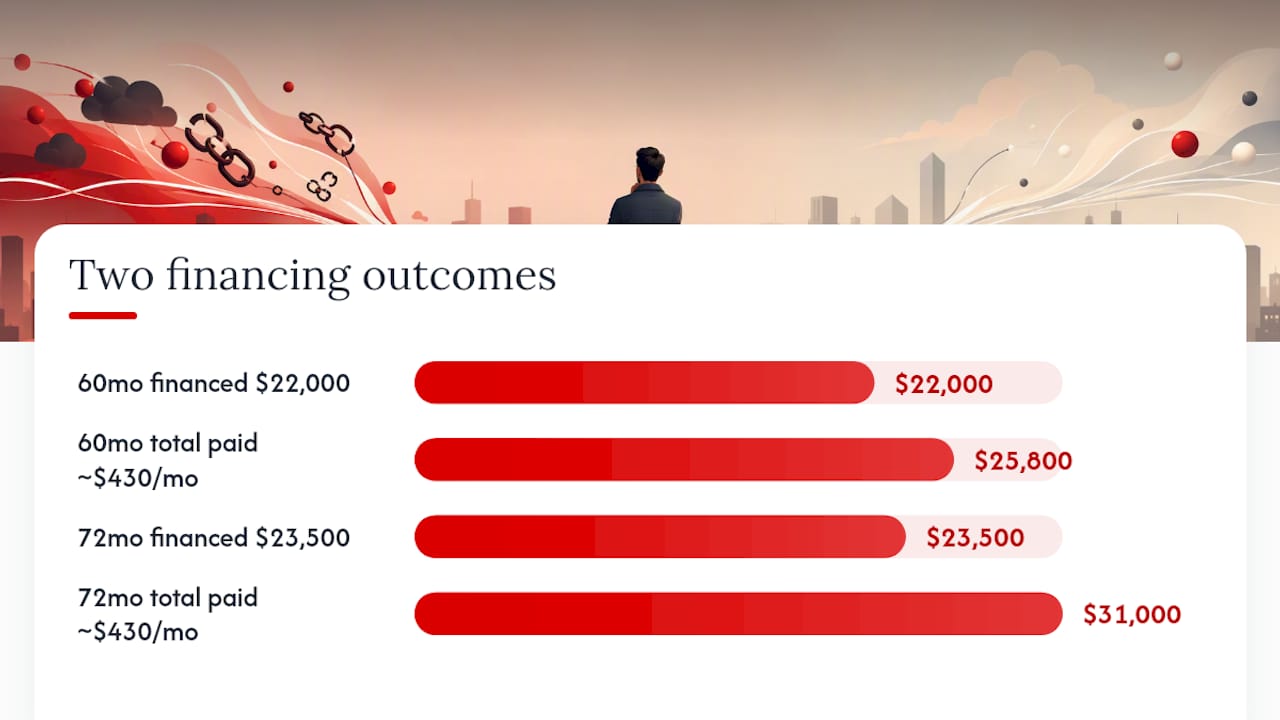
That is why Edmunds consistently advises buyers to negotiate the total price first, then evaluate financing separately. For a deeper look at smart car loan strategies, compare your preapproved rate against whatever the dealer offers.
Finance red flags:
- The finance officer presents only a monthly payment, not the total financed amount or APR.
- Add-ons are described as "included" without a separate line-item price.
- Spot delivery is offered before financing is fully approved.
- A "payment convenience fee" or "processing fee" appears on the finance contract.
- The loan term is extended without your explicit agreement.
Questions to ask the finance officer before signing:
- What is the buy rate the lender approved?
- What is the total financed amount, including all add-ons?
- What is the APR, and is it fixed or variable?
- Is there a prepayment penalty?
- What is the total amount I will pay over the life of the loan?
What hidden costs are unique to used cars?
Used vehicles carry a separate layer of potential surprise expenses that new-car buyers rarely face. AAA's vehicle maintenance guidance notes that deferred maintenance significantly raises the risk of large repair bills, and shop labor rates nationally now run above $130 per hour. A used car that looks clean on the surface can carry thousands in deferred work.
Used-car specific costs to watch:
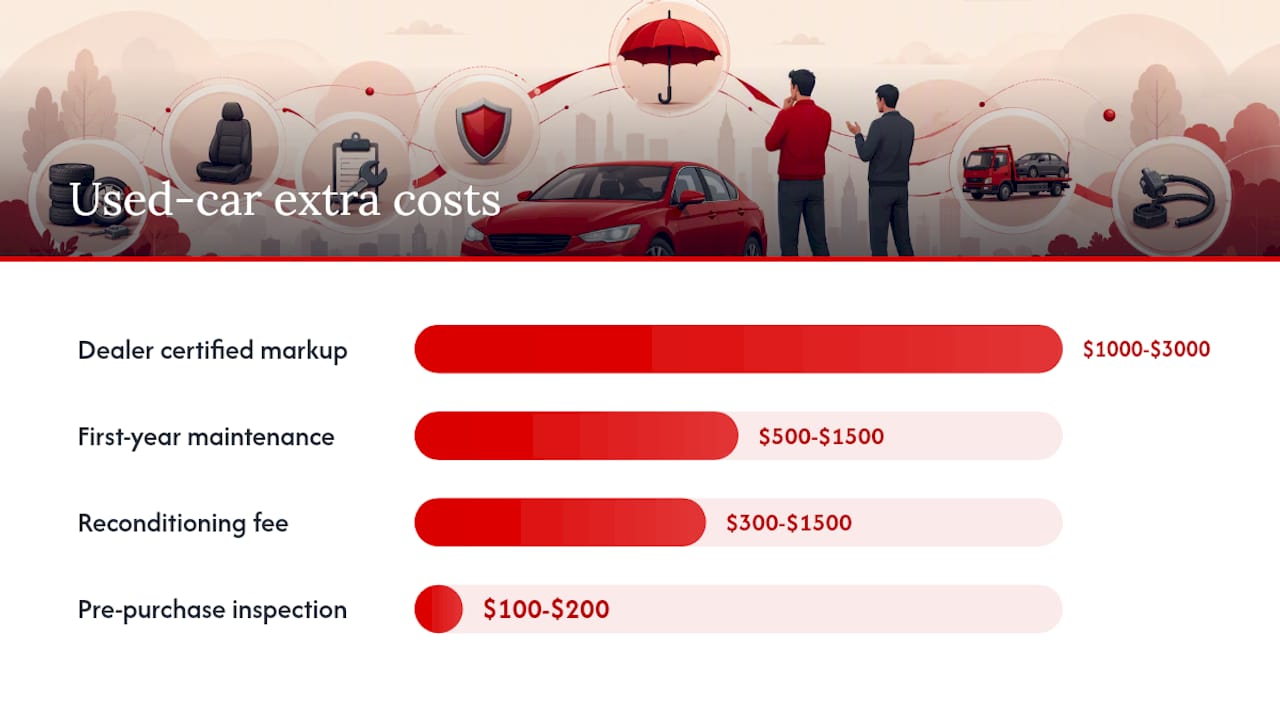
- Reconditioning fees: Dealers charge $300–$1,500 to "recondition" a used vehicle, but this work is a cost of doing business, not your expense. Contest it.
- Undisclosed prior damage: Paint overspray, misaligned panels, or mismatched paint codes signal prior collision repair. A pre-purchase inspection catches this.
- Title brands: A salvage, rebuilt, or flood title dramatically reduces resale value and can affect insurability. Always run a vehicle history report.
- Odometer discrepancies: Compare the odometer reading to service records in the vehicle history report. A mismatch is a serious red flag.
- Dealer "certified" markup: A dealer-certified label can add $1,000–$3,000 to the price. Verify what the certification actually covers in writing.
- Emissions and state inspection costs: Some states require a fresh inspection certificate. Confirm who pays for it.
- Immediate maintenance items: Tires, brakes, and battery are often near end-of-life on used vehicles. Budget $500–$1,500 for these in your first year.
Pre-purchase inspection cost: An independent mechanic inspection typically runs $100–$200 and covers the engine, transmission, brakes, suspension, electrical systems, and body condition. That $150 can reveal $3,000 in needed repairs before you commit.
A vehicle history report from Carfax or AutoCheck is a non-negotiable first step. It surfaces title brands, accident history, odometer rollbacks, and open recalls. For buyers on a tighter budget, the best used cars under $10,000 guide can help you identify models with lower long-term maintenance profiles.
Action steps for used-car buyers:
- Order a vehicle history report before visiting the dealer.
- Hire an independent mechanic (not the dealer's shop) to inspect the vehicle.
- Use inspection findings as a negotiation tool: documented repair needs justify a lower price.
- Budget for first-year maintenance separately from the purchase price.
What are your rights, and what can you do if a dealer overcharges you?
Federal and state law give you real recourse when a dealer adds unauthorized charges. The FTC's 2024 consumer alert is explicit: dealerships cannot charge you for add-ons you did not agree to, and buyers who discover unauthorized charges have the right to demand a refund.
Steps to take if you believe you were overcharged:
- Collect all documents: the signed contract, the Monroney sticker, any add-on disclosure sheets, and any written or email communications with the dealer.
- Contact the dealer's general manager in writing and request an itemized refund for any unauthorized charges.
- File a complaint with your state attorney general's consumer protection division.
- File a complaint with the FTC at ReportFraud.ftc.gov.
- If financing was involved, contact the lender directly to dispute unauthorized add-ons rolled into the loan.
State rules add another layer of protection. Doc-fee caps, lemon laws, and DMV fee schedules vary by state. Before you negotiate, check your state DMV's published fee schedule and your state statutes for documentation fee limits. Consumer Reports recommends verifying registration and title fees against the DMV's own list, since dealers occasionally pad these amounts.
Sales tax is a required charge, but the rate varies significantly by state and sometimes by county. Use the Tax Foundation's state sales tax database to confirm the correct rate for your purchase location before you calculate your expected OTD price.
What should you check on the final contract before signing?
The finance office is where deals fall apart for buyers who are not paying attention. Take your time here. The paperwork stage typically runs 45–90 minutes, and rushing through it is where most hidden fees get locked in. There is no legitimate reason to sign a contract with blank fields or line items you do not recognize.
Final contract checklist:
- Confirm the VIN on the contract matches the VIN on the vehicle.
- Verify the OTD price matches the number you agreed to in writing.
- Check every fee line item has a dollar amount and a description.
- Confirm the APR matches what was discussed, and ask for the buy rate in writing.
- Verify the total financed amount equals the OTD price minus your down payment and trade-in allowance.
- Confirm the trade-in allowance matches the separately agreed trade-in value.
- Check the odometer reading on the contract matches the vehicle's actual reading.
- Review warranty terms: confirm what is covered, for how long, and what the deductible is.
- Confirm there are no blank fields anywhere on the contract before you sign.
- Request a printed copy of every document you sign before you leave the lot.
Sample redlines to use:
If you see a fee you did not agree to, draw a single line through it, write "REMOVE" next to it, and initial it. Ask the finance officer to reprint the contract without that line. If they refuse, you have the right to walk away before signing.
If a warranty or protection product appears that you did not request, write "NOT AUTHORIZED" next to it and initial it. Do not sign a contract that includes products you did not agree to purchase.
Pro Tip: Photograph every page of the contract with your phone before leaving the dealership. If a dispute arises later, you will have a timestamped record of exactly what you signed.
The Money guide to hidden car costs recommends treating total cost of ownership, not just the purchase price, as the real number to evaluate. Factor in insurance, fuel, maintenance, and depreciation alongside the purchase price when deciding what you can afford.
Key TakeawaysAvoiding hidden car buying costs comes down to one discipline: get every number in writing before you agree to anything, and never let a monthly payment substitute for a clear OTD total.
| Point | Details |
|---|---|
| Demand OTD price first | Get an itemized out-the-door price in writing before discussing monthly payments or financing. |
| Know required vs. optional fees | Sales tax, title, and destination charges are required; doc fees, add-ons, and prep fees are negotiable or removable. |
| Get preapproved financing | A preapproved rate from your bank gives you a benchmark and limits dealer APR markup leverage. |
| Inspect used cars independently | A $100–$200 pre-purchase inspection can reveal thousands in needed repairs before you commit. |
| Elmwoodautosalesri's approach | Elmwoodautosalesri provides inspected inventory, non-commission sales, and itemized OTD quotes so buyers see every number clearly. |
Why transparent pricing is the only honest way to sell cars
Most buyers walk into a dealership knowing they might get charged extra for something. What they do not expect is how normalized that practice has become, or how many layers it operates on simultaneously. The finance office, the add-on sheet, the loan term, the trade-in number — each one is a separate lever, and experienced finance managers know how to move all of them at once while the buyer focuses on just one.
The argument dealers make is that buyers have access to all the information if they ask for it. That is technically true, but it places the entire burden on the person who is least familiar with the process. A buyer who has purchased two or three cars in their lifetime is negotiating against someone who does this every day. The information asymmetry is real, and pretending it is not does buyers a disservice.
What actually protects buyers is not cleverness or aggression at the negotiating table. It is preparation: a preapproved loan rate, a printed OTD price, an independent inspection report, and a willingness to walk away. Those four things, done before you sit down at the finance desk, remove most of the leverage dealers rely on. The hidden expenses in car buying are not inevitable. They persist because most buyers do not know to ask for the specific documents and numbers that expose them.
Elmwoodautosalesri's position on this is straightforward: clear pricing and inspected inventory are not a marketing promise. They are the foundation of a transaction both parties can trust. A buyer who understands every line item on their contract is a buyer who comes back, refers friends, and does not dispute the deal six months later.
Elmwood Auto Sales: transparent pricing, inspected vehicles, no pressure
Elmwoodautosalesri is the alternative for Providence-area buyers who want a clear OTD price, a fully inspected vehicle, and a finance conversation that starts with your actual approved rate, not a payment figure designed to obscure the total cost.
Every vehicle in Elmwoodautosalesri's inventory goes through a thorough inspection before it reaches the lot. The sales team works without commission-based incentives, which means the conversation stays focused on finding the right vehicle at a price that works for you, not on hitting a sales target. Financing options include in-house and third-party lenders, covering a range of credit profiles, and every financing offer comes with a printed breakdown showing the APR, total financed amount, and monthly payment side by side.
Ready to see what a straightforward deal looks like? Schedule a test drive at Elmwoodautosalesri and request your itemized OTD quote in writing. You will receive the inspection report, your financing options, and a printed contract with no blank fields before you make any decision.
Useful sources to verify facts and state-specific details
These sources are worth bookmarking before you negotiate. Each one covers a specific piece of the car-buying cost picture.
- Car dealerships can’t charge you for add-ons you don’t want | Consumer Advice (FTC)
- How to avoid car-buying fees | Consumer Reports
- Edmunds
- Before Buying a Car, Consider All These Hidden Costs | Money
- State sales tax rates | Tax Foundation
- 10 Hidden Costs of Buying a New Car Nobody Tells You (2026) | CarCostBreakdown
- Dealer add-ons explained: which extras are worth buying and which to skip | MotorTrend
For state-specific doc-fee caps and DMV registration fee schedules, go directly to your state's DMV website. Most states publish their full fee schedules online, and comparing those figures against your contract is one of the fastest ways to spot padding before you sign.