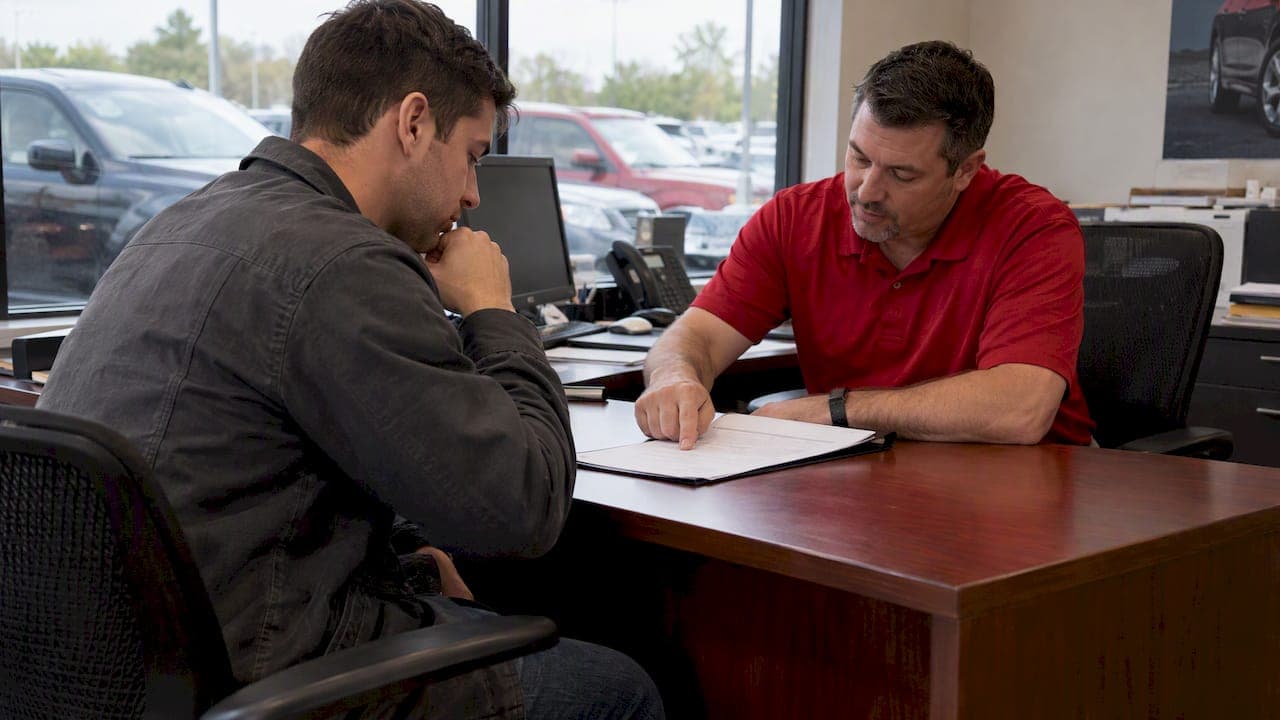
Yes, you can use your vehicle trade-in as a down payment, as long as the trade-in produces positive equity. If your loan payoff is higher than what the car is worth, you have negative equity, and dealers may roll that shortfall into your new loan or ask for cash instead. Always get the payoff amount and trade credit confirmed in writing before you sign anything.
TL;DR:
- Request a written payoff quote valid through your purchase date because accrued interest and fees can change the balance; compare several trade value estimates.
- Lock in the replacement vehicle’s out the door price before appraisal, then document the trade credit, payoff, amount financed, APR, and total payments in the contract.
- If you have negative equity, pay the shortfall in cash, wait while reducing the balance, or roll it into a new loan, increasing interest and the amount financed.
- Trade in credits may reduce taxable price in many states, but registration fees usually depend on the new vehicle’s value, weight, or type.
Table of Contents
- How dealers apply trade-in value to your purchase
- Steps to calculate your trade-in equity
- If you owe more than your car is worth
- How a trade-in changes your loan and monthly payment
- Negotiate price first, then handle the trade separately
- Fees and costs that can come with a trade-in
- How a trade-in affects your taxes and registration fees
- What a low-pressure trade-in process should look like
- Ready for a trade appraisal or financing help?
- FAQ
- Sources
- Authoritative resources for verifying your trade-in
How dealers apply trade-in value to your purchase
When you bring a car in for trade, the dealer appraises it and offers a trade allowance. That number gets applied as a credit against the price of the vehicle you're buying. If you own your car free and clear, or if its value is higher than what you owe, the leftover amount becomes your down payment credit on the new deal.
The picture changes when you still owe money on the trade. Here's how that typically plays out:
- If the trade value covers your payoff, the remaining amount reduces your down payment or purchase price.
- If you owe more than the car is worth, the dealer may roll the difference into your new loan.
- Some dealers deduct the shortfall from your down payment instead, which raises the cash you need upfront.
- A few dealers will ask you to pay the negative equity in cash before the deal moves forward.
Knowing which of these applies to your situation before you walk into a dealership keeps you from being surprised at the finance desk.
Steps to calculate your trade-in equity
Before you count on your trade-in to cover a down payment, do the math yourself. Start with an accurate payoff quote, not just your last statement balance, since payoff figures often include accrued interest and fees that change by the day, a point the CFPB stresses when discussing trade-ins on financed vehicles.
- Call or log into your lender's account to request a written payoff quote good through a specific date.
- Get trade-in value estimates from more than one source, such as Kelley Blue Book, Edmunds, or NADA Guides, since figures can vary between them.
- Ask the dealer for the out-the-door price on your replacement vehicle before the trade appraisal happens.
- Subtract your payoff from the trade-in offer: a positive number is your equity, a negative number is your shortfall.
- Gather your documents: title if you own the car outright, registration, loan payoff details, both sets of keys, and ID.
Pro Tip: Request your payoff quote the same week you plan to buy, since interest accrues daily and an outdated number can throw off your equity math.
If you owe more than your car is worth
Negative equity simply means your loan balance is higher than your car's trade value. The FTC warns that dealers sometimes roll that shortfall into your new loan, and other times deduct it directly from your down payment, so you need to read the contract closely to see which applies to your deal.
You generally have three paths forward:
- Pay the shortfall in cash upfront, which keeps your new loan amount lower but requires funds on hand.
- Roll the negative equity into your new loan, which spreads the cost but increases what you finance and the interest you pay.
- Hold onto the car a while longer, keep paying it down, or sell it privately to see if you can close the gap before trading.
Rolling negative equity into a new loan is a documented practice that leaves a nontrivial share of borrowers further underwater on their next vehicle, according to CFPB research on auto lending. If your shortfall is large, waiting a few months to pay down the balance can save you real money over the life of a new loan. For more on confirming exactly how a dealer plans to handle your payoff, see our guide on confirming payoff in writing before trading in with negative equity.
How a trade-in changes your loan and monthly payment
A trade-in with positive equity lowers the amount you finance right away, which usually means a smaller monthly payment or a shorter loan term. Negative equity works the opposite direction: when it's rolled into the new loan, your amount financed goes up before interest is even calculated.

Say you're financing a $25,000 car and roll in $3,000 of negative equity from your trade. You're now borrowing $28,000 instead of $25,000, and every month of your loan term carries interest on that extra amount, not just the car's price.
A few other financing effects to keep in mind:
- Many states calculate sales tax on the price after the trade-in credit is applied, which can lower your taxable amount, but rules vary by state so check your local requirements.
- An independent loan preapproval gives you a true baseline rate to compare against whatever the dealer offers, which helps you spot a marked-up rate before you sign.
- Extending your loan term to shrink the monthly payment usually means paying more interest overall, especially when negative equity is part of the balance.
Our guide to car loan preapproval walks through how to line up financing before you ever discuss a trade.
Negotiate price first, then handle the trade separately
The order of operations matters more than most buyers realize. Negotiate and lock in the out-the-door price on your new vehicle before you let a salesperson appraise your trade. Mixing the two numbers together makes it easy for the math to get blurry in your favor on paper and against you in the final contract.
- Agree on the full purchase price in writing, including fees, before mentioning your trade.
- Present your trade-in for appraisal as a separate step once the price is locked.
- Ask directly how the payoff will be handled and who is responsible for contacting your current lender.
- Confirm exactly where the trade credit will appear on the contract and in what amount.
- Compare the trade credit, payoff amount, amount financed, APR, and total payments against what you were told verbally.
Pro Tip: If a salesperson says "we'll take care of the payoff" without naming a dollar amount, ask for that figure in writing before moving forward.
Watch for mismatched numbers between the sales desk and the finance office. Our step-by-step guide to negotiating a trade-in offer covers the exact language to use when a dealer won't commit to specifics.
Fees and costs that can come with a trade-in
Trading in a car usually isn't free of cost even when it feels simple on the surface. If your vehicle has existing damage, such as a cracked windshield or worn tires, that condition typically lowers your appraisal offer, sometimes by more than the repair would have cost. A company like Auto Glass Kings notes that windshield repair is often far cheaper than replacement, so addressing small damage before appraisal can protect your trade value rather than losing it to a lower offer.

Some lenders charge an early payoff fee or require a specific payoff process that takes a few extra days to complete, which can delay when your trade credit actually applies. If you're trading in a truck or larger vehicle with aftermarket parts, keep in mind that modifications don't always add value dollar for dollar, and some dealers appraise modified trucks more conservatively.
There's also the cost of time: getting multiple trade-in estimates and a current payoff quote takes a little legwork, but skipping that step is the more expensive mistake. A rushed trade based on a single estimate or an outdated payoff figure can leave hundreds of dollars on the table, or worse, saddle you with unexpected negative equity rolled into your new loan.
How a trade-in affects your taxes and registration fees
In many states, the taxable price of your new vehicle is reduced by your trade-in credit, meaning you pay sales tax on the difference rather than the full purchase price. If you're trading in a car worth $8,000 toward a $20,000 purchase, you may only owe tax on $12,000, depending on your state's rules.
Not every state offers this trade-in tax credit, and the ones that do often set their own limits or exceptions, so it's worth confirming the specific treatment where you live before assuming a lower tax bill. Registration fees are typically separate from the trade-in transaction itself and are based on your new vehicle's value, weight, or type rather than anything tied to your trade.
Keep your bill of sale and trade-in paperwork on hand when you register your new car, since some state motor vehicle offices ask for proof of the trade-in credit applied at the dealership to calculate your final tax bill correctly.
What a low-pressure trade-in process should look like
A trade-in shouldn't feel like a guessing game, and it doesn't need to. We aim to provide commission-free sales conversations and thorough vehicle inspections, so the numbers you hear reflect the car in front of you, not a sales quota. Used cars are inspected carefully before they reach the lot, and that same standard applies to how trades are evaluated.
Payoff handling and trade credit are documented in writing as part of a tailored financing process, which includes options for buyers across a range of credit histories. Our advice to every customer is simple: confirm your payoff amount before you arrive, and keep your price negotiation separate from your trade appraisal.
— Elmwood
Ready for a trade appraisal or financing help?
If you're weighing a trade-in against a straight down payment, we make the process straightforward from the first conversation. Trade-in appraisals are backed by inspections rather than guesswork, along with financing options built for a range of credit situations, including buy-here-pay-here solutions when traditional lending isn't a fit.
Getting started takes a few simple steps:
- Request a trade-in appraisal online and bring your current payoff information.
- Apply for financing ahead of time to know your rate before you shop.
- Browse our current inventory to find a vehicle that fits your budget and your trade.
Trade credit and payoff handling are put in writing before signing, helping to avoid surprises at the finance desk. Visit us in Providence to see how a low-pressure trade-in should feel.
FAQ
What is the $3,000 rule for cars?
This isn't an official rule from any regulator or lender, it's informal buyer advice suggesting you avoid rolling more than about $3,000 of negative equity into a new loan. The idea is to limit how much extra interest and risk you take on, though the right threshold depends on your budget and loan term.
Is it better to trade in or make a cash down payment?
It depends on your trade-in's equity position: a car worth more than you owe works like cash toward your purchase, while a car worth less than you owe adds cost if rolled into the new loan. If your trade has negative equity, paying it off separately with cash often costs less over time than financing it.
Is it worth putting $10,000 down on a car?
A larger down payment, whether from cash or trade-in equity, lowers your amount financed and can reduce your monthly payment and total interest paid. The right amount depends on the vehicle price, your loan term, and what you can comfortably afford to put down.
Can you trade in a car with no down payment?
Yes, a trade-in can function as your entire down payment if its equity covers the amount the dealer requires, meaning you wouldn't need to bring additional cash. If the trade has little or negative equity, though, you may still need a separate down payment or acceptance of a higher loan amount.
Sources
- Auto trade-ins and negative equity: When you owe more than your car is worth | FTC
- Should I trade in my car if it’s not paid off? | CFPB
- Negative equity in auto lending report | CFPB
Authoritative resources for verifying your trade-in
For a deeper look at how payoff and negative equity work, the CFPB's guidance on trading in a financed car and the FTC's consumer advice on negative equity are solid starting points. For trade-in value estimates, check Kelley Blue Book, Edmunds, and NADA Guides before accepting any dealer offer.