
Most lenders ask for the same seven things: proof of identity, proof of income, proof of residence, proof of insurance, your Social Security number for a credit check, vehicle information, and paperwork for your down payment or trade-in. Getting preapproved usually requires far less. You can often skip the vehicle-specific paperwork entirely until you're ready to sign at funding.
TL;DR:
- Most lenders require proof of identity, income, residence, insurance, vehicle details, and down payment or trade-in paperwork, though preapproval reduces document needs.
- Self-employed borrowers need at least one to two years of tax returns, and recent pay stubs suffice for salaried applicants, with bank statements supporting income.
- Preapproval typically only requires proof of identity, income, and Social Security number, while final funding needs vehicle title, registration, and insurance proof.
- Organizing documents into clear, full-page scans in PDF or JPEG formats speeds processing and reduces delays during application.
- Verifying your details against your credit report and fixing mismatched info can prevent holdups, as most issues are rectifiable within a day or two.
Table of Contents
- What Documents Do You Need for a Car Loan? A Full Checklist
- Preapproval vs. Final Funding: What You Need Now vs. Later
- How to Organize and Submit Your Documents Without Delays
- What Lenders Actually Check (and What Trips People Up)
- How Elmwood Handles Paperwork for Buyers
- Why Most Auto Loan Advice Gets the Order Wrong
- Ready to Apply? Here's How Elmwood Makes It Easy
- Where to Verify These Rules Yourself
- Sources
- FAQ
What Documents Do You Need for a Car Loan? A Full Checklist
Every lender phrases its requirements a little differently, but the categories rarely change. Here's what actually satisfies each one, including the edge cases that trip people up.
Proof of identity. A valid driver's license is the standard here, but a state ID or passport works too. If you've changed your name since your last credit application (marriage, divorce, legal name change), bring the court document or marriage certificate. A mismatch between the name on your ID and the name on your pay stub is one of the fastest ways to stall an application.
Proof of income. For salaried workers, two or three recent pay stubs and a W-2 usually cover it. Self-employed borrowers face a higher bar: expect to hand over one to two years of tax returns, 1099s, or profit-and-loss statements, since lenders can't verify freelance income the same way they verify a paycheck. Bank statements showing consistent deposits help fill gaps when your income comes from multiple sources.
Proof of residence. Lenders want something dated recently, typically within a 60 to 90 day window, that clearly shows your name and current address. A utility bill, a signed lease, a mortgage statement, or even a bank or credit card statement all qualify. If you moved recently and don't have a bill in your name yet, a signed lease agreement is your best bet.
Proof of insurance. This is where a lot of buyers overthink it. You don't need a finalized, fully issued policy to close a deal. An insurance binder or a coverage card from your provider is typically enough to satisfy the lender at funding, and you can read more about what counts as proof of insurance before your appointment. Most lenders require liability coverage at minimum, with collision and comprehensive often mandated if the vehicle is financed rather than paid for outright.
Vehicle information. This includes the VIN, the purchase agreement, current registration, and an odometer reading. If you're buying from a private party or trading in a vehicle you still owe money on, you'll also need the title and a lien payoff statement from your current lender.
Down payment and trade-in documentation. A cashier's check or bank statement showing available funds covers the down payment side. For a trade-in, bring the title (or registration if the title is held by a lienholder), current registration, and any payoff information if there's an outstanding loan on the vehicle.
Your Social Security number. Lenders use it to pull your credit report and assess risk. If you don't have an SSN, some lenders accept an ITIN, though your options may narrow, and it's worth calling ahead to confirm.
Special circumstances. Co-signers need their own identity and income documents. Divorced applicants sometimes need a decree showing alimony or child support obligations (or income). New hires without pay stubs yet can often substitute a signed employment offer letter.
According to Bankrate's documentation checklist, these categories, identity, income, residence, insurance, vehicle information, down payment, and title or registration, cover what nearly every lender in the country requests in some form.
Pro Tip: Scan your pay stubs and bank statements as soon as you start shopping, even before you've picked a vehicle. Having a folder ready cuts days off the process once you find the car you want.
Preapproval vs. Final Funding: What You Need Now vs. Later
You don't need your full paperwork stack to start shopping. Preapproval and final funding ask for different things, and knowing the difference saves you from gathering documents you don't need yet.
- For preapproval, lenders typically want proof of identity, proof of income, and your Social Security number for a soft or hard credit check. That's usually the entire list.
- For final funding, once you've picked a specific vehicle, you'll need to add the title (for trade-ins or private-party purchases), registration, VIN, and either an insurance binder or coverage card.
- Between the two stages, most lenders give you a shopping window, often around 30 days, before you need to finalize vehicle details.
Lenders delay vehicle-specific paperwork because they don't yet know what you're buying. A preapproval locks in your rate and budget range without tying you to a specific car, which also strengthens your negotiating position once you're at the dealership. For a deeper breakdown of how this stage works, our guide to auto loan preapproval walks through typical timelines. Requirements vary by lender, so if you're working with a credit union or an online lender rather than a dealership, it's worth a quick call to confirm exactly what they'll want at each stage.
How to Organize and Submit Your Documents Without Delays
A little organization here saves real time later. Lenders and dealers process clean, well-labeled files faster than a pile of blurry phone photos.
- Name your files clearly, something like "Smith_PayStub_March2026.pdf" beats "IMG_4471.jpg" every time a loan processor opens your folder.
- Stick to PDF or JPEG formats, and scan full pages rather than photographing them at an angle. Glare and cropped corners are common reasons uploads get rejected.
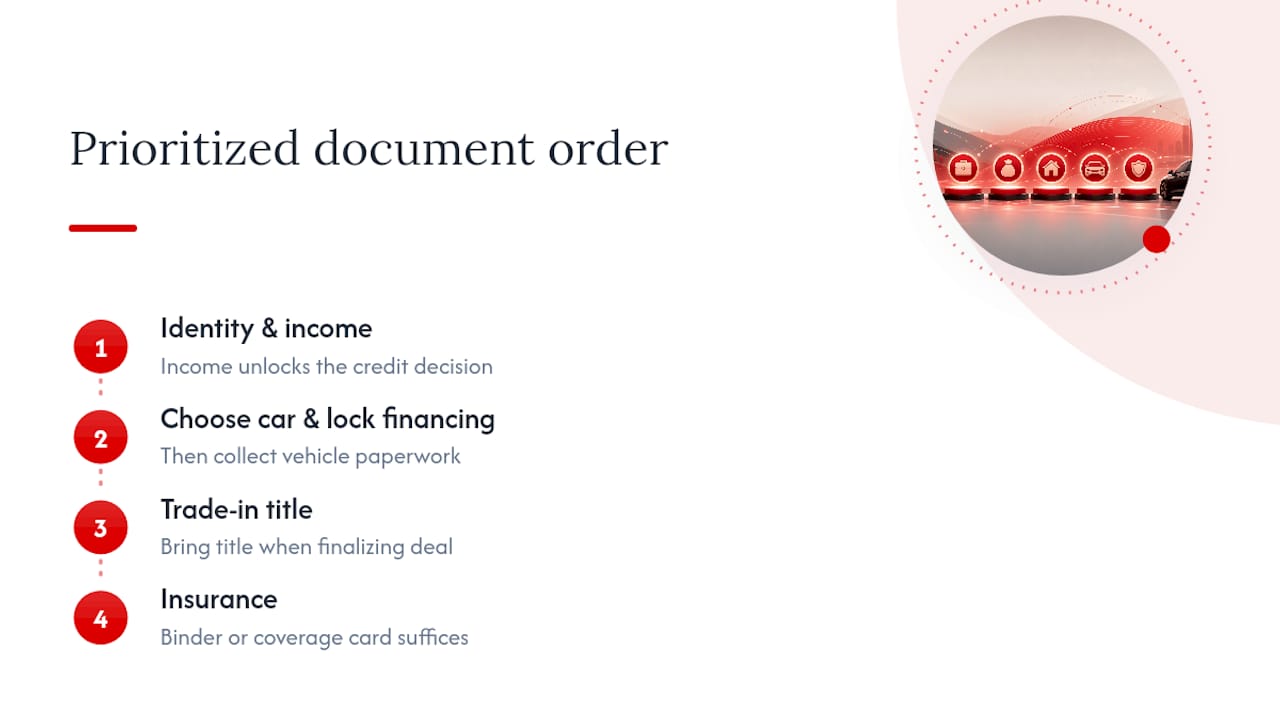
- Upload income and identity documents first since those unlock your credit decision faster. Vehicle paperwork can follow once you've settled on a car.
- If you're applying through an online lender, most now accept digital copies without issue, according to Bankrate, so a phone scanning app is usually enough.
Pro Tip: Never email your Social Security number or bank statements as an unencrypted attachment. Use the lender's secure upload portal or hand documents over in person at the dealership.
What Lenders Actually Check (and What Trips People Up)
Behind every document request is a verification step. Lenders confirm your identity against your credit file, cross-check your income against your stated employer, verify your address matches your credit report, and pull a lien search on any trade-in vehicle to make sure there's no unpaid balance hiding on the title.
Your income documents also feed your debt-to-income ratio, which lenders use to judge how much car payment you can realistically handle alongside your existing debts.
The most common issues that slow down or sink an application:
- A name or address that doesn't match between your ID, pay stub, and credit report.
- Proof of residence that's older than the lender's accepted window, usually 60 to 90 days.
- An undisclosed lien on a trade-in vehicle that surfaces during the title search.
- Self-employed income that lacks enough documentation, such as only one year of tax returns when the lender wants two.
Most of these are fixable. A supplemental bank statement, an employer verification letter, or a payoff statement from your current lienholder usually resolves the holdup within a day or two.
How Elmwood Handles Paperwork for Buyers
Our team isn't rushing you through document collection just to close a deal faster. We walk buyers through exactly what's needed, whether you're financing in-house through our buy here, pay here programs or working with a third-party lender.
Here's what that looks like in practice:
- Start your financing application online before you visit, so we already have your income and identity information on file.
- Bring your driver's license, a recent pay stub or two, and proof of residence to your appointment to keep things moving.
- If you're trading in a vehicle, bring the title or registration and any payoff information for appraisal.
- Document copies are used to submit financing requests to multiple lenders at once, often speeding approval compared to applying to one lender at a time.
For more on what to expect once you're at the dealership, our post on what to expect when buying a used car covers the full process, and our proof of residence guide breaks down acceptable documents in more detail.
Why Most Auto Loan Advice Gets the Order Wrong
Most articles on this topic hand you a flat list of documents and call it done. That misses the part that actually matters: sequencing. Buyers who show up to a dealership with every vehicle document in hand but no income verification often stall harder than buyers who walk in with pay stubs and nothing else, because income is what unlocks the credit decision in the first place.
The conventional advice also overstates how hard proof of insurance is to satisfy. Plenty of buyers delay their purchase for days trying to get a full policy issued when a binder or coverage card would have closed the deal the same afternoon.
If you take one thing from this, prioritize identity and income documents before anything else. Vehicle paperwork, trade-in titles, and insurance details can wait until you've picked a car and locked in financing. Chasing the full stack too early wastes time on documents you might not even need in their final form.
— Elmwood
Ready to Apply? Here's How Elmwood Makes It Easy
The team helps buyers pull together documents and guide them toward suitable financing options, including buy here, pay here programs for buyers with various credit profiles.
If you've already gathered your pay stubs, ID, and proof of residence, apply online now and our team will start matching you with financing options right away. Prefer to talk it through in person? Schedule a visit and bring your checklist with you. Either way, you can browse our current inventory while your application is in review, and if you're trading in a vehicle, our trade-in page walks you through what that process looks like on our end.
Where to Verify These Rules Yourself
- The Consumer Financial Protection Bureau covers borrower protections and general lending guidance.
- Bankrate offers a practical, regularly updated document checklist.
- Progressive explains insurance binders and what insurers provide for funding.
Sources
- Consumer Financial Protection Bureau (CFPB)
- Auto loan documentation checklist | Bankrate
- What Do You Need to Finance a Car? | Progressive
- How do auto loan pre-approvals work | SCCU
FAQ
What documents are needed for a car loan?
Most lenders ask for proof of identity, proof of income, proof of residence, proof of insurance, your Social Security number, and vehicle information. If you're trading in a car or making a down payment, you'll also need related paperwork like a title or bank statement.
What are the 5 documents required for a loan?
Definitions vary slightly by lender, but a common core five includes a driver's license or ID, recent pay stubs or tax returns, a utility bill or lease for residence, proof of insurance, and your Social Security number for the credit check.
What are some examples of loan documents?
Examples include a driver's license, W-2s or 1099s, a signed lease or mortgage statement, an insurance binder or coverage card, and a vehicle title or registration. Self-employed borrowers may also need tax returns or profit-and-loss statements to verify income.
How much would a $30,000 car loan cost a month?
As an illustrative example only, a $30,000 loan at a 7% APR over 60 months would run roughly $594 a month before taxes and fees, though your actual rate and payment depend on your credit profile and the lender's terms. Getting preapproved is the fastest way to see your real number before you shop.