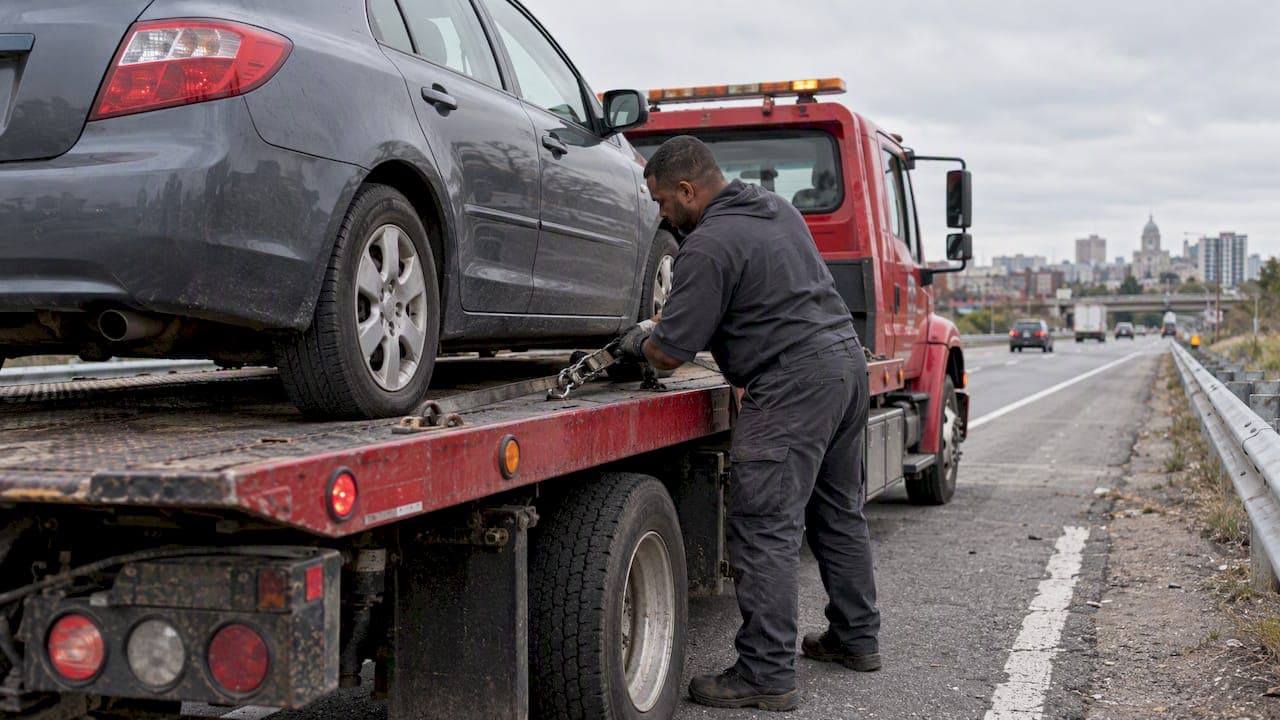
Roadside assistance coverage pays for, or sends help for, the common problems that leave a car stranded: a dead battery, a flat tire, an empty tank, a locked door or a tow. It usually comes with limits on towing distance, labor time and how many calls you can make. It does not pay for the repair itself. Below, we explain what is typically covered, where the gaps are, what it costs and how to choose, with a focus on people buying a used vehicle.
TL;DR
- Roadside assistance typically covers towing, jump-starts, fuel delivery, tire changes, lockout help and winching, not repairs, parts or fuel.
- Insurance versions generally follow the car, while auto club memberships follow the member, including in a rental or a friend's vehicle.
- Cost ranges from about $5 to more than $100 a year, and some plans are free perks.
- A windshield protection plan is a separate product that usually repairs chips and small cracks. It rarely pays for a full replacement.
Table of Contents
- What does roadside assistance coverage include?
- What is not covered by roadside assistance?
- Where does roadside assistance come from?
- How much does roadside assistance cost?
- How is roadside assistance different from towing coverage?
- Will using roadside assistance raise your insurance rates?
- What does a windshield protection plan cover?
- Do you need roadside assistance on a used car?
- Our perspective: coverage is only half of the plan
- How can Elmwood help you buy with confidence?
- FAQ
- Sources
What does roadside assistance coverage include?
Most plans share a core list of services. GEICO describes its emergency roadside service as covering towing, battery jump-starts, fuel delivery, tire changes, lockout services and winching. Amica notes that towing is often just one component, alongside jump-starts, lockout help, fuel delivery and flat-tire service.

Here is what each service usually means in practice.
Towing. If the car cannot be driven, a truck takes it to a repair shop. How far it goes depends on the plan.
Jump-start. A technician connects a booster to get a dead battery running. If the battery is truly finished, you still pay for a new one.
Flat-tire change. The technician puts on your spare. Having a usable spare matters, because the service does not supply a tire.
Fuel delivery. Someone brings enough fuel to reach a station. The plan sends the fuel, but the fuel itself is generally your cost.
Lockout service. Help getting into the car when the keys are inside.
Winching. Pulling a car out of a ditch, mud or snowbank when it is stuck but not otherwise damaged. Plans differ on whether this is included and how much time it allows.
Think of roadside assistance as designed for minor breakdown events. Amica's explanation distinguishes it from collision and other coverages, which respond to specified covered losses such as crash damage.
What is not covered by roadside assistance?
The exclusions are where buyers get surprised. Read the benefit guide before you need it. Common limits include:
- Towing beyond the mileage limit. GEICO says its service does not cover towing past the applicable mileage limit, repair costs, replacement parts, fuel purchases or extensive on-scene labor.
- Labor time and distance. State Farm lists labor beyond the first hour and towing past the nearest repair facility as examples of emergency road service limits.
- Certain causes of breakdown. One membership benefit guide states that for mechanical disablement from improper maintenance, fire, flood or other natural disasters, provider fees and other service costs are at the member's expense. Terms differ by plan, so check yours.
- The repair bill. No roadside plan pays to fix the underlying problem. For that, you need a warranty or service contract, which we cover below.
If a plan has a cap on the number of calls per year, it is usually in the same document. Look for it before you rely on the plan for an older car that may need help often.
Where does roadside assistance come from?
You can get it from several places, and the differences matter more than the list of services. NerdWallet explains that it may be offered through insurance policies, auto clubs and manufacturers. Insurance coverage typically follows the vehicle, while membership organizations cover the member and may add travel assistance and discounts.
| Source | Who is covered | Typical strengths | Typical limits |
|---|---|---|---|
| Auto insurance add-on | The insured vehicle | Low cost, one bill, simple to add | Towing distance caps, may tow to the nearest approved shop |
| Auto club membership | The member, in any car | Works in rentals and other people's cars, extra perks | Annual fee, tiers with different mileage allowances |
| Manufacturer program | The specific vehicle, often for a set period | Often free with a new or certified vehicle | Ends after a set term, tied to one brand |
| Credit card or other perk | The cardholder, with conditions | No added cost | Often pays for service rather than dispatching it, narrow terms |
On the club side, one major club's comparison says some insurance plans limit towing distance or require towing to the nearest approved repair facility, while members can choose a destination within their membership's mileage allowance. That is the club's own view, so weigh it against the actual terms of the insurance policy you hold. Motor club programs also commonly come in tiered memberships, with benefits and cost varying by level.
Some insurers add trip interruption coverage. For example, one private-client auto program pays up to $100 a day and $500 total for meals, lodging and commercial transportation after a breakdown more than 100 miles from home. That is a specific program, not a standard feature, so ask whether yours offers anything similar.
How much does roadside assistance cost?
Less than most people expect. NerdWallet reports a range from $5 to more than $100 a year, and some providers include it as a free perk. An insurance add-on sits at the low end. A club membership with long towing allowances and multiple-driver coverage sits at the high end.
When you compare prices, put the number beside three things:
- Towing miles included. A cheap plan with a short tow limit can leave you paying the difference on a highway breakdown.
- Calls per year. Some plans cap the number of service calls.
- Who is covered. If your household shares cars or you drive rentals, a plan tied to one vehicle leaves gaps.
Prices change, so confirm the current figure on the provider's own page or with your insurance agent.
How is roadside assistance different from towing coverage?
Towing is one part of roadside assistance, not the whole thing. Amica explains that a collision tow may fall under collision coverage, while a breakdown tow generally requires roadside assistance for it to be paid. So the cause of the tow decides which coverage responds.
That has a practical consequence. If you have collision coverage but no roadside add-on, an engine that quits on the highway may leave you paying for the tow yourself.
Destination matters too. State Farm says emergency road service covers a tow to the nearest repair location when the vehicle is not drivable, but generally not the extra cost if you prefer a different mechanic farther away. If you have a trusted shop in Providence, ask before you buy whether the plan will tow there, and how many miles it allows.
A word on a different kind of towing: if you plan to pull a trailer or boat, that is about your vehicle's rating, not your coverage. Our guide to towing capacity math walks through it.
Will using roadside assistance raise your insurance rates?
Possibly, but rarely from a single call. According to Insurance.com, one or two roadside claims in a year are unlikely to raise rates, but several in a short period could raise rates or lead to nonrenewal. The same source says roadside assistance from a club has no effect on car insurance.
So if your car needs frequent help, the call history is a signal worth acting on. A vehicle that strands you repeatedly needs a diagnosis, not another jump-start.
What does a windshield protection plan cover?
Windshield coverage is a separate question from roadside help, and the two get mixed up. A windshield protection plan is typically a repair benefit for glass damage from road debris. It is not a breakdown service.
One published benefit guide gives a clear example of the terms. It covers repair of stars, chips and cracks under six inches long caused by road hazards or debris, as long as they sit outside the driver's direct line of sight and can be repaired with standard methods. The same agreement does not pay for a replacement windshield, but reimburses $100 if the member buys one because the glass cannot be repaired under the agreement.
That is one agreement, and others differ. Three questions sort out most plans:
- Does it cover repair only, or replacement too?
- Is there a deductible, and is it waived for repairs?
- Does damage in the driver's line of sight count?
If you want windshield repair coverage under your car insurance instead, it usually sits under comprehensive coverage, so ask your agent whether glass has its own deductible.
Windshield and road-hazard protection also overlaps with what a warranty covers and does not. Our partner-style explainer on how auto warranties interact with repairs helps you see where a repair claim ends and another plan has to step in. For the details on what warranties include, see our guide to used car warranty types.
Do you need roadside assistance on a used car?
Often yes, and more so the older the vehicle. A used car may be out of its factory coverage, so a manufacturer roadside program may have ended or never applied. An insurance add-on or a club membership fills that gap at a modest annual cost.
Before choosing, run through this checklist:
- Check what is already included. Ask whether any remaining factory or dealer coverage includes roadside help.
- Check your insurance policy. Look for an emergency road service line on your declarations page.
- Match the plan to your driving. Long highway commutes and family road trips call for longer towing allowances. Short city trips may need less.
- Match it to the car. An SUV with all-wheel drive has more tires and parts to maintain, which our AWD maintenance guide covers.
- Plan for the repair. Roadside help gets you off the shoulder. A warranty or service contract is what pays for the fix. We compare them in our guide to vehicle service contracts and explain the exclusions in our bumper to bumper warranty piece.
If you are weighing whether a repair plan is worth it, this breakdown of extended warranty decisions shows how buyers think about a repair bill that could reach $3,000. For the options a dealership can sell, see dealership warranty options. If you are heading out on a long trip, our family road trip checklist covers the pre-trip checks that prevent many breakdowns in the first place.
Our perspective: coverage is only half of the plan
We sell used vehicles in Providence, and we see the same pattern from buyers. They put a lot of energy into the monthly payment and very little into what happens on the day the car will not start. Both matter.
We do not work on commission, so nobody here earns more by steering you toward a particular car or add-on. That lets us say plainly what we think. First, a thorough inspection before the sale does more to prevent roadside calls than any plan afterward. A car with a weak battery, worn tires or a leaking hose is the one that strands you, and those are the things an inspection is meant to find. Second, roadside assistance is cheap insurance against a bad day, but it is not protection against a bad repair bill. Treat the two as separate decisions. Third, read the towing terms. A plan that tows only to the nearest shop may be fine in a city and frustrating on a rural road.
If you are a first-time buyer, ask any seller, us included, to explain what the vehicle comes with and what it does not. A clear answer is a good sign.
— Elmwood
How can Elmwood help you buy with confidence?
If you are shopping for a reliable used car, SUV or truck in the Providence area, start with our inspected used inventory. We inspect our vehicles and offer warranty and extended warranty products, so you can talk through coverage with a salesperson who is not paid on commission.
If you are not sure which vehicle fits your budget, our Car Finder can help you narrow it down. For payments, we offer in-house and third-party options for a range of credit profiles, and you can start on our used car financing application. Have a car to move on? See our trade-in page.
FAQ
What does roadside assistance cover?
Most plans cover towing, jump-starts, tire changes, fuel delivery, lockouts and sometimes winching. They generally do not pay for repairs, replacement parts or the fuel itself. Towing distance and labor time are limited, so read your plan's terms.
Is roadside assistance worth it?
For many drivers it is, because the cost can be as low as $5 a year for an insurance add-on, while a single tow can cost much more. It is most useful on older vehicles or if you drive long distances. If your insurer or card already includes it, you may not need a second plan.
What is the difference between roadside assistance and towing?
Towing is one service within roadside assistance. A plan with only towing will not jump a battery or change a tire. A tow after a crash may be handled under collision coverage instead.
Does a windshield protection plan replace my windshield?
Usually not. Many plans repair small chips and cracks, and some reimburse a fixed amount toward a replacement. Check whether your plan states a repair size limit and what it does with damage in your line of sight.
Sources
- GEICO: 24/7 Roadside Assistance
- Amica: What Is Roadside Assistance?
- State Farm: What is Emergency Road Service Insurance?
- NerdWallet: Roadside Assistance: Do You Need It?
- AAA Club Alliance: Roadside Assistance vs. Coverage Through Auto Insurance
- NHSA: Should I Join a Roadside Assistance Program
- Insurance.com: Does using roadside assistance increase your premium?
- RV Complete benefit guide
- How Auto Warranties Interact with Repairs: 2026 Guide