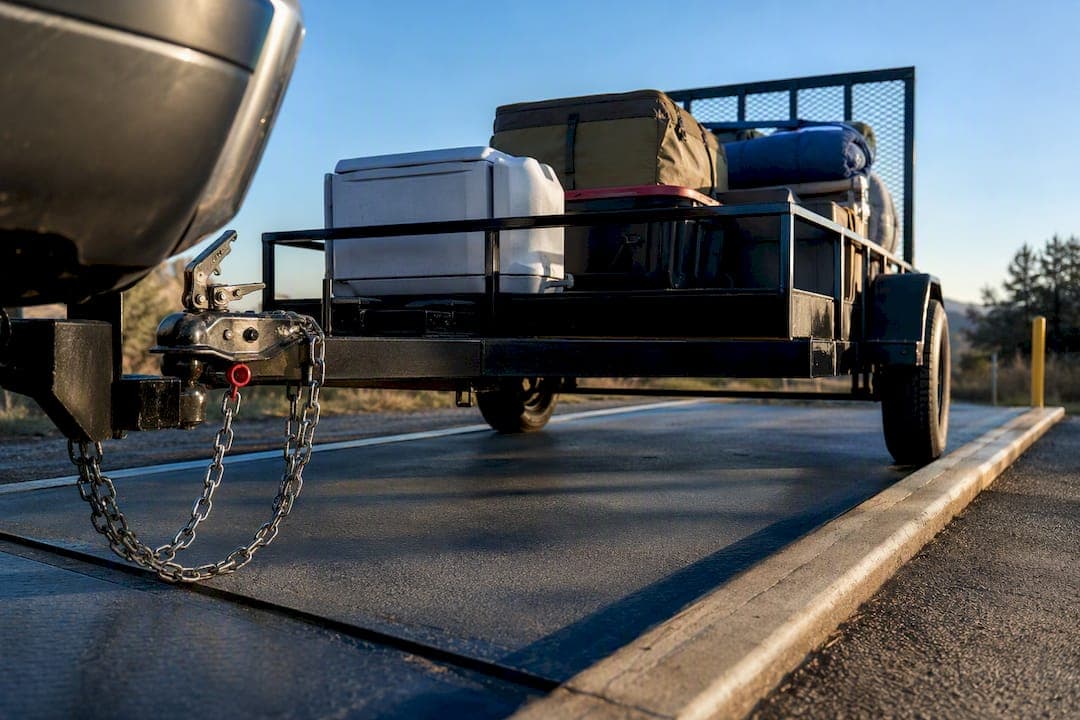
Towing capacity is the maximum weight a vehicle is engineered to pull, including the trailer plus everything loaded on it. It's a manufacturer rating tied to a specific configuration, so the number quoted in an ad rarely matches your exact trim and VIN. Always calculate with the loaded trailer weight, not the empty one, and leave room below the ceiling rather than towing right up to it.
TL;DR:
- Towing capacity reflects the maximum weight a vehicle can safely pull, including the trailer and all loaded items, not just the trailer's dry weight.
- The rated maximum tow number depends on proper vehicle configuration, such as trim level, tow package, axle ratio, and drivetrain, which vary widely across models.
- The actual limit is usually determined by the lowest of five interacting numbers: GVWR, GCWR, payload, tongue weight, and the tow rating itself.
- Using loaded trailer weight, ensuring correct hitch class, and accounting for tongue weight and payload are essential to avoid overloads during towing.
- Real-world conditions like hills, heat, and headwinds can reduce towing comfort and safety margins, so leaving 10 to 20 percent buffer below rated capacity is recommended.
Table of Contents
- What Towing Capacity Explained Actually Measures
- GVWR, GCWR, Curb Weight, Payload, and Tongue Weight
- How Manufacturers Set Tow Ratings
- Calculating Your Available Tow and Tongue Weight
- Hitches, Brake Controllers, and Setup Mistakes
- EVs, Grades, Heat, and Other Real-World Limits
- Where to Verify Your Vehicle's Real Numbers
- Your Pre-Tow Checklist and the Mistakes That Cause Accidents
- An Auto Dealer's View on Tow-Ready Used Vehicles
- Standards and Tools Worth Bookmarking
- Sources
What Towing Capacity Explained Actually Measures
The number on a spec sheet is not the weight of an empty trailer. It's the gross weight the manufacturer certifies a properly equipped vehicle can safely pull, which means the trailer's frame plus everything riding inside or on it: cargo, fresh water, propane tanks, batteries, and gear. Skip that math and you'll almost always land under the real number by a wide margin. Towing capacity includes the trailer plus everything loaded on it, and published ratings assume the vehicle is set up correctly for the job.
That "properly equipped" phrase carries a lot of weight, literally. A base trim without a tow package might carry a significantly lower rating than the same model with one. This is where most confusion starts, because shoppers see a headline number in a brochure and assume it applies to any version of that truck or SUV.
A few misunderstandings show up constantly:
- Using a trailer's dry weight instead of its loaded weight, which can understate the real number by 1,000 pounds or more once you add water, gear, and a full propane tank.
- Confusing towing capacity with payload, which is a completely different rating that covers what rides inside the vehicle itself, not what it pulls behind.
- Assuming the highest advertised tow number applies across an entire model lineup instead of one specific trim, engine, and drivetrain combination.
- Ignoring tongue weight, the portion of the trailer's weight that presses down on the hitch and eats into the tow vehicle's payload.
Get those four points straight and you're already ahead of most people shopping for a tow-capable vehicle.
GVWR, GCWR, Curb Weight, Payload, and Tongue Weight
Five numbers govern every towing decision, and they interact in ways that trip people up constantly. Learn what each one means and you'll know exactly which one is going to be your limiting factor before you ever hook up a trailer.
GVWR (Gross Vehicle Weight Rating) is the maximum your vehicle can weigh once loaded, including passengers, cargo, and fluids. You'll find it on the door-jamb sticker on the driver's side, usually paired with the front and rear axle weight ratings.
GCWR (Gross Combined Weight Rating) is the maximum combined weight of the tow vehicle and trailer together, fully loaded. This is often the number that actually limits you, not the advertised max tow figure, because GCWR accounts for everything on both sides of the hitch at once.
Curb weight is what the vehicle weighs empty, with no passengers, cargo, or trailer attached. It's your starting point for the payload math.
Payload is GVWR minus curb weight. It represents everything the vehicle itself can carry: people, cargo, and tongue weight from a trailer.
Tongue weight is the portion of the trailer's total weight that transfers down onto the hitch, and it counts against payload, not against the towing number directly.
Here's how those numbers typically play out in real scenarios:
- A half-ton pickup with a high max tow rating but a modest payload often runs out of payload room before it runs out of towing capacity, especially once passengers and gear are loaded in the cab.
- A heavy-duty truck with a strong GCWR can usually handle both a big trailer and a full payload without conflict.
- An SUV rated to tow a boat or camper frequently has less payload headroom than buyers expect, because the towing number gets marketed hard while payload gets buried in the spec sheet.
Understanding towing capacity means understanding that it's rarely one number holding you back. It's whichever of these five runs out first.
How Manufacturers Set Tow Ratings
Automakers didn't always test towing the same way, which used to make cross-brand comparisons close to meaningless. That changed when most manufacturers adopted the SAE J2807 standard around model year 2013, a testing protocol that standardizes acceleration, braking, and grade performance requirements for tow ratings. A truck tested under J2807 has actually proven it can pull its rated weight up a specified grade, brake it to a stop, and handle it at speed, not just survive a spec-sheet calculation.
Configuration still changes everything. A tow package typically bundles a larger radiator, a dedicated transmission cooler, a heavier-duty alternator, and integrated trailer wiring. Those upgrades address what tends to fail first when a vehicle is pushed near its limit: the cooling and braking systems, not the engine. That's why axle ratio and drivetrain also matter. A shorter, more aggressive axle ratio improves low-speed pulling power at some cost to fuel economy and top-speed cruising, and it can raise the tow rating on an otherwise identical trim.
The result is one model year producing half a dozen different tow numbers depending on cab size, bed length, engine choice, and options. Kelley Blue Book's guidance on this is direct: check your specific configuration, not the number in the headline ad.
Calculating Your Available Tow and Tongue Weight
Here's the math that actually tells you whether a vehicle and trailer combination works, step by step.
- Find your Max Tow rating. This comes from the OEM towing guide or supplement for your exact VIN, not a general brochure number.
- Weigh or estimate your loaded trailer GVW. Add cargo, fluids, batteries, and gear to the trailer's dry weight to get a realistic total.
- Calculate Available Tow. Subtract your loaded trailer weight from Max Tow. A positive number with room to spare means you're within range.
- Calculate tongue weight. Multiply loaded trailer GVW by the typical percentage for that trailer type. Travel trailers and utility trailers usually run 10 to 15%, boat trailers often sit lower at 5 to 10%, and fifth wheel or gooseneck pin weights run higher, from 15 to 25%.
- Calculate Available Payload. Subtract curb weight, passengers, cargo, and tongue weight from GVWR. What's left has to be zero or positive.
- Apply the 80% guideline. Compare your loaded trailer weight to 80% of Max Tow as a practical safety cushion rather than towing right at the rated ceiling.
Pro Tip: Weight-distribution hitches redistribute tongue load across both axles and improve handling, but they don't add a single pound to your GVWR or payload rating. Don't let a hitch upgrade talk you into exceeding your numbers.
Here's a worked example. Say your truck has a Max Tow rating of 9,000 pounds and a GVWR of 7,000 pounds with a curb weight of 5,200 pounds, giving you 1,800 pounds of payload. Your loaded travel trailer weighs 6,500 pounds.
Available Tow: 9,000 minus 6,500 equals 2,500 pounds of margin. That passes comfortably.
Tongue weight at 12% of 6,500 pounds equals 780 pounds. Subtract that from your 1,800 pounds of payload, then subtract two passengers and cargo at roughly 400 pounds, and you're left with 620 pounds of payload headroom. Still positive, but tighter than the towing number alone would suggest.
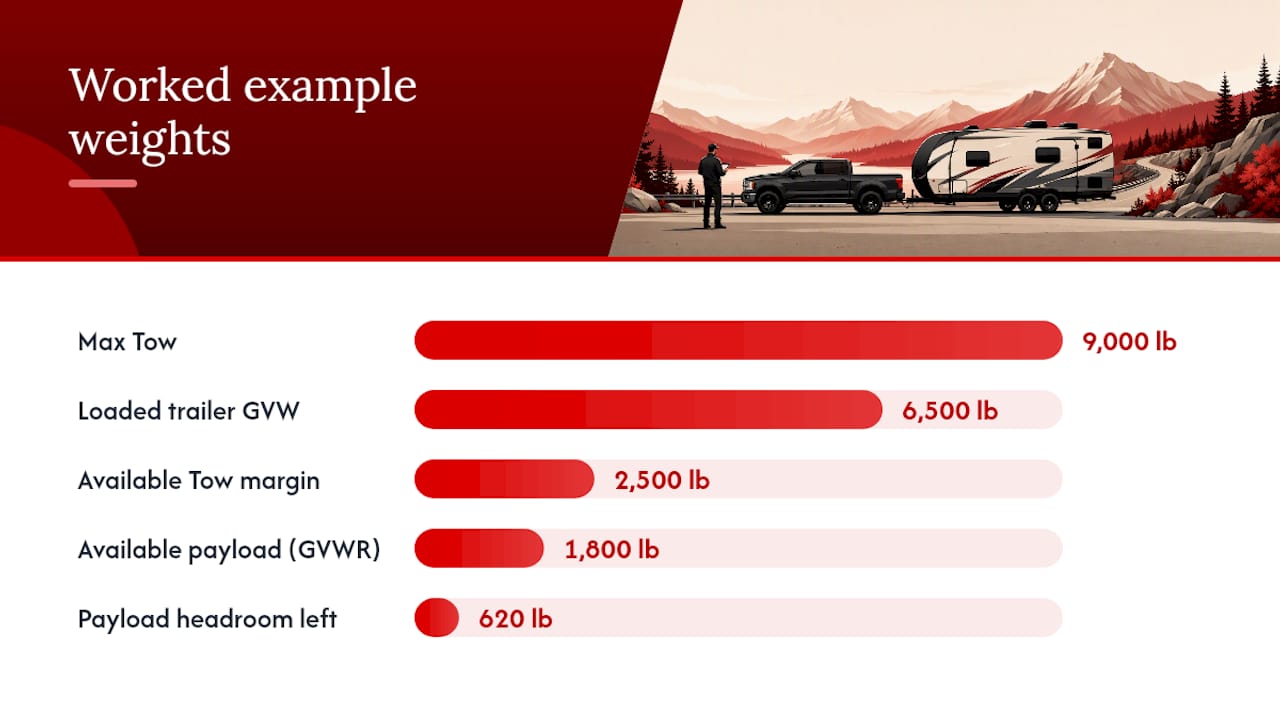
Your 6,500 pound trailer sits comfortably under that threshold, which puts this combination in pass territory rather than caution or fail.
Hitches, Brake Controllers, and Setup Mistakes
Hardware determines whether a rated capacity is actually usable. Hitches are classified by weight rating, from Class 1 units suited to small utility trailers up to Class 5 and gooseneck or fifth-wheel setups rated for the heaviest loads a pickup can carry. Match the hitch class to your trailer's loaded weight, not just to what fits your receiver.
Weight-distribution hitches earn their keep whenever tongue weight starts pulling the rear of the tow vehicle down and lifting the front end. They spread that load across both axles, restoring steering feel and headlight aim, and most manufacturers require them once you're towing a meaningful percentage of your rated max. Sway control, often built into the same hitch, counters the side-to-side motion that heavier trailers can develop at highway speed.
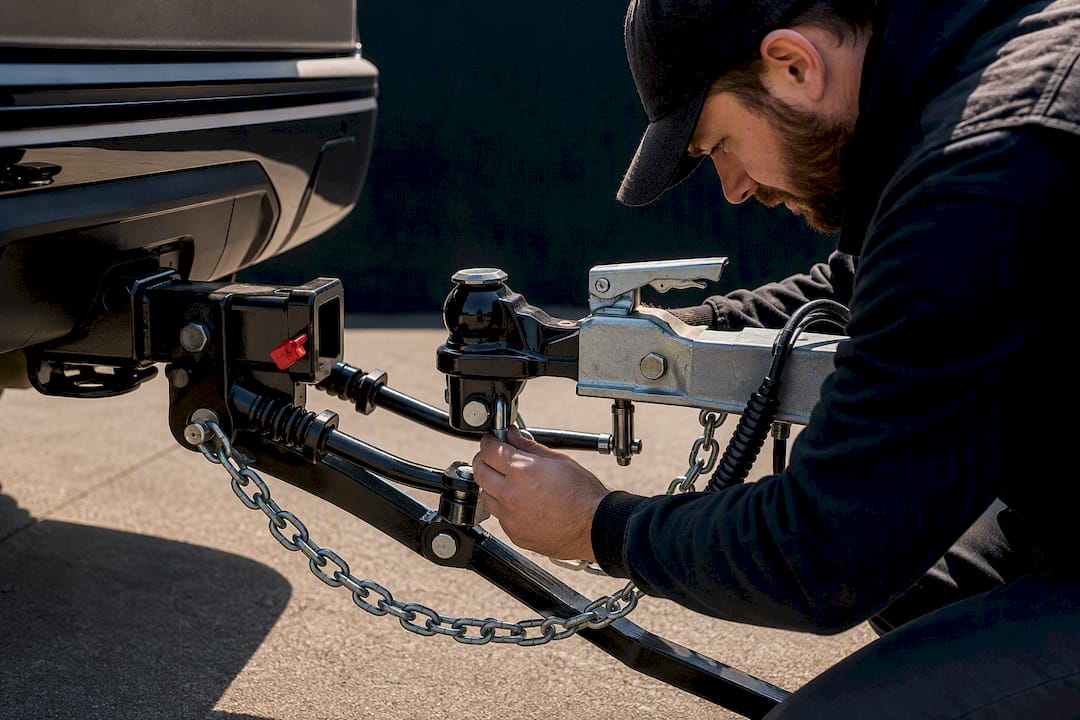
Trailer brakes matter just as much. Most trailers over roughly 3,000 pounds require their own brakes, wired to a brake controller in the tow vehicle that applies proportional stopping power. Skipping this is one of the most common and most dangerous shortcuts in towing.
Common setup mistakes worth avoiding:
- Towing without a brake controller on a trailer heavy enough to require one.
- Using a weight-carrying hitch when the load calls for weight distribution.
- Guessing at tongue weight instead of measuring it with a scale.
- Mismatching hitch ball size to the trailer coupler.
EVs, Grades, Heat, and Other Real-World Limits
A rated number is measured under close to ideal conditions, and real driving rarely offers those. Towing with an electric vehicle cuts into range hard: expect roughly a 40 to 55% reduction depending on trailer weight and aerodynamics, which means route planning around charging stops becomes part of the towing plan, not an afterthought.
Sustained grades tax cooling systems and transmissions well beyond flat-highway driving, and high ambient heat compounds that stress on both the engine and the tow vehicle's brakes. Headwinds add drag that behaves a lot like towing a heavier trailer than the one actually behind you.
None of this changes your rated Max Tow number, but it changes what's comfortable to run every day. Leaving 10 to 20% of margin under your rated capacity for routine towing gives you a buffer for hills, heat, and wind instead of discovering that buffer doesn't exist on a mountain grade in July.
Where to Verify Your Vehicle's Real Numbers
Your owner's manual and the manufacturer's towing supplement are the two most reliable sources for trim-specific numbers, and they're worth pulling before you trust any number from an ad or a sales conversation.
- The door-jamb sticker on the driver's side lists GVWR, front and rear axle weight ratings, and often the tire and loading information tied to your exact build.
- The OEM towing guide breaks ratings down by cab configuration, bed length, engine, and axle ratio, which is the level of detail a general brochure never provides.
- VIN-based lookup tools can decode your exact configuration and run the payload and tongue weight math automatically, producing a pass, caution, or fail result for a specific trailer.
Treat any online calculator as a starting point for verification, not a replacement for the manufacturer's own documentation.
Your Pre-Tow Checklist and the Mistakes That Cause Accidents
Run through this before every trip, not just the first one:
- Confirm your trailer's loaded GVW, not its dry weight, using a scale if you have any doubt.
- Calculate tongue weight and subtract it, along with passengers and cargo, from your GVWR to confirm payload headroom.
- Verify your hitch class matches or exceeds the trailer's loaded weight.
- Check that trailer wiring and brake controller are connected and functioning.
- Test trailer brakes at low speed before merging onto a highway.
- Adjust mirrors for trailer width and set tire pressure to the vehicle's loaded specification.
The mistakes that cause real accidents are almost always the same handful: relying on a trailer's dry weight instead of its loaded weight, ignoring how tongue weight eats into payload, skipping a brake controller on a trailer that needs one, and simply overloading payload with passengers and gear on top of an already heavy tongue weight. Exceeding a rated capacity risks brake failure, transmission overheating, and loss of control, which is why the published number functions as an engineering ceiling rather than a target to aim for.
An Auto Dealer's View on Tow-Ready Used Vehicles
At Elmwoodautosalesri, every truck or SUV that comes through our Providence lot gets checked for the mechanical basics that towing depends on: cooling system condition, brake wear, hitch mounting integrity, and whether factory tow-package components are actually present and documented. If you're shopping for a tow-capable used vehicle, ask the seller whether the factory tow package was installed, what axle ratio the vehicle carries, whether it has a dedicated transmission cooler, and whether they can produce the OEM towing supplement tied to that VIN. We also work through tailored financing options for buyers across a range of credit histories, so a tow-ready truck doesn't have to come with a tow-sized headache on the paperwork side. If you want to see the cooling system, hitch, and wiring in person before you commit, you can book a test drive and walk through it with us directly.
Towing math rewards patience and punishes guesswork. The vehicles that hold up over years of towing are almost never the ones with the biggest number on the window sticker. They're the ones where the owner actually ran the numbers, matched the hitch to the trailer, and left themselves a margin instead of towing right up to the edge of what the truck was rated to handle. That discipline costs nothing and it's the single biggest predictor of whether a tow rig lasts.
— Elmwood
Standards and Tools Worth Bookmarking
For anyone who wants to verify their own numbers, a few resources are worth keeping handy: the SAE J2807 testing standard explains how modern tow ratings are actually tested, Kelley Blue Book's towing guide breaks down configuration differences, and a VIN-based calculator can run your specific payload and tongue weight math. Your owner's manual and OEM towing supplement remain the final word for your exact vehicle.
Sources
- How to Measure Towing Capacity, GVWR, GCWR — CURT
- Towing capacity guide: everything you need to know — Kelley Blue Book
- What is towing capacity? A complete guide — TowingSpecs
- Towing capacity calculator (VIN lookup) — RevRated
- Truck towing standard: SAE J2807 update (2013) — Rving With Mark Polk