
Usually, no. Most drivers pay more in premiums than they ever collect in claims, according to member surveys reported by Consumer Reports. But "usually" isn't "always." Inspection reports often reveal which vehicles carry real mechanical risk, and for those cars, a warranty can make sense. The right answer depends on your car's age, mileage, and how much you have set aside for a bad month.
TL;DR:
- Extended warranties are more beneficial for high-mileage, older vehicles with a history of mechanical issues, especially if repairs could threaten financial stability.
- Factory warranties are free but limited, while third-party service contracts can cost thousands and often contain exclusions and dealer markups affecting value.
- Comparing self-insuring by saving for repairs against the cost of premiums makes sense for reliable models or owners with sufficient savings, but not for high-risk vehicles.
- Reading the contract carefully ensures coverage matches your needs, with special attention to exclusions, repair shop eligibility, and transferability.
- Purchasing an extended warranty before the factory warranty expires can lower costs, but a thorough inspection report helps determine real risk and avoid unnecessary expenses.
Table of Contents
- What Is an Extended Car Warranty, and How Is It Different From Factory Coverage?
- Who Actually Benefits From an Extended Warranty?
- What Does the Math Actually Look Like?
- How Do You Read the Contract and Avoid Red Flags?
- When Is the Best Time to Buy an Extended Warranty?
- Elmwood Auto Sales' Perspective on Dealer-Backed Protection
- Our Take: Stop Debating in the Abstract and Run Your Own Numbers
- Ready to Look at a Specific Car? Let's Talk Numbers
- Sources
- FAQ
What Is an Extended Car Warranty, and How Is It Different From Factory Coverage?
An extended car warranty isn't technically a warranty at all. It's a vehicle service contract, sold by a third-party company, a dealer, or occasionally the automaker, that promises to pay for specific repairs after your factory coverage runs out. Factory warranties come free with a new car purchase. Vehicle service contracts are a separate product you buy, often for thousands of dollars, financed into your loan or paid up front.
Coverage generally falls into three tiers:
- Bumper-to-bumper plans cover most components except wear items like brakes and tires, and cost the most.
- Powertrain plans cover the engine, transmission, and drivetrain only, the parts most likely to trigger a five-figure repair bill.
- Named-component plans list specific covered parts, which means anything left off that list is your responsibility.
Every contract carries exclusions, and pre-existing conditions are almost never covered. Kelley Blue Book notes that dealer markups on these plans are common, so the sticker price you're quoted at signing rarely reflects the plan's actual cost to the provider, which relates closely to how dealer floorplan financing dynamics influence dealer-side markup practices. Premiums, deductibles per visit, and whether you finance the contract into your auto loan all change the real total you'll pay.
Who Actually Benefits From an Extended Warranty?
Run through this checklist before you sign anything:
- Check the vehicle's age and mileage bucket. A car under five years old with under 60,000 miles has lower repair risk than one pushing 100,000 miles. Older, higher-mileage vehicles shift the math toward a warranty making sense.
- Look up the model's reliability history. Some models have a documented pattern of transmission or electrical failures; others rarely see a major repair before 150,000 miles. NerdWallet recommends weighing reliability data before assuming every used car carries the same risk.
- Think about how long you'll actually keep the car. A three-year ownership horizon on a reliable model rarely justifies a five or six-year contract you won't use fully.
- Run your own numbers. Could you cover a $3,000 repair from savings without financial stress? If yes, self-insuring often wins. If a surprise repair bill would force you into debt, a warranty buys certainty you might genuinely need.
Nobody fits every box, and that's the point. A 2019 sedan with 40,000 miles and a strong reliability record looks nothing like a 2014 SUV with 110,000 miles and known transmission issues.
What Does the Math Actually Look Like?
The median repair bill runs about $725, but that number hides a wide range. Engine repairs run $3,000 to $7,500. Transmission work runs $1,800 to $6,500, according to CNBC Select reporting on industry repair data.
By the Numbers: Over half of all repair bills exceed $1,000, and a single major repair can easily cost more than a year of warranty premiums combined.
Here's how that plays out in two scenarios. Say a service contract quotes $2,400 for three years of powertrain coverage with a $100 deductible per visit. If you self-insure instead, setting that $2,400 aside and never touching it, you come out ahead unless you have a major powertrain failure during that window. On a reliable model, the Kelley Blue Book analysis suggests self-insuring usually produces a better outcome. On a model with known transmission weak points, one $4,500 repair erases nearly two years of premiums in a single visit, and the math flips.
Before signing anything, weigh the alternatives:
- Mechanical breakdown insurance, sometimes bundled with auto insurance, can cost less than a standalone service contract.
- A dedicated repair savings account, funded monthly instead of paid as one lump premium, keeps the money yours if you never need it.
- Limited or single-system plans (transmission-only, for example) cost less than bumper-to-bumper and target your actual risk.
How Do You Read the Contract and Avoid Red Flags?
Before you sign, go line by line through the contract:
- The exact list of covered components, not a summary
- Every listed exclusion, including wear items and pre-existing conditions
- The waiting period before claims are eligible
- Which repair shops are authorized, and whether your usual mechanic qualifies
- Labor rate caps, which can leave you paying the difference at a higher-priced shop
- Whether the contract transfers if you sell the car
Vague exclusion language ("wear and tear as determined by administrator") should make you pause. Cold-call warranty offers, the ones that seem to know your VIN before you've spoken to anyone, are almost always overpriced third-party pitches disconnected from any dealer relationship.
Negotiation works here just like it does on the car itself. CNBC Select reporting notes that third-party contracts purchased after the sale often cost less than the same coverage bundled at signing, since dealer markups inflate day-of-sale pricing.
Pro Tip: Ask for the vehicle's full inspection report before you negotiate warranty price. A documented, recently passed inspection gives you leverage to push back on a quote built around unknown risk, since the provider is pricing uncertainty they can no longer claim exists.
When Is the Best Time to Buy an Extended Warranty?
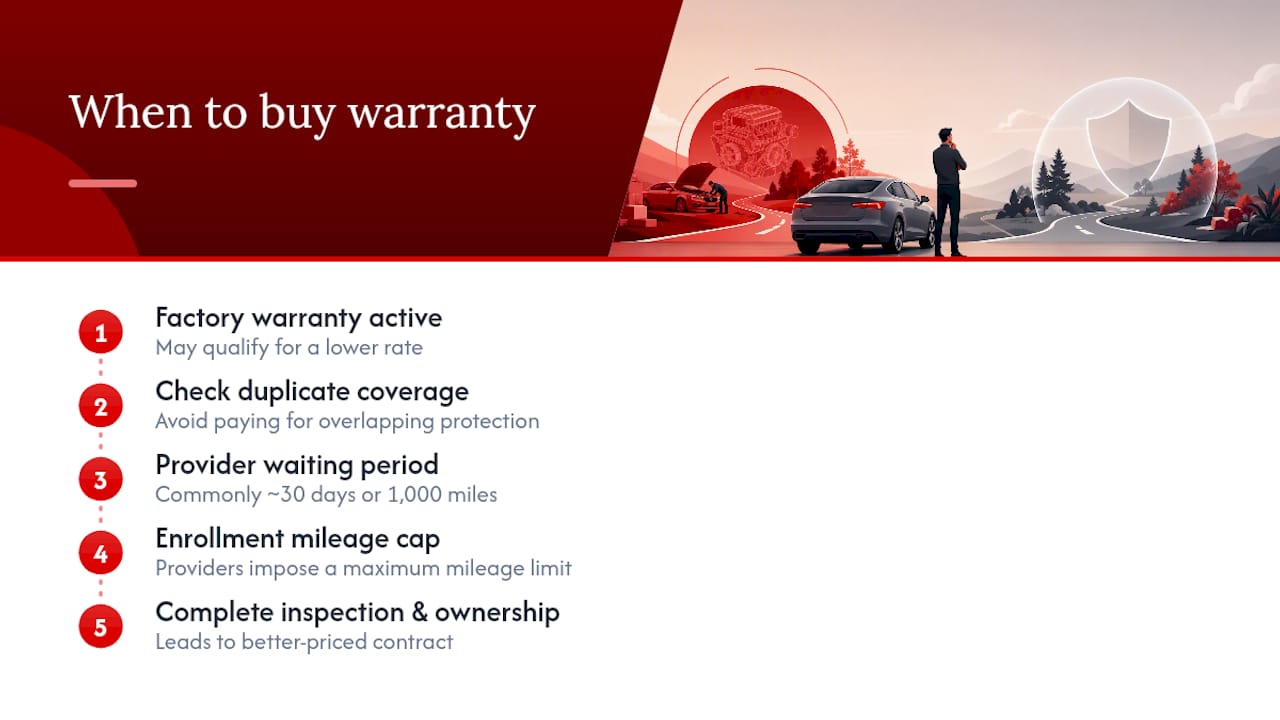
Buying while the factory warranty is still active can get you a lower rate, but check first that you're not paying for coverage that duplicates what you already have. Most independent providers enforce a waiting period, commonly around 30 days or 1,000 miles, before any claim is eligible, and they cap enrollment at a maximum mileage. Waiting until you have a completed inspection and real ownership data on the car often gets you a better-priced contract, since the provider isn't pricing in unknowns you've already ruled out.
Elmwood Auto Sales' Perspective on Dealer-Backed Protection
This dealership does not run on commission, so the sales approach avoids pushing customers toward unnecessary add-on contracts. Our low-pressure approach means the sales conversation stays focused on the car, not the upsell. Every vehicle on our lot goes through a thorough inspection before it's listed, and we document that condition report for you.
That inspection record matters more than most buyers realize. It tells you upfront what's already been checked and repaired, which narrows the real risk a warranty would need to cover. Read our used car warranty guide or browse our warranty archive for deeper coverage comparisons before you decide.
Our Take: Stop Debating in the Abstract and Run Your Own Numbers
The conventional advice on extended warranties splits into two unhelpful camps: "never buy one" or "always buy one." Neither survives contact with a real used car. The Consumer Reports data on premiums exceeding payouts is real, and it should make you skeptical of any warranty pitched as a no-brainer. But that data describes averages across every car and every buyer, not your car and your finances.
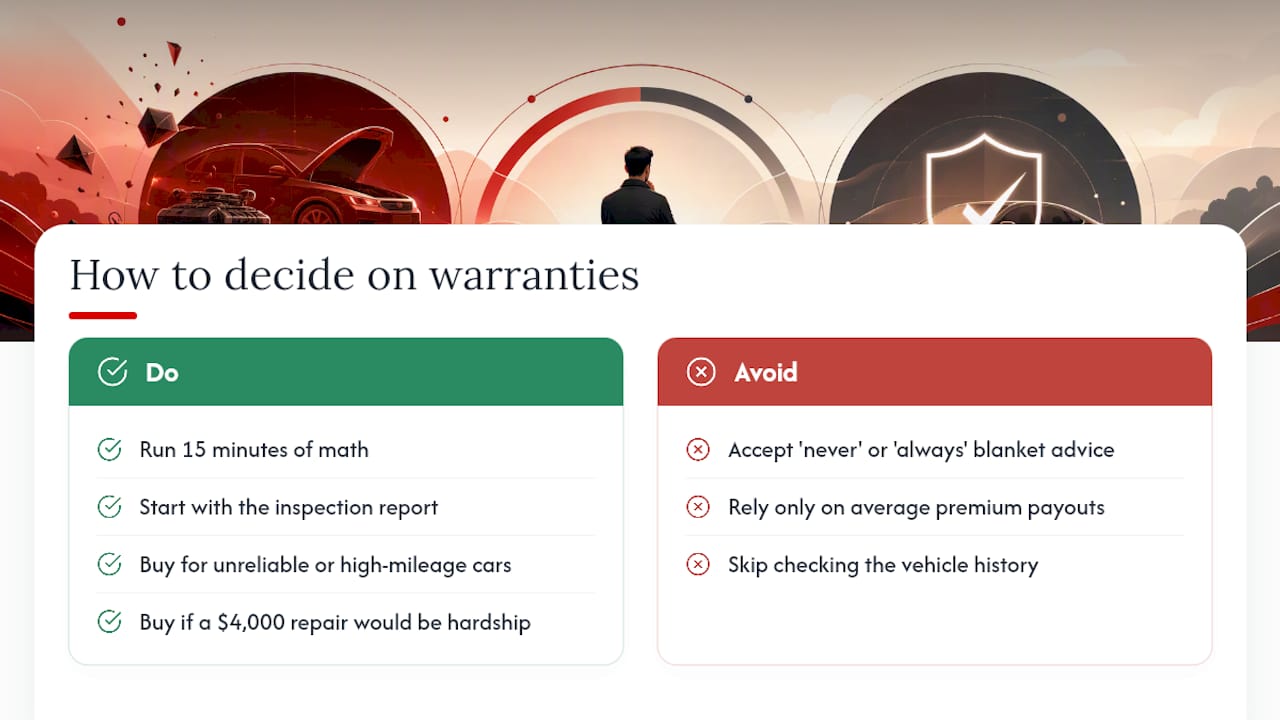
What the research actually supports is narrower and more useful: warranties earn their cost on unreliable models, high-mileage vehicles, and for buyers who genuinely couldn't absorb a $4,000 repair without hardship. They rarely earn their cost on reliable models bought by buyers who have savings to spare. The mistake most shoppers make isn't buying or skipping a warranty. It's skipping the fifteen minutes of math that would have told them which camp they're actually in.
Start with the inspection report, not the sales pitch. A documented vehicle history tells you more about real risk than any warranty brochure will.
— Elmwood
Ready to Look at a Specific Car? Let's Talk Numbers
Every vehicle comes with a documented inspection report, which serves as the starting point for deciding whether a protection plan makes sense for your situation, rather than relying on a generic sales script. Because the sales approach avoids commission incentives, the team can explain what a specific car's inspection actually found and what that means for your repair risk, without steering you toward unnecessary add-ons.
If you're weighing a used sedan, SUV, or truck against a warranty decision, the smartest next step is seeing the car and its inspection history in person. Schedule a test drive with Elmwood Auto Sales in Providence, and ask us directly about the vehicle's condition report and what dealer-backed protection options, if any, fit your plans.
This article is general information, not a substitute for advice from a qualified financial advisor. Consult a qualified financial professional about your own circumstances before acting on anything here.
Sources
- Should You Get an Extended Warranty for Your Car? - Consumer Reports
- Is an extended car warranty worth it? - CNBC Select
- Car Warranty Guide: Everything You Need to Know - Kelley Blue Book
- Should I buy an extended car warranty for a used car? - NerdWallet
- Why is there a waiting period for extended warranties? - Endurance
FAQ
What are two reasons not to buy an extended warranty?
Most owners pay more in premiums than they ever recover in claims, and many contracts exclude pre-existing conditions and wear items, leaving gaps buyers don't discover until they file a claim.
What does Dave Ramsey say about extended car warranties?
Financial advisors who favor self-insuring generally argue that setting the premium amount aside in savings outperforms buying a contract, especially on reliable models, since you keep the money if no major repair happens.
How much does a 5-year extended warranty cost?
Pricing varies widely by coverage tier, vehicle age, and provider, but bumper-to-bumper plans cost more than powertrain-only or named-component plans; get a specific quote based on your vehicle rather than relying on a flat number.