
Dealership warranties are optional extended coverage plans sold by car dealers that protect you from certain repair costs after your factory warranty expires. They are technically vehicle service contracts, not warranties under federal law, because you purchase them separately. The FTC draws a clear line between a manufacturer's warranty, which is included in the purchase price, and a service contract, which you buy on top of it. Understanding that distinction is the first step toward making a smart decision at the dealership.
Here is what you need to know before signing anything:
- Factory warranty: Comes with every new car at no extra charge, covering production defects for a set period or mileage.
- Extended dealership warranty: An optional purchase, either manufacturer-backed or third-party, sold through the dealer's finance office.
- Powertrain plan: Covers the engine, transmission, and drive axle components only.
- Silver/Gold plan: Mid-tier coverage that adds electrical, infotainment, and other systems on top of the powertrain.
- Platinum/bumper-to-bumper plan: The most comprehensive option, covering most vehicle parts except wear-and-tear items.
- Complimentary warranty: Occasionally offered by dealers at no charge with select new or certified pre-owned vehicles.
Key buyer considerations: costs range from $1,000 to $3,000 on average, dealer markups can be steep, repair location restrictions often apply, and third-party alternatives are worth comparing before you commit.
What types of car warranties does a dealership offer?
Dealerships sell several distinct types of warranties, and the differences between them affect both your coverage and your total cost. Knowing which category you are looking at prevents confusion in the finance office.
Factory warranty (new car warranty): Every new vehicle comes with a manufacturer's warranty at no extra cost. It covers production defects for a defined period and mileage, typically a few years or tens of thousands of miles. This coverage is backed directly by the automaker and requires no separate purchase.
Manufacturer-backed extended warranties: These are sold by the dealership but backed by the original equipment manufacturer (OEM). Examples include Toyota Extra Care and Kia Distinction. Because the automaker stands behind them, repairs use OEM parts and factory-trained technicians.
Third-party extended warranties sold at the dealership: Some dealers also carry plans backed by independent companies rather than the automaker. These often cost less and offer more flexibility in where you can get repairs done. As one finance manager at a Tennessee-based Acura dealer noted, third-party options are sometimes cheaper, more flexible, or both.
Complimentary warranties: A smaller number of dealers include a free extended warranty with select new or qualifying used vehicles. These vary widely in scope and duration.
The main coverage tiers across these plans break down as follows:
- Powertrain plans cover roughly 50 parts, including the engine, transmission, transfer case, and drive axles.
- Silver/Gold plans typically cover 200–500 parts, adding the electrical system, infotainment, and more.
- Platinum plans (bumper-to-bumper) cover 2,000–5,000 parts depending on the make and model, with exceptions for wear-and-tear items like brake pads and wiper blades.
Pro Tip: Ask the finance manager to show you the actual contract before agreeing to anything. If they cannot produce a contract for review, decline the coverage.
What do dealership warranties cover, and what do they exclude?
Coverage scope varies significantly depending on which plan tier you choose. A powertrain plan protects the core mechanical components that make the car move: the engine, transmission, transfer case, and drive axles. Move up to a Silver or Gold plan and you add coverage for the electrical system, air conditioning, steering, and infotainment. A Platinum or bumper-to-bumper plan covers the vast majority of vehicle parts, with a short exclusions list rather than a defined list of covered parts.
What dealership warranties consistently do not cover is just as important. Routine maintenance is excluded across virtually all plans, including oil changes, tire rotations, and brake pad replacements. Normal wear-and-tear items like wiper blades, tires, and brake pads are also off the table. Damage from accidents, misuse, off-road driving, or unauthorized aftermarket modifications voids coverage for affected components.
| Coverage area | Powertrain plan | Silver/Gold plan | Platinum plan |
|---|---|---|---|
| Engine and transmission | Yes | Yes | Yes |
| Drive axle and transfer case | Yes | Yes | Yes |
| Electrical system | No | Yes | Yes |
| Air conditioning and steering | No | Yes | Yes |
| Infotainment system | No | Yes | Yes |
| Most other vehicle parts | No | Partial | Yes |
| Wear-and-tear items | No | No | No |
| Routine maintenance | No | No | No |
| Accident damage | No | No | No |
One restriction that catches many buyers off guard is the repair location requirement. Dealer-obligor contracts typically require repairs to be performed at that dealer's authorized network. If you move to a different city or travel frequently, this can be a real inconvenience. Read the contract's service section carefully to understand exactly where you can take the car.
Keeping your maintenance records is also critical. The warranty company can request documentation of oil changes, tire rotations, and inspections. If you cannot show you maintained the vehicle properly, a claim can be denied.
How much does a dealership warranty cost?
Dealership warranty pricing is one of the least transparent parts of the car-buying process. Costs average between $1,000 and $3,000 for a multi-year extended warranty, though high-end plans for luxury vehicles can run $5,000 or more. The price depends on the vehicle's make, model, age, mileage, and the level of coverage you select.

The bigger issue is dealer markup. Industry insiders report markups of 40% to 400%, meaning a warranty the dealer purchases wholesale for $1,000 could be offered to you for $4,000 or more. That spread is negotiable, which most buyers do not realize.
| Pricing factor | What it means for you |
|---|---|
| Base warranty cost | The wholesale price the dealer pays for the plan |
| Dealer markup | Added profit margin, ranging from 40% to 400% |
| Add-ons (paint protection, glass coverage) | Often bundled in and difficult to remove |
| Financing the warranty | Adds interest charges over the loan term |
| Deductibles | Per-repair costs you pay out of pocket at the time of service |
Financing the warranty through your auto loan compounds the cost. Including a warranty in a car loan means you pay interest on the warranty cost over the entire loan period, raising the total expense well beyond the sticker price of the plan itself.
Key figure: Dealer markups on extended warranties can range from 40% to 400%, meaning a plan sold for $4,000 may have cost the dealer $1,000.
Dealers also frequently bundle mandatory add-ons like paint protection or glass coverage into the warranty package to increase profit. These additions can be non-removable and inflate the price beyond basic coverage. Always ask for an itemized breakdown.
How do dealership warranties compare to third-party providers?
The core trade-off is straightforward: dealership warranties offer OEM parts and factory-trained technicians, while third-party providers offer more flexibility in repair locations and often lower prices. Neither is universally better. The right choice depends on your priorities.
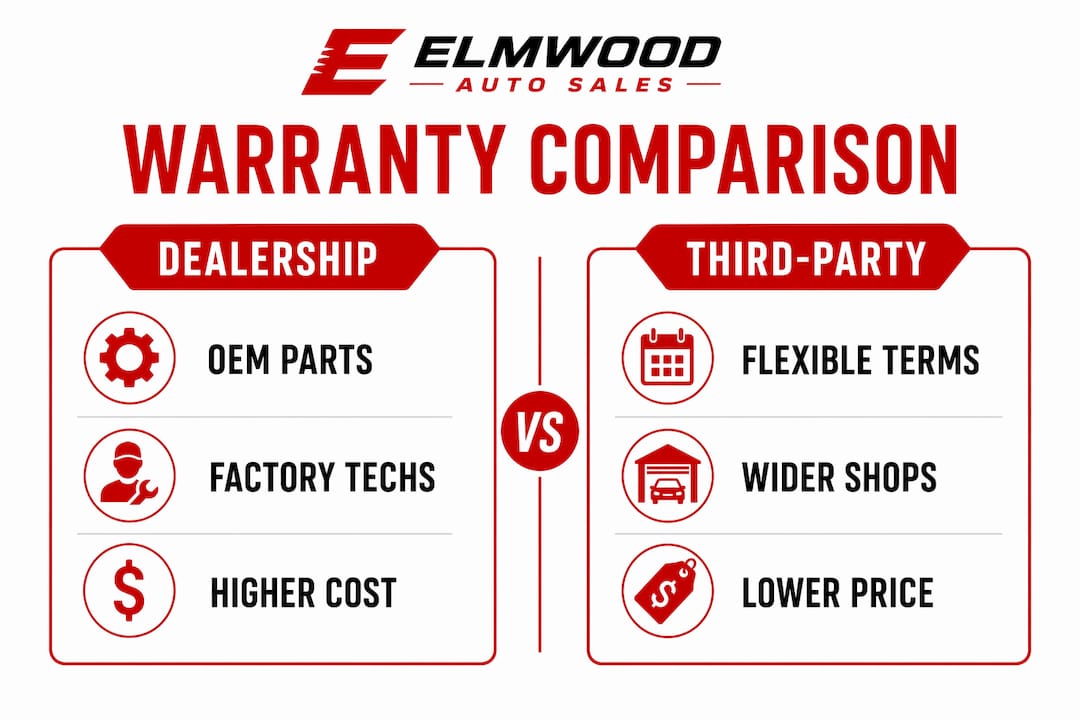
| Dimension | Dealership warranty | Third-party warranty |
|---|---|---|
| Coverage scope | Manufacturer-backed, OEM parts | Varies; may use aftermarket parts |
| Cost | Typically higher due to markups | Often lower; more competitive |
| Repair location | Usually restricted to authorized dealer network | Typically any ASE-certified facility |
| Purchase timing | Usually required at time of vehicle purchase | Can often be purchased after factory warranty expires |
| Customer service | Administered by automaker or third-party administrator | Varies by provider |
| Flexibility and exclusions | Fewer coverage options; add-ons may be bundled | More customizable; broader shop access |
Third-party plans can typically be purchased after your factory warranty expires, giving you time to shop around. Dealership plans usually must be bought during the vehicle purchase or while the factory warranty is still active. That timing pressure is one reason buyers feel rushed into a decision in the finance office.
A few well-known third-party providers worth researching include Endurance, which offers multiple coverage tiers from powertrain-only plans up to bumper-to-bumper exclusionary coverage; Autopom!, which offers plans up to seven years or 150,000 miles; and Carchex, which specializes in coverage for higher-mileage vehicles. These companies are not sold through dealerships, so comparing their quotes against a dealer's offer gives you a real price benchmark.
The repair shop restriction is the most practical difference for daily life. Dealership-backed plans typically send you back to an authorized dealer for all covered work. Third-party plans generally let you use any shop certified by the National Institute for Automotive Service Excellence (ASE), which matters if you have a trusted independent mechanic or if you move.
What are the pros and cons of dealership warranties?
Pros:
- OEM parts and factory technicians: Manufacturer-backed plans use original equipment parts and technicians trained specifically on your vehicle's make and model.
- Convenience: You can purchase coverage at the same time as the vehicle, without researching separate providers.
- Perks: Most dealership warranties include roadside assistance, towing, and rental car reimbursement.
- No upfront reimbursement hassle: Manufacturer-backed plans typically pay the repair shop directly, so you do not have to pay out of pocket and wait for reimbursement.
- Potential loan inclusion: You can roll the cost into your auto loan, spreading payments over time.
Cons:
- Higher cost and markups: Dealer markups are significant and the base price is often higher than comparable third-party plans.
- Restricted repair locations: Most dealer-obligor contracts require you to use the dealer's authorized network, limiting your options.
- Bundled add-ons: Paint protection, glass coverage, and similar extras are often added to the package and cannot be removed.
- Interest on financed warranties: Rolling the warranty into your loan means paying interest on it for years.
- Early activation: Plans often take effect immediately, meaning you pay for coverage during the period when your new car is least likely to need major repairs.
- High-pressure sales environment: The FTC warns that service contracts are frequently presented late in the sales process, after a long day of negotiating, sometimes without clear disclosure that they are optional.
For buyers who want the peace of mind of OEM-quality repairs and do not mind paying a premium, a dealership warranty can make sense. For buyers who prioritize cost control and repair flexibility, a third-party plan or a dedicated savings fund may serve them better.
How should you evaluate and decide on a dealership warranty?
The best approach is to treat the dealer's offer as one option, not the only option. Here is a practical framework for making the decision:
- Compare before you commit. Get the dealer's best price, then request quotes from third-party providers for comparable coverage. Prices on the same vehicle can vary by $1,500 or more between providers.
- Read the full contract. Review what is covered, what is excluded, where repairs must be performed, and how claims are filed. Never agree to a plan without seeing the actual contract.
- Negotiate the price. Dealer markups are real and negotiable. Ask for an itemized breakdown and push back on bundled add-ons.
- Check the administrator. Dealership warranties are often administered by a third-party company, not the automaker itself. Knowing who handles claims affects how disputes are resolved.
- Verify transferability. A transferable warranty can add resale value if you sell the car privately. Confirm whether a transfer fee applies.
- Consider a savings alternative. Progressive and other insurers suggest that setting aside a dedicated repair fund can be more economical than paying for a restrictive service contract, particularly for reliable vehicles.
- Do not buy duplicate coverage. If your factory warranty still has years left, purchasing an extended plan immediately creates overlap. You pay for coverage you do not yet need.
Pro Tip: The finance office is where dealers make significant money on add-ons. If you feel pressured to decide immediately, ask to take the contract home overnight. A reputable dealer will allow it. If they will not, that tells you something important about how they do business. For more on reading a dealer's character, see how to spot an honest dealer.
Are dealership warranties worth buying?
The honest answer is: it depends on your specific situation. A dealership warranty is more likely to be worth the cost if you drive a vehicle with a below-average reliability record, plan to keep the car well past the factory warranty expiration, or want the assurance of OEM parts and authorized service. If you find a plan priced well below the average of around $1,000 per year of bumper-to-bumper coverage, that is a reasonable deal worth considering.
On the other hand, if your vehicle has a strong reliability history and you drive moderate miles, the math often does not favor buying an extended plan at the dealer's asking price. A new car's factory warranty already covers the period when major failures are least likely. Paying for extended coverage that activates immediately means you are funding protection during years when you probably will not use it.
The question of who administers the warranty also affects its value. If the plan is administered by a third-party company rather than the automaker, your claims experience depends entirely on that administrator's responsiveness and financial stability. Research the administrator, not just the dealer.
For used car buyers, the calculation shifts. If you are purchasing a vehicle outside its factory warranty period and cannot absorb a large unexpected repair bill, a well-priced extended plan from a reputable provider, whether dealer-backed or third-party, offers genuine protection. The key is comparing options rather than accepting the first offer in the finance office.
What red flags should you watch for during the warranty sales process?
Several warning signs indicate that a warranty offer deserves extra scrutiny.
Late-stage pressure: The FTC specifically flags the tactic of presenting service contracts after a long day of negotiating, when buyers are tired and less likely to read carefully. If the warranty conversation happens only after you have agreed on the vehicle price and financing, slow down.
Vague coverage language: Contracts that use phrases like "mechanical breakdown only" without defining what qualifies can leave you with denied claims. Ask for specific examples of what would and would not be covered.
Pressure to decide immediately: A legitimate warranty offer does not expire the moment you leave the finance office. If a dealer insists you must decide right now, that urgency is a sales tactic, not a real deadline.
Undisclosed add-ons: If the quoted price includes paint protection, tire and wheel coverage, or other extras you did not ask for, request an itemized breakdown. Some of these add-ons are presented as part of the warranty package without clear disclosure.
No contract available for review: If the finance manager cannot provide the actual contract for you to read before signing, walk away. You have every right to review the full document.
Unsolicited mail or phone offers: Robocalls and mailers warning that your "warranty is about to expire" are almost never from your actual dealer or manufacturer. These are third-party solicitations, and the FTC warns they often involve high-pressure tactics, requests for personal financial information upfront, and contracts with so many exclusions that coverage is effectively worthless.
Knowing your consumer rights in auto sales before you walk into the finance office puts you in a much stronger position.
How do you file and use a dealership warranty claim?
Filing a claim under a dealership warranty follows a defined process, and skipping any step can result in a denial.
Step 1: Contact the warranty administrator before authorizing repairs. Most contracts require pre-approval for covered work. Call the number on your contract and describe the problem. The administrator will tell you whether the repair is covered and which facilities are authorized to perform it.
Step 2: Take the vehicle to an authorized repair location. Dealer-obligor contracts require you to use the dealer's authorized network. Taking the car to an independent shop without prior approval typically voids the claim for that repair.
Step 3: Provide your maintenance records. The warranty company can ask for documentation showing you followed the manufacturer's recommended maintenance schedule. Keep receipts for oil changes, tire rotations, and inspections. Missing records are one of the most common reasons claims are denied.
Step 4: Review the repair order before authorizing work. Confirm that the technician's diagnosis matches what the administrator approved. Any additional work not pre-approved will likely be your out-of-pocket expense.
Step 5: Understand the reimbursement process. Manufacturer-backed dealership warranties typically pay the repair facility directly. Third-party-administered plans may require you to pay first and submit a claim for reimbursement. Know which process applies to your contract before the repair begins.
If a claim is disputed, the contract should specify how to escalate. The administrator handles disputes first. If the administrator goes out of business, the dealer may be responsible for fulfilling the contract terms.
How long do dealership warranties last, and what are the mileage limits?
Dealership warranty terms vary widely based on the plan tier, the vehicle, and the provider. Factory warranties typically cover a vehicle for a set number of years or miles, whichever comes first, with powertrain coverage often lasting longer than bumper-to-bumper coverage.
Extended dealership warranties can range from a few months and 3,000 miles at the low end to 10 years and 100,000 miles at the high end, depending on the plan. Platinum or bumper-to-bumper plans from automakers tend to run 5–7 years or 60,000–100,000 miles. Powertrain-only plans sometimes extend further in mileage because they cover fewer components.
A few practical points on terms:
- Coverage starts from the original vehicle sale date, not from when you purchase the extended plan. If you buy an extended warranty two years into ownership, you have already used two years of the term.
- Mileage limits are firm. Once the odometer hits the contract ceiling, coverage ends regardless of how much time remains.
- Some plans have a waiting period, often 30 days and a set number of miles, before claims are honored. This prevents buyers from purchasing coverage for a known pre-existing problem.
- Getting a warranty that outlasts how long you plan to own the vehicle means paying for coverage you will never use. Match the term to your realistic ownership horizon.
Eligibility limits also apply. Most dealership extended warranties will not cover vehicles with more than 100,000 miles on the odometer, and some require purchase before the factory warranty expires.
Can a dealership warranty be transferred to a new owner?
Transferability varies by contract and is not guaranteed. Some dealership warranties allow the remaining coverage to transfer to a subsequent owner when the vehicle is sold privately, while others terminate at the point of sale.
When a warranty is transferable, it typically adds measurable resale value. A buyer purchasing a used vehicle with active extended coverage has lower financial exposure to unexpected repairs, which can justify a higher asking price. If you plan to sell the car before the warranty expires, confirming transferability before you buy the plan is worth the extra question.
Transfer fees are common. The contract will specify the fee amount and the process for notifying the administrator of the ownership change. Missing the notification window can void the transfer.
If you are buying a used car, ask the seller whether any warranty coverage remains and whether it is transferable. Also check whether any time remains on the original factory warranty. A vehicle still within its factory warranty period may not need an extended plan at all.
For buyers who want to understand the full range of used car warranty types before making a decision, reviewing coverage categories in detail helps clarify what you are actually getting with any plan.
At Elmwoodautosalesri, every vehicle goes through a thorough inspection before it reaches the lot, and the team is committed to transparent conversations about coverage options, financing, and what each plan actually includes. There are no commission-based pressure tactics, which means you get honest answers about whether a warranty makes sense for the specific car you are considering. If you are ready to explore quality used vehicles with straightforward pricing and real financing options, visit Elmwoodautosalesri to see current inventory.
Key Takeaways
Dealership warranties are optional service contracts, not true warranties under federal law, and the decision to buy one should be based on coverage value, total cost, and your specific vehicle and driving situation.
| Point | Details |
|---|---|
| Factory vs. extended warranty | A factory warranty is included in the purchase price; a dealership extended warranty is a separate, optional purchase. |
| Cost range and markups | Extended warranties average $1,000–$3,000, with dealer markups ranging from 40% to 400% of the wholesale price. |
| Repair location restrictions | Dealer-obligor contracts typically require repairs at the authorized dealer network, limiting your flexibility. |
| Third-party alternatives | Third-party providers often allow repairs at any ASE-certified shop and can be purchased after the factory warranty expires. |
| Transferability matters | A transferable warranty can boost resale value; always confirm transfer terms and fees before purchasing. |