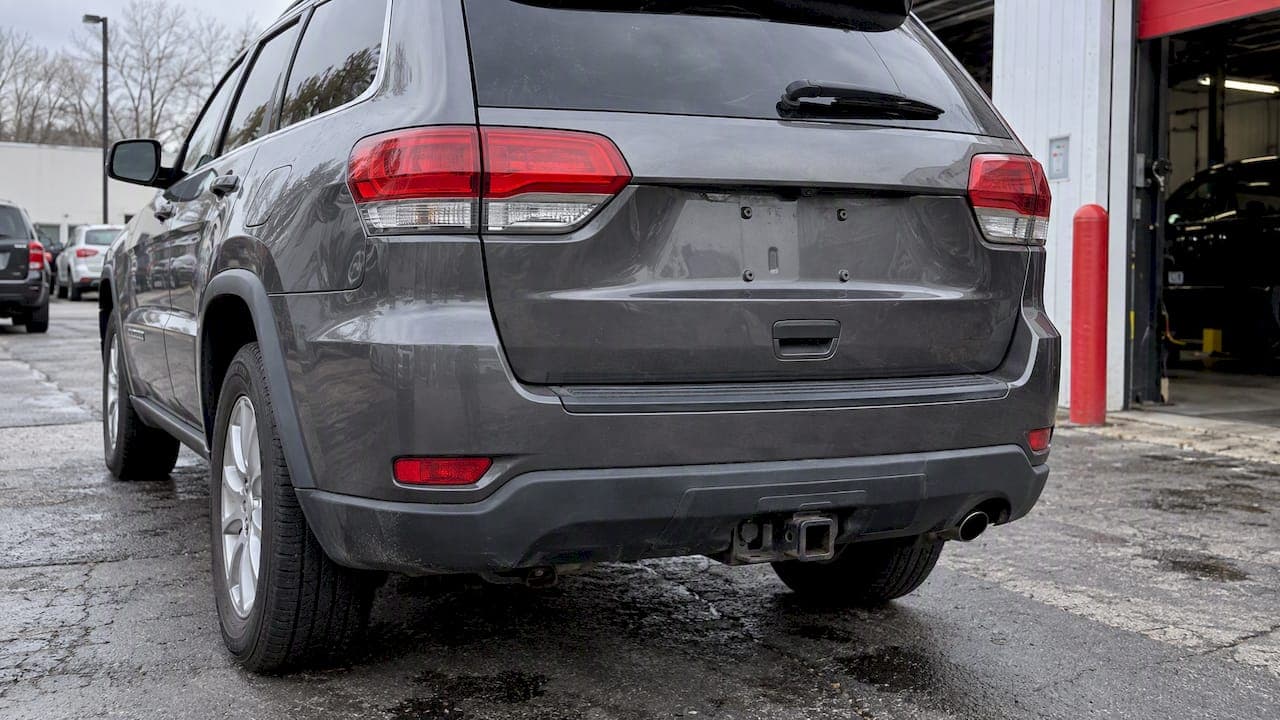
A hitch class is a rating that tells you how much trailer weight a receiver hitch is built to pull and how large its receiver opening is. Class 1 is the lightest and Class 5 the heaviest. Most SUVs, minivans and half-ton pickups end up with a Class 3 or Class 4 hitch, and the gap between those two is smaller than most shoppers expect. The class on the hitch is only half the answer, though. Your vehicle's own towing rating decides what you can actually pull.
TL;DR
- Hitches are rated Class 1 to Class 5. Each step up means a higher trailer weight limit and, usually, a bigger receiver opening.
- Class 1 and 2 use a 1-1/4 inch receiver. Class 3 and 4 commonly use a 2 inch receiver, the most common size on SUVs, vans and pickups.
- Class 3 is typically rated to about 8,000 lbs of trailer weight and Class 4 to about 10,000 lbs. Both can reach 12,000 lbs with a weight-distributing setup.
- The lowest rating in the chain wins: hitch, ball mount, ball, trailer coupler, and the vehicle itself.
- If you are buying used, check the tow rating of the specific vehicle and the hitch already on it before you count on either.
Table of Contents
- What does a hitch class actually measure?
- The five hitch classes side by side
- What is the difference between Class 3 and Class 4?
- Why is the 2 inch receiver so common?
- The weakest link sets your limit
- Do accessories have to match the hitch class?
- Are hitches tested to a standard?
- How do you find out which class a used vehicle already has?
- Which class fits which kind of buyer?
- Our perspective: buy the vehicle first, then the hitch
- Looking for a used SUV or truck that can tow?
- FAQ
- Sources
What does a hitch class actually measure?
Class is a shorthand for strength. Trailer hitches are sorted into five classes by structure, receiver opening size and maximum weight capacity. Two numbers matter most:
- Gross trailer weight (GTW): the total weight of the trailer plus everything loaded on it.
- Tongue weight (TW): the downward pressure the trailer's coupler puts on the hitch ball. It is usually a fraction of the gross trailer weight.
Both numbers rise with class. The class also tells you the receiver size, which decides what accessories will slide in: ball mounts, bike racks, cargo carriers and so on.
One point trips up many first-time buyers. These are hitch ratings, not vehicle ratings. As etrailer puts it, the right class depends on what you want to tow and what your vehicle can handle. A heavy-duty hitch bolted to a small sedan does not turn the sedan into a tow vehicle.
The five hitch classes side by side
The figures below come from the manufacturer's comparison chart at Curt's towing guide. Individual hitches vary by brand and model, so always read the label on the hitch you are looking at.
| Class | Receiver opening | Max gross trailer weight | Max tongue weight | Typical vehicles |
|---|---|---|---|---|
| Class 1 | 1-1/4 inch | Up to 2,000 lbs | Up to 200 lbs | Cars and crossovers |
| Class 2 | 1-1/4 inch | Up to 3,500 lbs | Varies by model | Larger cars, crossovers, some minivans |
| Class 3 | 2 inch | Up to 8,000 lbs | Up to 800 lbs | SUVs, minivans, light pickups |
| Class 4 | 2 inch | Up to 10,000 lbs | Up to 1,000 lbs | Full-size SUVs and pickups |
| Class 5 | 2 inch or larger | Often 16,000 lbs and up | Higher still | Heavy-duty pickups |
A few notes on reading the table:
- Class 3 hitches can range up to 8,000 lbs, and some sources list Class 3 and Class 4 ceilings of 8,000 to 10,000 lbs and 10,000 to 15,000 lbs. The spread comes from different manufacturers rating their own products.
- Class 5 is sold in more than one form. Curt, for example, lists Class 5 hitches rated up to 17,000 lbs with a 2 inch receiver and up to 20,000 lbs with a 2-1/2 inch receiver.
- Class 1 and 2 are for small loads: bike racks, cargo carriers, a small utility trailer or a light cargo box.
What is the difference between Class 3 and Class 4?
This is the question behind most hitch searches, and the honest answer is: weight rating, mostly.
Both classes commonly use a 2 inch by 2 inch receiver opening. That means the same ball mounts and the same accessories will physically fit either one. What changes is how much the steel is engineered to handle. According to Curt's published figures, Class 3 hitches generally support up to 8,000 lbs of trailer weight and 800 lbs of tongue weight, while Class 4 hitches often support up to 10,000 lbs and 1,000 lbs.
With a weight-distributing hitch assembly, which uses spring bars to spread tongue weight across the tow vehicle and trailer axles, both classes can be rated up to 12,000 lbs in that same source. That is why a Class 3 and a Class 4 can look similar on a spec sheet once a weight-distributing setup is involved.

Which one do you need?
Use this short test:
- Find the heaviest thing you will realistically tow. Weigh the loaded trailer, not the empty weight on the brochure.
- Add a margin. Do not plan to run at the very limit every trip.
- Check your vehicle's rating. If the vehicle is rated for 5,000 lbs, a Class 4 hitch does not raise that to 10,000 lbs.
- Pick the class that covers the load and the vehicle. If a Class 3 covers both with room to spare, a Class 4 adds cost and weight without adding what you can legally and safely tow.
For weekend use with a small camper, a pair of jet skis or a utility trailer, Class 3 is usually plenty on a mid-size SUV. Class 4 makes sense when your vehicle is rated high enough to use it, such as a full-size truck, and you tow loaded trailers regularly.
Why is the 2 inch receiver so common?
The 2 inch receiver is widely considered the most versatile size, standard for Class 3 and Class 4 and found on most full-size SUVs, minivans and pickups. Lippert's guide notes that it handles everything from bike racks and small utility trailers to medium-sized campers, and that 2 inch receivers come in Classes 3, 4 and 5.
For a used-car shopper, that has a practical upside. If the vehicle you buy already has a 2 inch receiver, accessories and ball mounts are easy to find, and you have room to grow if your needs change.
The weakest link sets your limit
A towing system is a chain, and the lowest-rated part decides the capacity of the whole thing. That chain includes:
- The vehicle's manufacturer tow rating
- The hitch receiver and its class rating
- The ball mount and its shank
- The hitch ball and its diameter
- The trailer coupler
- Safety chains and any weight-distribution hardware
Your owner's manual and the sticker on the driver's door jamb are where the vehicle's limits live. Some manufacturers publish a chart that ties the maximum trailer weight to the hitch type installed at the factory, like this chart in a Ram 2500/3500 owner's manual. If you are shopping for a used truck, it is worth finding the equivalent page for the exact model year.
For the vehicle side of the math, our guide to towing capacity in six steps walks through how to compare your trailer against what the vehicle can pull. If you are comparing trucks and SUVs, payload versus towing math explains why the number on the hitch is not the number that limits most buyers. Payload, meaning passengers, cargo and tongue weight, often runs out first.
Do accessories have to match the hitch class?
Yes, and this is where people get caught. A bike rack or cargo carrier that slides into your receiver is not automatically safe for it. Curt's guidance is that you should confirm the accessory is rated for the hitch class and the tongue weight you are applying.
Adapters add another wrinkle. Fitting a smaller accessory into a larger receiver with an adapter is generally possible, but the adapter can create new leverage points and reduce the tongue weight capacity of the system, per Curt's towing guide. If you plan to use an adapter, read the rating on the adapter and the accessory, and use the lower figure.
The same discipline applies to rented vehicles. If you ever plan to tow with a van you do not own, rental van towing checks are worth reading before pickup, because the limits on a rental depend on the vehicle and the rental terms, not on the hitch you wish it had.
Are hitches tested to a standard?
There are voluntary industry standards. SAE International's J684 standard covers couplings, hitches and safety chains used with trailers whose gross vehicle weight rating does not exceed 10,000 lbs. A newer SAE information report, J3352, sets out minimum performance criteria for conventional towing systems up to 20,000 lbs gross trailer weight rating, and it does not cover weight-distributing hardware.
You do not need to read the standards. What you can do is buy hitches and parts from makers who say their products are tested to recognized criteria, and avoid unlabeled hitches with no visible rating.
How do you find out which class a used vehicle already has?
If you are looking at a used SUV or truck, do not assume a hitch means it is ready to tow. Here is how to check, in order:
- Look for the label. Many hitches carry a sticker or stamped plate with the gross trailer weight and tongue weight ratings. Faded or missing labels are a reason to ask more questions.
- Measure the opening. Per Lippert, receiver tubes come in 1-1/4, 2, 2-1/2 and 3 inch sizes. A 1-1/4 inch opening points to Class 1 or 2. A 2 inch opening could be Class 3, 4 or 5, so you need the label or the hitch maker's part number.
- Check how it is mounted. Look at the bolts, the welds and any rust around the mounting points under the rear bumper.
- Find the vehicle's tow rating. Use the owner's manual for that exact model year and trim. Engine, axle ratio and drivetrain can change the rating on the same model.
- Ask whether the hitch was factory installed or added later. Aftermarket installs vary in quality, so ask for any paperwork.
- Have the vehicle inspected with towing in mind. Brakes, tires, suspension, cooling and transmission all work harder under load.
We cover the broader inspection side in our used SUV buying checklist for families.
Which class fits which kind of buyer?
Think about use before you think about class.
Small loads and carriers (Class 1 or 2). Bike racks, a cargo tray, a small utility trailer. Crossovers and sedans fit here. If your daily driver is a compact car or crossover, you will most likely be shopping in this tier, and the vehicle's own limit matters more than the hitch.
Family SUV with an occasional trailer (Class 3). A pop-up camper, a boat on a single-axle trailer, a loaded utility trailer. Many mid-size and full-size SUVs and minivans are fitted with Class 3 hitches, and a 2 inch receiver gives you flexibility.
Regular towing with a truck or large SUV (Class 3 or 4). If you tow most weekends in season, look at the higher end of what your vehicle is rated for, and consider a weight-distributing setup for heavier trailers.
Heavy trailers (Class 5 and beyond). Large campers and equipment trailers. At this point you are usually shopping for a heavy-duty truck, and gooseneck and fifth-wheel hitches enter the conversation. Curt lists those as separate hitch types from receiver hitches.
If cargo space matters as much as towing, our look at verifying SUV cargo space at the dealer and the piece on why roof rails matter cover the other ways families carry more.

Our perspective: buy the vehicle first, then the hitch
We sell used cars, trucks, SUVs and vans in Providence, and hitch questions come up often in the same breath as budget questions. Our view is simple. Start with the vehicle and what you honestly tow, then match the hitch to it, not the other way around.
That is why we do not pressure anyone toward a bigger truck for a trailer they might buy someday. We work without commission-based sales tactics, so the conversation can stay on what you need. And because every vehicle we sell goes through a thorough inspection, we are comfortable talking about the parts of a vehicle that matter for towing: the frame and mounting points, brakes, tires and drivetrain.
If towing is on your list, tell us what you plan to pull. We will point you to vehicles that fit, and we will say so plainly when a vehicle is not the right match. Check the tow rating for the exact model year and configuration before you sign anything, and ask us to help you find it.
— Elmwood
Looking for a used SUV or truck that can tow?
If you have a trailer weight in mind, start with our used SUVs, trucks and vans and tell us what you tow. Not seeing the right one? Our Car Finder can search for a specific vehicle. We also offer used car financing for a range of credit profiles, and if you have a vehicle to move, you can trade in or sell your car toward the next one.
For a closer look at what to drive, see our guides to the best used trucks for family hauling and the best used SUVs for families.
FAQ
What is the maximum weight a Class 2 hitch can tow?
Class 2 hitches generally go up to 3,500 lbs of gross trailer weight and use a 1-1/4 inch receiver, according to Curt. Your vehicle's own tow rating may be lower than that, and the lower number is your limit.
What is the most common hitch size?
The 2 inch receiver is widely considered the most common size for light to medium towing. It is standard on Class 3 and Class 4 hitches, which cover most full-size SUVs, minivans and pickups.
Can I put a Class 4 hitch on any vehicle to tow more?
No. A stronger hitch does not raise the vehicle's tow rating. Your vehicle's manufacturer rating, usually in the owner's manual, still sets the ceiling. A higher-class hitch only helps if the vehicle itself is rated to use that capacity.
Does a weight-distributing hitch change the class?
It does not change the class, but it can change the rating. Curt lists Class 3 and Class 4 hitches at up to 12,000 lbs when paired with an appropriate weight-distributing assembly. Check that the vehicle and trailer are rated for it too.
How do I tell whether a used SUV has a Class 3 or Class 4 hitch?
Look for the rating label on the hitch, then check the receiver opening and the hitch maker's part number. If the label is missing, ask for installation paperwork or have a qualified hitch installer identify it before you tow.
Sources
- Types of Trailer Hitches and Hitch Classes, Towing 101 (Curt)
- How to Choose the Right Trailer Hitch Class (etrailer)
- A Beginner's Guide to Hitch Classes (Lippert)
- Trailer Hitch Type and Maximum Trailer Weight (Ram owner's manual)
- SAE J684: Trailer Couplings, Hitches, and Safety Chains
- SAE J3352: Conventional Towing System Information Report