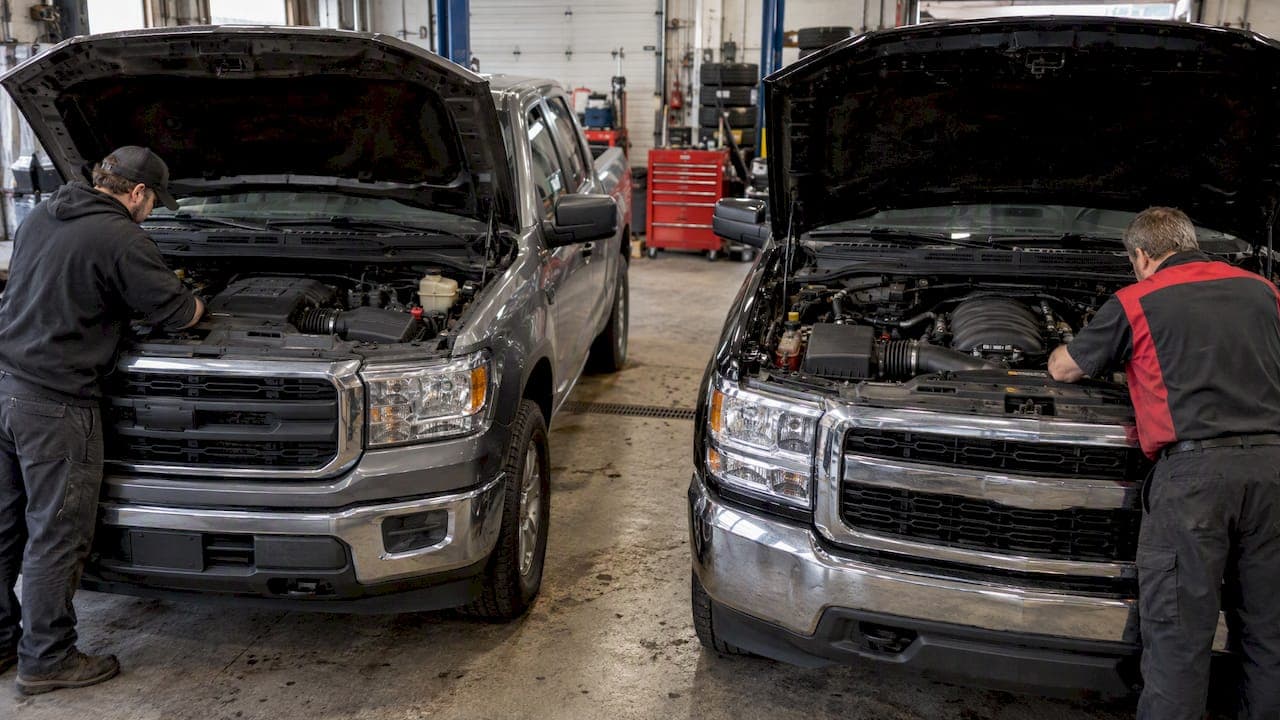
A V6 covers nearly every daily driver's needs, from commuting to occasional light towing, while a V8 earns its keep when you tow heavy loads often, run sustained high-demand work, or simply want the deeper sound and power delivery that comes with eight cylinders. The decision comes down to three questions: how often you tow, whether your loads are continuous or occasional, and how much you value V8 character over fuel savings.
TL;DR:
- For occasional light towing, a well equipped V6 often suffices, but check the specific vehicle’s tow rating against your trailer’s loaded weight before buying.
- Some 2026 Ram 1500 six cylinder configurations rate 22 mpg combined, versus 19 mpg for the 5.7 liter V8; frequent towing can erase that advantage.
- Before buying used, review service records, request compression and leak down tests, and verify turbo inspection history for turbocharged V6 models.
- Frequent heavy towing favors a V8’s low rpm torque and heat tolerance; turbocharged V6s can match some outputs, but add components needing service.
Table of Contents
- Matching Your Use Case to the Right Engine
- Horsepower, Torque, and Acceleration: What the Numbers Mean for You
- Fuel Economy Differences and the Real Cost to Own
- What Maintenance and Repair Costs Differ Between V6 and V8
- Subjective Differences: Sound, Smoothness, and Handling
- Costs and Complexity of Swapping or Upgrading
- How We Help Buyers Choose and Verify V6 or V8 Used Cars
- Quick Rule of Thumb: Which Engine Should You Pick Now
- Find, Inspect, and Finance the Right V6 or V8 With Us
- FAQ
- Sources
Matching Your Use Case to the Right Engine
Most buyers do not need to study engine architecture to make the right call. They need to look honestly at how they use their vehicle and match that pattern to what each engine does well.
For daily driving and commuting, a V6 is the practical choice. It costs less to fuel, weighs less, and delivers more than enough power for merging, passing, and daily errands. Kelley Blue Book's guidance confirms that modern V6s are adequate for most drivers, with V8s reserved for heavier-duty needs.
Weekend performance driving shifts the calculus. Enthusiasts often want the sound and immediate top-end pull of a V8, though a turbocharged V6 can close much of that gap at a lower price point and better everyday fuel economy.
Occasional towing, think a small trailer a few times a year, usually stays within a well-equipped V6's limits. KBB notes that the old assumption that more cylinders always means better performance is outdated, since modern forced-induction and hybrid systems let many V6 trucks handle light-duty towing with confidence. If you are unsure how your trailer weight compares to a vehicle's rating, our guide on calculating towing capacity walks through the math before you buy.
Frequent heavy towing or work-truck duty is where V8s still lead. Sustained heavy loads generate more heat and stress than an occasional weekend trip, and V8s are built to handle that punishment over years of use without the added complexity of a turbocharger working overtime.
Here is how the four common use cases break down:
- Daily commuting: V6 wins on fuel cost and purchase price, with power to spare for normal driving.
- Weekend performance: V8 wins on sound and character, though a turbo V6 narrows the performance gap.
- Occasional towing: V6 often suffices if your loads stay light and infrequent.
- Heavy-duty work or frequent towing: V8 wins on sustained torque, heat tolerance, and long-term durability under load.
If you are shopping for a truck that needs to handle both family duty and occasional hauling, our breakdown of the best used trucks for family hauling is a useful next stop.
Horsepower, Torque, and Acceleration: What the Numbers Mean for You
Horsepower tells you how fast an engine can do work over time, while torque tells you how much twisting force it generates right now, at any given RPM. For towing and hauling, torque matters more because it determines how easily a vehicle gets a heavy load moving from a stop without straining.
V8 engines have historically delivered their peak torque at lower RPMs than naturally aspirated V6s, which is why they feel more confident under a loaded trailer hitch. KBB's engine comparison points out that V8s remain the industry standard for frequent, heavy-duty towing because their design provides strong torque at low RPM along with better heat and altitude tolerance over long hauls.
Turbocharged V6s have changed part of this equation. By forcing more air into a smaller displacement engine, manufacturers can produce torque curves that rival or match some V8 outputs, often while using less fuel in everyday driving. Jalopnik's analysis notes that downsizing and forced induction let many modern V6s approximate V8 power, though that performance comes with its own turbo-related maintenance considerations.
A few practical takeaways for comparing specs on a window sticker or build sheet:
- Low-end torque matters most for towing, hill starts, and merging with a loaded vehicle.
- Peak horsepower matters most for sustained highway speed and passing power.
- Turbo lag can affect how a V6's power feels at low speeds compared to a V8's immediate response.
A typical full-size pickup shows a meaningful torque gap between engine choices, which is why KBB recommends matching engine choice to towing frequency rather than defaulting to the engine with more cylinders. The practical lesson: look at the torque curve for your specific model and trim, not just the cylinder count on the spec sheet.
Fuel Economy Differences and the Real Cost to Own
Fuel economy is where V6s most consistently pull ahead, and the gap shows up clearly in EPA data. The 2026 Ram 1500's fuel economy page lists a combined 22 mpg for some 6-cylinder configurations versus 19 mpg combined for the 5.7-liter V8, a gap that adds up over years of ownership.
To put that in perspective with illustrative numbers: for a moderate annual driving distance, a vehicle with about 3 mpg better combined fuel economy can save several hundred dollars per year in fuel costs, adding up to significant savings over multiple years.
That advantage narrows or disappears in two common scenarios:
- Heavy or frequent towing forces a V6 to work harder, often erasing its fuel economy edge over a V8 doing the same job more comfortably.
- High-load daily driving, like consistent mountain routes or a fully loaded truck bed, pushes smaller engines toward thirstier operation.
EPA combined estimates show a typical gap of a few miles per gallon between many 6-cylinder and 8-cylinder pickup variants, according to fueleconomy.gov's model data for the Ram 1500, which is a meaningful difference when multiplied across tens of thousands of miles. Before you commit to a specific trim, comparing the EPA window sticker numbers for the exact configuration you want is worth the extra five minutes.
What Maintenance and Repair Costs Differ Between V6 and V8
Cylinder count affects more than just power. It directly changes how much oil an engine holds, how many spark plugs need replacing, and how much coolant the cooling system requires, all of which shape your long-term service bill.
Jalopnik's cost analysis cites a real-world example: a BMW N63 V8 holds roughly 9 quarts of oil compared to about 6.5 quarts for the B58 inline-six, a gap that compounds over dozens of oil changes across years of ownership. V8s also typically carry more spark plugs, which raises the cost of a tune-up when that service comes due.

Turbocharging complicates the comparison. A naturally aspirated V8 is mechanically simpler in some respects, while a turbocharged V6 introduces components, like the turbocharger itself, intercooler plumbing, and additional cooling demands, that can mean higher service costs when something goes wrong. Jalopnik's reporting notes this shift directly: downsized turbo engines can match V8 power, but the maintenance profile changes once a turbo enters the picture.
When you are evaluating a used vehicle with either engine type, a short checklist helps you avoid costly surprises:
- Ask for a compression test to confirm all cylinders are performing evenly.
- Request a leak-down test to check for worn piston rings or valve issues.
- If the engine is turbocharged, ask specifically about turbo inspection history and any recorded boost-related repairs.
- Review maintenance records for spark plug and coolant service intervals.
- Check for any oil consumption notes in service history, which can signal developing wear.
Pro Tip: Always ask to see a vehicle's full service history before you buy, since gaps in oil changes or turbo maintenance tell you more about future reliability than the odometer does.
Subjective Differences: Sound, Smoothness, and Handling
Numbers only tell part of the story. A V8's firing order and larger displacement typically produce a deeper, fuller exhaust note and a smoother power delivery that many drivers find more satisfying, especially under acceleration. That sound and feel is part of why some buyers choose a V8 even when a V6 would technically do the job.
A lighter V6, on the other hand, shifts weight away from the front axle, which can improve a vehicle's handling balance and make smaller sedans and crossovers feel more nimble through corners. Nissan's own engine comparison notes that V6 engines are typically lighter and more compact, benefits that show up in both fuel economy and everyday drivability.
Modern engineering has narrowed the noise, vibration, and harshness gap that once separated the two. Active noise cancellation, better engine mounts, and refined turbo tuning mean a well-built V6 today rides smoother and sounds better than V6s from a decade ago. For drivers chasing a specific exhaust character, aftermarket options exist too. Valve-controlled exhaust systems, like those detailed in this breakdown of exhaust sound tuning, let owners adjust tone and performance character after the fact rather than requiring a full engine swap.
Key experiential differences to weigh:
- Sound character: V8s generally deliver a deeper, more resonant exhaust note at idle and under load.
- Weight distribution: V6s tend to improve handling balance in smaller vehicles.
- Refinement: modern engineering has closed much of the smoothness gap between the two engine types.
Costs and Complexity of Swapping or Upgrading
Swapping a V6 for a V8 sounds appealing on paper, but the real-world hurdles are significant. Beyond the engine itself, you are looking at mounting and drivetrain compatibility, wiring harness and ECU reprogramming, cooling system upgrades, and emissions compliance testing that varies by state. None of these are simple weekend projects, and a botched swap can leave a vehicle unreliable or illegal to register.
For most buyers, cheaper alternatives deliver much of the benefit without the headache:
- A professional performance tune can unlock additional power from an existing V6, often for a modest cost compared to a full swap.
- Adding or upgrading forced induction on a compatible V6 can close much of the power gap with a V8 at a fraction of swap costs.
- Drivetrain upgrades, like a better-matched rear axle ratio, can improve towing feel without touching the engine at all.
Rough cost tiers for planning purposes: a basic performance tune typically sits at the budget end, forced-induction upgrades land in the mid-range given parts and labor complexity, and a full engine swap with supporting wiring and emissions work sits at the high end of the spectrum.
Pro Tip: Before investing in any upgrade, confirm your state's emissions rules, since a modified engine that fails inspection can cost you more in compliance fixes than the upgrade itself.
How We Help Buyers Choose and Verify V6 or V8 Used Cars
Every vehicle that is offered for sale is inspected before listing, with checks aimed at identifying engine wear relevant to both V6 and V8 models. Turbocharged vehicles are also assessed for turbo health, recognizing its distinct wear characteristics from the engine block.
Our financing approach emphasizes flexibility rather than a one-size-fits-all loan. We offer tailored financing options designed to accommodate a range of credit histories, reducing limitations based on loan structures. Our inventory includes a mix of vehicle types, allowing buyers considering V6 and V8 options to find a variety in one place, easing the shopping experience.
Quick Rule of Thumb: Which Engine Should You Pick Now
If you commute and rarely tow, pick a V6. If you haul family gear and tow occasionally, a well-equipped V6 usually covers it. If you tow heavy loads often or run a work truck daily, choose a V8. Before buying either, ask the dealer for a compression test, a service history review, and, for turbocharged engines, a turbo inspection report.
— Elmwood
Find, Inspect, and Finance the Right V6 or V8 With Us
Our buying process is designed to be low-pressure, without commission-based sales tactics influencing engine choice. Each vehicle undergoes thorough inspection before listing to help ensure it meets key quality standards, whether it features a V6 or V8 engine.
If you know the engine type you want, our car finder tool helps you search by make, model, and configuration. If you have a trade-in to put toward your next vehicle, our trade-in page gets that process started, and our financing application is built to work with a range of credit histories. Browse our full inventory of used cars, trucks, and SUVs to see what is available right now.
FAQ
Is a V6 better than a V8?
Neither engine is universally better. A V6 is typically the better choice for daily driving and fuel economy, while a V8 is the better choice for frequent heavy towing or sustained high-demand use, according to Kelley Blue Book's comparison.
What are the disadvantages of a V6 engine?
A V6 generally produces less low-end torque than a comparable V8, which can make frequent heavy towing or sustained hard work feel more strained. Turbocharged V6s can close that gap but add turbo-specific components that introduce their own maintenance considerations, as Jalopnik's analysis notes.
Why are V6 engines becoming more common than V8s?
Manufacturers increasingly favor V6 engines, often turbocharged, because they deliver competitive power with better fuel economy and lighter overall vehicle weight. This shift reflects stricter fuel economy expectations and the ability of modern forced induction to approximate V8 performance in many driving situations.
What are the downsides of a V8 engine?
V8 engines typically cost more to fuel and often carry higher routine maintenance costs, since they tend to use more oil and more spark plugs than a comparable V6. Jalopnik's cost breakdown points to real oil capacity differences, like roughly 9 quarts for a V8 versus 6.5 quarts for a six-cylinder alternative, that add up over years of ownership.
Sources
- Do I Need a V8? Or Is a V6 Good Enough? - Kelley Blue Book
- Gas Mileage of 2026 Ram 1500
- Do V8s Require More Maintenance Than V6s? - Jalopnik