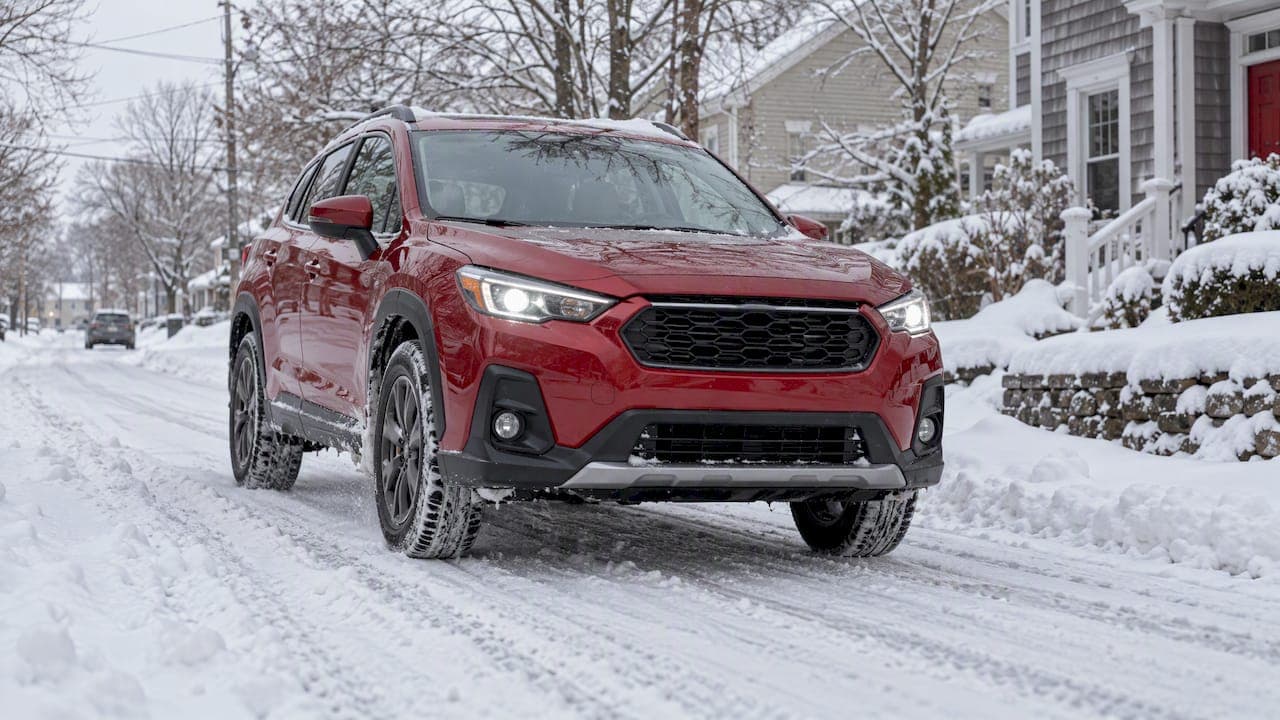
For most winter driving, winter tires matter more than all-wheel drive, because tires control braking and cornering and AWD mostly helps you accelerate. Consumer Reports found that winter tires matter more than AWD in many snow and ice situations. The best setup is both: AWD to get moving and winter tires to stop and steer. If you can only afford one, a front-wheel-drive car on winter tires often beats an AWD vehicle on all-seasons.
TL;DR
- AWD sends power to more wheels, so it helps you pull away on slick or unplowed roads. It does not help you brake or turn.
- Winter tires use softer rubber and deeper tread designed for cold, snow and ice, and they improve going, stopping and cornering.
- An AWD vehicle on all-season tires can still struggle to stop and stay on course. FWD with four winter tires is often the more secure combination.
- Fit winter tires to all four wheels, not just the front pair.
- Buying used? Check the drivetrain, the tire condition and the tread depth before you decide what you need.
Table of Contents
- What does AWD actually do on snow?
- What do winter tires do that all-season tires do not?
- How much shorter are stopping distances with winter tires?
- Do you need winter tires if you have AWD?
- Is AWD with all-season tires better than FWD with winter tires?
- Should winter tires go on all four wheels?
- How do you get the most out of AWD in winter?
- What should you check when buying a used AWD vehicle?
- Our view on AWD and winter tires
- Find a winter-ready used vehicle in Providence
- FAQ
- Sources
What does AWD actually do on snow?
All-wheel drive delivers engine power to all four wheels instead of two. When one tire slips, the system can send torque to tires with more grip. That is a real advantage when you are pulling out of a snowy driveway, climbing a hill or moving through an unplowed street.
The limit is that driving a car has three jobs: going, stopping and turning. Bridgestone notes that AWD can help with unplowed roads and acceleration on slick surfaces but does little for turning and braking on snow and ice. Your brakes act on all four wheels in every car, whether it is AWD or not, so the extra driven wheels add nothing at a stop sign.
That is the reason drivers feel confident in AWD and then get surprised. The car accelerates so easily that it feels sure-footed, right up to the moment you need to slow down for a turn or a red light.
What do winter tires do that all-season tires do not?
Every system in your car, AWD included, depends on four patches of rubber about the size of a hand. Michelin makes the point that tires are the only contact between the vehicle and the road, however advanced the technology above them.
Winter tires are built for that contact patch in three ways:
- A rubber compound that stays soft in the cold. All-season rubber stiffens as temperatures fall and loses grip.
- Deeper tread with more biting edges. These grip snow and pack it into the grooves, which helps because snow grips snow.
- Tread patterns designed to move slush and water. That keeps more rubber on the pavement.
Bridgestone's guidance is that winter tires are strongly recommended for AWD vehicles in regions with frequent winter storms or temperatures below 45°F. That is a useful rule of thumb in New England, where many cold mornings have no snow at all but still bring pavement that is cold enough to stiffen all-season rubber.
How much shorter are stopping distances with winter tires?
Stopping is where the gap is largest, and the numbers are consistent across testers.
| Test | What was compared | Result |
|---|---|---|
| Tire Rack, 2026 | Snow stops from 25 mph, winter vs conventional all-season | Winter tires stopped over 25 feet shorter, with similar advantages on ice |
| MotorTrend, 2019 | 12 mph braking, same SUV on winter vs all-season tires | 34 feet vs 57 feet, about 1.5 car lengths |
| Consumer Reports, 2015 | AWD vehicles on all-season tires on a snow course | Some struggled to stay on course, and a couple plowed through corners and off the track |
One more comparison is closer to the decision you face. Tire testers ran a pair of Mini Countryman models, one AWD on all-season tires and one front-drive on winter tires. The AWD car accelerated out of corners better. The front-drive car on winters stopped about a car length shorter on snow, and its turn-in and braking were better. The lap times on the handling course were nearly identical, but the winter-tire car was easier to control.
That is a single test of one model, so read it as an illustration of the pattern rather than a rule for every vehicle. It matches what Consumer Reports and the tire makers describe.
Do you need winter tires if you have AWD?
In most of the snow belt, yes, if you want the shortest stops and the most predictable cornering. Bridgestone puts it plainly: AWD does not remove the need for winter tires, and in areas with heavy snowfall, AWD with good winter tires is the most versatile combination.
Many drivers skip them anyway. In a Consumer Reports survey of 54,295 subscribers who drove AWD or 4WD vehicles in snow for more than six days the previous winter, fewer than 15 percent used winter tires. That means most AWD owners are relying on the one feature that does not help them stop.
Here is a simple way to decide:
- You drive in snow or ice regularly, or on hilly roads: AWD plus four winter tires gives you the most margin.
- You drive mostly plowed city roads and can wait out storms: AWD on good all-season tires may be enough for you, though cold mornings still favor winter rubber.
- You have a front-wheel-drive car and a tight budget: four winter tires are usually the better first investment than changing vehicles.
Is AWD with all-season tires better than FWD with winter tires?
It depends on what you ask the car to do. For pulling away on a snowy hill or from a deep, unplowed driveway, the AWD vehicle has an edge. For stopping, turning and holding a line, the winter-tire car has the edge. Since most winter crashes happen when a driver cannot slow or steer in time, not when they cannot get started, grip at the tires usually wins.

Another point, which often gets missed, is that you can improve the second car more cheaply than the first. Adding winter tires to a car you already own costs far less than buying AWD. If you are shopping, though, you do not have to choose: many used SUVs come with AWD, and you can add winter tires after the purchase.
Should winter tires go on all four wheels?
Yes. Bridgestone's tire manual says winter tires applied to the front axle must also be applied to the rear for safe operation, and it names front-wheel-drive, 4x4 and AWD vehicles. The same manual says safe operation under braking and cornering is especially dependent on the rear tires in winter.
In practice, two winter tires and two all-seasons give you a car with mismatched grip: the end with winter tires holds, and the other end can slide. A set of four matched tires keeps the car predictable.
Tire matching matters for AWD mechanics too, since the drivetrain is designed around tires of similar size and wear. Our guide on tire matching and inspection checks for AWD vehicles explains what to look for.
How do you get the most out of AWD in winter?
Whichever tires you choose, a few habits make the car safer.
Start gently and let the system work. AWD helps you pull away, but hard throttle on ice can still spin tires. Hill starts are easier when you understand the vehicle's hold features. This explanation of hill hold control and rollback shows how a car can help you launch from a stop on a slope, and why that assistance does not replace tire grip when you need to brake.
Leave more room. Stopping distances on snow and ice are much longer than on dry pavement, no matter what you drive. Slow down before the corner, not in it.
Check tread depth. Worn tires lose snow grip quickly. Use our at-home tire tread depth check before the first storm.
Rinse off road salt. Salt and brine stay on the underbody and wheels all winter. Advice on winter car washing frequency applies to Rhode Island's salted coastal roads too: frequent rinses protect paint, wheels and underbody parts.
Prepare early. Our checklist for Rhode Island winter driving and fall prep covers the rules and the supplies to have before the first storm.

What should you check when buying a used AWD vehicle?
If winter capability is on your list, shop with these checks:
- Confirm the drivetrain. AWD, 4WD and front-wheel drive are not the same. Ask which system the vehicle has and how it works. If you are looking at a 4x4 pickup, read about checking the locking differential first.
- Look at all four tires. Matching brand, size and wear on an AWD vehicle protects the drivetrain. Uneven tires are a negotiating point or a cost to plan for.
- Measure tread depth. Deep tread matters in snow and slush.
- Ask for the vehicle history report and inspection details. Know what was checked and what was serviced.
- Budget for a second set of wheels and tires. Many drivers keep winter tires on separate wheels to make seasonal swaps simpler.
Families weighing size and features can use our used SUV buying checklist for families and our roundup of the best used SUVs for families. If you are unsure whether to go used or new, see used SUV vs new SUV.
Our view on AWD and winter tires
We sell used vehicles in Providence, and winter is when buyers ask us the most about drivetrains. Our honest answer is that AWD and winter tires do different jobs, and the best result comes from using both.
AWD is a genuine advantage in New England. It helps you get out of a snowy driveway, up a slick hill and onto the road with confidence. That is why so many families and commuters ask us for SUVs and why we are glad to help them find one that fits their budget.
Tires are the other half. We never want a buyer to leave with a drivetrain they trust more than their tires can support. That is why we inspect every vehicle we sell, and why we encourage you to look at tread depth and tire matching on any vehicle you consider.
Because we do not work on commission, you can ask us direct questions about drivetrains, tires and history reports without feeling pushed. If you want an AWD vehicle, we will help you find one. If a front-wheel-drive car suits your budget better, we will tell you what it takes to make it winter-ready.
Elmwood
Find a winter-ready used vehicle in Providence
If you want AWD for the winter, we can help you find it. Browse our used SUVs, trucks, vans and cars, or tell us what you need and let our Car Finder search for you. Our vehicles go through a thorough inspection before they are sold, and our sales team does not work on commission, so you can take your time.
Need financing? We offer in-house and third-party options for a range of credit profiles, including buy here, pay here. You can apply for used car financing online. Have a car to trade in? Start on our trade-in page, and when you are ready to see a vehicle in person, book a test drive.
FAQ
Is AWD or winter tires better for snow?
Winter tires usually make a bigger difference overall, because they improve stopping and cornering as well as starting. AWD mainly helps you accelerate. For the best result, use AWD with winter tires on all four wheels.
Can I use winter tires on only two wheels?
That is not recommended. Bridgestone's manual says winter tires on the front axle must also be on the rear for safe operation, including on AWD vehicles. Mismatched grip can make the car unpredictable under braking and in turns.
When should I put winter tires on?
Bridgestone points to sub-45°F temperatures as a time when winter tires are strongly recommended, so many New England drivers swap in late fall, before the first storm. Winter tires that stay on in warm weather wear faster, so plan to swap them back in spring.
Is AWD worth it if I already plan to buy winter tires?
It can be. AWD helps you start on hills and in unplowed streets, and it pairs well with winter tires. If your budget is tight, a front-wheel-drive vehicle on four winter tires is a strong, practical choice. We can talk through both options with you in Providence.
Sources
- Do You Really Need AWD in the Snow? Consumer Reports
- Do I Need Snow Tires If I Have AWD? Bridgestone
- Tire Maintenance, Safety and Warranty Manual, Bridgestone (NHTSA)
- AWD vs Winter Tires: The Truth About Safety, Michelin USA
- Winter Tires vs. All-Season: What the Tests Actually Show, Tire Rack
- Are Snow and Winter Tires Worth It? MotorTrend
- AWD With All-Season Tires Or FWD On Snows, Motor1
- Hill hold control and rollback
- Winter car washing frequency