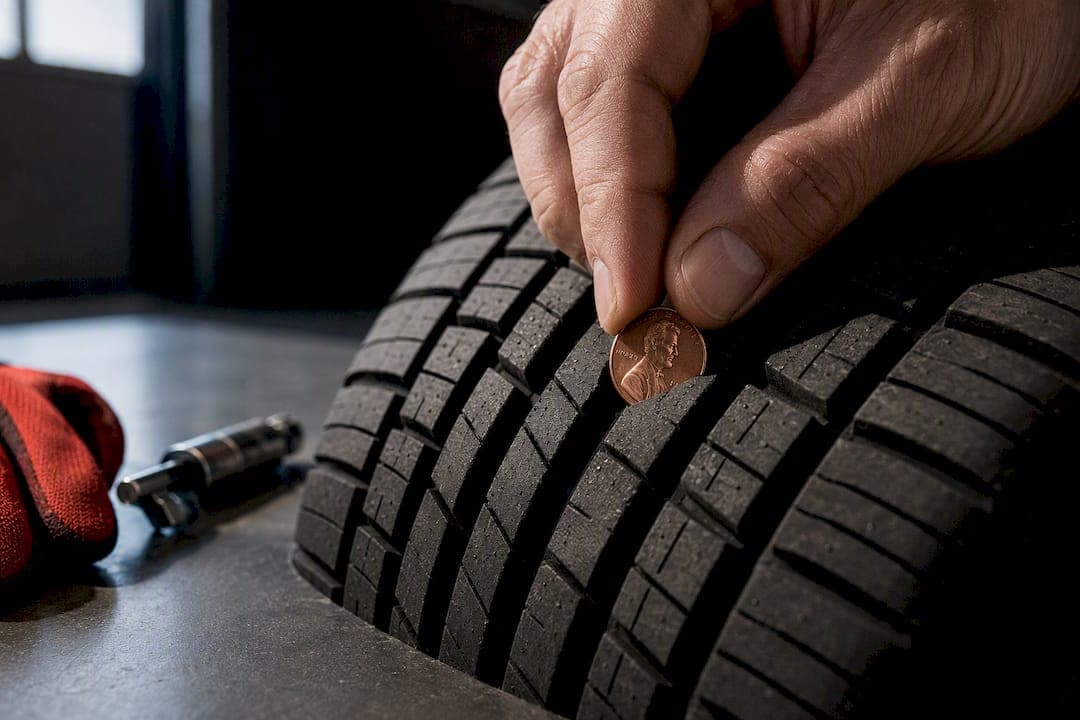
The fastest way to know if a tire is unsafe is a penny test at 2/32". Slide a penny into the tread with Lincoln's head down; if the top of his head shows, that tire needs replacing now. The four reliable checks are the penny test, the quarter test, a tread depth gauge, and the built-in wear bars molded into the tire itself. Measure several spots on each tire, not just one, and glance over the sidewall for damage while you're down there.
TL;DR:
- Checking multiple points on each tire with a gauge or coin is essential since uneven wear can indicate mechanical issues needing attention.
- Replace tires at or below 2/32 inch tread depth immediately, but consider 4/32 inch as the safer threshold for wet or winter conditions.
- Visible sidewall damage or embedded objects require urgent professional assessment, regardless of tread depth.
- Regular monthly checks of tread and pressure extend tire life and improve safety, especially for drivers with heavy mileage or rough conditions.
- Replacing only the worn tires on the rear axle improves vehicle stability in wet conditions, regardless of tread depth across all tires.
Table of Contents
- What Is a Tire Tread Depth Check and Which Method Should You Use?
- How to Measure Tire Tread Depth the Right Way
- Why Uneven Tread Wear Is a Warning Sign, Not Just a Number
- When Should You Actually Replace Your Tires?
- Beyond the Tread: Visual Signs a Tire Needs Attention Now
- How Often Should You Check Your Tires?
- What a Professional Tire Inspection at Elmwood Auto Sales Covers
- A Practical Note on Getting This Right
- Get a Professional Tire Check at Elmwood Auto Sales
- Sources
- FAQ
What Is a Tire Tread Depth Check and Which Method Should You Use?
Each method balances speed against precision, and knowing when to reach for which one keeps you from either wasting time or missing a problem.

The penny test is the classic go-to. Insert a penny into a tread groove with Lincoln's head pointing down. If any part of his head is visible, the tread has worn down to 2/32 inch or less. Goodyear considers that tire done. That threshold matches federal guidance from the U.S. Tire Manufacturers Association, which sets 2/32 inch as the replacement line for passenger tires.
The quarter test works the same way but checks for a deeper margin. Flip a quarter into the groove with Washington's head down. If his head disappears into the tread, you have roughly 4/32 inch remaining, a level Goodyear and Michelin both flag as a safer cushion for wet roads.
A tread depth gauge removes the guesswork. These small tools cost only a few dollars, slide into the groove, and give you an exact reading in 32nds of an inch, which Goodyear notes makes it more reliable than either coin test.
Wear bars, the rubber ribs molded across the tread, appear flush with the surface once a tire hits 2/32 inch. The National Highway Traffic Safety Administration requires these indicators on every passenger tire, and since they're spaced intermittently around the circumference, you may need to rotate the wheel a bit to spot one.
- Penny test: fast, free, confirms the legal minimum
- Quarter test: fast, free, confirms the safer 4/32" buffer
- Gauge: most accurate, best for tracking wear over time
- Wear bars: built-in, no tools required, check at several points
How to Measure Tire Tread Depth the Right Way
A single measurement tells you almost nothing, because tires rarely wear evenly. Here's a routine that gives you a real picture of each tire's condition.
- Pick three spots on each tire: the center groove, the inner shoulder, and the outer shoulder.
- Rotate the wheel and repeat at two or three points around the circumference, since wear often varies with steering geometry and road crown.
- Insert the coin or gauge straight down into the groove, not at an angle, and press until it touches the base.
- Record the lowest number you find, not the average. Goodyear is clear on this: a single low spot governs the tire's status even if every other reading looks fine.
- Compare that lowest reading against your thresholds. At or below 2/32 inch, replace immediately. Between 2/32 inch and 4/32 inch, plan to replace soon, especially before wet or snowy weather.
- Write it down. A simple note with the date and mileage lets you track how fast a tire is wearing and catch a problem before it becomes a blowout.
Pro Tip: Keep a tread depth gauge in your glove box next to your tire pressure gauge. Checking both takes under five minutes and turns a guessing game into an actual record you can trust.
Why Uneven Tread Wear Is a Warning Sign, Not Just a Number
If even one spot on one tire reads 2/32 inch, that tire gets replaced, regardless of what the rest of the tire or the other three tires measure. Uneven wear is also a symptom, not just a measurement problem, and it usually points to something mechanical.
- Wear concentrated in the center: often overinflation
- Wear on both outer edges: often underinflation
- Wear on one edge only: usually misalignment
- Cupping or scalloped patches: often worn shocks or suspension components
- One tire wearing faster than the other three: check that tire's alignment and balance individually
A quick check of tire pressure against the placard inside your driver's door catches the inflation issues in minutes. Alignment and suspension problems need a shop's attention. If only one or two tires show heavy wear while the others look fine, you may be able to replace just those, but if the cause is mechanical, fix that first or you'll wear out the new tires the same way.
When Should You Actually Replace Your Tires?
The legal floor is 2/32 inch, and both NHTSA and the U.S. Tire Manufacturers Association treat it as the point where a tire has to come off the vehicle. But "legal" and "safe" aren't the same thing.
Traction doesn't hold steady until 2/32 inch and then drop off a cliff. Michelin notes that wet-weather stopping distance and hydroplaning resistance decline noticeably once tread falls below 4/32 inch, well before the legal minimum.
That's why many technicians recommend treating 4/32 inch as your real trigger point, particularly if you drive in rain, snow, or ice regularly. Heavier vehicles and trucks carrying loads face the same physics with less margin for error. If you're only replacing two tires instead of four, install the new pair on the rear axle. The U.S. Tire Manufacturers Association recommends this placement to keep the vehicle stable in wet conditions.
Beyond the Tread: Visual Signs a Tire Needs Attention Now
A tire can measure fine on tread depth and still be dangerous. Walk around the vehicle and check the sidewalls and surface for these signs before you drive anywhere.
- Bulges or blisters on the sidewall, which signal internal damage
- Cords or fabric showing through the rubber
- Cuts or gouges deep enough to expose the tire's internal layers
- Cracking along the sidewall, common on older tires even with plenty of tread
- Tread separating from the tire body, sometimes visible as a bubble or lump
- Embedded objects like nails or screws, which need immediate professional attention rather than a quick pull
Any of these calls for a stop, not a drive to the shop. Have the vehicle towed or driven at low speed on local roads only, and get frame and structural damage checked too if the tire damage followed a pothole or curb strike, since the impact can affect more than just the tire.
How Often Should You Check Your Tires?
Check tread depth about once a month, ideally the same time you check tire pressure, since both take just a few minutes. Drivers who put on serious highway miles, tow trailers, or deal with harsh winters should check more often.
- Monthly check: tread depth and tire pressure together
- Rotation: every 5,000 to 8,000 miles or per your owner's manual, which the U.S. Tire Manufacturers Association ties directly to even wear and longer tire life
- Professional inspection: piggyback it onto an oil change or scheduled service, when a technician already has the vehicle on a lift
Keeping a tire dressing product on hand can also help protect sidewalls from cracking between checks, and resources like this tire dressing comparison walk through options for general upkeep.
What a Professional Tire Inspection at Elmwood Auto Sales Covers
If you'd rather have a second set of eyes confirm your readings, A professional tire inspection typically includes checks of tread depth, sidewall condition, and alignment indicators, often done without commission-driven pressure to sell unnecessary services. Our test-drive checklist covers exactly what a technician looks for during a road test, tires included. Bring the vehicle in, or ask about an inspection when you schedule a visit.

A Practical Note on Getting This Right
Most drivers check one spot and call it done. That's the mistake. Measure several points, use a gauge when precision matters, and replace early. A new tire costs far less than what a blowout on the highway can cost you.
— Elmwood
Get a Professional Tire Check at Elmwood Auto Sales
A professional inspection can provide confirmation of tread readings and sidewall condition with no sales pressure attached.
Every vehicle in our inventory goes through a thorough inspection before it ever reaches the lot, covering tires, alignment indicators, and the same points outlined in our test-drive checklist. If your current tread readings have you thinking about your next vehicle instead of a fourth tire, our Car Finder tool can match you with something reliable, and our trade-in page lets you see what your current car is worth toward the switch. Ready to have a professional take a look? Schedule a test drive at Elmwood Auto Sales in Providence and get your tires, and the rest of the vehicle, checked out properly.
Sources
- How To Measure Tire Tread Depth | Goodyear
- Care and Service of Passenger and Light Truck Tires | USTMA / USTires
- Tire tread depth: why it matters and how to measure it | Michelin USA
- NHTSA interpretation: treadwear indicator and related requests
FAQ
Should I replace my tires when tread depth is around 5/32 inch?
Not necessarily right away, but start watching closely, especially before wet weather. At 5/32 inch you're still above the 4/32 inch buffer that Michelin associates with reduced wet-traction risk, but you're getting close.
Is it normal to have 40,000 miles on a set of tires?
It depends entirely on the tire and driving conditions rather than mileage alone; check tread depth directly instead of relying on an odometer number, and read more on planning replacements ahead of major mileage milestones.
What counts as a bad tread depth for tires?
Anything at or below 2/32 inch is the legal replacement point set by NHTSA and the U.S. Tire Manufacturers Association. Many technicians consider anything below 4/32 inch worth planning to replace soon, particularly for wet-weather driving.
Is 6/32 inch enough tire tread?
Yes, 6/32 inch is generally considered healthy tread with room to spare before you need to think about replacement. Keep checking it monthly and watch for uneven wear across the tire, since a single low spot can drop faster than the rest.