
Choosing between a used SUV and a new SUV is defined by one core trade-off: lower upfront cost and faster feature access versus factory warranty protection and long-term reliability certainty. For most budget-conscious buyers in 2026, the used SUV vs new SUV decision comes down to how long you plan to own the vehicle, how much financing costs matter to your monthly budget, and whether you prioritize immediate savings or peace of mind. Both paths have real advantages. The right answer depends on your financial situation, ownership goals, and risk tolerance. This guide lays out the numbers and the nuances so you can decide with confidence.
How do the costs compare between used and new SUVs?
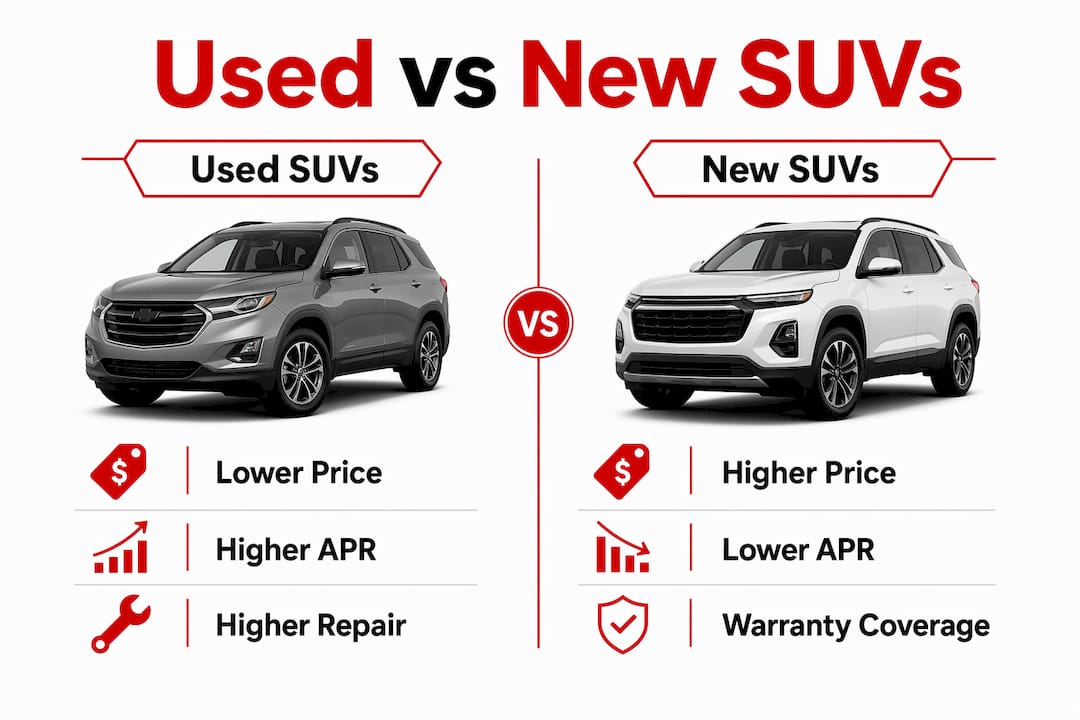
The monthly payment difference between used and new SUVs is significant. Used SUV buyers pay an average of $537 per month compared to $767 for new SUV buyers, a gap of $230 every month. Over a five-year loan, that difference adds up to $13,800 in total payment savings, which is real money for any household budget.
However, financing rates complicate the picture. New-car loans average 6.6% APR while used-car loans average 11.4% APR. That higher rate on a used vehicle partially offsets the lower purchase price, meaning your total interest paid over the loan term can be higher than you expect. A buyer financing $28,000 on a used SUV at 11.4% pays considerably more in interest than someone financing $35,000 on a new SUV at 6.6%, depending on loan length.
Depreciation is the other major cost factor. New SUVs lose the most value in their first two years, which is why buying around three years old captures the steepest depreciation drop without sacrificing too much in technology or condition. A three-year-old Toyota RAV4 or Honda CR-V typically retains strong reliability while costing 20 to 30 percent less than its new equivalent.
Repair costs also factor into total cost of ownership. Used SUVs over five years old average $800 to $1,000 in annual repair costs once factory warranties expire. New SUVs carry no such near-term repair risk, though their higher monthly payments represent a different kind of ongoing financial obligation.
| Cost Factor | Used SUV | New SUV |
|---|---|---|
| Average monthly payment | $537 | $767 |
| Average loan APR | 11.4% | 6.6% |
| Annual repair costs (5+ years) | $800–$1,000 | Minimal under warranty |
| First-year depreciation | Already absorbed | 15–25% of purchase price |
| Down payment requirement | Lower | Higher |
Pro Tip: Run your numbers through a loan calculator before visiting any dealership. Plug in both the used and new purchase prices with their respective average APRs to see your true monthly obligation and total interest paid over the loan term.
What features and vehicle conditions set used SUVs apart?
One of the strongest reasons for buying a used SUV is feature access. Used SUVs provide access to premium features like leather seating, panoramic sunroofs, and advanced safety suites at prices well below what those trims cost new. A buyer with a $30,000 budget can often purchase a three-year-old luxury-trim SUV, such as a Mazda CX-90 Premium Plus or a Hyundai Palisade Calligraphy, that would have cost $48,000 to $55,000 new. That is a meaningful upgrade in comfort and technology for the same monthly budget.
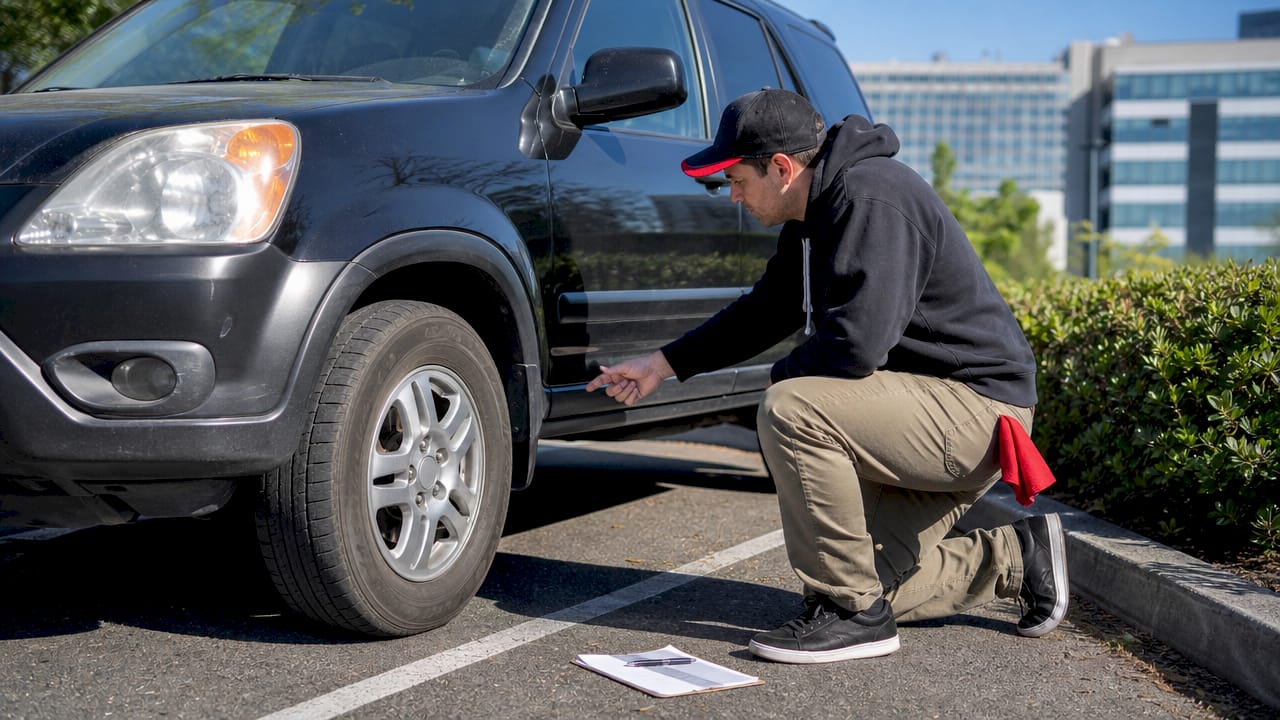
The trade-off is condition uncertainty. Used vehicles carry histories you cannot always see at first glance. Deferred maintenance, minor collision repairs, and flood damage are real risks that a vehicle history report from Carfax or AutoCheck can partially reveal but not fully guarantee against. Comprehensive service records are more predictive of used vehicle reliability than mileage alone, which means a 70,000-mile SUV with full dealer service documentation is often a safer buy than a 45,000-mile vehicle with gaps in its maintenance history.
New SUVs eliminate that uncertainty entirely. Factory warranties and known quality reduce the risk of hidden damage or unexpected maintenance issues in the first several years of ownership. For buyers who want to drive without worrying about what the previous owner did or did not do, that peace of mind carries real value.
Certified pre-owned programs represent a middle ground worth considering. CPO SUVs from brands like Toyota, Honda, and Ford go through multi-point inspections and carry extended manufacturer-backed warranties, often at prices 10 to 15 percent below comparable new models. They offer much of the reliability assurance of a new vehicle while preserving some of the cost savings of buying used.
Pro Tip: Always request a full vehicle history report and an independent pre-purchase inspection from a trusted mechanic before finalizing any used SUV purchase. A $150 inspection fee can prevent a $4,000 repair surprise.
How does your ownership timeline affect the used vs new decision?
How long you plan to keep the vehicle is one of the most decisive factors in the used SUV vs new cost analysis. Here is how ownership duration shapes the financial outcome:
-
Keep it 7 to 10 years. Buying new makes stronger financial sense when you hold the vehicle long enough to spread depreciation across many years. Long-term ownership favors new vehicles, according to Kevin Roberts of CarGurus, because the per-year depreciation cost drops significantly the longer you own the car. A $42,000 SUV kept for ten years costs $4,200 per year in depreciation. The same vehicle sold after three years costs far more per year of use.
-
Plan to trade in within 3 to 5 years. Buying used is the smarter play here. You avoid the steepest depreciation curve, pay a lower purchase price, and can resell at a value that has already stabilized. Frequent traders who buy new absorb the largest depreciation losses.
-
Drive high annual mileage. High-mileage drivers, those covering 18,000 to 25,000 miles per year, should weigh used vehicle wear rates carefully. A used SUV with 40,000 miles that you drive 20,000 miles annually will reach 100,000 miles in three years, potentially triggering major maintenance costs sooner than expected.
-
Drive low annual mileage. Low-mileage drivers, under 10,000 miles per year, often get the most value from a used SUV purchase. The vehicle ages slowly, repair costs stay manageable, and the lower purchase price delivers clear savings without accelerated wear.
Modeling these scenarios with a loan calculator before you commit is the most practical step any buyer can take. Tools like the calculators on Bankrate or NerdWallet let you input purchase price, APR, loan term, and estimated annual mileage to project true cost of ownership across different timelines.
What are the reliability and safety considerations?
Reliability and safety are where new SUVs hold their clearest advantage. The newest models from Toyota, Subaru, and Hyundai include standard driver assistance features like automatic emergency braking, lane-keeping assist, and adaptive cruise control that were optional or unavailable on models from five or more years ago. If active safety technology is a priority for your family, a newer model year delivers measurably better protection.
That said, used SUVs from reliable brands hold up well. The Toyota 4Runner, Honda Pilot, and Subaru Outback consistently rank among the most dependable used SUVs on the market, with repair frequencies well below the industry average even at higher mileage. Checking crash test ratings from the Insurance Institute for Highway Safety (IIHS) and the National Highway Traffic Safety Administration (NHTSA) for the specific model year you are considering gives you objective safety data rather than general assumptions.
| Reliability Factor | Used SUV | New SUV |
|---|---|---|
| Factory warranty coverage | Expired or limited | Full manufacturer warranty |
| Driver assistance tech | Varies by model year | Standard on most 2024+ models |
| Crash test data availability | Available for older models | Current ratings available |
| Annual repair cost risk | $800–$1,000 (5+ years old) | Minimal in first 3 years |
| CPO option available | Yes, for qualifying vehicles | Not applicable |
A three-year-old SUV often balances lower depreciation with technology and safety features comparable to new models, making it the sweet spot for buyers who want reliability without paying full new-car prices. Extended warranty plans and vehicle service contracts can add another layer of protection for used buyers who want coverage beyond the factory warranty period.
When does buying a used SUV make the most sense in 2026?
The current market conditions in 2026 favor used SUV buyers in several specific situations. Over 20% of new vehicle buyers in Q4 2025 carried monthly payments exceeding $1,000, a clear sign that new vehicle affordability has become strained for a large segment of buyers. Used SUVs directly address that pressure.
Buying used makes the most sense when you fit one of these buyer profiles:
- You need a lower down payment to preserve cash reserves for other financial priorities.
- Your credit history means you qualify for financing but at rates that make a lower purchase price critical to keeping payments manageable.
- You want access to a higher trim level or luxury brand that falls outside your new-car budget. A used Acura MDX or Volvo XC60 often costs less than a new mid-trim Toyota Highlander.
- You are a first-time SUV buyer who wants to test the vehicle type before committing to a long-term new-car loan.
- You live in a region like Rhode Island where road salt and winter conditions mean vehicles depreciate faster, making a lower initial investment more practical.
The benefits of used SUVs extend beyond price. Lower registration fees, reduced insurance premiums on older model years, and the ability to pay off the loan faster all contribute to financial flexibility that new-car buyers often sacrifice.
Key takeaways
The smartest choice between a used SUV and a new SUV depends on your ownership timeline, monthly budget, and how much reliability certainty you need.
| Point | Details |
|---|---|
| Monthly payment gap | Used SUVs average $230 less per month than new, freeing up meaningful cash flow. |
| Financing rate trade-off | Higher used-car APRs (11.4% vs 6.6%) can offset purchase price savings on longer loans. |
| Three-year sweet spot | SUVs around three years old capture post-depreciation value while retaining modern safety tech. |
| Ownership duration matters | Long-term owners benefit more from buying new; short-term or frequent traders save more buying used. |
| Inspection is non-negotiable | Service records and pre-purchase inspections are the most reliable predictors of used SUV reliability. |
My honest take on the used vs new SUV debate
At Elmwoodautosalesri, we work with buyers across every budget and credit profile, and the most common mistake we see is buyers stretching into a new SUV payment they cannot comfortably sustain. A $767 monthly payment sounds manageable in the dealership, but it becomes a real burden when paired with insurance, fuel, and registration costs. We have seen buyers walk away from a new SUV purchase, reconsider their timeline, and find a three-year-old certified pre-owned model that checks every box at $230 less per month.
The other misconception worth addressing directly: used does not mean unreliable. The buyers who get burned on used vehicles are almost always the ones who skipped the vehicle history report or declined a pre-purchase inspection. Every used SUV on our lot at Elmwoodautosalesri goes through a thorough inspection before it is offered for sale. That is not a marketing line. It is the standard we hold ourselves to because our reputation in Providence depends on it.
My practical advice: decide your ownership timeline before you decide your budget. If you are keeping the vehicle for a decade, consider new. If you are realistic about trading in within five years or need to preserve monthly cash flow, a well-inspected used SUV from a trusted source is almost always the stronger financial decision in 2026's market.
— Elmwood
Find your next SUV at Elmwoodautosalesri
Elmwoodautosalesri carries a curated inventory of inspected used SUVs in Providence, RI, with transparent pricing and no commission-based pressure tactics. Whether you are comparing a certified pre-owned Mazda CX-90 or evaluating financing options that fit your credit history, the team at Elmwoodautosalesri provides honest guidance at every step. The dealership offers buy-here, pay-here solutions for buyers with a range of credit backgrounds, along with tailored loan structures designed to keep monthly payments realistic. Explore the current inventory and use the online tools to model your financing before you visit. Quality vehicles and straightforward service are the standard, not the exception.
FAQ
What is the average monthly payment difference between used and new SUVs?
Used SUV buyers pay an average of $537 per month compared to $767 for new SUV buyers, a difference of $230 monthly. Over a five-year loan, that gap represents $13,800 in total payment savings.
Should I buy a new or used SUV if I plan to keep it long-term?
Long-term ownership of seven to ten years generally favors buying new, because depreciation is spread across more years and factory warranty coverage reduces early repair costs. Buyers who trade in within five years typically save more by purchasing used.
How do I reduce reliability risk when buying a used SUV?
Request a full vehicle history report from Carfax or AutoCheck and pay for an independent pre-purchase inspection before finalizing any used SUV purchase. Comprehensive service records are more predictive of reliability than mileage alone.
What is a certified pre-owned SUV and is it worth it?
A certified pre-owned SUV is a used vehicle that has passed a manufacturer-approved multi-point inspection and carries an extended warranty backed by the automaker. CPO programs from Toyota, Honda, and Ford offer reliability closer to new vehicles at prices typically 10 to 15 percent below comparable new models.
Are used SUVs more expensive to finance than new ones?
Yes. Used-car loans average 11.4% APR compared to 6.6% for new-car loans, which increases total interest paid over the loan term. Buyers should calculate total loan cost, not just monthly payment, when comparing used and new SUV financing options.