
A dealership customer review rating is a calculated, star-based score that reflects the overall satisfaction of car buyers with a dealership's products and services. Platforms like DealerRater and Cars.com generate these ratings by aggregating star scores from multiple verified customer reviews, then weighting them by recency and volume to reflect current dealership performance rather than outdated impressions. The result is a composite trust indicator that tells you, at a glance, how a dealership treats its customers today.
These ratings typically factor in:
- Star scores from individual customer reviews, averaged across all submissions
- Recency weighting, so that recent feedback carries more influence than reviews from several years ago
- Review volume, since a rating built on dozens of reviews is more reliable than one based on just a few
- Dealer response rate, which signals how actively the dealership engages with customer feedback
- Written review sentiment, which adds qualitative depth beyond the numerical score
Understanding what goes into a dealership's rating helps you use it correctly. A 4.8-star score from 12 reviews tells a different story than a 4.6-star score from 400 reviews.
Why customer reviews matter when you're buying a car
Reviews are the closest thing to a trusted referral from a stranger. Nearly all consumers read online reviews before making a purchase, and 85% report that positive reviews influence their decision to buy, while 77% say negative ones push them away. For a purchase as significant as a vehicle, that influence is even more pronounced.
Reviews offer something a dealership's own website cannot: unfiltered accounts of real buyer experiences. They reveal whether the sales process felt transparent, whether the financing options were explained clearly, and whether the vehicle matched its description. A dealership that consistently earns high marks across these areas is one that has built trust through repeated, honest interactions.
92% of consumers care about star ratings when choosing a business, and 31% will only consider dealerships with 4.5 stars or more in 2026, up from 17% just one year earlier.
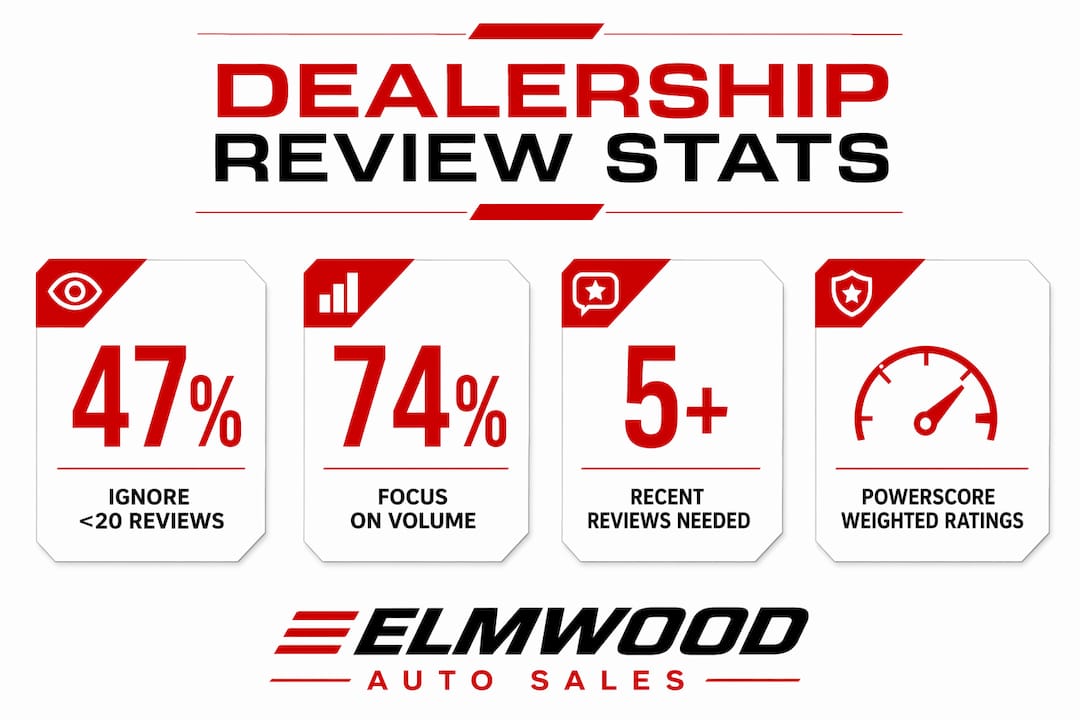
Review volume also matters. 47% of consumers won't use a business with fewer than 20 reviews, and 74% focus only on reviews written within the last three months. Recency and quantity together signal that a dealership is actively serving customers and earning consistent feedback, not coasting on a handful of old five-star scores.
Negative reviews carry weight too, but not always in the way you might expect. A dealership that responds professionally to criticism often builds more trust than one with a perfect score and no engagement. Buyers read those responses and judge whether the dealership takes accountability seriously.

Where to find reliable dealership reviews in the United States
Not all review platforms are equal. Some verify purchases, some use weighted algorithms, and some rely entirely on unmoderated submissions. Knowing where to look saves time and reduces the risk of being misled.
-
DealerRater is one of the most widely used automotive-specific review platforms in the United States. It requires a minimum of 5 reviews within the last 24 months before displaying an official rating, and it weights recent reviews more heavily to reflect current staff and management quality. DealerRater also calculates a PowerScore for award purposes, factoring in star rating, review count, and response rate.
-
Cars.com uses a similar recency-weighted calculation and shares the same minimum review threshold as DealerRater, since both platforms are owned by the same parent company. Cars.com updated its rating methodology in October 2022 to give greater weight to recent reviews, citing data from NADA showing that the average dealership employee tenure is two years.
-
Google Business Profile is the most visited review destination for local businesses in the United States. Ratings here are not automotive-specific, but the sheer volume of Google reviews for most dealerships makes them a useful cross-reference. Look for how the dealership responds to one-star reviews, not just how many five-star scores it has collected.
-
CARFAX Verified Dealer Reviews ties customer feedback directly to vehicle history data, adding a layer of context that general platforms lack. A dealership listed on CARFAX with strong reviews has passed an additional layer of vetting connected to vehicle transparency.
Check review recency on every platform. A dealership with 300 reviews but none posted in the last six months deserves the same scrutiny as one with very few reviews total.
How to evaluate dealership ratings beyond the star score
A star rating is a starting point, not a verdict. Reading it correctly requires looking at several factors together.
- Total review count: A 4.7-star rating from 250 reviews is far more reliable than a 4.9-star rating from 8 reviews. Higher volume reduces the impact of any single outlier review.
- Recency of reviews: Prioritize dealerships with reviews posted within the last 90 days. Staff turnover and management changes can shift the customer experience quickly.
- Dealer responses: When a dealership owner or manager responds to reviews, including negative ones, it signals attentiveness. Professionally handled criticism demonstrates accountability and can actually build confidence in future buyers.
- Sentiment consistency: Look for recurring themes across written reviews. If multiple buyers mention long wait times or unclear pricing, that pattern is more telling than any single complaint.
- Red flags: Be cautious of a cluster of five-star reviews posted within a short window, reviews that use identical phrasing, or a complete absence of any critical feedback. A healthy review profile includes a mix of ratings.
Pro Tip: Cross-reference ratings across at least two platforms before visiting a dealership. A strong score on DealerRater combined with a solid Google Business Profile rating gives you a much more complete picture than either source alone.
One nuance worth knowing: unhappy customers are more likely to post reviews than satisfied ones. This creates a natural imbalance where a dealership's rating may skew lower than its actual service quality. Dealerships that actively encourage satisfied buyers to share their experiences tend to have ratings that more accurately reflect reality. When you see a dealership with a high volume of recent, positive reviews, that effort to collect balanced feedback is itself a trust signal.
For a broader look at what makes a dealership worth trusting, the signs of a trustworthy car dealership go well beyond star scores alone.
What 2026 research reveals about dealership ratings and buyer behavior
The data from 2026 paints a clear picture: consumer expectations for dealership ratings have risen sharply, and the methodology behind those ratings has grown more sophisticated to match.
74% of consumers only trust reviews written in the last three months, and 68% will only use a business with four or more stars.
DealerRater's PowerScore methodology illustrates how far rating systems have moved beyond simple averages. The PowerScore uses a Bayesian algorithm that compares each dealership's star rating, review count, and response rate against the baseline average of all eligible dealers. To qualify for a Consumer Satisfaction Award, a dealership must meet minimum thresholds for the number of reviews and average rating, as well as receive reviews regularly throughout the year. The difference between award winners and runners-up is sometimes a thousandth of a percentage point.
Cars.com applies a parallel approach, requiring at least 5 reviews within 24 months and weighting recent submissions more heavily. A dealership that earned strong reviews three years ago but has gone quiet since will see its displayed rating reflect that gap.
Some platforms take a different approach entirely. The Dealer Transparency Index, developed by CarEdge, scores dealerships based on objective data from verified out-the-door price quotes rather than customer opinions. It grades dealers on itemized price disclosure, fee transparency, and willingness to provide written pricing. This kind of objective scoring complements subjective reviews by measuring dealer behavior directly. Understanding dealership marketing effectiveness alongside review scores gives buyers an even fuller picture of how a dealership operates.
The marketing gap identified in current research is worth understanding. Dissatisfied customers are more emotionally motivated to post reviews than satisfied ones, which means a dealership's public rating can underrepresent its actual quality. Dealerships that actively solicit feedback from happy buyers produce ratings that more accurately reflect the full range of customer experiences. When you evaluate a dealership's score, factor in whether the review volume suggests an active feedback culture or a passive one.
Reviews also function as what researchers describe as an engine of trust, reducing perceived risk by answering the questions buyers actually have: Was the price fair? Was the vehicle as described? Did the financing process feel honest? A dealership with detailed, recent, and consistently positive written reviews answers those questions before you ever walk through the door.
Knowing how to read a dealer's reputation in full context, not just the star score, is one of the most practical skills a car buyer can develop in 2026.
Key Takeaways
Dealership customer review ratings are weighted, multi-factor scores that reflect current buyer satisfaction, and understanding how they are calculated helps you make a more confident, informed car purchase.
| Point | Details |
|---|---|
| Ratings weight recency heavily | DealerRater and Cars.com require at least 5 reviews in 24 months and give recent feedback more influence than older scores. |
| Consumer expectations have risen | In 2026, 31% of buyers will only consider dealerships with 4.5 or more stars, up from 17% the prior year. |
| Volume and consistency matter | 47% of consumers won't trust a business with fewer than 20 reviews; consistent sentiment across reviews is the top trust factor. |
| Dealer responses are a trust signal | Professionally handled negative reviews demonstrate accountability and can positively influence future buyers. |
| Cross-platform checking reduces risk | Comparing ratings on DealerRater, Cars.com, Google Business Profile, and CARFAX gives a more complete and reliable picture. |
At Elmwoodautosalesri, transparency is built into every step of the buying process. No commission-based pressure, thorough vehicle inspections, and financing options designed for a range of credit histories. See why buyers in Providence, RI consistently rate the experience highly.
Explore your options at Elmwoodautosalesri and find a dealership where the reviews reflect exactly what you will experience in person.