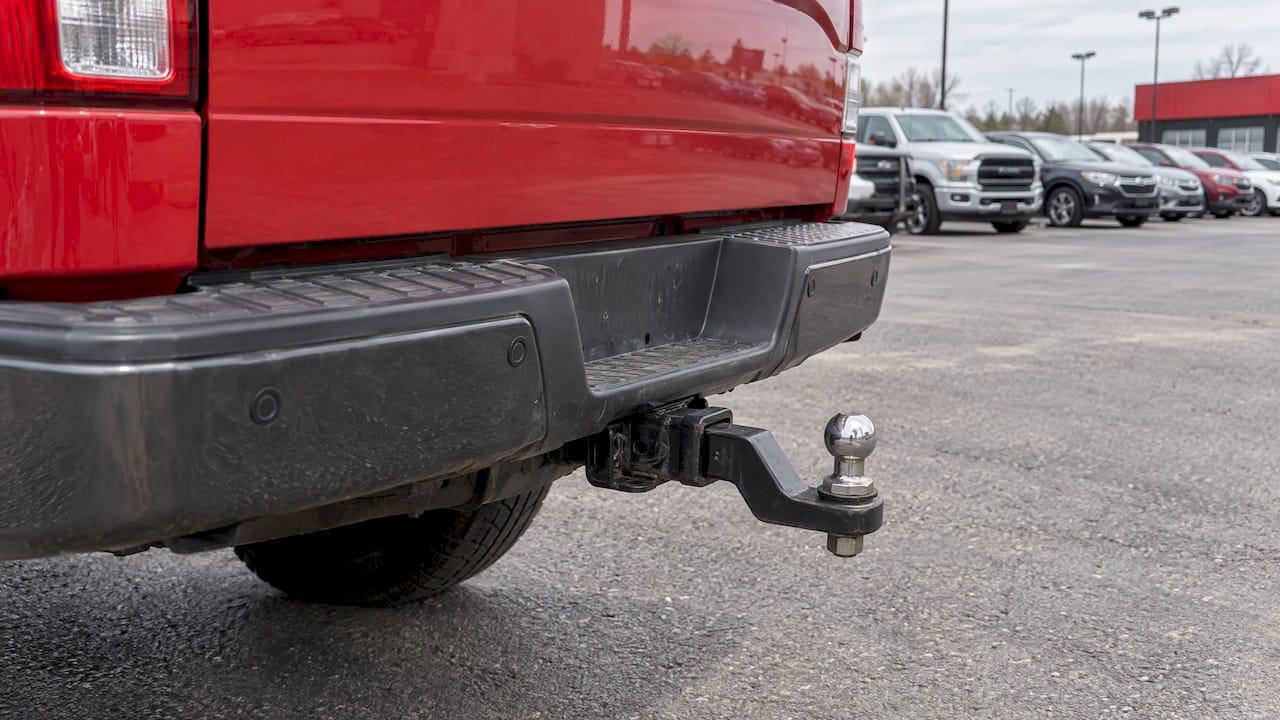
Trailer hitch classes sort receiver hitches by how much weight they can pull and by the size of the receiver opening. Class 1 is the lightest and Class 5 is the heaviest. A higher number means a higher capacity and, in general, a larger receiver tube. The class on the hitch is only half the answer, though. Your vehicle's own tow rating decides how much you can actually pull, and we walk through how to check both below.
TL;DR
- Hitches come in five classes. Class 1 and 2 use a 1-1/4 inch receiver, and Class 3 and 4 use a 2 inch receiver.
- Using CURT's ratings, Class 1 tops out around 2,000 lbs, Class 2 around 3,500 lbs, Class 3 at 8,000 lbs, and Class 4 at 10,000 lbs.
- Your towing setup is only as strong as its lowest-rated part, and that includes the vehicle, the drawbar and the ball.
- Check the label on the hitch and the tow rating in your owner's manual before you buy a trailer or a vehicle.
Table of Contents
- What are trailer hitch classes, and why do they exist?
- How do the five hitch classes compare?
- What is the difference between a Class 1 and a Class 2 hitch?
- What does a Class 3 hitch tow?
- What is a Class 4 hitch rated for?
- What are the receiver hitch sizes?
- How do you match a hitch class to your vehicle and trailer?
- Which class fits which kind of trailer?
- What should you look for in a used vehicle if you plan to tow?
- Our perspective on hitch classes and used vehicles
- Looking for a used truck or SUV that can tow?
- FAQ
- Sources
What are trailer hitch classes, and why do they exist?
The towing industry developed a classification system that groups hitches by how much weight they can tow, covering both total trailer weight and tongue weight, according to the Oregon Department of Transportation. The same guide notes that the three most common hitch types are weight-carrying, weight-distributing, and fifth-wheel or gooseneck hitches.
For most drivers, the classes refer to receiver hitches, the square tube bolted to the frame that accepts a ball mount. CURT divides receiver hitches into five classes based on towing capacity and receiver tube size.
Two numbers matter in every class:
- Gross trailer weight (GTW): the total weight of the trailer and everything on it.
- Tongue weight (TW): the downward force the trailer coupler puts on the hitch ball.
Both are printed on the hitch label, and both need to be at or above what your trailer will actually weigh when loaded.
How do the five hitch classes compare?
The figures below use CURT's published ratings. Other manufacturers publish slightly different numbers. Mopar's trailering guide, for example, lists lower figures for some classes, so always read the label on the actual hitch.
| Class | Receiver size | Max trailer weight (GTW) | Max tongue weight (TW) | Typical vehicles |
|---|---|---|---|---|
| Class 1 | 1-1/4 inch | Up to 2,000 lbs | 200 lbs | Compact cars, crossovers |
| Class 2 | 1-1/4 inch | Up to 3,500 lbs | 350 lbs | Cars, vans, crossovers |
| Class 3 | 2 inch | Up to 8,000 lbs (12,000 lbs with weight distribution) | 800 lbs (1,200 lbs with weight distribution) | Crossovers, vans, SUVs, trucks |
| Class 4 | 2 inch | Up to 10,000 lbs (12,000 lbs with weight distribution) | 1,000 lbs (1,200 lbs with weight distribution) | SUVs, full-size trucks |
| Class 5 | 2 inch or 2-1/2 inch | Varies by manufacturer, commonly 17,000 to 20,000 lbs and up | Varies by manufacturer | Heavy-duty trucks |
The Class 1, 2, 3 and 4 figures come from CURT's hitch class guide. Class 5 is a special case: according to TruckSpring, the Society of Automotive Engineers does not officially recognize Class 5, so you should confirm what a Class 5 hitch can safely tow with its manufacturer.
What is the difference between a Class 1 and a Class 2 hitch?
Both use the same 1-1/4 inch receiver and are made for light-duty trailers behind cars, vans and crossovers. The difference is capacity. CURT rates Class 1 at about 2,000 lbs GTW and 200 lbs TW, and Class 2 at up to 3,500 lbs GTW and 350 lbs TW.
In practice:
- Class 1 suits a bike rack, a cargo carrier or a small utility trailer behind a compact car. U-Haul advises that a compact car towing up to 2,000 lbs should use a Class 1 hitch.
- Class 2 gives you more headroom for a small camper, a pair of personal watercraft on a trailer, or a loaded utility trailer.
Can a Class 2 hitch pull a trailer? Yes, up to its rating. But a hitch cannot raise what the vehicle can handle. CURT's advice is to always abide by the lowest-rated towing component, including the vehicle itself. If your car is rated for 2,000 lbs, a Class 2 receiver does not make it a 3,500 lb tow vehicle.
What does a Class 3 hitch tow?
Class 3 is the most common step up, and the one many SUV and truck shoppers end up looking for. According to CURT, a Class 3 hitch has a 2 inch receiver and is rated up to 8,000 lbs GTW and 800 lbs TW. Used with a weight-distribution system, it can reach 12,000 lbs GTW and 1,200 lbs of tongue weight.
That 2 inch opening matters because it fits the widest range of accessories: ball mounts, cargo carriers, bike racks and weight-distribution hardware. If you are unsure which class to buy, many drivers with a mid-size or larger SUV land here.
A weight-distributing hitch spreads tongue weight across the axles. The U.S. Army Safety Center explains that it transfers weight to the tow vehicle's front axle, which improves steering response when tongue weight is high.

What is a Class 4 hitch rated for?
CURT lists a Class 4 hitch with a 2 inch receiver, rated up to 10,000 lbs GTW and 1,000 lbs TW. With weight distribution it carries up to 12,000 lbs GTW and 1,200 lbs of tongue weight, the same weight-distribution ceiling as Class 3.
This is the class for larger travel trailers, horse trailers and heavy equipment haulers behind half-ton and heavier trucks. Our own hitch class breakdown on Class 3 vs 4 goes deeper on when the extra 2,000 lbs is worth it.
What are the receiver hitch sizes?
Receiver size is the inside opening of the tube. Mopar's trailering guide lists four main sizes:
- 1-1/4 inch: Class 1 and Class 2.
- 2 inch: Class 3, Class 4, and some Class 5.
- 2-1/2 inch: Class 5.
- 3 inch: heavy-duty trucks.
Two cautions apply when you shop. First, receiver size is not the same as class. A 2 inch receiver can be Class 3, 4 or 5, so read the label for the actual rating. Second, adapters reduce capacity. According to a hitch sizing guide, Draw-Tite says its 2 inch to 1-1/4 inch adapter cuts the hitch rating by 50 percent, and CURT limits its adapter rating to the hitch.
How do you match a hitch class to your vehicle and trailer?
Start with the vehicle, then the trailer, then the hitch. Here is the order we suggest.
- Find your vehicle's tow rating. It is in the owner's manual or on the door-jamb labels. Our guide to towing capacity math shows a step-by-step way to compare it with a real trailer.
- Weigh the loaded trailer. Use the trailer's GVWR as a ceiling if you cannot weigh it. Add the cargo you plan to carry.
- Check tongue weight. Compare it with the hitch's TW rating and with what your vehicle allows.
- Pick a hitch class that covers the trailer. TruckSpring suggests choosing a hitch rated slightly above what you need, which gives you a safety margin.
- Match the ball and ball mount. Per Mopar, the ball must be the exact same size as the coupler and rated for the trailer's gross weight. The size and maximum capacity are stamped on top of the ball.
- Confirm every part's rating. TruckSpring gives an example: a Class 3 hitch with a Class 2 drawbar is only rated to tow up to 3,500 lbs.
The Oregon DOT also advises following the tow vehicle and trailer manufacturers' recommendations and making sure the hitch has provisions for safety chains. Whichever hitch you choose, make sure it has a proper place to attach them. If you tow a pontoon boat, you can also read how registration number placement works before you hit the road with it.
What about brakes and wiring?
Heavier trailers need their own braking. The U.S. Army Safety Center notes that for a trailer with a loaded weight over 1,500 pounds, many states require a separate braking system plus a breakaway switch on the tongue that applies the trailer brakes if it separates. Check Rhode Island's rules, or those of any state you drive through, with the state DMV before towing a heavier trailer.
Do payload and gross combined weight matter too?
Yes. Tongue weight counts against your payload, and the total of truck, cargo and trailer has to stay within the gross combined weight rating. We cover that in our look at payload versus towing math, which is useful if you are shopping for a used truck or SUV.
Which class fits which kind of trailer?
These are general matches based on the ratings above. Always confirm against your vehicle's own limits.
- Bike rack or small cargo carrier: Class 1 or 2, depending on your vehicle.
- Small utility trailer, light camper or single jet ski trailer: Class 2, within 3,500 lbs and 350 lbs of tongue weight.
- Mid-size boat, loaded car hauler, mid-size travel trailer: Class 3, up to 8,000 lbs, or more with weight distribution.
- Large travel trailer, horse trailer, equipment trailer: Class 4, up to 10,000 lbs.
- Heavy-duty work or fifth-wheel type loads: Class 5, a fifth-wheel or gooseneck setup, and manufacturer-confirmed ratings.
Storing the trailer matters as well. If you do not have room at home, it helps to compare vehicle storage options for covered or outdoor parking before you buy.
What should you look for in a used vehicle if you plan to tow?
The hitch is the easy part to change. The vehicle is not. Used buyers should look at:
- The tow rating for that exact configuration. Engine, axle ratio and drivetrain change it, and so does the model year.
- Whether a hitch is already installed. Read its label and check the receiver for rust and cracks, and look at the wiring connector.
- Brakes, tires and cooling. Towing puts extra demand on all three.
- Engine choice. Our guide on V6 vs V8 towing covers the tradeoffs, and the diesel vs gas truck guide covers heavier loads.
Families who need both seats and towing power can start with our used trucks for family hauling or used SUVs for families guides. A good candidate to look at is the 2019 Ram 1500 Classic Crew Cab in our inventory.
Our perspective on hitch classes and used vehicles
Most towing problems we hear about start the same way: someone buys a trailer or a hitch first and checks the vehicle second. We think the order should be reversed. Find out what the vehicle is rated to tow, then choose the trailer, then the hitch.
That is one reason we believe in a low-pressure approach. We do not work on commission-based sales tactics, so you can ask what a truck or SUV is built to tow and get a straight conversation about it. Our vehicles go through a thorough inspection before they are offered, which is designed to meet high safety and reliability standards.
If you tow regularly, tell us what you pull and how heavy it is. We can point you toward the used trucks, SUVs and vans in our lineup that are worth a look, and our Car Finder is there for the ones you do not see listed.
Elmwood
Looking for a used truck or SUV that can tow?
Elmwood Auto Sales is a used car dealership in Providence, RI. We carry inspected used cars, trucks, SUVs and vans, and we offer financing options for a range of credit profiles, including buy here, pay here.
Browse the used trucks, SUVs and vans on our lot, tell our Car Finder what you tow, or apply for financing online. If you have a vehicle to move, see our trade-in page.
FAQ
What makes a hitch Class 3?
A Class 3 hitch has a 2 inch receiver and, according to CURT, is rated for up to 8,000 lbs GTW and 800 lbs TW. With a weight-distribution system the ratings go up to 12,000 lbs and 1,200 lbs. The label on the hitch states the exact numbers for your model.
Can a Class 2 hitch pull a trailer?
Yes, as long as the trailer stays within the hitch's rating, typically up to 3,500 lbs GTW, and within the vehicle's own tow rating. The lowest-rated part sets the limit, so check the owner's manual first.
What are the different sizes of tow hitches?
The main receiver sizes are 1-1/4 inch, 2 inch, 2-1/2 inch and 3 inch, according to Mopar. The 1-1/4 inch size is used on Class 1 and 2, the 2 inch size on Class 3 and 4, and the larger sizes on Class 5 and heavy-duty trucks.
What is a Class 4 trailer hitch rated for?
CURT rates a Class 4 hitch up to 10,000 lbs GTW and 1,000 lbs TW. With weight distribution, it reaches 12,000 lbs GTW and 1,200 lbs of tongue weight.
Sources
- Types of Trailer Hitches and Hitch Classes, CURT
- How to Choose the Best Trailer Hitch for Your Vehicle, CURT
- Trailering Basics Part 1, Mopar
- Trailer Hitch Class Ratings Guide, TruckSpring
- Towing a Trailer in Oregon, Oregon DOT
- Towing A Trailer, U.S. Army Safety Center
- The Complete Guide to Selecting a Trailer Hitch, U-Haul
- Hitch receiver sizes and adapter ratings
- Pontoon boat registration number placement
- Vehicle storage options: outdoor, covered or indoor