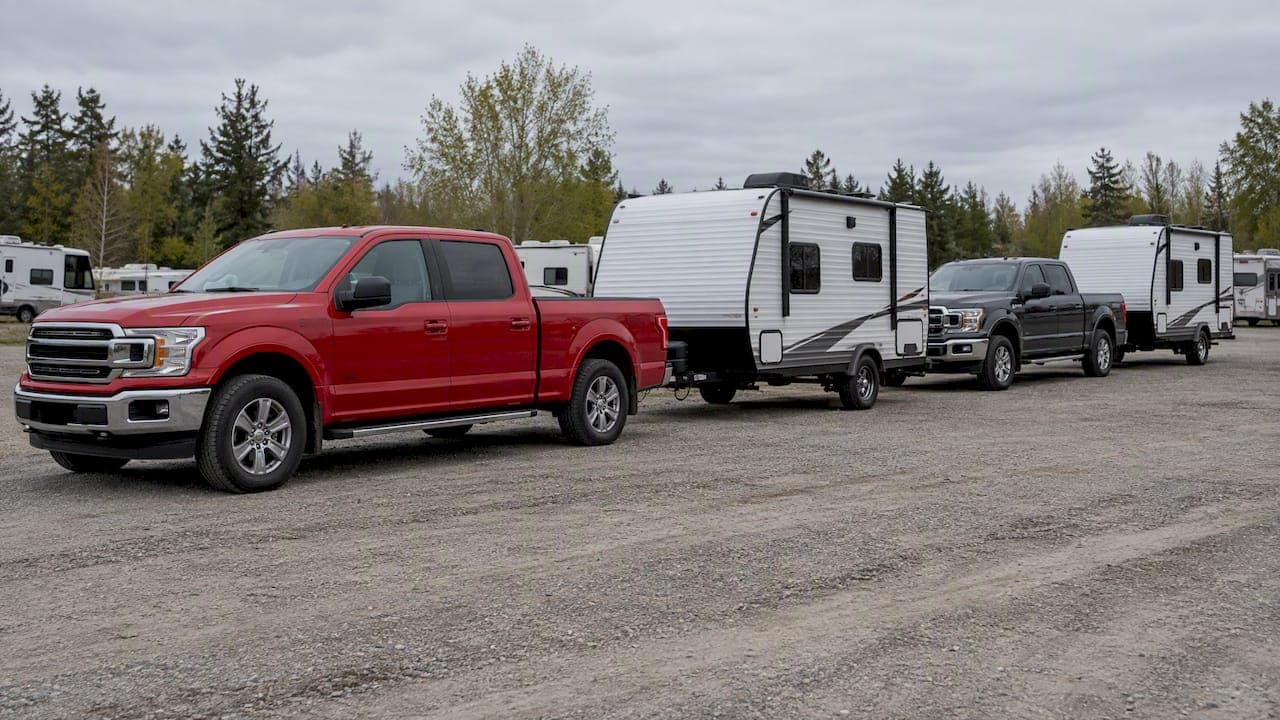
Diesel is the better towing tool for heavy trailers pulled often, and gas is the better value for lighter loads pulled now and then. The line most buyers land on is somewhere around 10,000 to 12,000 pounds of trailer, combined with how many miles a year you actually tow. Below that, a modern gas truck usually does the job for less money. Above it, or on mountain routes every month, diesel earns its price.
This guide walks through the ratings that matter, real fuel economy numbers from towing tests, what each engine costs to own, and how to match a used truck to your trailer before you sign anything.
TL;DR
- Diesels make more low-rpm torque and carry higher tow ratings, which matters most for heavy-duty trucks pulling big fifth-wheels, horse trailers or equipment.
- In one 2026 towing loop test, a diesel Ram 2500 returned 13.2 mpg against 11.1 mpg for its gas sibling, but the diesel option cost $12,995 more.
- For occasional towing of a boat, camper or utility trailer, a gas truck usually costs less to buy and maintain.
- Never tow right at the limit: check GVWR, GCWR and payload on the specific truck, and leave a margin.
- Match the truck to your real driving calendar, not to the biggest number on a brochure.
Table of Contents
- Which ratings decide how much a truck can tow?
- How much more can a diesel tow than a gas truck?
- How do diesel and gas engines feel with a trailer behind them?
- What does towing do to fuel economy?
- Do diesel trucks have better stopping power with a trailer?
- What does each truck cost to buy and keep?
- What is the 80% rule for towing?
- Which truck fits your towing, and which should you skip?
- Looking for a used truck to tow with?
- FAQ
- Sources
Which ratings decide how much a truck can tow?
Before comparing engines, learn four numbers, because they decide what is safe no matter what is under the hood.
GVWR is the maximum loaded weight of the truck itself as set by the manufacturer. NHTSA describes GVWR as the maximum loaded weight of a single vehicle, independent of the trailer's own rating. GCWR covers the truck and trailer together. As Virginia's Department of Wildlife Resources explains, it is the most weight the truck can safely get moving and stop.
Payload is what the truck can carry in the cab and bed, including passengers, cargo, fuel and the trailer's tongue or pin weight. Towing capacity is the trailer weight the truck can pull when it is equipped as the manufacturer specifies.

Payload is where diesel buyers are sometimes surprised. One media comparison of heavy-duty trucks notes that a Ram diesel has less payload than the gas version because the engine is heavier, and that the extra weight adds wear to parts like tie rod ends, ball joints and bearings. So a diesel can tow more and still have less room for a heavy fifth-wheel pin weight, passengers and gear.
When you compare trucks, a towing guide from RV Life recommends checking the exact engine, cab and bed, transmission, final-drive ratio, towing package, suspension, wheels, tires and fluid coolers, because tow ratings are configuration-specific. Then match the trailer's GVWR and hitch or pin weight to the payload, counting passengers, cargo and fuel. If you want a step-by-step version, see our towing capacity math and our guide to hitch classes.
How much more can a diesel tow than a gas truck?
In the heavy-duty class, quite a bit more. One 2026 comparison reports that the Ford F-350 diesel tops out near 40,000 pounds, while gas versions of similar trucks typically cap out around 15,000 to 22,000 pounds. Those are maximum figures for specific configurations, and most buyers will never need them.
Half-ton trucks are a different story. Most family-hauling pickups sit in a range where gas V6 and V8 engines are well matched to boats, pop-ups, travel trailers and utility trailers. If you are still deciding between engine sizes, our V6 vs V8 guide covers towing and used-car checks side by side.
The practical takeaway: the diesel advantage grows with trailer weight. If your trailer is light, the extra capacity is capacity you pay for and never use.
How do diesel and gas engines feel with a trailer behind them?
The two engines are built for different jobs. RealTruck's explainer says diesels prioritize torque and produce power across the rpm band, while gas engines are tuned for higher horsepower and make peak power at higher rpm.
What that means on the road:
- Starting and climbing. A diesel pulls a heavy load from a stop and up a grade without needing to rev. A gas engine will downshift and run at higher rpm, which is louder and thirstier, but perfectly workable for moderate loads.
- Stability. In the April 2026 Ram comparison by The Fast Lane Truck, the diesel felt steadier in crosswinds and stronger on mountain terrain. Part of that is simply the heavier truck.
- Gap is narrowing. The same Driving Line analysis points out that modern gas engines paired with eight- or ten-speed automatics make the performance gap smaller than many shoppers expect.
If you tow over mountain passes with a large trailer several times a season, you will notice the diesel. If you tow a boat to a lake twenty minutes away, you probably will not.
What does towing do to fuel economy?
Every truck loses mpg with a trailer, and diesels usually lose less in absolute terms. Here are measured examples from published tests, all under specific conditions, so treat them as illustrations and not guarantees.
| Test | Diesel | Gas |
|---|---|---|
| 2025 Ram 2500 Cummins vs. 2026 Ram 2500 6.4L HEMI, about 4,000 lb enclosed trailer, 123-mile Denver loop (April 2026) | 13.2 mpg, 9.3 gallons used | 11.1 mpg, 11.1 gallons used |
In that test, the diesel was 18.9% more fuel-efficient than the gas truck. Another test shows how much a trailer costs even a diesel: a 2021 Chevrolet Tahoe with the 3.0L Duramax returned 27.7 mpg on a loop without a trailer and 12.1 mpg towing 6,500 pounds at 70 mph.
Why such a big drop? Air resistance. A U.S. Department of Energy report states that at 70 mph aerodynamic drag is about 65% of total energy use for a typical heavy truck, which is why a tall, wide trailer can cut mpg so sharply. The Department of Energy's Alternative Fuels Data Center lists trailer-gap reducers, side skirts and similar aerodynamic equipment as ways to improve fuel economy by reducing drag.
One more point on fuel: diesel and gas are priced differently at the pump, and the gap moves. Compare cost per mile, not mpg alone. Diesel also produces more CO2 per gallon, about 15% more by EPA factors, at 10,180 grams per gallon versus 8,887 for gasoline.

How far will 100 gallons of diesel take you?
Do the arithmetic with your own mpg. At the 13.2 mpg the Ram 2500 diesel returned while towing in the test above, 100 gallons covers about 1,320 miles. At the 12.1 mpg of the Tahoe with a 6,500-pound trailer, it is about 1,210 miles. Unloaded, the same Tahoe's 27.7 mpg would stretch 100 gallons to roughly 2,770 miles. Your result depends on trailer shape, speed and terrain.
Do diesel trucks have better stopping power with a trailer?
Often, yes. An exhaust brake is a diesel advantage that assists with stopping when towing heavy loads, letting the engine hold speed on long downgrades so the service brakes stay cooler. That matters in hilly country with a loaded trailer.
Gas trucks rely more on the transmission's tow/haul mode and the service brakes, plus the trailer's own brakes, which must be working and properly adjusted. Either way, towing is hard on brakes, and the result is often a heavy coat of dust on your wheels. If that is something you deal with, here is how to remove brake dust safely without harming the finish.
What does each truck cost to buy and keep?
Diesel trucks cost more to purchase and maintain than gas trucks, but they return better fuel economy and tend to hold higher resale value. Modern diesels also carry more complex components, including turbochargers, diesel exhaust fluid (DEF) and particulate filters.
In the 2026 Ram test, the diesel option added $12,995 to the price. The testers' conclusion was that this cost, plus DEF, maintenance and potential repairs, makes the gas truck the better deal for infrequent towing.
Buying used changes the math in your favor. Much of the new-truck premium has already depreciated away, so the question becomes whether a particular used diesel has been maintained well, with records for fuel filters, DEF system service and oil changes. Our five-year cost comparison goes into the numbers for used truck buyers.
A simple way to think about it:
- Estimate how many miles a year you will tow, not just drive.
- Multiply by the fuel savings per mile you might see, using the mpg figures above as a guide.
- Compare that to the higher purchase price, DEF and maintenance.
- If the savings do not cover the premium over the years you plan to own the truck, gas is the better value.
What is the 80% rule for towing?
The 80% rule is a safety margin, not a law. The idea is that you should not load your truck and trailer to the limit of the truck's capacity. The Virginia DWR guidance suggests that a fully loaded boat and trailer weigh no more than 85% of the truck's towing capacity, which leaves reasonable payload. The same source stresses that GVWR and GCWR are maximums that must not be exceeded, and that maxing out towing capacity leaves no room for passengers or gear.
So whether you use 80% or 85%, the point is the same: build in a buffer. A trailer rated at 10,000 pounds fully loaded is a poor match for a truck rated at 10,200. Our 80% GCWR guide shows the payload and towing math for used truck and SUV buyers.
If you tow with a slide-in camper or a weight-distribution setup, NHTSA's interpretation letter notes that each axle should be weighed separately so that none is overloaded. A certified truck scale gives you the real numbers.
Our perspective on diesel vs. gas
At Elmwood Auto Sales, we see the same mistake again and again: buyers shop the engine before they know the trailer. We would rather start with what you tow, how often, and how far.
For most of the families who walk in, a well-inspected gas truck or SUV is the sensible fit. It handles a boat, a camper or a utility trailer, and it keeps the purchase price and repair risk down. When you tow heavy loads regularly, a diesel can be worth the premium, provided the maintenance history backs it up.
That is why every vehicle we sell goes through a thorough inspection, and why our sales staff are not paid on commission. You get a straight answer about whether a truck fits your trailer, even if the answer is a less expensive one. We also work with a range of credit profiles, so the right truck does not have to wait on a perfect credit score.
Elmwood
Which truck fits your towing, and which should you skip?
Start with your calendar, as Diesel World suggests: consider your towing miles, long highway trips versus short local ones, and whether towing is occasional or the truck's main job.
A gas truck likely fits if:
- You tow a boat, small camper or utility trailer a handful of times a year.
- Your trailer, loaded, stays comfortably under your truck's rating with a margin.
- Most of your driving is around town, where a diesel's extra maintenance and cost are harder to justify.
- You want a lower purchase price and simpler repairs.
A diesel likely fits if:
- You regularly pull a heavy fifth-wheel, large travel trailer, horse trailer or equipment.
- You drive long highway distances or through mountains with the trailer attached.
- You will keep the truck for years and can document service on the emissions system.
- You need the exhaust brake and the low-rpm pulling power.
If you are towing a camper, remember that you also need cab space for the family and room in the bed for gear. Our guide to truck cab configurations helps with that, and our list of used trucks for family hauling is a good starting point. A used half-ton such as this Ram 1500 Classic Crew Cab shows the kind of crew-cab pickup many families tow with. Always confirm the specific tow rating for the exact configuration before you buy.
Before a first tow, check the hitch class, the ball and mount ratings, the wiring, the trailer brake controller and the tire condition on both truck and trailer. Then load the trailer so that about 10 to 15 percent of its weight sits on the tongue for a conventional bumper-pull, and confirm with your owner's manual.
Looking for a used truck to tow with?
We are a used car dealership in Providence, RI, and we do not use commission-based sales tactics. You can browse our inventory of inspected used trucks and SUVs, tell us what you tow, and we will help you find a match. If the right truck is not on the lot, our Car Finder can search for it.

Need financing? Our used car financing application covers a range of credit histories, including buy here, pay here options. You can also trade in your current vehicle, and when you find a truck you like, book a test drive and bring your trailer's specs with you.
FAQ
Is a diesel truck worth more than a gas truck?
Generally, diesels hold higher resale value, according to Driving Line. That does not mean every diesel is the better deal. A higher purchase price, more complex emissions equipment and maintenance history all affect what you actually get back. Documented service records help a diesel hold its value.
Is diesel or gas better for occasional towing?
For occasional towing, gas is usually the better value. In the 2026 Ram comparison, the testers concluded that the diesel's added cost, DEF, maintenance and potential repairs made the gas truck the better deal for infrequent towing. A gas truck with a proper tow package can handle many boats and campers.
What is the 80% rule for towing?
It is a rule of thumb, not a legal requirement. It says to keep your loaded trailer well below the truck's maximum rating, leaving room for passengers, cargo and tongue weight. Virginia's wildlife agency suggests no more than 85% for a loaded boat and trailer.
What should I compare when choosing a truck to tow an RV?
Compare the exact engine, cab and bed, transmission, axle ratio, tow package, suspension, tires and coolers. Then match the RV's GVWR and hitch or pin weight to the truck's payload, counting passengers and fuel, using the RV Life towing guide as a checklist.
Sources
- Do the Math on Towing Capacity, Virginia DWR
- NHTSA interpretation on GVWR
- NHTSA interpretation on weight-distribution truck camper trailers
- Gas Versus Diesel Trucks: Which One Is Right For You?, Driving Line
- Diesel vs Gas Truck for Towing, Trailer Place
- Diesel Vs. Gas Trucks: Which Should You Buy?, RealTruck
- Ram HD Cummins vs. HEMI Denver 100 towing loop, The Fast Lane Truck
- 2021 Chevy Tahoe Diesel MPG loop, The Fast Lane Truck
- FY 2004 Annual Progress Report for Heavy Vehicle Systems, U.S. Department of Energy
- Vehicle Parts and Equipment, Alternative Fuels Data Center
- Are You Choosing Diesel or Gas for Your Next Tow Rig?, Diesel World
- Towing Guide, RV Life
- Remove Brake Dust Safely, Diamondbrite