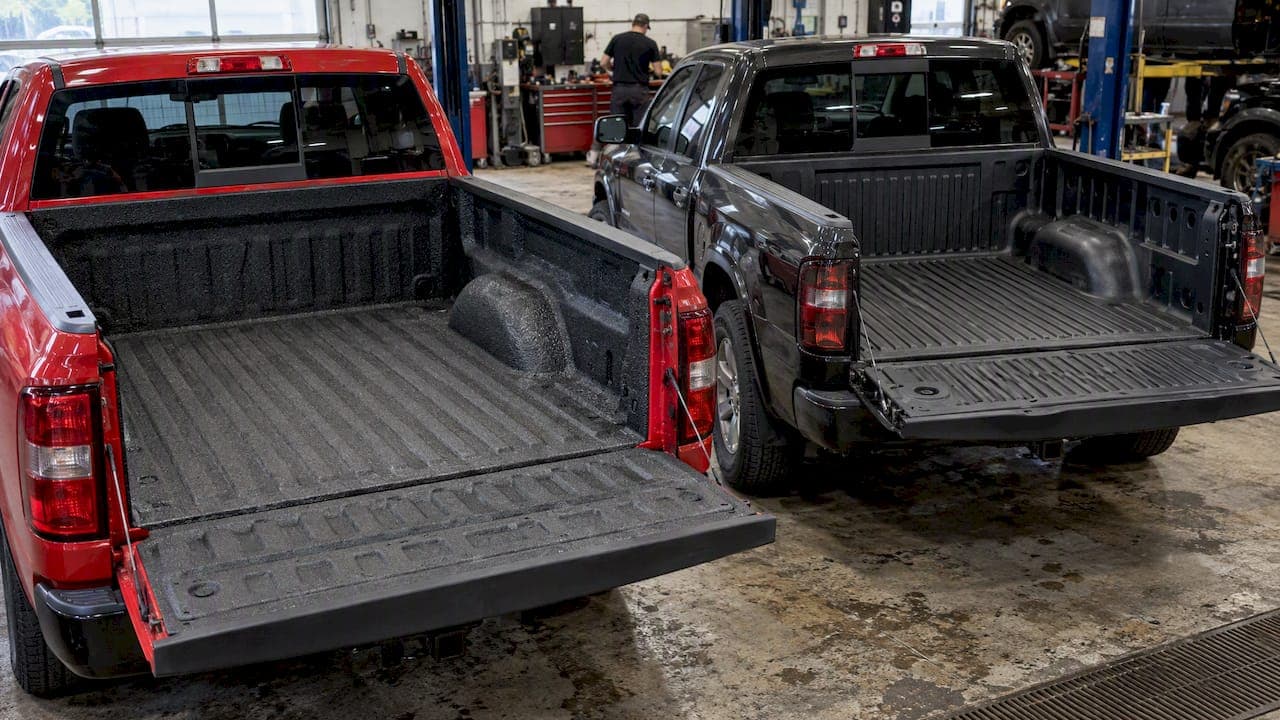
A spray-in bedliner bonds to the bed and protects better against rust. A drop-in liner costs less, can be removed, and cushions the metal from dents. Most owners who keep a truck for years and want the best rust protection are better served by a professionally applied spray-in. Owners who want a lower price, flexibility or an easy way out later are often happier with a well-fitted drop-in. Below, we compare the two on protection, traction, cost, repairs and resale, so you can match the liner to the way you use your truck.
TL;DR
- Spray-in liners bond to the bed, leave no gap for water to sit, and are the type Consumer Reports prefers for rust protection and traction.
- Drop-in liners cost less, can be removed to inspect the bed, and act as a buffer against dents. A poor fit can trap moisture and let rust start unseen.
- Typical professional pricing runs $400 to $900 for a spray-in and $250 to $500 for a drop-in, according to one parts retailer's 2026 guide.
- Spray-ins are permanent. If you may change your mind, or you plan to sell soon, that matters.
- If you are shopping for a used truck, check what is already in the bed before you decide anything.
Table of Contents
- How are the two liner types actually different?
- Which one protects the bed better?
- Which is easier for loading and everyday cargo?
- How much does each cost?
- What are the downsides of each?
- Does the liner affect resale value?
- What should you check on a used truck's liner?
- What do we recommend at Elmwood?
- Looking for a truck to put a liner in?
- Which should you choose?
- FAQ
- Sources
How are the two liner types actually different?
A drop-in liner is a pre-molded piece, usually hard plastic or a carpet-style material, that sits inside the bed. You can install it yourself in a few minutes. A spray-in liner is a coating applied directly to the bare bed, which is why it becomes part of the truck.
That single difference drives almost everything else. Because a drop-in sits on top of the bed, it can be lifted out, replaced or swapped for another type. Because a spray-in is bonded to the metal, it follows every corner and seam but cannot be taken off. Consumer Reports says either kind protects a pickup bed from scratches, dents and dings and gives cargo a skid-resistant surface.
Installation is also different in effort and skill. Penda says spray-in application should be done professionally and needs the bed surface prepared first, while drop-in problems usually come from choosing the wrong fit for your bed. So with a spray-in, the shop's work decides the result. With a drop-in, your measuring decides it. If you are unsure of your bed length, our guide to measuring truck bed sizes walks through it.

What are the drop-in styles?
Not all drop-ins behave alike. RealTruck separates slick hard-plastic liners from carpet-style liners. Hard plastic is easy to hose off but can let cargo slide, and it can trap moisture and debris unless you clean it regularly. Carpet-style liners use polypropylene fiber over a rubber or foam backing, which gives more grip and comfort and stays modular and removable.
So the choice is really among three options: hard-plastic drop-in, carpet-style drop-in and spray-in. Many online arguments compare only the first and the last, which is why they sound so heated.
Which one protects the bed better?
For rust, the spray-in has the edge. Consumer Reports prefers spray-ins because they protect better against rust, stop dirt, water and debris from collecting underneath, and provide better traction. Jalopnik reports that spray-ins bond to the bed, give a seamless slip-resistant surface and resist peeling and cracking.
The weak point of a drop-in is the space between the liner and the bed. Jalopnik notes that drop-ins can rattle, shift and trap water and dirt, and that corrosion can follow if gaps or a poor fit leave moisture against the metal. Top Bedliners adds that regular cleaning helps, but water, dirt, salt or sand working in around the edges is still a rust risk. If you drive through winters with road salt, that is worth weighing seriously.
Does a spray-in beat a drop-in on impacts?
Not always. Spray-in coatings are tough against abrasion, and RealTruck says a properly applied professional spray-in is highly abrasion-resistant and reaches corners and crevices. But Penda points out that a spray coating can still transmit a dent to the metal underneath, because the coating is thin and bonded to it. A drop-in acts as a buffer, so a dropped tool or a heavy crate is absorbed partly by the liner. Jalopnik also cautions that concentrated heavy loads can damage the metal beneath a spray-in.
The same Penda page notes that the abrasive texture of a spray coating can scratch cargo. If you haul finished lumber, appliances or painted items, that is a real consideration.
What about chemicals like fuel and oil?
Top Bedliners says spray-in coatings can resist common chemicals such as fuel and oil, but resistance varies by product. Ask the shop for the manufacturer's technical data sheet for the exact coating they use, and check that it covers what you carry.
Which is easier for loading and everyday cargo?
It depends on what you load. A slick hard-plastic drop-in lets heavy items slide in easily, and that is exactly why some people like it for things such as a snowmobile or a pallet. The cost is that cargo slides out just as easily during braking, so you need tie-downs every time.
A spray-in grips. The textured surface helps keep loads in place, which Consumer Reports counts as a point in its favor. The trade-off is friction when you want to slide things in, and the abrasion on cargo mentioned above.
Carpet-style drop-ins sit between the two. They are gentler on gear and on knees and hands when you climb in, and they hold items better than hard plastic. They can hold moisture, though, so let them dry out after wet loads.
A simple rule of thumb:
- If you mostly haul things that need to stay put (tools, bags, gear, groceries), a spray-in or carpet-style liner suits you.
- If you often slide long, heavy items in and out, a hard-plastic drop-in is easier, with proper tie-downs.
- If you carry delicate or finished items, a drop-in or a bed mat protects the cargo better than a rough coating.
How much does each cost?
Drop-ins cost less up front. Consumer Reports priced options for a 2018 Chevrolet Silverado 1500 LTZ at $495 for a Chevy spray-in and $305 for a long-box drop-in, with a tailgate liner adding $50. Those are 2017-era dealer-accessory figures for one truck, so treat them as a ratio rather than a quote.
More recent ranges come from AmericanTrucks, which reports typical professional spray-in pricing of $400 to $900 and drop-in pricing of $250 to $500. It also describes drop-ins as commonly lasting about 5 to 10 years, depending on use.
| Hard-plastic drop-in | Carpet-style drop-in | Professional spray-in | |
|---|---|---|---|
| Typical price (2026 retailer range) | $250 to $500 for drop-ins | $250 to $500 for drop-ins | $400 to $900 |
| Installation | Do it yourself | Do it yourself | Shop application, bed prep required |
| Rust protection | Weaker if moisture gets underneath | Weaker if moisture gets underneath | Strongest, bonded to the metal |
| Traction | Low, cargo can slide | Better grip | Good grip, textured |
| Dent buffering | Good | Good | Limited |
| Removable | Yes | Yes | No |
The cheaper price does not always mean cheaper ownership. A drop-in that lasts five to ten years may be replaced once, while a spray-in can stay for the life of the truck. Over a long ownership, the gap narrows. Over a short one, the drop-in wins on price.
What are the downsides of each?
Drawbacks of spray-in liners
Permanence is the big one. Consumer Reports warns that spray-in liners could make some bed repairs challenging. AmericanTrucks says they are hard to remove cleanly, and Penda says removing the coating after application is nearly impossible without further damage.
If you ever do need to strip a bonded coating, patience and technique matter more than force. Pros who work with bonded films use controlled heat and slow peeling, as described in this guide to vinyl wrap removal methods. Even so, a sprayed-on bedliner is a heavier job than a film, and you should assume it stays.
Other drawbacks to plan for:
- The bed must be prepared properly, and a rushed job can peel or bubble.
- Dents can still show through.
- The textured finish can scuff cargo and be rough on bare skin.
Drawbacks of drop-in liners
The main problems are fit, movement and moisture. A liner that is the wrong size or that shifts will rattle and can rub paint. Gaps let sand, salt and water collect, and the bed beneath can rust where you cannot see it. Hard plastic can also become slippery and, as RealTruck notes, needs regular cleaning to avoid trapping debris.
The upside is that you can pull a drop-in out, wash and inspect the bed, and put it back or replace it. AmericanTrucks notes that drop-ins can be removed when you sell the truck or change to a different liner type.
How should you maintain a drop-in?
Once or twice a season, take it out, rinse the bed and the liner, let both dry fully, and look for chipped paint or surface rust underneath. Touch up bare spots before reinstalling. If you drive on salted roads, do this after winter. That ten-minute routine is what separates a drop-in that protects from one that hides a rust problem.

Does the liner affect resale value?
Consumer Reports says truck accessories can boost resale value, but it does not single out one liner type. In practice, a clean, well-fitted liner and a rust-free bed tell a buyer the truck was cared for.
A spray-in hides the bed, so a buyer cannot check the metal underneath. A removable drop-in lets a buyer or inspector look directly. Neither is a problem if the truck has records and an honest inspection. If you plan to sell or trade the truck within a few years, a removable liner keeps your options open. If you are thinking of trading your current truck in, you can start with a trade-in request and let us appraise it as it stands.
What should you check on a used truck's liner?
A liner can make a used truck look better than it is. When you shop for a used pickup, treat the bed as part of the inspection.
- Ask what type it is. A drop-in can be lifted out. Ask to see the bed underneath.
- Look at the edges and seams. Rust blisters, flaking paint or sand and dirt packed at the rails point to trapped moisture.
- On a spray-in, look for bubbling, lifting or cracks near the tailgate and wheel wells, where water finds a way in.
- Check the frame and underbody too. Bed rust is often a sign of wider corrosion. Our rust inspection guide for used car buyers and our cosmetic vs. structural rust checklist explain what to look for and what to ask for.
- Think about protection beyond the bed. If you are weighing underbody treatments as well, read when undercoating a used car pays off.
The same logic applies to the truck you choose. A crew cab like our 2019 Ram 1500 Classic Crew Cab gives a family room inside and a bed for weekend loads, and the liner you put in should fit how you actually use it. For more on matching a truck to family use, see our guide to used trucks for family hauling.
What do we recommend at Elmwood?
We sell used trucks to people who will actually work them, and we inspect vehicles before they reach the lot, so we pay attention to what is under a liner. Our view is simple: the liner should match the owner, not the other way around.
If you plan to keep a truck for years, drive in winter weather and want the least maintenance, a professionally applied spray-in is the stronger long-term choice for the bed. Make sure the shop prepares the surface properly and ask which coating they use.
If you want a lower price, expect to change trucks, or like to inspect the bed yourself, a well-fitted drop-in makes sense. Choose the carpet-style type if traction and comfort matter, and measure the bed before you buy.
Whichever you choose, protect against the real problem, which is moisture sitting against bare metal. A liner of either kind only works if the bed under it was sound when it went in. That is why we encourage every truck buyer to ask to see the bed, not just the liner.
— Elmwood
Looking for a truck to put a liner in?
We have a rotating selection of inspected used trucks, SUVs, cars and vans in Providence, RI. Browse our used trucks to see what is on the lot now, or tell us what you need and let our Car Finder look for it. If budget is the question, you can apply for financing online before you visit. We offer financing options for a range of credit profiles, including buy here, pay here.
Which should you choose?
Use these questions as a final check.
- Will you keep the truck five years or more? A spray-in tends to pay off. Under that, a drop-in costs less.
- Do you drive on salted or sandy roads? Favor a spray-in, or commit to cleaning under a drop-in.
- Do you slide heavy items in and out often? A hard-plastic drop-in helps, with tie-downs.
- Do you carry finished or delicate items? Choose a drop-in or bed mat.
- Might you want to remove it later? Choose a drop-in.
There is also no rule that you must pick one forever. Many owners start with a drop-in and move to a spray-in on their next truck once they know how they use the bed.
FAQ
Is a spray-in bedliner worth more than a drop-in?
It usually costs more, with typical professional prices of $400 to $900 against $250 to $500 for a drop-in. It is worth it if you want the strongest rust protection and plan to keep the truck. If you expect to sell soon or want a removable option, a drop-in gives better value.
How much does a drop-in bedliner cost?
AmericanTrucks reports a typical range of $250 to $500 for a drop-in, and Consumer Reports listed $305 for a long-box drop-in on a 2018 Silverado 1500. Price depends on bed length, material and whether the liner is carpet-style or hard plastic. Always measure your bed before you order.
What are the disadvantages of a spray-on bedliner?
It is permanent, which can complicate bed repairs and makes removal very difficult. It can transmit dents to the metal underneath and its rough surface can scratch cargo. The result also depends heavily on how well the shop prepares the bed.
Can a drop-in liner cause rust?
Yes, if water, dirt, salt or sand gets trapped between the liner and the bed. A good fit, regular removal for cleaning and prompt touch-ups to chipped paint reduce the risk. A carpet-style liner needs time to dry out after wet loads.
Does a bedliner raise resale value?
Consumer Reports says truck accessories can boost resale value. A clean liner over a rust-free bed signals a well-kept truck, and a removable liner lets a buyer inspect the metal underneath.
Sources
- Truck Accessories, Consumer Reports
- Spray Vs. Drop-In Bed Liner: Pros And Cons, Jalopnik
- Spray-In Bed Liners Vs. Drop-In Bed Liners, RealTruck
- Spray-In vs Drop-In Bed Liners: Which Is Better?, Top Bedliners
- How Drop-In Bedliners Compare to Spray-On Coatings, Penda
- Truck Bed Liner Buyer's Guide, AmericanTrucks
- Vinyl Wrap Removal