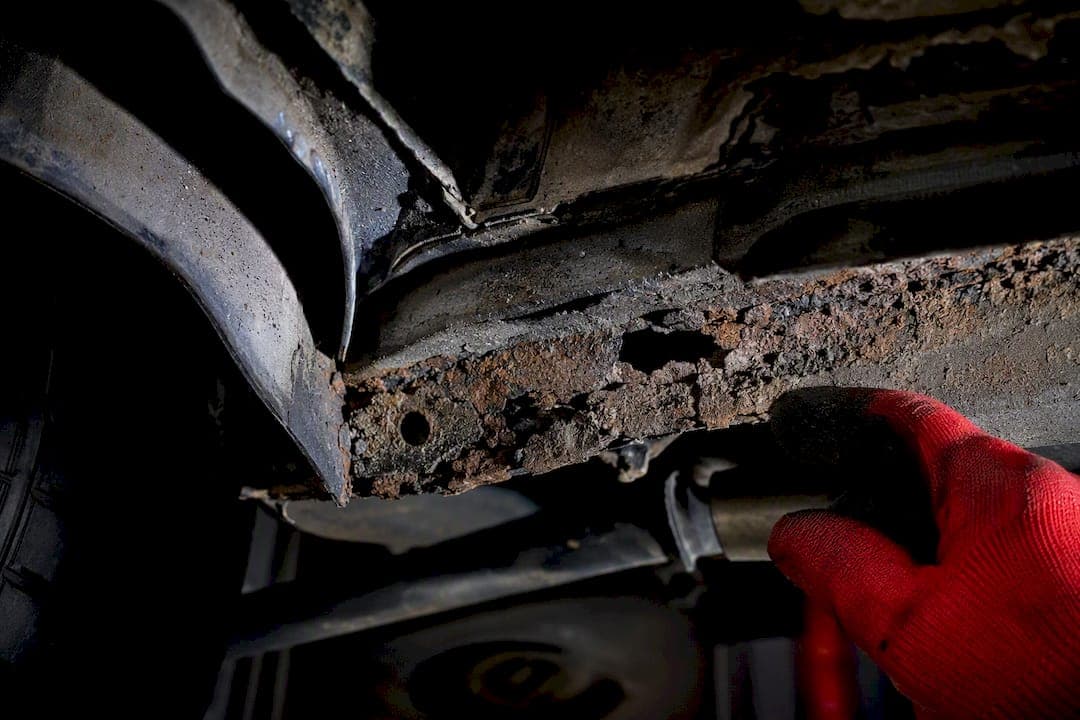
Surface rust on paint, trim, or bolts is usually cosmetic and fixable with basic bodywork. Rust that reaches the frame, subframe, suspension mounts, or eats through metal (perforation, exhaust gases entering the cabin) is a safety red flag, not a cosmetic one. Before you decide, ask for a lift inspection or documented repair receipts. If a seller refuses either one, that refusal is your answer.
TL;DR:
- Rust on structural components like frame rails or suspension mounts poses safety risks and requires professional inspection, especially if there's perforation or flaking.
- Visual checks should focus on wheel arches, rocker panels, door bottoms, and under the windshield cowl, with a lift examination being the most reliable method to detect hidden corrosion.
- Surface rust appears as bubbling or scaling paint and is generally safe after removal, while deep pitting, holes, or flexible panels indicate significant structural damage.
- Costs to repair rust vary from simple surface treatments to extensive welding and replacement, with structural fixes potentially exceeding the vehicle's value.
- Always obtain documented inspection reports and repair receipts before purchasing, and prioritize thorough undercarriage and frame assessments, especially for cars from salted-road regions.
Table of Contents
- What Should You Check for Rust on a Used Car in 10 Minutes?
- Where Does Rust Usually Show Up First on a Car?
- How Can You Tell Surface Rust From Structural Rust?
- How Do You Inspect a Used Car for Hidden Structural Rust?
- What Does It Cost to Fix Rust on a Car?
- How Do You Prevent Rust From Spreading After You Buy?
- What's a Fair Negotiation Strategy When a Car Has Rust?
- What Should You Ask Any Seller to See Before Buying?
- The Buyer's Mental Model for Rust
- Ready to Look at Inspected Inventory Instead of Guessing?
- Sources
- FAQ
What Should You Check for Rust on a Used Car in 10 Minutes?
Run this sequence during a viewing or test drive:
- Walk the exterior and scan wheel wells, rocker panels, and door bottoms for bubbling paint or scaling.
- Press or poke suspicious spots with a screwdriver or pick. Metal that gives way or flakes is a bad sign.
- Lift the trunk carpet and spare tire cover to check the trunk pan and floor.
- Crawl underneath with a flashlight and scan the frame rails, sills, and exhaust hangers.
- Check the windshield cowl area and drain holes for trapped debris and rust staining.
Bring a flashlight, a small magnet, a pick or screwdriver, a phone camera, and a mirror for tight spots. Photograph every suspicious area, and ask the seller directly whether the car spent winters on salted roads and whether any rust repairs have ever been done. Lifting the vehicle and inspecting the undercarriage with a flashlight remains the single most reliable way to catch problems a quick walkaround will miss.
Where Does Rust Usually Show Up First on a Car?
Rust does not spread evenly. It concentrates in spots where moisture collects and drains poorly, and each hotspot carries a different level of risk.
- Wheel arches and inner arches. The most common cosmetic entry point, but bubbling here can mask thinning metal on the inner arch liner that you can't see from outside.
- Rocker panels and sills. These often hide corrosion near structural seams and, on many vehicles, seatbelt anchor points, so surface bubbling here deserves more scrutiny than it gets on a fender.
- Frame rails, subframes, and suspension mounts. This is where rust turns from an eyesore into a safety issue. Weakened metal at these points affects crash protection and steering control.
- Door bottoms, trunk pan, and the cowl area under the windshield. Moisture gets trapped in these seams and can migrate into the cabin floor over time.
Knowing which spots are load-bearing versus purely cosmetic tells you where to spend your inspection time and where a little rust is genuinely no big deal.
How Can You Tell Surface Rust From Structural Rust?
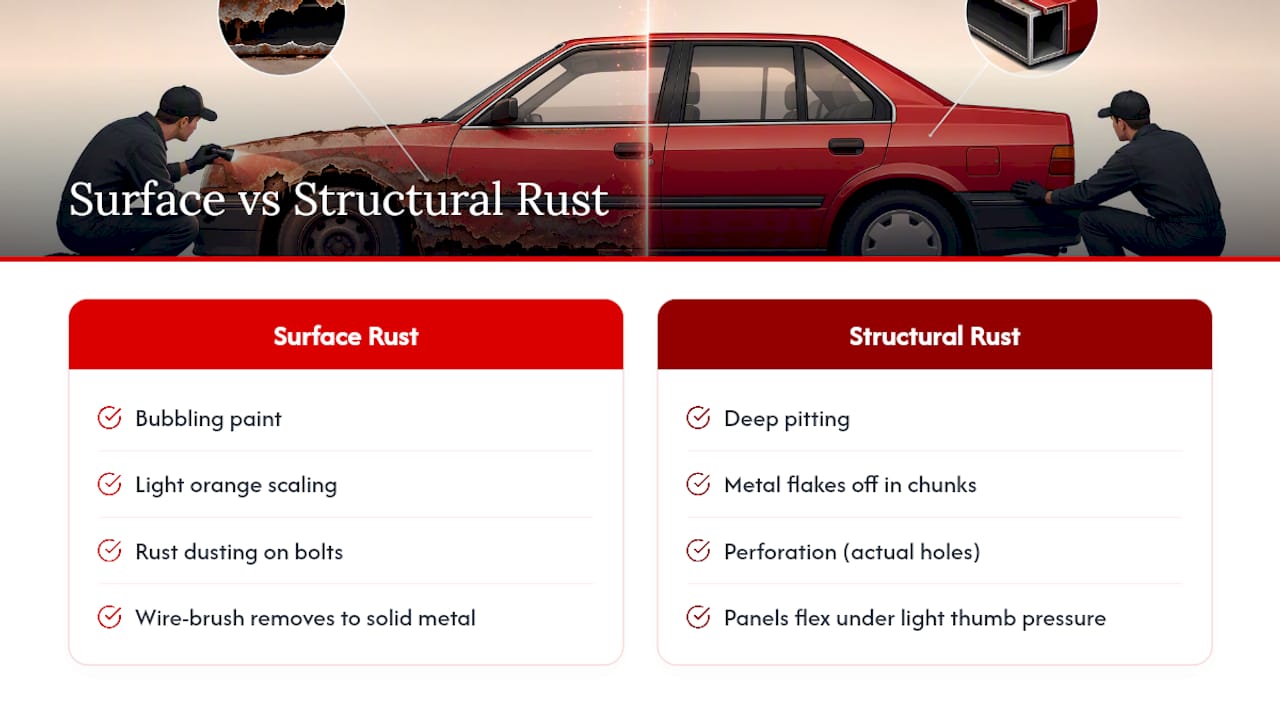
Surface rust looks like bubbling paint, light orange scaling, or rust dusting on exposed bolts and brackets. Wire-brush it off and you typically find solid metal underneath. This is the kind of corrosion that shows up on almost every used car north of the Mason Dixon line and rarely affects safety on its own, according to Carfax's breakdown of rust severity.
Structural rust looks different. Watch for pitting that goes deep, metal that flakes off in chunks, actual holes (perforation), or panels that flex or dent under light thumb pressure. Vehicle safety inspectors specifically look for exhaust leaks reaching the cabin, protruding sharp metal, and frames that are no longer in solid condition, all of which can fail a state safety inspection outright.
The trickiest cases hide inside boxed frame sections or behind trim panels. A pinhole on the surface can mean a much larger cavity of corrosion underneath, especially in cars that spent years in salt-heavy climates. Rust doesn't care how a car looks from the driver's seat. It cares about the six inches of hidden steel behind the wheel well.
How Do You Inspect a Used Car for Hidden Structural Rust?
A visual scan at a dealership lot only tells you so much. To really know what's happening underneath, follow these steps:
- Get the car on a lift or ramps. A flat crawl under the car with a flashlight is better than nothing, but a lift gives you a full, unobstructed view of the frame rails and suspension mounts.
- Tap and press key structural points. Solid metal sounds solid and resists a light press. Rusted metal sounds hollow or flakes.
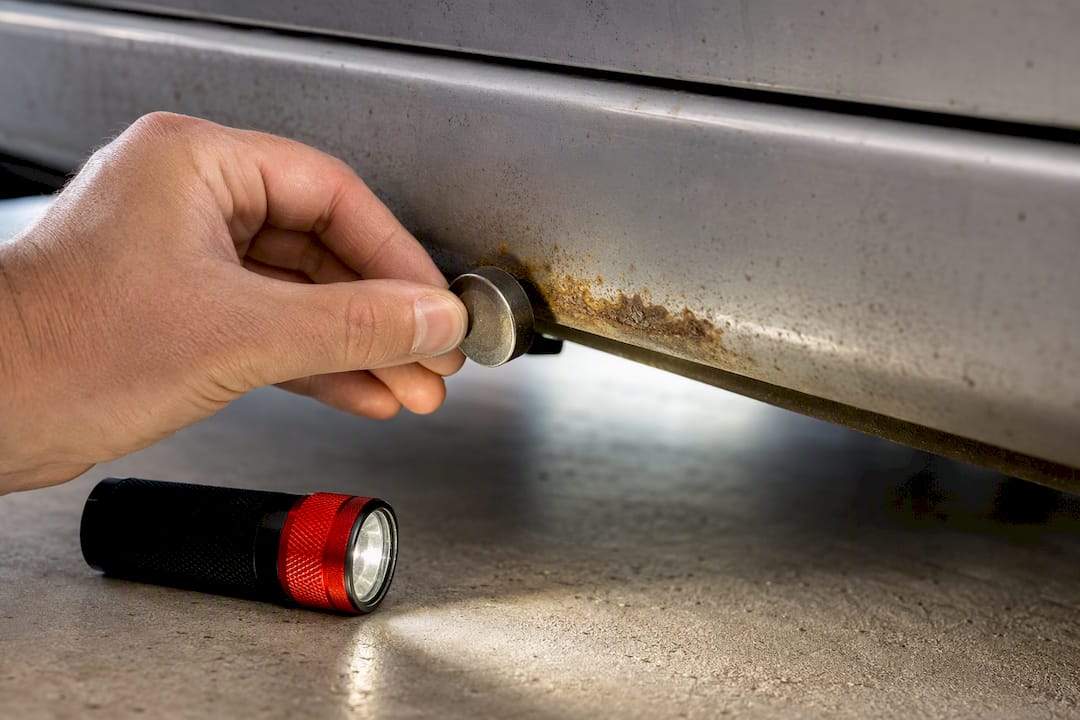
- Use a magnet on suspicious panels. A magnet won't stick to thick body filler, which is a common way sellers mask patched rust holes.
- Ask the shop to measure metal thickness at any spot that looks questionable, especially near mounting points.
- Request documentation of any prior welding or patch work, including photos from the repair.
A reputable mechanic can run all of this in under an hour, and it's worth writing your request in plain terms: "Please inspect the frame rails, subframe, and suspension mounting points for rust, and note any filler, patching, or non-factory welds you find."
Pro Tip: Bring your own magnet to the viewing. If it won't stick to a rusty-looking rocker panel, there's a good chance body filler is hiding something the seller doesn't want you to see.
What Does It Cost to Fix Rust on a Car?
Repair cost depends entirely on where the rust sits and how far it's spread. Getting quotes for repairs, then folding that number into your offer, is the most useful negotiating tool you have.
- Surface rust: Wire-brushing, a rust converter, and touch-up primer and paint. Often a DIY job or a low-cost stop at a body shop.
- Moderate corrosion: Patch panels, seam welding, and professional rust treatments on rockers or wheel arches. This lands in the moderate range and usually takes a shop a day or two.
- Structural repairs: Cutting out and welding new sections into frame rails or subframes. This requires real labor and parts, and costs can climb high enough to exceed the car's actual value.
Get at least two independent estimates before you commit to buying a rusty car, and be wary of any shop that offers to weld over corrosion without cutting back to clean steel first. Plating over contaminated metal traps moisture underneath and the rust simply comes back.
How Do You Prevent Rust From Spreading After You Buy?
Once you own the car, a little maintenance goes a long way toward slowing further corrosion.
- Wash the underside after winter driving or any exposure to salted roads, and keep drain holes in the doors, sills, and trunk clear of debris.
- Touch up paint chips and stone dings as soon as you notice them, before bare metal has a chance to oxidize.
- Consider a professional cavity wax or underseal treatment, especially if you live somewhere that salts roads heavily. Products designed specifically for road salt exposure can meaningfully slow the corrosion cycle.
- Check the undercarriage each spring and fall, since rust can go from surface-level to structural within a few years in salted-road climates if it's left untreated.
What's a Fair Negotiation Strategy When a Car Has Rust?
Use repair quotes, not guesswork, to justify a price reduction. Two or three independent estimates give you a real number to bring to the negotiating table instead of an arbitrary discount request.
Some conditions should end the conversation entirely rather than lead to a lower offer. Perforated frame rails, compromised suspension mounts, or any sign that exhaust gases are reaching the cabin are immediate walk-away triggers, not negotiating points. Rust that has already been "repaired" also deserves scrutiny. Ask for written repair invoices, lift photos from before and after the work, and a signed inspection report. A documented history of frame damage or repair is one of the clearest ways to confirm whether a car is safe to drive today.
What Should You Ask Any Seller to See Before Buying?
A trustworthy seller should hand over a signed inspection report without hesitation. A trustworthy used car process is typically built around thorough inspections aimed at meeting real safety and reliability standards, and any seller worth buying from should be able to produce something similar.
At minimum, ask for itemized repair receipts, lift photos of the undercarriage, and a written inspection report you can keep for your own records. If structural rust shows up anywhere in that documentation, insist on a fresh professional re-check before you sign anything, and confirm whether any warranty or extended coverage options apply to repaired areas.
The Buyer's Mental Model for Rust
Look at the frame, suspension mounts, and sills first. If those check out clean, everything else is a cosmetic conversation and a price adjustment, not a reason to walk. If you're still unsure after a flashlight and a magnet, the ten or twenty minutes it takes for a mechanic to put the car on a lift is cheaper than discovering the problem after you've already signed the loan paperwork.
— Elmwood
Ready to Look at Inspected Inventory Instead of Guessing?
This dealership built its process around answering the exact question this article just walked you through: is this rust cosmetic, or is it a problem? Every vehicle in their inventory goes through a thorough inspection built to meet real safety and reliability standards, so you're not the one crawling under a stranger's car with a flashlight trying to decide.
Browse our current inspected used cars, trucks, SUVs, and vans, or use our Car Finder to tell us what you're looking for and skip the lot-walking entirely. If financing is part of the equation, our online application works with a range of credit histories, including buy here, pay here options. When you're ready to see a specific vehicle in person, schedule a test drive and ask to see the signed inspection report while you're there. We'll show it to you without a sales pitch attached.
Sources
For deeper reading on inspection standards and severity indicators referenced throughout this guide, see Carfax's rust inspection guide, J.D. Power's inspection steps, and state rust inspection rules. Always confirm findings with a professional mechanic before finalizing a purchase.
- Car Rust: How Much Is Too Much? (and How to Fix It)
- How To Inspect A Car With Rust
- The Truth About Rust: When Is It Cosmetic and When Is It Structural?
FAQ
What Is the $3,000 Rule for Cars?
It's a rough budgeting guideline some buyers use: if repairs, including rust remediation, become expensive relative to the car's value, it's usually smarter to walk away than to fix it. It's not an official standard, just a practical gut check worth applying once you have real repair quotes in hand.
Is a Little Bit of Rust OK on a Car?
Yes. Light surface rust on trim, bolts, or paint is common and rarely affects safety, since it's typically limited to the metal's outer layer. Rust becomes a real concern only once it reaches structural areas like the frame, subframe, or suspension mounts, or creates actual holes and perforation.
Which Car Brand Rusts the Most?
Rust patterns depend far more on climate and road salt exposure than on brand. A car that spent its life in a salted-road region will show more corrosion than the same model kept somewhere dry, which is why checking vehicle history for prior northern registration matters more than chasing brand reputation.
Is It Worth Fixing Rust on a Car?
It depends entirely on scope. Small surface rust is almost always worth fixing with a DIY treatment or a quick shop visit. Structural repairs involving cutting and welding frame sections can cost enough to exceed the car's actual value, which makes walking away the more sensible move in many cases.