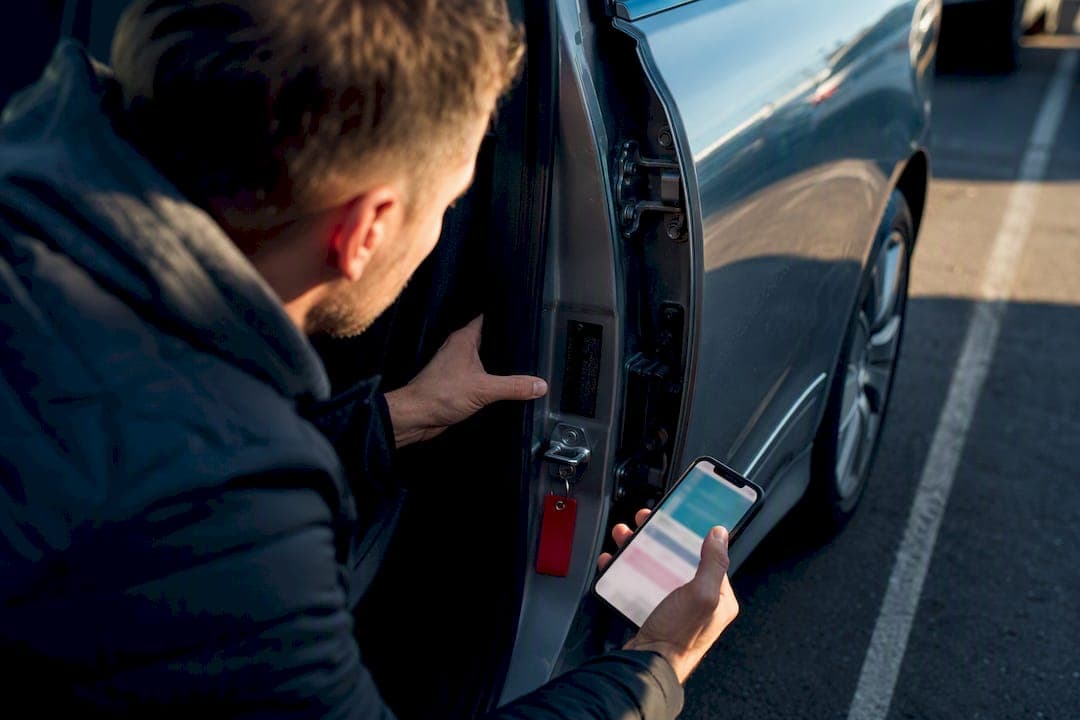
The fastest way to run an open recall check is the free National Highway Traffic Safety Administration VIN lookup. Enter your 17-character VIN, and it shows any unrepaired recalls filed against that specific car. License plate searches and manufacturer sites work as backups. Grab your VIN off the dashboard or registration and run it now, before you read another word.
TL;DR:
- The NHTSA VIN lookup covers unrepaired recalls from the past 15 years and may not show recent VINs or recalls from smaller manufacturers.
- Using multiple tools, such as license plate searches and vehicle history reports, increases the chances of catching overlooked recalls.
- An open recall means a safety defect has been identified but not yet fixed, so contacting the dealer for repair is essential and remains free.
- Always request proof of recall repairs, such as stamped repair orders, before completing a used-car purchase to avoid hidden safety issues.
- Relying solely on a clean VIN lookup result is insufficient; physical proof of repairs and documentation should be part of your buying process.
Table of Contents
- How Do You Run the Official VIN Lookup for an Open Recall Check?
- Other Reliable Ways to Check for Car Recalls
- What Does 'Open Recall' Actually Mean?
- Found an Open Recall? Here's What to Do Next
- Used-Car Buyer's Pre-Purchase Recall Checklist
- How Elmwood Auto Sales Handles Recall Checks and Inspections
- Our Take: Skip the Guesswork, Get the Paper Trail
- Sources
How Do You Run the Official VIN Lookup for an Open Recall Check?
Your VIN lives in three easy spots: the lower corner of the windshield on the driver's side, the driver's side door jamb sticker, or your registration and insurance card. It's always 17 characters, mixing letters and numbers. If you're unsure which digits count, this breakdown of what a VIN actually tells you walks through the format.
Once you have it, here's the process:
- Go to nhtsa.gov/recalls or the SaferCar VIN tool directly.
- Type in your full 17-character VIN. No spaces, no dashes.
- Select your vehicle's make if the tool prompts you.
- Read the result line. It will say either "0 unrepaired recalls" or list one or more open campaigns with a description and remedy status.
- Save a dated screenshot or PDF of that result page.
The wording matters. "Unrepaired" or "open" means the fix hasn't been logged as complete. "Completed" means a shop already performed the remedy under that recall number.
Pro Tip: Screenshot the results page with your phone's clock or the browser date bar visible. If you're negotiating a used-car deal or disputing a warranty claim later, a dated image beats your memory every time.
Here's a limit worth knowing before you assume a clean result means a clean car: the SaferCar VIN lookup only covers unrepaired recalls from roughly the past 15 calendar years, and it can lag behind on very recently assigned VINs. A car that rolled off the line last month might not show up yet, even with an active campaign already filed.
Other Reliable Ways to Check for Car Recalls
The VIN lookup is the gold standard, but it's not the only tool worth knowing, especially if you're shopping for a used car and don't have the seller's VIN yet.
- License plate search: Several state DMV portals and recall tools accept a plate number instead of a VIN. It's convenient when you're standing in a dealer lot without paperwork in hand, but plate-to-VIN records can lag if a car recently changed hands or was re-registered.
- Manufacturer recall portals: Brand-specific sites sometimes post very recent campaigns or confirm a completed repair before it's fully synced to the federal database. Worth a second look if NHTSA shows nothing but you've heard rumors of a new campaign.
- Vehicle history reports: Services like CARFAX run recall screening by VIN or plate and can show past completed repair history alongside title and accident records. That extra context is useful, but expect to pay a fee for the full report.
- Coalition lookup tools: Check To Protect runs a free VIN or plate search and puts heavy emphasis on one fact buyers often miss: recall repairs cost nothing at authorized dealers.
Running two of these in tandem, typically NHTSA plus one alternative, catches most blind spots a single search might miss.
What Does 'Open Recall' Actually Mean?
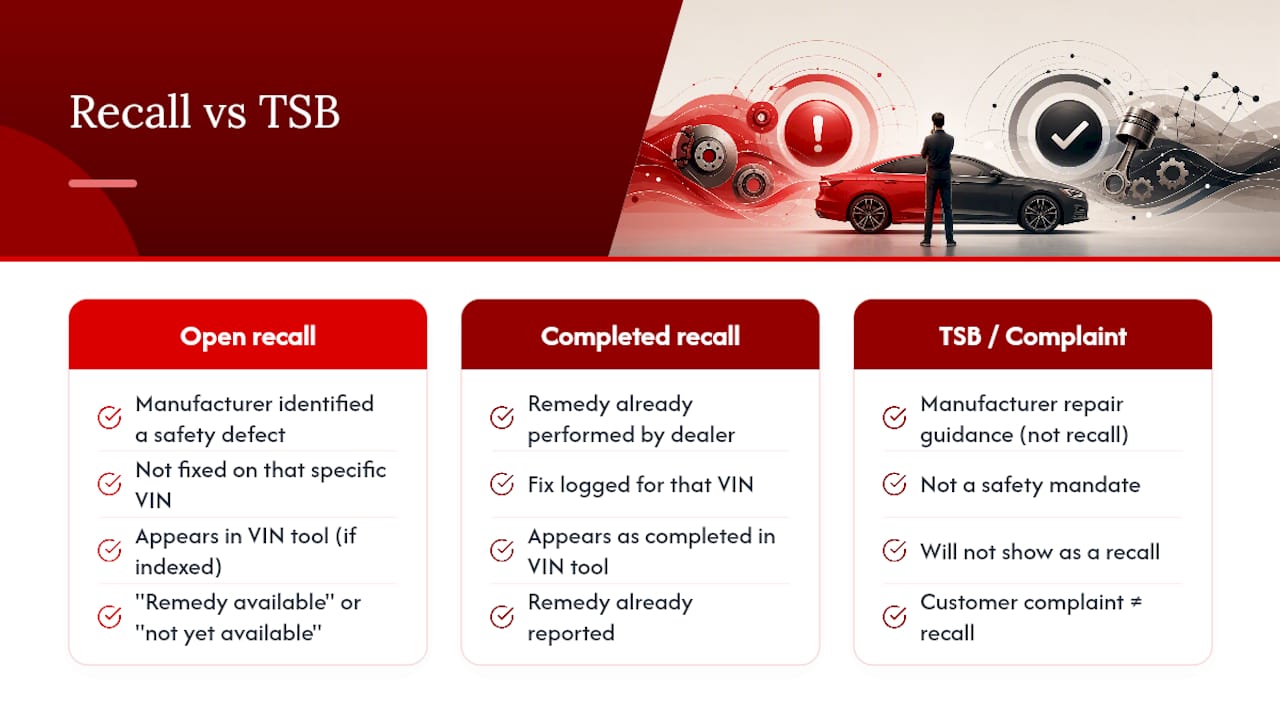
An open recall, sometimes called an unrepaired or active recall, means a manufacturer identified a safety defect and the fix hasn't been logged as done on that specific VIN. A completed recall means a dealer already performed the remedy and reported it.
NHTSA's VIN tool generally covers the past 15 years and excludes a handful of edge cases: brand-new VINs not yet indexed, and some smaller manufacturers with limited reporting history, per SaferCar's own coverage notes.
Don't confuse a recall with a Technical Service Bulletin (TSB) or a customer complaint. A TSB is a manufacturer's internal repair guidance for a known issue, not a safety mandate, and it won't show up as a recall. Also watch for "remedy available" versus "remedy not yet available" language. The first means a dealer can fix it today. The second means the defect is confirmed, but parts or a repair procedure aren't ready.
Found an Open Recall? Here's What to Do Next
Don't panic. Getting an open recall fixed is usually straightforward and it costs you nothing.
- Call any authorized dealer for that make. Recall repairs are free at the dealership regardless of your car's age, mileage, or warranty status. You don't need to buy the car there.
- Schedule the repair and ask how long it takes. Some fixes are same-day; others involve backordered parts.
- Request the stamped repair order. This is your proof the recall was completed. Keep it with your registration paperwork.
- If the remedy isn't available yet, keep your dated VIN lookup on file and ask the dealer or manufacturer for a notification timeline. Manufacturers are required to notify registered owners by mail, but those notices get lost or missed constantly, according to NHTSA's own owner guidance.
- If you're buying used, ask the seller to complete the repair or hand over proof of completion before you sign anything.
Pro Tip: A verbal "yeah, that recall's fixed" from a private seller means nothing. Ask for the paper. If they don't have it, the dealer that did the work can usually reprint it.
Used-Car Buyer's Pre-Purchase Recall Checklist
Before you hand over a deposit on any used car, run through this short list. It takes ten minutes and can save you a repair bill or a safety scare down the road.
- Locate the VIN and run it through the NHTSA lookup, saving a dated copy of the results.
- Cross-check the manufacturer's portal and a vehicle history report for completed recall records the federal tool might not show yet.
- Ask for stamped dealership repair orders on any recall work the seller claims is already fixed.
- Build recall-related systems (airbags, brakes, steering) into your pre-purchase inspection checklist, not just an afterthought.
- Use any open, unrepaired recall as a real negotiating point on price or as a condition of sale.
A car with an open recall isn't automatically a car to avoid. It's a car that needs one more phone call before the deal closes. For more on what a trustworthy transaction should look like from start to finish, this rundown on spotting an honest dealer covers the documentation habits worth expecting from any seller.
How Elmwood Auto Sales Handles Recall Checks and Inspections
Every vehicle that comes through our lot goes through a thorough inspection process before it's offered for sale, and that review includes checking recall status against the VIN on file. Documentation may be available so buyers have information about what has been checked or repaired.
You can ask for records related to inspections and recall status for a specific vehicle. You can also schedule a test drive and bring your questions about recall history, inspection results, or financing straight to the lot.
Our Take: Skip the Guesswork, Get the Paper Trail
Most advice on recalls stops at "check the VIN," which is correct but incomplete. The VIN lookup tells you whether a recall exists. It doesn't prove a fix happened, and it won't catch every edge case, especially on very new VINs or smaller manufacturers, as SaferCar's own coverage notes admit.
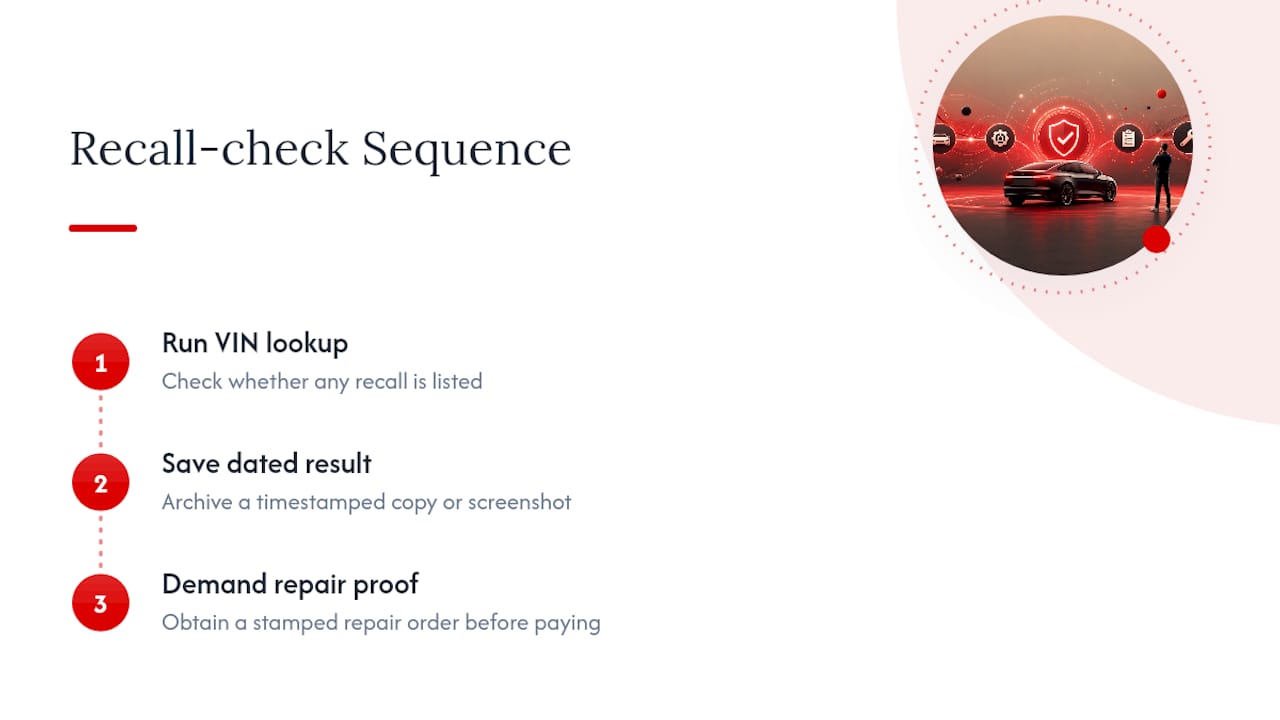
The gap most buyers fall into is trusting a clean lookup result as the final word. A completed status without a stamped repair order is a claim, not proof. We'd rather see buyers treat the VIN lookup as step one and the paperwork chase as step two, particularly on private-party used-car deals where nobody's checking your work for you.
Prioritize this order: run the VIN, save the dated result, then demand physical proof of any claimed repair before money changes hands. That sequence protects you far more than a single search ever will.
— Elmwood
Sources
- Check for Recalls: Vehicle, Car Seat, Tire, Equipment | NHTSA
- Recalls Look-up by VIN - Vehicle Identification Number
- Vehicle Recall Check by VIN or License Plate | Check to Protect
- Check for Car Recalls - Search by License Plate or VIN