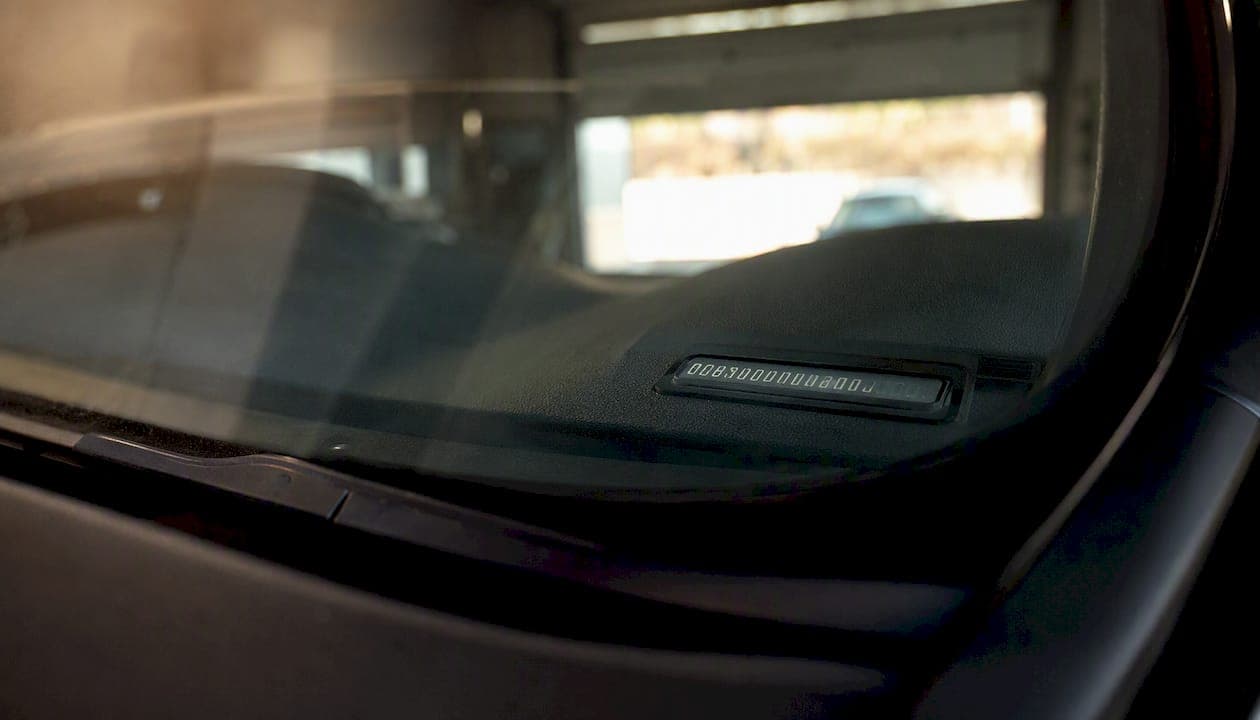
A vehicle identification number, or VIN, is a vehicle's unique 17-character code that identifies its manufacturer, model year, and production details. This code has been the standard for road vehicles sold in the United States since 1981, and it's the single most reliable way to verify what a car actually is before you buy it. The National Highway Traffic Safety Administration (NHTSA) sets the rules for how VINs are built, and the ISO 3779 standard governs the international structure behind them. At Elmwood Auto Sales, we run a VIN check on every vehicle that comes through our lot, because it's the fastest way to confirm a car's history before it ever reaches a customer.
Here's what a VIN lets you do in about two minutes:
- Verify model year and origin — confirm the car is what the listing or seller claims it is.
- Check recalls, theft, and title history — spot open safety recalls or a salvage title before you sign anything.
- Order parts or confirm equipment — match the exact trim, engine, and factory options to your vehicle.
Pro Tip: Before you test-drive any used car or click into an online listing, jot down the VIN and run it through NHTSA's free vPIC decoder. It takes less time than adjusting your mirrors, and it can save you from a very expensive mistake.
Table of Contents
- What Does VIN Stand For and Where Did the 17-Character Format Come From?
- Why Does a Vehicle Identification Number Matter to You?
- How Is a VIN Structured, Character by Character?
- How Do You Decode a Sample VIN Step by Step?
- Where Can You Find the VIN on a Vehicle?
- What If a VIN Isn't 17 Characters Long?
- How Do You Decode and Check a VIN Yourself?
- What Are the Warning Signs of VIN Tampering?
- How Does Elmwood Auto Sales Use VINs During Inspections?
- What Should You Do Right Now With This Information?
- Where Can You Verify a VIN Yourself?
- A Publisher's Note on VIN Transparency
- Frequently Asked Questions About Vehicle Identification Numbers
- Sources
What Does VIN Stand For and Where Did the 17-Character Format Come From?
VIN stands for vehicle identification number, and it functions as a car's fingerprint. No two vehicles on the road share the same one. Federal regulation defines it plainly: a VIN is a series of Arabic numbers and Roman letters assigned to a vehicle for identification purposes, and that definition covers everything from the check digit to the manufacturer identifier baked into the code.
Before 1981, VINs varied wildly in length and format from one manufacturer to the next. Some ran 11 characters, others 13, and cross-referencing a Ford VIN against a Chevrolet VIN required different logic entirely. That inconsistency made theft tracking and recordkeeping a mess. NHTSA fixed the problem by mandating the 17-character format that every road vehicle sold in the U.S. has used since. If you're looking at a car built in 1982 or later, its VIN meaning and structure follow the same 17-character rules regardless of the manufacturer.
Why Does a Vehicle Identification Number Matter to You?
A VIN isn't just a string of characters stamped somewhere on the car. It's the key that unlocks everything you actually need to know before handing over money.
- Recall checks — confirm whether the manufacturer has issued a safety fix that hasn't been performed yet.
- Vehicle history reports — see accident records, odometer readings, and ownership changes.
- Title and registration — the VIN ties the physical car to its legal paperwork at the DMV.
- Theft and salvage verification — flag a car that's been reported stolen or rebuilt from a total loss.
- Ordering parts — match the exact engine, transmission, and trim package for repairs.
- Service history — many shops log repairs by VIN, so a full history can follow the car for years.
When you plug a VIN into SaferCar's recall lookup tool, NHTSA cross-references it against every open manufacturer recall tied to that specific vehicle, not just its model line. That distinction matters because two cars of the same year and trim can have different recall statuses depending on when and where they were built.
Free government tools like vPIC and SaferCar tell you about recalls and manufacturing data, but they won't show you accident history or past ownership. That's where paid services like CARFAX and AutoCheck come in. They pull from insurance claims, auction records, and state title databases to build a fuller picture. Consumer Reports notes that a decoded VIN can reveal where a car was built, its model year, and often its factory equipment, but the deeper accident and ownership history usually requires one of these paid reports.

How Is a VIN Structured, Character by Character?
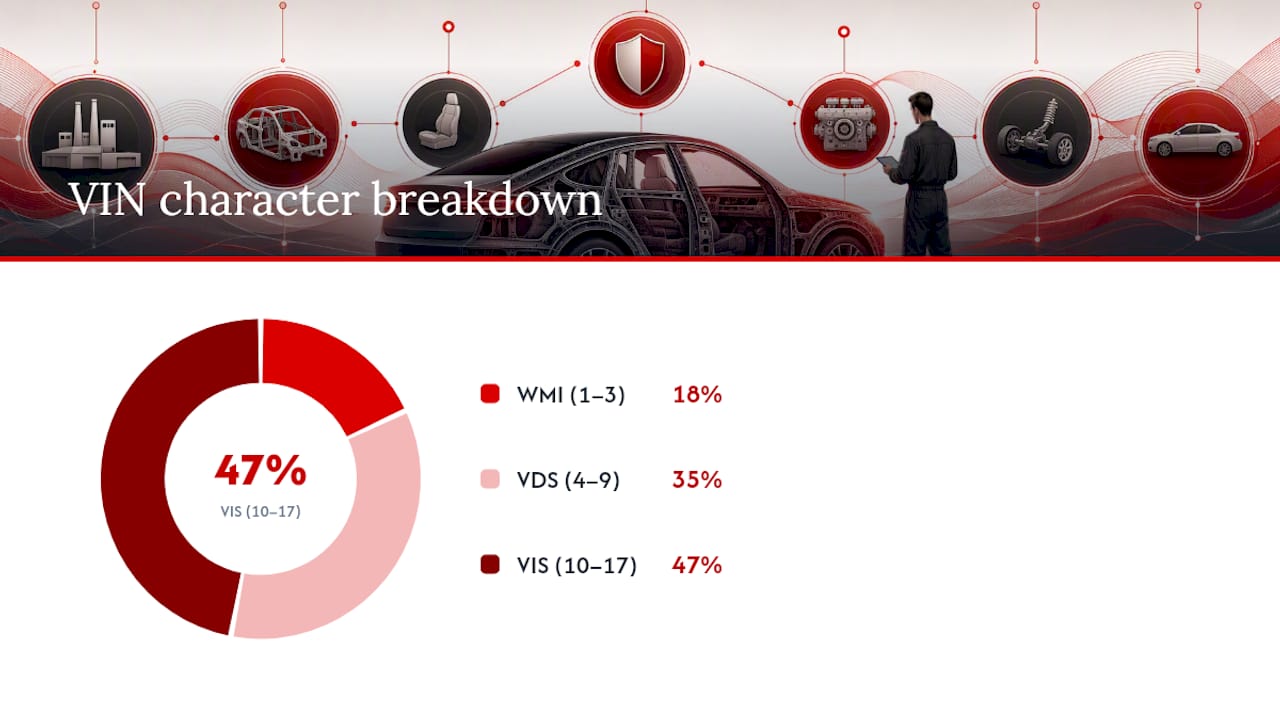
Every VIN breaks down into three sections: the World Manufacturer Identifier (WMI), the Vehicle Descriptor Section (VDS), and the Vehicle Identifier Section (VIS). According to Vermont's DMV, the first three characters make up the WMI, the next six form the VDS, and the final eight compose the VIS, which includes the model year and production sequence.
Here's what each position actually tells you:
- Position 1 — country where the vehicle was manufactured.
- Position 2–3 — manufacturer (combined with position 1, this forms the WMI).
- Position 4–8 — vehicle attributes like body style, engine type, and restraint system.
- Position 9 — the check digit, a calculated value used to catch transcription errors.
- Position 10 — model year, using a letter or number code.
- Position 11 — the assembly plant where the vehicle was built.
- Position 12–17 — the production sequence number, unique to that specific vehicle.
The check digit deserves special attention. Federal regulation defines it as part of the required VIN terminology, and it works by applying a mathematical formula across the other 16 characters. If someone mistypes a single digit while copying a VIN, the check digit calculation won't match, which flags the error immediately. It's a built-in spellcheck for one of the most important numbers on your car.
| VIN Position | What It Represents |
|---|---|
| 1–3 | World Manufacturer Identifier (country and maker) |
| 4–8 | Vehicle Descriptor Section (body, engine, restraint type) |
| 9 | Check digit (error detection) |
| 10 | Model year |
| 11 | Assembly plant |
| 12–17 | Production sequence number (unique to that vehicle) |
Pro Tip: The 10th character uses a repeating cycle of letters and numbers to encode the model year. A "1" typically points to a 2001 model, while an "A" points to 2010, and the pattern repeats every 30 years. If the letter doesn't match the year the seller claims, ask questions before you ask for the keys.
How Do You Decode a Sample VIN Step by Step?
Let's walk through an illustrative example: 1HGCM82633A123456. This isn't a real vehicle's VIN, but it follows the standard format so you can see how the pieces fit together.
- 1 (position 1) — manufactured in the United States.
- HG (positions 2–3) — Honda, forming the WMI along with position 1.
- CM8263 (positions 4–9) — descriptor section covering body style, engine, and the check digit.
- 3 (position 10) — model year, which in this cycle points to 2003.
- A (position 11) — the specific assembly plant.
- 123456 (positions 12–17) — the unique production sequence number for that individual car.
Online decoders like NHTSA's vPIC tool pull much of this information from data that manufacturers themselves submit, which is why results can occasionally be incomplete for older or lower-volume vehicles. It's also worth remembering that the letters I, O, and Q are never used in a VIN, because they're too easy to confuse with the numbers 1 and 0. If you see one of those letters on a VIN plate or listing, that's a red flag worth investigating before you go any further.
Where Can You Find the VIN on a Vehicle?
The VIN shows up in more places than most buyers realize, and checking more than one location is smart practice, not paranoia.
- Driver's-side dashboard — visible through the windshield from outside the car; this is the fastest place to check first.
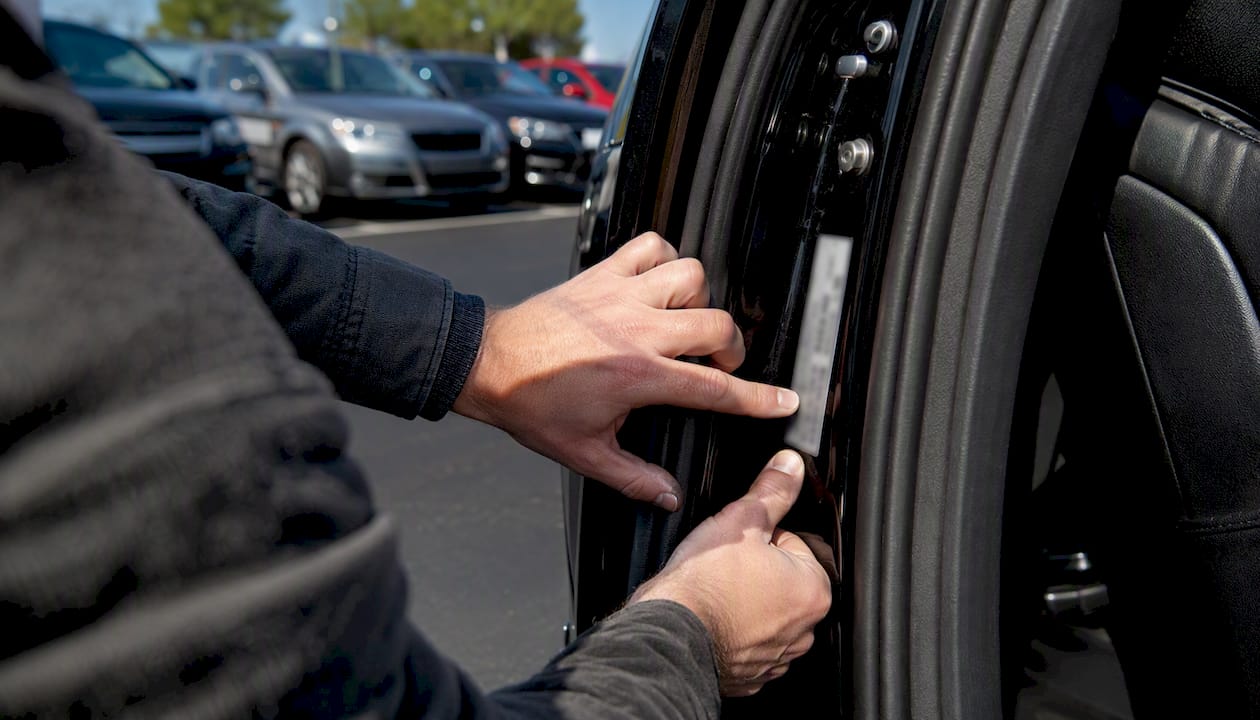
- Driver's-side doorjamb — look for a sticker when you open the driver's door.
- Engine block or frame rails — often stamped directly into the metal.
- Title — printed on the vehicle's legal ownership document.
- Registration — listed on the current registration card.
- Insurance card — most policies list the VIN alongside coverage details.
State DMV guidance, including Texas's DMV resources, consistently points to the dashboard and doorjamb as the two most reliable spots to start.
Pro Tip: Never trust a single VIN source. Compare the number on the dashboard against the doorjamb sticker and the title before you commit to a purchase. If they don't match exactly, walk away or ask for a written explanation.
What If a VIN Isn't 17 Characters Long?
Sometimes a VIN you're checking comes back shorter than 17 characters, and there are a few explanations, some harmless and some worth a closer look.
- Pre-1981 vehicles — older cars used shorter, non-standardized VIN formats before the 17-character rule took effect.
- Transcription mistakes — a seller or listing site may have dropped a character by accident.
- Damaged or tampered plates — physical damage or intentional alteration can make a VIN unreadable or incomplete.
If you run into a short VIN, start by checking a second location on the vehicle, then compare it against the title and registration. For genuinely older or collector vehicles, contacting your local DMV is often the cleanest way to confirm the correct format. The 1981 boundary matters here specifically because it's the dividing line NHTSA drew when it standardized the 17-character system nationwide, so anything built afterward should follow the modern format without exception.
How Do You Decode and Check a VIN Yourself?
Here's the sequence we recommend to anyone shopping for a used car:
- Copy the VIN exactly, character by character, avoiding the letters I, O, and Q.
- Run it through NHTSA's vPIC decoder to confirm manufacturer, model year, plant, and country of origin using data manufacturers reported directly.
- Search SaferCar.gov for any open recalls tied to that specific VIN.
- Order a paid vehicle-history report through a service like CARFAX or AutoCheck if you need accident, ownership, or odometer records.
Free government decoders and paid history reports serve different purposes, and it helps to know which one to reach for:
- NHTSA vPIC and SaferCar — free, manufacturer-reported data on build specs and recalls; no accident or ownership history.
- CARFAX and AutoCheck — paid reports pulling from insurance, auction, and title records; the best option when you need to know what happened to the car after it left the factory.
Consumer Reports specifically recommends leaning on official government decoders rather than random commercial VIN sites, many of which exist mainly to upsell you on a report you may not need.
Pro Tip: Save a screenshot or PDF of every VIN lookup you run. If a seller's claims don't match what NHTSA or a history report shows, you'll have documentation ready when you raise the discrepancy.
What Are the Warning Signs of VIN Tampering?
VIN cloning and tampering are real problems in the used-car market, and knowing the warning signs protects you from buying a stolen or misrepresented vehicle.
- Mismatched VINs between the dashboard, doorjamb, and title.
- Grinding marks, scratches, or discoloration around a stamped VIN plate.
- Rivets that look mismatched, replaced, or tampered with.
- Inconsistent fonts or spacing compared to factory-standard VIN plates.
- Missing stickers where one should legally be present, such as the doorjamb.
Experienced inspectors routinely cross-check VINs across the dashboard, doorjamb, and engine block or frame rail specifically because cloned vehicles often show inconsistencies in one location but not another. Resources like Protect A Plate's guide to vehicle identity protection go into more depth on how plate cloning happens and what protective steps exist for owners.
If you spot a discrepancy, here's the order of operations:
- Document everything — photograph each VIN location and note the exact differences.
- Run an immediate history search using the VIN from the title, since that's typically the legally registered number.
- Contact your local DMV or police department if the mismatch looks intentional rather than a simple typo.
A single missing digit on a bill of sale usually just needs a correction. Physical evidence of grinding, mismatched rivets, or an altered plate is a different category entirely, and that's when law enforcement should get involved.
How Does Elmwood Auto Sales Use VINs During Inspections?
Every vehicle that comes onto our lot goes through the same VIN verification process before it's ever listed for sale. We cross-check the number on the dashboard, the doorjamb sticker, and the title to confirm they all match. From there, we run the VIN through NHTSA's decoder and pull a vehicle history report to confirm recall status, prior accidents, and title condition. We also use the VIN to verify factory equipment, so what's advertised matches what's actually on the car.
Our inspection process includes:
- Cross-checking the VIN across the door jamb, dashboard, and title.
- Running NHTSA and vehicle history reports on every vehicle before listing.
- Confirming equipment details and open recall status against the decoded VIN.
- Including the VIN and lookup results directly in the vehicle's inspection paperwork.
We also provide free vehicle history reports on our vehicles, because we'd rather you see the full picture before you make a decision than find out something after the fact. If you're curious about what our inspection and purchase process looks like from start to finish, that's worth a read too.
Pro Tip: Whether you're buying from us or anywhere else, ask for printed VIN lookup results and the inspection sheet before you sign anything. A dealer who hesitates to hand those over is telling you something important.
What Should You Do Right Now With This Information?
Understanding a VIN's meaning is not just for mechanics. It's a shortcut to answers about model year, recall status, and vehicle history, and having a full history report in hand is one of the most important checks recommended when evaluating any certified pre-owned or standard used vehicle.
A vehicle's history, recall status, and true identity are only as reliable as the VIN check performed before purchase.
| Point | Details |
|---|---|
| 17-character standard | Every U.S. road vehicle built since 1981 uses this format, per NHTSA. |
| Check digit catches errors | Position 9 flags mistyped or altered VINs before they cause confusion. |
| Multiple check locations | Compare the dashboard, doorjamb, and title to catch mismatches early. |
| Free vs. paid tools | Use NHTSA vPIC and SaferCar first, then CARFAX or AutoCheck for full history. |
| Immediate next step | Copy your VIN, run it through vPIC, then decide if a paid report is needed. |
Where Can You Verify a VIN Yourself?
Start with NHTSA's vPIC decoder, since it's free and pulls directly from manufacturer-submitted data. From there, layer in the other resources depending on what you're trying to confirm.
| Tool | What It Shows | Best Used For |
|---|---|---|
| NHTSA vPIC | Manufacturer, model year, plant, country | First check on any VIN |
| SaferCar.gov recall search | Open safety recalls tied to the VIN | Confirming recall repairs are complete |
| CARFAX / AutoCheck | Accident, ownership, odometer history | Full history before a purchase |
| Consumer Reports VIN guide | Plain-language explainer on what a VIN reveals | Understanding decode basics |
| State DMV VIN pages | Location guidance and title verification | Confirming VIN placement and paperwork |
Run NHTSA's decoder first. If the car checks out and you're moving toward a purchase, that's the point to invest in a paid history report for the deeper ownership and accident record.
A Publisher's Note on VIN Transparency
We emphasize VIN transparency because it's the fastest way to earn trust with someone who's about to make a major purchase. A VIN doesn't lie about model year, recall status, or manufacturing origin, and when we hand a customer that information upfront, it removes the guesswork that makes car buying stressful in the first place. If you'd like a printed VIN history or inspection report on a vehicle you're considering, schedule a test drive with us, or reach out through Elmwood Auto Sales directly and we'll walk you through it before you ever get behind the wheel.
Frequently Asked Questions About Vehicle Identification Numbers
What does VIN stand for? VIN stands for vehicle identification number, a unique 17-character code assigned to identify a specific vehicle.
How do I find my VIN without opening the car? Look through the windshield at the driver's-side corner of the dashboard. That's the fastest location to check without opening a door.
Is a VIN lookup free? NHTSA's vPIC decoder and SaferCar's recall search are both free. Full accident and ownership history typically requires a paid report from a service like CARFAX or AutoCheck.
Why do some VINs not have 17 characters? Vehicles built before 1981 used shorter, non-standardized formats. A modern car with fewer than 17 characters likely reflects a transcription error or a damaged plate.
Can a VIN be faked or cloned? Yes. Criminals sometimes copy a legitimate VIN onto a stolen vehicle. Cross-checking the VIN across the dashboard, doorjamb, and title helps catch this before you buy.
Sources
- Vehicle Identification Number (VIN) — NHTSA
- VIN Decoder | vPIC — NHTSA
- Vehicle identification number (VIN) — Vermont DMV
- 49 CFR § 565.12 — Definitions (VIN terms) — Legal Information Institute
Recommended
- Transparency Matters – Why Elmwood Auto Sales Provides Free Vehicle History Reports - Elmwood Auto Sales
- Why Used Car Dealer Certifications Matter in 2026
- Dealership Vehicle Inspection Process: What Buyers Should Know
- Service History Transparency – What Sets Elmwood Auto Sales Apart - Elmwood Auto Sales