
Commission-based pay usually increases short-term pressure and upselling risk for car buyers. Salary, flat-fee, and hybrid models reduce those pressures by shifting a salesperson's focus from per-deal profit to customer satisfaction and repeat business. If price transparency and a low-pressure experience matter most to you, favoring a no-commission dealership is the clearest path to a more honest transaction. Elmwood Auto Sales in Providence, RI operates on exactly that model, and it's a concrete example of what transparent car sales look like in practice.
Here's what that means for you as a buyer:
- Commission floors typically pay salespeople a percentage of front-end gross profit, creating a direct financial incentive to maximize the price you pay.
- Non-commissioned stores, as covered by Motor1, shift that incentive toward volume and customer happiness rather than per-deal margin.
- Buyers at no-commission or clear-hybrid dealerships report measurable psychological relief when they know the salesperson's income isn't riding on a single transaction.
- Elmwood Auto Sales is a real-world example you can visit or contact to experience the difference firsthand.
Table of Contents
- How dealerships calculate commission and what it means for your deal
- How commission, salary, flat-fee, and hybrid models compare for buyers
- How pay models change what salespeople actually do on the lot
- What to look for when you visit a dealership
- Exactly what to ask before you sign anything
- What to expect on timing and cost at commission vs. non-commission stores
- What the research shows, and how Elmwood Auto Sales applies it
- Key Takeaways
- Why the pay model conversation matters more than most buyers realize
- A low-pressure test drive is one step away at Elmwood Auto Sales
- Sources and further reading
How dealerships calculate commission and what it means for your deal
The math behind a salesperson's paycheck shapes every conversation on the showroom floor. Most commission-based pay plans start with the vehicle's front-end gross profit, which is the difference between the dealer's cost (including any factory-to-dealer incentives) and the price you agree to pay. From that gross, the dealer subtracts a fixed pack amount, typically several hundred to over a thousand dollars, to cover overhead and marketing before the salesperson sees a dollar of commission.
Statistic to know: Front-end commission rates commonly run within a typical range, with tiered "stair-step" plans that push the percentage higher as a salesperson sells more units in a month.
A quick worked example: a car sells for $18,000 against a dealer cost of $16,000, producing $2,000 in front gross. After a $900 pack deduction, the commission base drops to $1,100. At 25%, the salesperson earns $275 on that deal. That number climbs fast if the salesperson also participates in back-end products like extended warranties, GAP insurance, and financing, each of which carries its own commission percentage.
Key mechanics buyers should understand:
- Pack deductions reduce the commission base and are rarely disclosed to buyers, but they directly affect how aggressively a salesperson negotiates.
- Per-unit minimums ("mini deals") guarantee a floor payment, often a modest fixed amount, when gross is too thin to produce meaningful commission.
- Tiered bonuses reward hitting monthly unit targets, which explains why pressure often spikes at the end of a month.
- Back-end participation gives salespeople a separate incentive to push add-ons during the finance office visit, independent of the vehicle price itself.
Understanding hidden dealer fees and pack mechanics before you walk in gives you a real advantage at the negotiating table.
How commission, salary, flat-fee, and hybrid models compare for buyers
Each pay model creates a different showroom culture. The table below maps the four main structures against the dimensions that matter most to you as a buyer.
| Dimension | Straight Commission | Salary Only | Flat Fee per Unit | Hybrid (Salary + Bonus) |
|---|---|---|---|---|
| Honesty / customer trust | Lower — income tied directly to margin | Higher — no per-deal financial motive | High — fixed pay removes margin pressure | Moderate-high — base removes desperation |
| Pricing transparency | Lower — pack and gross are guarded | Higher — price is less personal | High — one-price models common | Moderate — depends on bonus structure |
| Upselling pressure | High — back-end adds income | Low | Low to moderate | Moderate — bonus may reward add-ons |
| Staff turnover | High — income volatility drives exits | Lower — predictable income | Lower | Lower than straight commission |
| How pay is calculated | % of front gross after pack | Fixed monthly salary | Fixed dollar amount per car sold | Base salary + per-unit or CSI bonus |
| Customer satisfaction (CSI) | Variable — deal-focused behavior | Consistently higher | Consistently higher | Generally higher than straight commission |
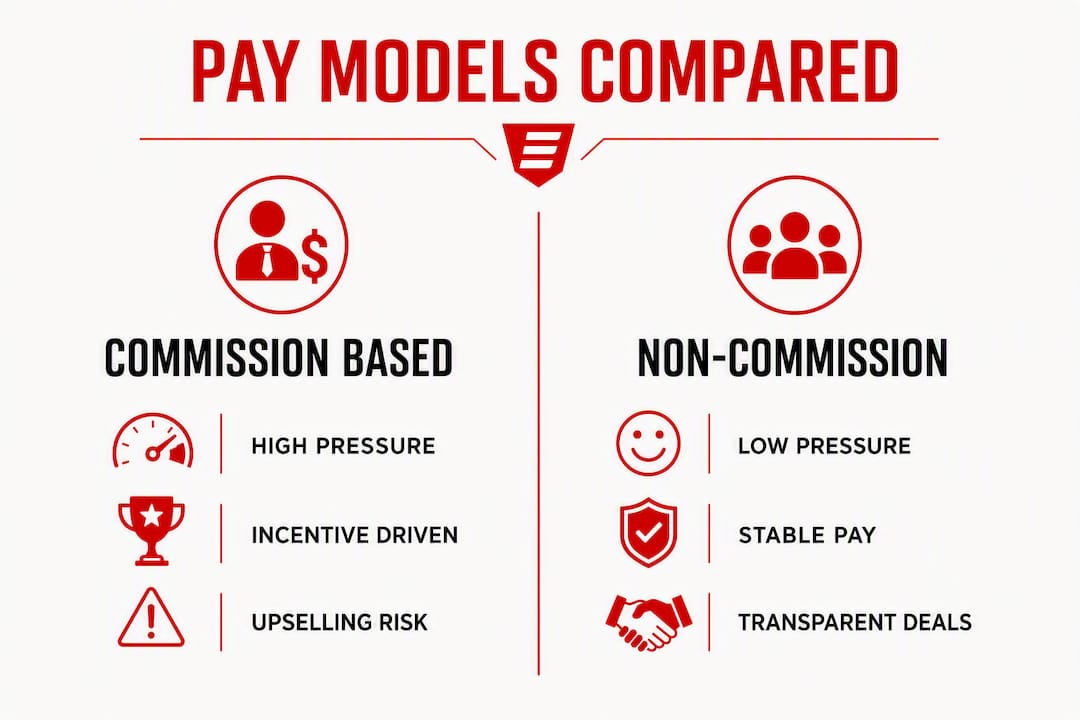
Commission floors attract aggressive closers and suit high-volume, multi-rooftop operations where unit counts are the primary performance metric. Salary and flat-fee floors favor team-oriented selling and tend to appear at single-point or lower-volume stores where reputation and repeat business carry more weight.
Pros and cons for buyers at a glance:
- Straight commission: faster close on a busy floor, but higher risk of price inflation and add-on pressure.
- Salary only: more relaxed experience, though without volume incentives the store may carry less inventory variety.
- Flat fee per unit: one-price simplicity, best at higher-volume stores where the model is financially sustainable.
- Hybrid: balances motivation with stability; buyer experience depends heavily on what the bonus rewards (units, CSI, or gross).
How pay models change what salespeople actually do on the lot
Pay structure is the single biggest driver of salesperson behavior, and its effects show up in specific, predictable ways. On a straight-commission floor, salespeople have a financial reason to close quickly, steer you toward higher-margin vehicles, and push back hard on any price concession. Split deals, where two salespeople contest credit for the same customer due to CRM attribution problems, add another layer of urgency that has nothing to do with your needs and everything to do with their paycheck.

Back-end product commissions amplify this further. When a salesperson earns a separate percentage on GAP insurance, paint protection, or an extended warranty, the finance office visit becomes a second sales event with its own pressure. Buyers who don't know this often feel blindsided by the F&I menu.
Non-commissioned associates, by contrast, report that removing deal-based pay eliminates the financial motive to steer buyers toward higher-margin cars. The focus shifts to matching you with the right vehicle and building the kind of relationship that generates referrals and repeat visits. Customer service standards at these stores tend to be more consistent because the salesperson's income doesn't spike or collapse based on a single negotiation.
Pro Tip: Ask the salesperson directly: "Is your pay tied to the profit on this specific deal?" A straightforward "no" with a brief explanation of their pay structure is a strong trust signal. Evasion or a redirect to the manager is worth noting.
What to look for when you visit a dealership
Spotting a genuinely low-pressure, honest dealership takes less than five minutes if you know what to check. Use this list before or during your visit:
- One-price or no-haggle language in ads and on the lot — posted prices that match the website are a strong signal of pricing consistency.
- Clear fee disclosure before you sit down to negotiate; ask for a breakdown of all fees and the pack amount upfront.
- Visible pay model or policy — some dealerships post their no-commission policy on their website or in the showroom, as Elmwood Auto Sales does.
- Consistent online pricing — if the listed price changes between your first visit to the website and your second, that's a red flag.
- Inspection reports and vehicle history available before you ask; a dealership that volunteers a Carfax or state inspection report is signaling transparency.
- Stable staff — if the salesperson you spoke with last week is still there this week, that's a sign of lower turnover and a healthier pay environment.
- Review patterns — look for dealership review ratings that mention low pressure, honesty, and repeat purchases, not just "great deal."
A truthful answer to "How are your salespeople paid?" sounds like: "We pay a flat fee per car, not a percentage of profit." A suspicious response redirects to the vehicle or the deal without answering the question. Spotting an honest used car dealer comes down to whether the dealership answers direct questions directly.
Exactly what to ask before you sign anything
These six questions work at any dealership, regardless of pay model. They expose incentives, reduce pressure, and give you the information you need to compare quotes fairly.
- "How are your salespeople compensated — salary, commission, or a mix?" Listen for specifics. A vague answer ("we have a competitive pay plan") tells you the structure favors the house.
- "What fees are included in this price, and what's the pack deduction?" Most salespeople won't know the pack amount, but asking signals that you understand the math.
- "Can I see the out-the-door price in writing before we discuss financing?" Separating the vehicle price from the financing conversation is the single most effective way to avoid inflated totals.
- "Who gets credit for this sale if I spoke with someone else first?" This surfaces split-deal dynamics and tells you whether internal competition might be affecting your experience.
- "What's included in the extended warranty, and what does the finance office earn on it?" Back-end product commissions are real; asking the question often reduces the pitch intensity.
- "Is this price the same as what's listed on your website right now?" Price consistency between online and in-person is a basic transparency test.
For practical negotiation tips, always bring a written walk-away threshold, negotiate price and trade-in value separately, and never let the monthly payment be the only number on the table.
What to expect on timing and cost at commission vs. non-commission stores
The buying experience at a commission-heavy floor tends to move faster, but that speed often comes with trade-offs. Salespeople motivated by per-deal gross have a reason to compress the process and get you to the finance office before you've had time to compare alternatives. A visit at a high-pressure store can run two to four hours once you factor in the back-and-forth on price and the F&I menu.

Non-commission and hybrid floors typically spend more time upfront understanding what you need, which can extend the initial conversation but shortens the negotiation phase because there's less maneuvering on price.
On cost, the pack and back-end commission structure means the headline price you see is rarely the full story:
- A typical pack deduction is built into the dealer's cost structure before commission is calculated, so the salesperson has no incentive to cut into it.
- Back-end products (GAP, warranties, paint protection) can add several hundred to a few thousand dollars to the total if you accept the full F&I menu without scrutiny.
- At a flat-fee or no-commission store, the salesperson has no financial reason to push those add-ons, so the out-the-door price is more likely to reflect the vehicle's actual value.
Always request the full out-the-door cost breakdown in writing before agreeing to anything, regardless of which model the store uses.
What the research shows, and how Elmwood Auto Sales applies it
Industry research points in a consistent direction: hybrid and non-commission pay structures are increasingly adopted to improve customer satisfaction scores and reduce staff turnover, while straight commission remains dominant at high-volume operations where aggressive closing is a feature, not a bug.
The data points that matter most for buyers:
| Metric | Range / Finding | Source |
|---|---|---|
| Front-end commission rate | 20–30% of gross after pack | rework resources |
| Pack deduction range | $500–$1,200 per deal | DealSpeak |
| Commission vs. salary culture | Commission floors favor high-volume; salary floors favor single-point stores | CarDealership.com |
| Non-commission buyer benefit | Psychological relief and faster negotiations reported | CarTalk Radio |
| Split-deal conflict | CRM attribution failures create internal urgency that harms buyer experience | MotorTrend |
Elmwood Auto Sales applies these findings directly. Operating without commission-based pay means the sales team has no financial reason to steer you toward a higher-margin vehicle or push add-ons you don't need. Every car on the lot goes through a thorough inspection before it's offered for sale, and financing options, including in-house arrangements for buyers with varied credit histories, are presented without the F&I upsell pressure common at commission floors. Buyers who want to see this in practice can schedule a test drive and compare the experience directly.
Key Takeaways
Commission-based pay creates direct financial incentives that increase price pressure and upselling risk, while salary, flat-fee, and hybrid models shift salesperson focus toward customer satisfaction and transparent pricing.
| Point | Details |
|---|---|
| Commission rate range | Front-end commission typically runs 20–30% of gross profit after a $500–$1,200 pack deduction. |
| Back-end pressure is separate | Finance office add-ons carry their own commission, making the F&I visit a second sales event. |
| Non-commission buyer benefit | Buyers report lower pressure and faster negotiations when salesperson pay isn't tied to a single deal. |
| Key questions to ask | Ask how salespeople are paid, request the out-the-door price in writing, and separate price from financing. |
| Elmwoodautosalesri approach | Elmwood Auto Sales operates without commission-based pay, offering inspected used vehicles and in-house financing in Providence, RI. |
Why the pay model conversation matters more than most buyers realize
Most car buyers walk onto a lot focused on the vehicle, the monthly payment, or the trade-in value. The pay model running behind the scenes rarely comes up. That's a mistake, and it's one that costs buyers real money.
The commission structure doesn't just affect how a salesperson talks to you. It shapes which cars they show you first, how quickly they try to move you to the finance office, and how hard they push back when you ask for a lower price. A salesperson earning 25% of front gross on a $2,000 margin deal takes home $275. On a $4,000 margin deal, that doubles. The incentive to steer you toward the higher-margin car is built into the math, not the person.
What's underestimated is how much the absence of that incentive changes the conversation. When a salesperson's income doesn't hinge on your specific deal, the dynamic shifts from negotiation to consultation. That's not idealism. It's what non-commissioned dealerships report consistently, and it's why buyers at those stores describe the experience as noticeably different.
The practical takeaway: before you spend hours negotiating, spend five minutes asking how the salesperson gets paid. The answer tells you more about what to expect than any review site.
A low-pressure test drive is one step away at Elmwood Auto Sales
Elmwood Auto Sales gives Providence-area buyers a concrete alternative to commission-driven sales. Every vehicle on the lot is inspected before it's listed, pricing is straightforward, and the sales team's pay isn't tied to the profit margin on your deal. That means no steered recommendations, no F&I pressure tactics, and no split-deal urgency affecting your experience.
Financing options, including in-house arrangements for buyers across a range of credit histories, are available without the upsell environment common at commission-based stores. If you want to see what transparent car sales actually feels like, book a test drive at Elmwood Auto Sales and compare it to any other lot you've visited.
Sources and further reading
- Non-Commissioned Car Salesman: Is It Worth It? — Motor1: backs the buyer psychology and salesperson behavior claims in the BLUF and case example.
- What Is a Split Deal? Inside How Car Sales Commissions Really Work — MotorTrend: source for split-deal mechanics and CRM attribution conflicts.
- What Is a No-Commission Car Dealership? — Elmwood Auto Sales Blog: explains the no-commission model and what buyers can expect.
- Signs of a Trustworthy Car Dealership: 2026 Buyer Guide — Elmwood Auto Sales Blog: checklist for identifying honest dealerships.