
A no-commission car dealership is one where salespeople earn a fixed salary or flat fee per vehicle sold instead of a percentage of the profit on each deal. This model removes the financial incentive to push buyers toward higher-priced vehicles or unnecessary add-ons. The result is a buying experience built on transparency rather than pressure. Elmwoodautosalesri operates on exactly this principle, offering Rhode Island car buyers honest pricing and straightforward interactions from the first conversation to the final signature.
What is a no-commission car dealership and how does it differ?
Traditional dealerships pay salespeople 20–25% of frontend gross profit on each vehicle sold. That structure creates a direct conflict of interest: the more you pay, the more the salesperson earns. A no-commission dealership breaks that link entirely by paying staff a fixed wage regardless of the vehicle's price or profit margin. The industry term for this model is "one-price" or "non-commissioned" retail, and it is gaining ground across the American auto market.
The practical difference shows up immediately in how salespeople behave. Without a commission tied to profit, there is no reason to steer you toward a more expensive trim, push unnecessary warranties, or drag out negotiations. Salespeople focus on matching you to the right vehicle for your needs and budget. That shift in incentive changes the entire tone of the showroom floor.

Elmwoodautosalesri applies this model at its Providence, RI location, where pricing is transparent and the sales process is designed to inform rather than persuade. Buyers who want to spot an honest used car dealer will find that the absence of commission is one of the clearest signals of a customer-first operation.
How do no-commission car dealerships work in practice?
The compensation structure is the foundation of the model. Salespeople receive a fixed base salary, sometimes supplemented by a small flat bonus per unit sold. This volume-based incentive rewards throughput rather than profit per deal. 62% of dealerships are now moving toward hybrid compensation models that blend base salary with flat-rate volume bonuses, reflecting a broader industry shift away from pure commission pay.
Pricing at no-commission dealerships is typically set up front as a no-haggle, one-price figure. The sticker price is the selling price. Buyers do not need to negotiate, research dealer invoice costs, or worry about whether they left money on the table. That simplicity saves time and removes the anxiety that most buyers associate with car shopping.
The sales process itself changes shape in several important ways:
- Salespeople act as product specialists rather than deal closers, walking buyers through vehicle features and financing options without pressure.
- Pricing is posted clearly on vehicles and online, so buyers arrive informed rather than dependent on a salesperson for basic cost information.
- Test drives and vehicle comparisons are encouraged because the salesperson's pay does not depend on closing any single deal quickly.
- Financing conversations happen openly, with terms explained clearly rather than buried in back-office paperwork.
- Customer satisfaction scores replace gross profit as the primary performance metric, aligning staff incentives with buyer outcomes.
High-performing non-commissioned salespeople can earn well above the national average income. Salesperson income driven by volume rather than per-sale profit means the best staff close more deals at fair prices, not fewer deals at inflated ones. That dynamic benefits buyers and sellers alike.
What are the benefits of buying from a no-commission dealership?
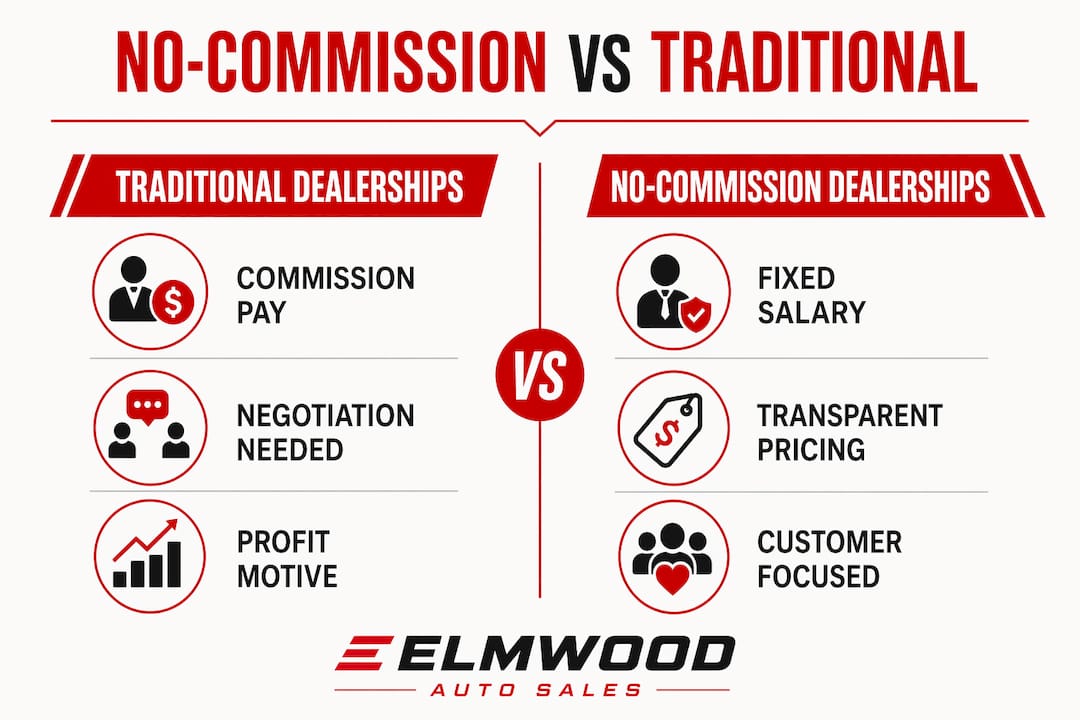
The most direct benefit is the removal of sales pressure. When a salesperson's paycheck does not depend on the profit margin of your specific deal, the urgency to close disappears. You can take your time, ask questions, and compare vehicles without feeling pushed toward a decision. That alone makes the experience fundamentally different from a traditional showroom.
Unbiased vehicle recommendations are a second major advantage. Non-commissioned salespeople prioritize customer long-term satisfaction over short-term profit, which means they will tell you honestly if a vehicle does not fit your needs. In a commission-based environment, that kind of candor costs the salesperson money. In a no-commission setting, it costs nothing and builds trust.
Simplified pricing and financing are equally valuable. One-price models eliminate the back-and-forth of negotiation, and transparent financing terms mean you understand exactly what you are agreeing to before you sign. Buyers with a range of credit histories benefit especially from this clarity, since the terms are explained rather than obscured.
Customer satisfaction scores at no-commission dealerships reflect these advantages. High-performing no-commission teams sometimes reach the 97th percentile in customer satisfaction, which drives word-of-mouth referrals and repeat business. That is a measurable outcome, not a marketing claim.
Pro Tip: Before visiting any dealership, check its BBB rating and customer reviews. A no-commission dealer with strong ratings is a reliable signal of consistent, pressure-free service. Learn what BBB ratings mean for buyers before you shop.
How do modern digital tools enhance no-commission car buying?
Digital tools and no-commission sales are a natural pairing. Both are designed to give buyers more control and less dependence on a salesperson's guidance. Customers can browse inventory via QR codes, schedule test drives, and review pricing from their smartphones before setting foot in a showroom. That self-directed approach fits perfectly with the no-pressure philosophy of non-commissioned retail.
Remote financing is another tool that changes the buying experience. Buyers can submit financing applications, receive approvals, and review loan terms from home. Digital-first retail experiments allow customers to complete purchases remotely, avoiding paperwork bottlenecks and the time pressure of a traditional dealership visit. The result is a transaction that fits the buyer's schedule rather than the dealer's closing goals.
These tools also improve transparency in inventory sourcing and vehicle history. Buyers can access vehicle history reports, state inspection records, and pricing breakdowns online before committing to a visit. Understanding how dealership inventory is sourced helps buyers evaluate whether a dealer's pricing reflects genuine market value. That level of access was rare a decade ago and is now a standard expectation at forward-thinking dealerships.
The combination of digital tools and no-commission sales staff creates a buying environment where the buyer sets the pace. You research on your own terms, arrive informed, and work with a salesperson whose only job is to help you find the right vehicle.
What operational changes drive success in no-commission dealerships?
The shift away from commission pay requires structural changes throughout the dealership. The most significant is the elimination of the traditional finance and insurance office. Product specialists handle entire sales transactions on the sales floor, bypassing the back-and-forth that traditionally happens in a separate F&I office. Removing that step reduces transaction time and eliminates a major source of buyer frustration.
Cultural change matters as much as structural change. Dealerships that succeed with no-commission models implement shorter work weeks and remove split deal arrangements, reducing employee burnout and improving team stability. A four-day work week is not just a perk. It signals a management philosophy that values employee well-being, which translates directly into better customer interactions.
The table below compares key operational features between traditional and no-commission dealership models:
| Feature | Traditional dealership | No-commission dealership |
|---|---|---|
| Salesperson pay | 20–25% of gross profit per deal | Fixed salary or flat fee per unit |
| Pricing model | Negotiable sticker price | One-price, no-haggle |
| Finance and insurance | Separate F&I office | Handled on the sales floor |
| Performance metric | Gross profit per unit | Customer satisfaction score |
| Work culture | High turnover, commission pressure | Stable teams, volume focus |
Pro Tip: Ask any dealership how its salespeople are compensated before you start shopping. A straightforward answer about fixed pay is a strong indicator of a transparent operation. Dealers who hesitate or deflect on this question are worth approaching with caution.
Key Takeaways
No-commission car dealerships deliver measurably better buyer experiences by replacing profit-driven incentives with fixed pay, one-price transparency, and customer satisfaction as the primary measure of success.
| Point | Details |
|---|---|
| Fixed pay removes conflict of interest | Salespeople earn the same regardless of vehicle price, eliminating pressure to upsell. |
| One-price model saves time | No-haggle pricing means buyers know the cost upfront without negotiating. |
| Digital tools extend transparency | QR code browsing and remote financing give buyers full control before visiting. |
| F&I elimination reduces frustration | Handling finance on the sales floor cuts transaction time and hidden-fee risk. |
| Customer satisfaction drives performance | Top no-commission teams reach the 97th percentile in satisfaction scores. |
Why no-commission selling is the honest path forward
I have watched the traditional commission model frustrate buyers for years. The incentive structure is the problem. When a salesperson earns more by selling you a higher-priced vehicle or a warranty you do not need, the relationship starts with misaligned interests. That is not a character flaw in salespeople. It is a structural flaw in the compensation model.
What I have seen at Elmwoodautosalesri confirms what the data shows. When salespeople are paid a fair fixed wage, they stop performing and start helping. Conversations become more honest. Buyers ask more questions because they do not feel the clock ticking. Financing discussions are clearer because there is no back-office pressure to add products to the deal.
The hardest part of transitioning to this model is not the compensation change. It is the cultural shift. Dealerships built around gross profit metrics have to relearn what success looks like. Customer satisfaction scores, repeat buyers, and referrals become the real measures of performance. That takes time and genuine commitment from ownership and management.
My honest advice to any car buyer in Rhode Island: ask about compensation before you ask about price. A dealer willing to tell you plainly that its staff earns a fixed salary has already shown you something important about how it operates. That transparency does not stop at the pay structure. It shows up in pricing, financing, and every conversation you have on the lot.
— Elmwood
Elmwoodautosalesri: transparent pricing, no pressure
Elmwoodautosalesri brings the no-commission model to Providence, RI, with fixed-pay sales staff, one-price vehicle listings, and a buying process built around your needs rather than a salesperson's quota.
Every vehicle on the lot passes a thorough inspection before it is listed, and financing options include buy here, pay here solutions for buyers across the full credit spectrum. Elmwoodautosalesri also integrates Capital One Digital Retail tools, so you can browse inventory, review financing terms, and move through the purchase process at your own pace. Whether you visit in person or start online, the experience is designed to be clear, reliable, and free of pressure from start to finish.
FAQ
What is a no-commission car dealership?
A no-commission car dealership pays its salespeople a fixed salary or flat fee per vehicle instead of a percentage of the profit on each sale. This structure removes the financial incentive to push buyers toward higher-priced vehicles or unnecessary add-ons.
How do no-commission dealerships make money?
No-commission dealerships generate revenue through vehicle sales volume, transparent financing, and service operations rather than maximizing profit on individual deals. The model prioritizes throughput and customer retention over per-unit margin.
Are no-commission dealerships worth it for buyers?
No-commission dealerships consistently produce higher customer satisfaction scores, with top performers reaching the 97th percentile, making them a strong choice for buyers who value transparency and a low-pressure experience.
How do I know if a dealership is truly no-commission?
Ask directly how salespeople are compensated. A no-commission dealer will confirm fixed pay without hesitation. You can also check whether pricing is posted as a firm one-price figure rather than a negotiable sticker.
Do no-commission salespeople still provide good service?
Non-commissioned salespeople focus on customer needs rather than closing profit, and high performers earn above-average incomes through volume. The model attracts staff who prefer building trust over applying pressure, which benefits buyers directly.