
First time buyer programs are starter auto loans built for people with little or no credit history. Get preapproved by a credit union or bank before you walk onto a dealer lot, then compare any in-house financing offer against that baseline. Some dealerships pair inspection-backed inventory with tailored financing to offer trustworthy local options once you know your numbers.
TL;DR:
- Preapproval from a bank or credit union provides a reliable baseline, improves negotiation power, and is typically quicker than dealer approval.
- Most first-time buyer programs require proof of employment, a down payment of 10-20%, and have caps on loan amounts and vehicle age or mileage.
- Dealership in-house financing offers convenience but often comes with higher rates and fees, so compare total costs carefully before committing.
- Saving a larger down payment and gathering all necessary documents can significantly improve approval chances and loan terms.
- These programs do not provide direct tax benefits, and government assistance options are limited mostly to local or state-specific transportation aid rather than grants.
Table of Contents
- What Are First Time Buyer Programs and Why Do Lenders Offer Them?
- Who Typically Qualifies for a Starter Auto Loan?
- Dealer Financing vs. Credit Unions vs. Online Lenders: Which Wins?
- How Do You Improve Your Approval Odds?
- What Should You Ask Before Accepting In-House Financing?
- Are There Government-Backed Assistance Programs for Car Buyers?
- Do First-Time Car Buyers Get Any Tax Benefits?
- What's the Typical Timeline From Application to Driving Away?
- Elmwood Auto Sales: How We Help First-Time Buyers
- Where to Read More on First-Time Buyer Programs
- Ready to Finance Your First Car in Providence?
- Sources
- FAQ
What Are First Time Buyer Programs and Why Do Lenders Offer Them?
A starter auto loan works differently than a standard car loan. Instead of leaning on years of credit history, lenders in these programs look at income stability, employment, and your ability to make consistent payments. First-time car buyer programs relax standard credit requirements and often ask for proof of employment and a down payment in exchange for that flexibility.
Most programs bundle in a few common incentives. No-credit or thin-file acceptance is the headline feature, but lenders frequently pair it with requirements like mandatory autopay enrollment or a short financial education course. Some credit unions sweeten the deal with a promotional stretch of 90 days with no payments due, though interest usually keeps building in the background.
Lenders run these programs for a straightforward reason: acquiring a new member or customer who sticks around for years is worth more than the short-term risk. Credit unions in particular use starter loans to bring in younger borrowers and give them a real shot at building credit history through a manageable, well-structured first loan.
Who Typically Qualifies for a Starter Auto Loan?
Eligibility rules vary by lender, but the pattern across most first-time buyer programs is consistent. You generally need to show you can hold a job and handle a monthly bill, even without a credit score to back it up.
Expect programs to check for:
- Minimum age (usually 18) and proof of steady employment or income
- No credit history or a thin credit file, rather than a damaged one, since some programs treat "no credit" and "bad credit" very differently
- A down payment, often required upfront rather than optional
- Caps on loan amount and sometimes limits on the vehicle's age or mileage
- Program-specific conditions like automatic payment enrollment, a short financial literacy course, or credit union membership
Some lenders spell these limits out clearly. Reliant Credit Union's first-time auto buyer program lists concrete rules around age, residency, employment history, and minimum down payment. Park Community Credit Union's Auto Starter Loan caps the loan amount and vehicle age while opening the door to recent graduates and limited-credit borrowers. If you're not sure where you stand, a no credit check car loan guide can help you figure out which category you fall into before you apply.
Dealer Financing vs. Credit Unions vs. Online Lenders: Which Wins?
Every financing route has a different tradeoff between speed, convenience, and cost. Understanding the differences before you sit down at a dealership changes how the whole negotiation goes.
In-house financing, sometimes called buy-here-pay-here, means the dealership itself acts as the lender. It's fast and convenient, especially if your credit is thin, but dealer financing can carry rate markups that experts recommend checking against an outside offer before you sign anything.
Credit unions frequently run dedicated first-time buyer programs with member-focused terms, lower rates, and a genuine interest in helping you build credit. The tradeoff is that you usually need to join the credit union first, and approval can take a little longer than a same-day dealer approval.
Banks and online lenders or loan marketplaces bring speed and competitive rates into the mix, particularly if you already have a banking relationship or a cosigner with established credit. They tend to outperform dealer financing when your credit is borderline rather than nonexistent.
Whichever route you're comparing, total cost matters more than the monthly payment. A lower payment stretched over a longer term, or with a higher APR, often costs more overall.
Total cost checklist:
- APR (not just the advertised "rate")
- Loan term length
- Origination or documentation fees
- Whether interest accrues during any promotional no-payment period
A types of car financing options guide walks through each channel in more detail if you want the full breakdown.
How Do You Improve Your Approval Odds?
Approval odds and loan terms both improve when you show up prepared rather than hoping the dealer works something out on the spot. A little preparation before you shop changes the entire negotiation.
- Get preapproved first. A preapproval from a credit union or bank gives you a real baseline offer and instantly strengthens your negotiating position. Preapproval is the single most effective lever a first-time buyer has.
- Save a down payment. Putting down 10% to 20% of the vehicle's price improves approval odds and loan terms more reliably than almost anything else you can do.
- Assemble your documents. Proof of income, a valid ID, and sometimes personal references speed up approval and avoid delays mid-process.
- Consider a cosigner if needed. A cosigner with established credit can unlock better rates, but understand that they're equally responsible for the loan if payments slip.
- Read the fine print on promotions. Autopay discounts are worth taking, but no-payment promotional periods usually still accrue interest behind the scenes.
- Calculate total loan cost, not just the monthly number, before you compare any two offers side by side.
Pro Tip: Run the math on total interest paid over the full loan term, not just the monthly payment, before you accept any offer. A $20 lower payment on a longer term can cost you hundreds more overall.
For a deeper walk-through on documentation and negotiation, see things to know before financing a car and the math behind why a down payment reduces car costs.
What Should You Ask Before Accepting In-House Financing?
Buy-here-pay-here financing can be a legitimate option for a first-time buyer with no credit file, but it comes with terms that deserve closer look before you sign. Bring this list with you:
- What's the APR, the total fees, and the full cost of the loan over its entire term?
- Does interest keep accruing during any advertised no-payment promotional period?
- Are payments reported to the major credit bureaus, so the loan actually helps build your credit?
- What happens at late payment or default, and are there repossession terms you should know upfront?
- Is there a prepayment penalty if you pay the loan off early?
- What's the return or inspection policy if the vehicle has an issue after purchase?
Ask for the paperwork in writing and compare it line by line against your preapproval offer before you commit. A prepayment penalty and dealer steps guide covers the loan-term traps that catch first-time buyers most often.
Are There Government-Backed Assistance Programs for Car Buyers?
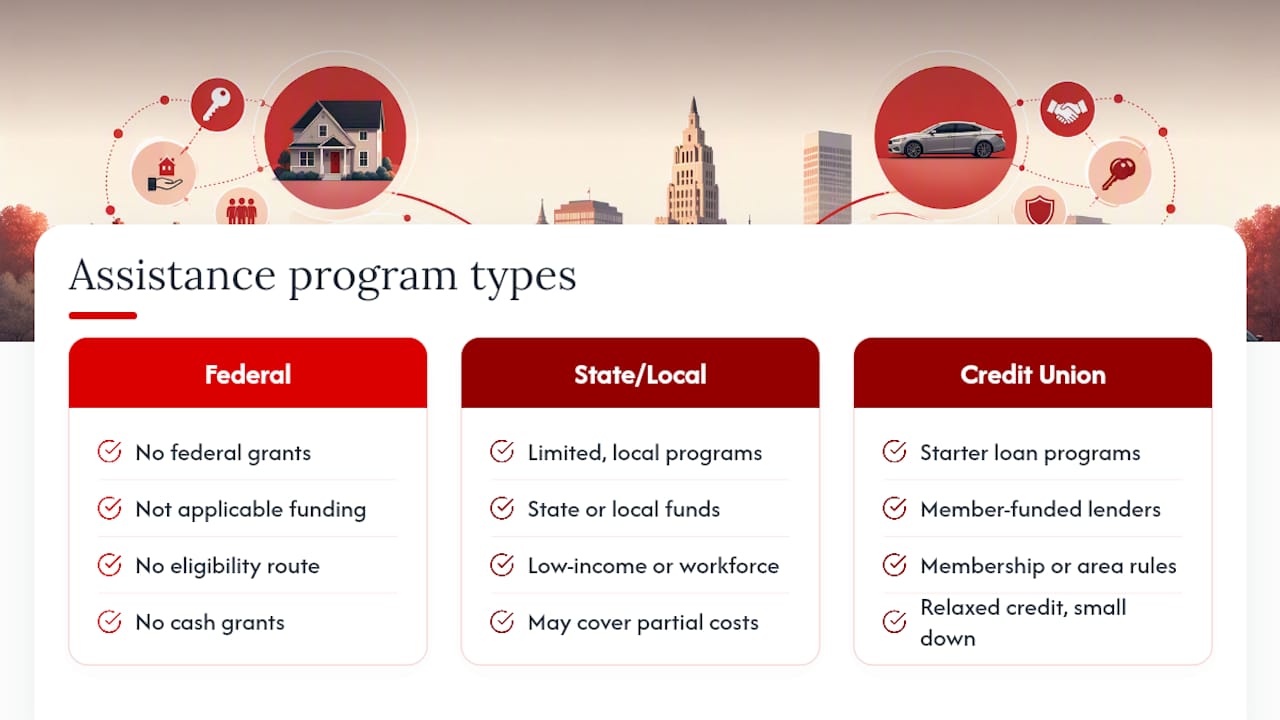
Government-backed assistance for vehicle purchases is far more limited than the mortgage-style down payment grants and tax credit programs built for first-time homebuyers. There's no federal equivalent of a housing grant that hands first-time car buyers cash toward a vehicle purchase.
What does exist tends to be narrower and state or locality specific. Some state workforce development programs offer transportation assistance to help low-income workers get to a job, occasionally covering a portion of vehicle costs or connecting applicants with low-interest loan programs through community organizations. Certain credit unions also structure their starter loan programs with membership requirements tied to a specific employer, school, or geographic area, which functions similarly to a local assistance program even though it isn't government funded.
The more realistic path for most first-time buyers is a credit union or community lender's dedicated starter loan program rather than a government grant. These programs do the practical work: relaxed credit requirements, manageable down payments, and terms designed around a buyer who's building financial history for the first time. If you're researching assistance programs specifically because your credit is a concern rather than your income, a bad credit car buying options guide is a more direct resource than searching for a grant that likely doesn't apply to your situation.
Do First-Time Car Buyers Get Any Tax Benefits?
There's no broad federal tax credit for simply being a first-time car buyer, unlike the credits available for certain electric vehicle purchases regardless of buyer history. If a tax benefit applies to your purchase, it almost always comes from the vehicle itself, not your status as a first-time buyer.
Electric and plug-in hybrid vehicles can qualify for federal tax credits based on the vehicle's battery sourcing, assembly location, and price cap, along with the buyer's income limits. These rules apply the same way whether it's your first car or your fifth. If you're shopping used, a smaller federal credit exists for qualifying used clean vehicles, again tied to the vehicle and income thresholds rather than buyer history.
Some states offer their own incentives, sales tax exemptions, or rebates for specific vehicle types, and a handful of local utility companies run rebate programs for EV purchases. None of these are first-time buyer programs in the traditional sense. They're vehicle-based or income-based incentives that a first-time buyer happens to be eligible for on the same terms as anyone else.
The practical takeaway: don't shop for a first car expecting a tax break tied to your buyer status. Focus your energy on the loan terms and total cost, since that's where the real savings are for someone financing their first vehicle.
What's the Typical Timeline From Application to Driving Away?
Most first-time buyers can move from application to keys in about one to two weeks, though the exact pace depends on how prepared you are going in.
Preapproval (1 to 3 days). Applying with a credit union or bank first typically returns a decision within a few days, sometimes same-day online. This step also tells you your realistic budget before you start browsing.
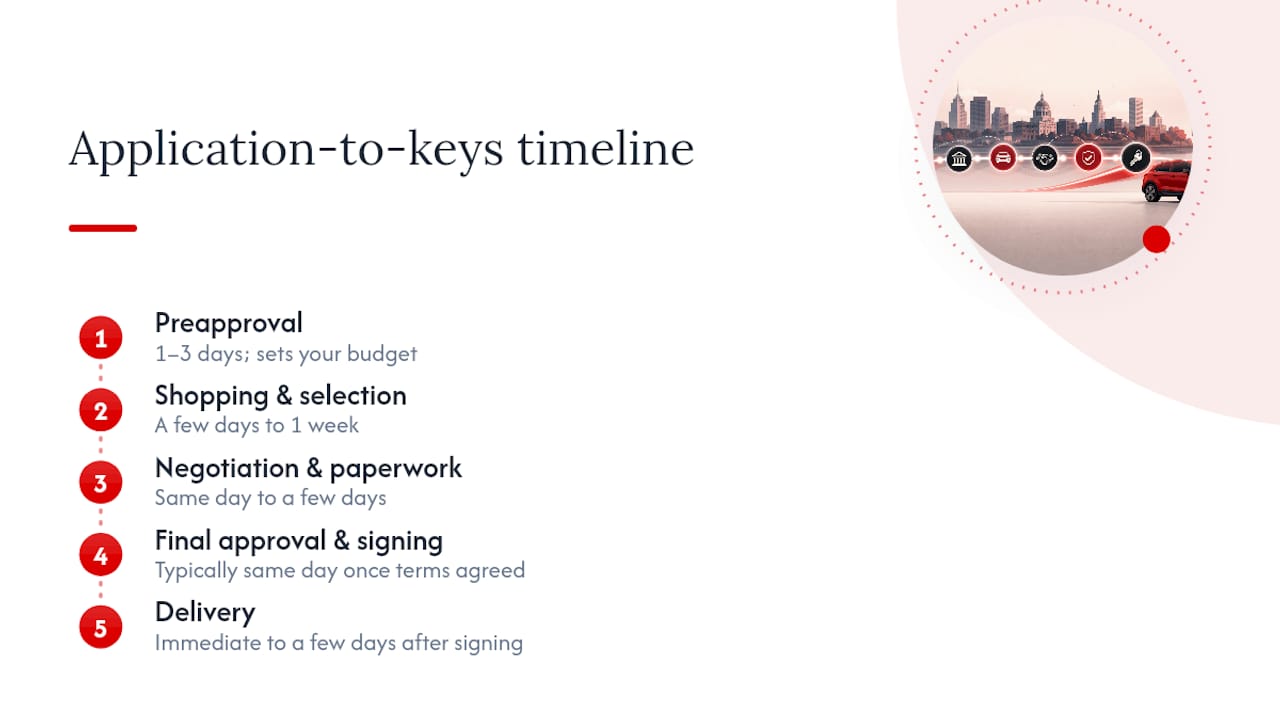
Shopping and vehicle selection (a few days to a week). With a preapproval number in hand, you can focus on vehicles within budget instead of falling for whatever payment a dealer quotes.
Dealer negotiation and paperwork (same day to a few days). If you're comparing an in-house offer against your preapproval, this is where you ask the questions above and compare the actual numbers side by side.
Final approval and signing (same day, once terms are agreed). Once you accept terms, either through your preapproval lender or the dealer, signing and paperwork usually wrap up in a single visit.
Delivery (immediate to a few days). Most buyers drive away the same day they sign, though a specific vehicle may need final inspection or a short wait if it's still being prepped.
Buyers who skip preapproval often stretch this timeline out by days or weeks, going back and forth between dealer offers with no baseline to compare them against.
Elmwood Auto Sales: How We Help First-Time Buyers
We built our sales process around one idea: no commission-based pressure tactics, ever. That means the person helping you through financing has no incentive to push you toward a higher rate or a longer term than you actually need. Every vehicle on our lot goes through a thorough inspection before it's offered for sale, so a first-time buyer isn't gambling on reliability on top of everything else they're learning about financing.
Some dealers offer tailored financing that can include in-house buy-here-pay-here solutions and third-party lender options, matched to where your credit actually stands rather than a one-size-fits-all approval process. If you've never financed a car before, that flexibility matters more than a flashy rate you might not qualify for anyway.
Our suggested next step is simple: get preapproved somewhere first, then bring that number to our finance team and walk our inventory. Comparing a real offer against a real vehicle beats guessing every time.
— Elmwood
Where to Read More on First-Time Buyer Programs
For deeper detail on program mechanics, Bankrate's guide to first-time car buyer programs and its breakdown of dealer financing are solid starting points. To see real eligibility rules in action, review Greater Nevada Credit Union's first-time buyer loan program and Park Community Credit Union's Auto Starter Loan.
Ready to Finance Your First Car in Providence?
Some dealerships offer a low-pressure alternative to commission-driven places for first-time buyers who need real financing flexibility, not a hard sell. Many vehicles are offered after thorough inspections, so buyers are not choosing between a good rate and a reliable car. Finance teams sometimes work with in-house and third-party options side by side, matching the structure to buyers' actual credit picture rather than steering them toward options with the highest commissions.
If you've already gotten preapproved, bring that offer in and we'll show you exactly how our terms compare. If you haven't started yet, our finance team can walk you through what a realistic first loan looks like before you ever sit down at a table. Browse our inspected inventory or get in touch with our financing team to start the conversation today.
This article is general information, not a substitute for advice from a qualified financial advisor. Consult a qualified financial professional about your own circumstances before acting on anything here.
Sources
- First-time Car Buyer Programs: How They Work & How To Apply | Bankrate
- First-Time Car Buyer Loan Program | Greater Nevada Credit Union
- First-Time Auto Buyer Program - Reliant Credit Union
- Auto Starter Loan - Park Community Credit Union
FAQ
What Credit Score Do I Need for a First-Time Buyer Program?
Most first-time car buyer programs are built for no credit or thin credit files, not just low credit scores, so a missing credit history often matters more than a specific number.
Is Buy-Here-Pay-here Financing a Good Idea for a First Car?
It can work well if you've been turned down elsewhere, but always compare the total cost, including APR and fees, against a credit union or bank preapproval before signing, since in-house rates can run higher.
How Much Down Payment Do I Need as a First-Time Car Buyer?
A down payment of 10% to 20% of the vehicle's price typically improves both approval odds and the loan terms you're offered.
Will a Starter Auto Loan Actually Build My Credit?
Yes, as long as the lender reports your payments to the credit bureaus, which most credit union first-time buyer programs do when payments are made on time.
Should I Get Preapproved Before Visiting a Dealership?
Yes. Preapproval gives you a concrete baseline offer and stronger negotiating power, and it's the step financial experts consistently point to as the most useful move a first-time buyer can make.