
Most auto loans let you pay them off early without any fee, but a real minority carry a prepayment penalty, and the only way to know for certain is to check your paperwork. Pull your Truth in Lending Act disclosure and request an official payoff quote that includes per-diem interest before you send a payment. Skipping that step matters because a penalty or a precomputed interest structure can quietly cancel out the interest savings you were counting on.
TL;DR:
- Most auto loans do not have prepayment penalties, but checking the Truth in Lending disclosure and payoff quote is essential to confirm early payoff costs.
- Prepayment penalties commonly take the form of flat fees, small percentage charges, or precomputed interest structures that reduce anticipated savings.
- State laws often limit prepayment penalties to loans with terms of 60 months or shorter, so longer-term loans are less likely to include enforceable penalties.
- When considering early repayment, compare the penalty amount and remaining interest savings to determine if paying off now offers a financial benefit.
- Always request a payoff quote with a valid-through date and confirmed application of extra payments before sending the final payment to avoid surprises.
Table of Contents
- What Is a Prepayment Penalty on an Auto Loan, and How Does It Work?
- Where to Find a Prepayment Clause and How to Confirm It With Your Servicer
- Does State Law Limit Prepayment Penalties? The 60-Month Rule Explained
- Is Paying Off Your Car Loan Early Actually Worth It?
- How to Avoid or Reduce Prepayment Penalties
- Your Payoff Checklist Before You Send a Final Payment
- An Honest Look at How Payoff Confusion Actually Happens
- Get Help Coordinating Your Payoff the Right Way
- Where to Verify Prepayment Rules and Run Your Own Numbers
- Sources
What Is a Prepayment Penalty on an Auto Loan, and How Does It Work?
A prepayment penalty is a fee some lenders charge when you pay off your loan faster than scheduled, because early payoff means the lender collects less interest than it planned for. Not every auto loan has one. Prepayment penalties are relatively uncommon among mainstream banks and credit unions, but they show up more often in subprime lending and dealer-arranged financing, according to Bankrate.
When a penalty does apply, it usually takes one of a few forms:
- A flat fee stated as a dollar amount in the loan note, regardless of when you pay off.
- A percentage penalty, often a small percent of your remaining balance, per Bankrate's reporting.
- Precomputed interest, sometimes called a Rule of 78s structure, which front loads interest so early payoff saves you far less than you'd expect.
That third type deserves attention because it doesn't look like a penalty on paper. The lender simply calculated your interest schedule so more of it comes due in the early months of the loan, which means paying off in month 10 of a 60 month loan saves you much less than a simple interest calculation would suggest.
Where to Find a Prepayment Clause and How to Confirm It With Your Servicer
Two documents settle the question. Your TILA disclosure legally has to itemize finance charges and any penalty clauses, and your promissory note or retail installment contract spells out the terms in full, according to the Consumer Financial Protection Bureau. Here's how to verify what you're actually dealing with:
- Search your loan documents for the phrases "prepayment penalty," "early payoff fee," or "precomputed interest."
- Log into your servicer's portal and request an official payoff quote, not just your current balance, since portal balances often omit per-diem interest owed on the exact day you pay.
- Call your servicer and ask them to confirm in writing whether extra payments apply to principal or get routed to future scheduled payments instead.
Watch for red flags like vague contract language, any mention of Rule of 78s, or a servicer that can't clearly explain how your extra payment gets applied.
Pro Tip: Always ask for the payoff quote's "good through" date. Interest accrues daily, so a quote from last week is already wrong today.

Does State Law Limit Prepayment Penalties? The 60-Month Rule Explained
State law is where most of the real protection lives. Many states permit lenders to charge a prepayment penalty only on loans with terms of 60 months or shorter, and lenders generally cannot charge one on longer terms.
- Many states plus Washington, D.C. commonly follow some version of this 60-month limit, according to Experian.
- If your loan runs 61 months or longer, a penalty clause is far less likely to be enforceable in those states.
- Rules still vary by state, so check your state regulator's site or ask the CFPB directly rather than assuming your loan is covered.
If you financed for 72 or 84 months, which has become common as vehicle prices have climbed, this rule often works in your favor. Shorter-term loans deserve a closer read of the contract.
Is Paying Off Your Car Loan Early Actually Worth It?
The math is simple once you have real numbers instead of estimates. Chase recommends checking with your lender for any penalty or restriction and weighing that cost against your projected interest savings before you commit.
Run it this way:
- Get your official payoff quote (balance plus per-diem interest).
- Find the penalty amount, if any, from your contract or servicer.
- Estimate your remaining scheduled interest if you kept paying on schedule.
- Subtract the penalty from the interest you'd save. If the number is positive, payoff wins.
Here's a simplified example on a $12,000 remaining balance with $900 in remaining interest left on the schedule:
Even with a penalty, paying off early may still make sense on a high-rate loan, but it's worth comparing that gain against other priorities like an emergency fund, higher-interest credit card debt, or a pending refund on a financed GAP or extended warranty product that's rolled into your loan.
Pro Tip: If your loan has a precomputed interest structure, ask your servicer for the exact interest rebate you'd receive on early payoff, not just an estimate. That figure can look nothing like the simple interest math you'd expect.
How to Avoid or Reduce Prepayment Penalties
The best time to deal with a prepayment penalty is before you sign, not after.
- Ask lenders directly, before you sign anything, whether the loan includes a prepayment penalty clause.
- If one exists, try negotiating its removal, or at minimum get written agreement that extra payments apply to principal.
- If you're considering refinancing, fold the penalty into your break-even math against the new loan's closing costs and rate; refinancing can still pay off even with a penalty, but only if the new terms clear that extra hurdle, according to Experian's analysis of the break-even math involved.
- If a penalty clause is already locked in, consider smaller extra payments spread over time instead of one lump payoff, since some contracts calculate penalties differently depending on timing.
- Always claim any pro-rated refund owed on financed add-ons like GAP coverage separately from your loan payoff, since that refund process usually runs through the product administrator, not your lender.
Pro Tip: Get every agreement about principal-only payments in writing before you send money. A phone call promise doesn't help you if the payment posts wrong.
Your Payoff Checklist Before You Send a Final Payment
Work through this in order so nothing slips through:
- Request an official payoff quote with a valid-through date and the per-diem interest line item included.
- Confirm whether your loan amortizes normally or uses precomputed interest, and get written confirmation on how extra payments post.
- Ask about refunds on any financed GAP or warranty products and the timeline to claim them.
- If refinancing instead of paying off outright, calculate your break-even point including the penalty and closing costs.
- Keep every email, payoff receipt, and confirmation number until the loan shows a zero balance on your credit report.
Pro Tip: Pay by the exact method your servicer specifies, whether that's a wire or a cashier's check. A personal check that takes days to clear can leave you owing a few extra dollars in interest you didn't expect.
An Honest Look at How Payoff Confusion Actually Happens
Most of the payoff headaches we see at Elmwood Auto Sales don't come from bad math. They come from assumptions. A buyer assumes their online portal balance is the real payoff number, or assumes an extra payment automatically hits principal, and neither is reliably true.
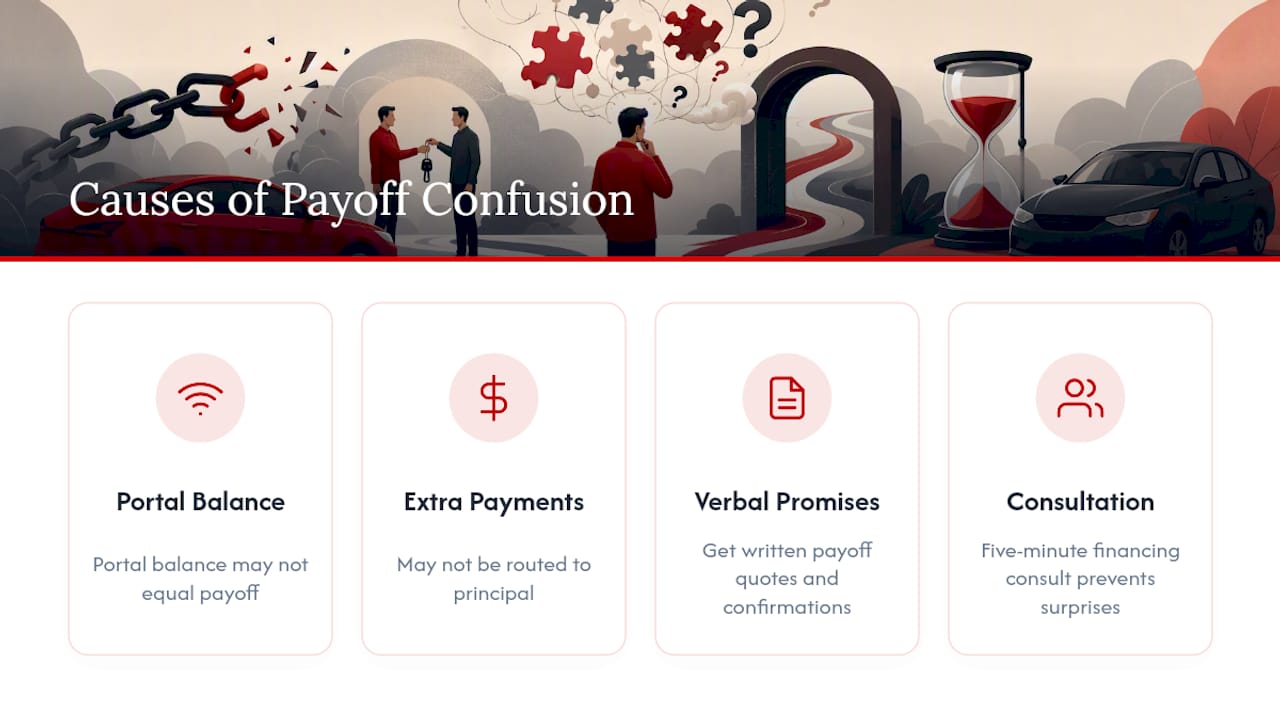
We provide written payoff quotes and confirm principal routing in writing as standard practice, because verbal assurances don't hold up when a balance comes in wrong. We also walk customers through claiming refunds on financed add-ons like extended warranties, since that process runs separately from the loan itself and catches people off guard.
If you're weighing an early payoff on a vehicle financed through us, bring your questions to a financing consultation before you send a final payment. It's a five-minute conversation that can save you from a surprise balance later.
— Elmwood
Get Help Coordinating Your Payoff the Right Way
Elmwood Auto Sales handles payoff coordination the same way we handle every financing conversation: straightforward, in writing, and without commission-driven pressure to push you one direction or another. If you financed with us and you're weighing an early payoff, we'll pull your official payoff figures, confirm how extra payments route to principal, and walk you through claiming any refund owed on a financed warranty or GAP product.
We also work with buyers who are still shopping and want financing that skips prepayment penalty clauses from the start, including classic car financing vs. personal loan options tailored for specialty vehicles. If you have questions about a loan you already hold or one you're considering, book a test drive and financing consultation at our Providence location, and we'll walk through the numbers with you in person.
Where to Verify Prepayment Rules and Run Your Own Numbers
- The CFPB's prepayment guidance confirms the legal disclosure requirements and your right to ask your lender directly.
- Experian's breakdown covers the 60-month rule and state-by-state variation in plain terms.
- For loan comparison math, review how extra payment strategies affect your total interest before deciding whether early payoff or refinancing wins.
This article is general information, not a substitute for advice from a qualified financial advisor. Consult a qualified financial professional about your own circumstances before acting on anything here.
Sources
- How to avoid paying a prepayment penalty — Experian
- Can I prepay my loan at any time without penalty? — CFPB
- Car loan prepayment penalty — Bankrate
- Paying off a car loan early — Chase