
A down payment cuts your total car costs by reducing the principal that accrues interest from day one. Every dollar you put down is a dollar that never generates interest charges over the life of the loan. Kelley Blue Book recommends at least 20% down on new cars and 10% down on used cars as the standard benchmarks to avoid negative equity and secure favorable loan terms. And according to NerdWallet, each $1,000 you put down typically reduces your monthly payment by a modest amount, depending on your APR and loan term.
The monthly savings are real, but they are actually the smaller part of the benefit. The bigger win is the reduction in total interest paid over 48, 60, or 72 months. A $6,000 down payment on a $30,000 car does not just trim your payment by roughly $90–$108 per month. It removes $6,000 from the balance that compounds interest charges every single month. That compounding effect is why the down payment significance in car purchases goes well beyond what shows up on your monthly statement.
Table of Contents
- 1. What counts as a down payment on a car?
- 2. How a down payment lowers your costs, step by step
- 3. Worked examples: how much do you actually save?
- 4. How much should you put down?
- 5. Pros and cons of putting more money down
- 6. How trade-ins and rebates work toward your down payment
- 7. Does a down payment work the same way on a lease?
- 8. When does it make sense to delay or skip a large down payment?
- 9. Practical tips for preparing and negotiating your down payment
- Key Takeaways
- What Elmwood actually sees at the finance table
- Financing options at Elmwoodautosalesri in Providence, RI
- Authoritative sources and further reading
1. What counts as a down payment on a car?
A down payment is any upfront value you apply to reduce the financed amount before the lender calculates your loan. Three things typically count: cash you pay at signing, trade-in equity (the market value of your current vehicle minus what you still owe on it), and manufacturer or dealer rebates that are applied directly to the purchase price. The Consumer Financial Protection Bureau confirms that your down payment can be cash, the net proceeds from a trade-in, or both.
What counts and what does not:
- Cash paid at signing: counts fully
- Trade-in equity (value above payoff balance): counts fully
- Manufacturer rebates applied to sale price: counts as an equivalent reduction
- Dealer-arranged incentives applied at closing: counts when applied to the purchase price
- Taxes, title, registration, and dealer fees: do NOT count; these are added costs, not down payment
- Extended warranty or add-on products rolled into the loan: do NOT count
From the lender's perspective, your down payment directly lowers the loan-to-value ratio (LTV). LTV is simply the loan amount divided by the vehicle's value. A lower LTV signals less risk to the lender, which is why a meaningful down payment can sometimes unlock better loan programs or a lower APR.
Pro Tip: If your trade-in has negative equity, meaning you owe more than it is worth, rolling that deficit into the new loan actually increases your LTV rather than reducing it. That is the opposite of a down payment. Get the trade-in payoff amount and the trade-in market value separately before you sit down in the finance office, so you know exactly what you are working with.
2. How a down payment lowers your costs, step by step
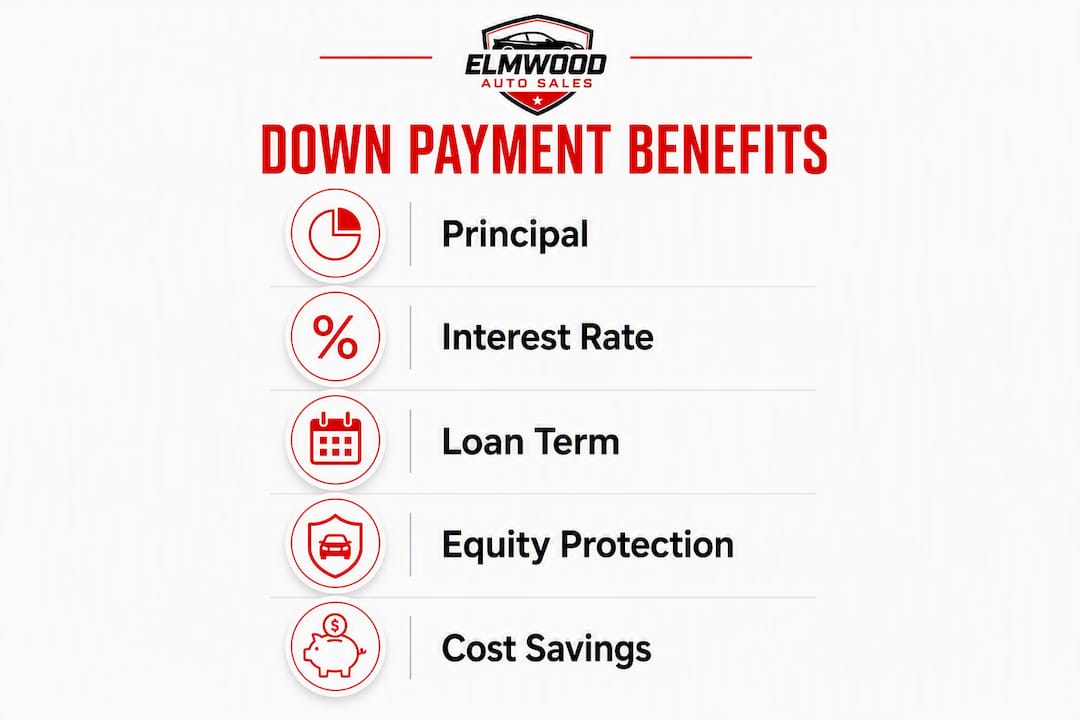
Understanding the mechanics helps you see why the CFPB notes that a down payment acts as a dollar-for-dollar reduction of the balance that interest is calculated against every month. Here is how that plays out across four connected steps.
Step 1: Principal reduction. Every dollar you put down comes off the loan balance before the lender ever runs an amortization schedule. Lower principal means lower interest charges from the very first payment. Think of it as prepaid principal that earns a guaranteed return equal to your loan APR.

Step 2: LTV and APR effects. Lenders use down-payment percentages as soft tier markers. Carsavr's auto loan down payment guide explains that crossing common thresholds, such as moving from below 10% to above 10%, or from below 20% to above 20%, can sometimes lower your APR in specific lender programs. A relatively small additional cash outlay at the right moment may unlock meaningful interest savings. SoFi confirms that a larger down payment can qualify borrowers for better rates in some programs by reducing lender risk.
Step 3: Term flexibility. When you finance a smaller amount, a shorter loan term becomes affordable. A 48-month loan instead of a 72-month loan on the same vehicle saves a significant amount in interest, because you are paying down principal faster and carrying the balance for fewer months.
Step 4: Negative equity protection. New cars depreciate quickly, often losing a significant portion of their value in the first year. If you finance 100% of the purchase price, you are likely underwater (owing more than the car is worth) within months. Starting with a meaningful down payment compresses that gap.
Pro Tip: Once your down payment exceeds a certain substantial fraction of the vehicle's value, additional cash down usually stops producing APR improvements. Lenders have already priced in the risk reduction at that point. Beyond that threshold, the benefit is purely principal reduction, which is still valuable, but you should weigh it against keeping cash liquid.
3. Worked examples: how much do you actually save?
Numbers make this concrete. The table below uses a mid-range purchase price with typical APR and loan term, comparing different down payment scenarios. These figures are calculated from standard amortization math consistent with calculator-based examples showing the savings from higher down payments.

| Down Payment | Amount Financed | Monthly Payment | Total Interest Paid | Total Cost |
|---|---|---|---|---|
| no down payment, full loan amount, estimated monthly payment, and total cost | ||||
| a moderate down payment reducing loan amount and associated payments and costs | ||||
| a larger down payment further reducing loan amount and associated payments and costs |
*Total cost includes the $6,000 paid upfront plus financed costs.
Increasing down payment significantly saves interest charges and reduces monthly payments. A moderate down payment scenario saves a meaningful amount in interest and reduces monthly payments. Those figures align with the NerdWallet rule-of-thumb of $15–$18 per $1,000 down.
The APR difference matters too. On a $27,000 loan over 60 months, the difference between a 6.5% APR and a 7.5% APR is roughly $730 in additional interest. If a larger down payment moves you across a lender's tier threshold and drops your APR by even one point, that rate improvement can be worth as much as the principal reduction itself.
First-year amortization snapshot (0% vs. 20% down, $30,000 car, 6.5% APR):
| Month | Balance at 0% Down | Interest at 0% Down | Balance at 20% Down | Interest at 20% Down |
|---|---|---|---|---|
| 12 | — | — | — | $110 |
The interest difference in month one alone is $33. That gap narrows slowly over time, but it compounds across every month of the loan.
4. How much should you put down?
The standard industry benchmarks are 20% on a new car and 10% on a used car. Chase's 20-4-10 rule guidance and Kelley Blue Book both cite these figures as the starting point for avoiding negative equity and accessing reasonable loan terms. But the right number for you depends on more than a rule of thumb.
Factors that should adjust your target:
- Your APR. The higher your rate, the more valuable each dollar of down payment becomes. At 9% APR, putting down an extra $2,000 saves considerably more than at 3% APR.
- Expected ownership length. Planning to keep the car for seven or more years? Down payment matters less because you will eventually build equity regardless. Selling or trading in within three years? A larger down payment protects you from being underwater at trade-in time.
- Emergency fund status. Never drain your emergency savings to hit a down payment target. A three-month cash reserve should be the floor before you commit a large lump sum to a vehicle.
- Alternative uses for the cash. If your loan APR is 3.9% and you have high-interest debt at 19%, paying down that debt first is the better financial move.
- Credit tier. Subprime borrowers typically face higher APRs, which makes every dollar of down payment more valuable. A larger down payment also reduces lender risk and can sometimes improve the rate offered.
Pro Tip: Target enough down payment to start your loan at no more than 110% LTV. That means accounting for taxes, title, and fees, which typically add 8–12% to the purchase price in most states. On a $25,000 car with $2,500 in fees, your total obligation at signing is roughly $27,500. A 10% down payment of $2,500 leaves you at 100% LTV, which is a solid starting position.
For buyers with limited credit history or lower credit scores, a larger down payment is one of the most direct ways to improve loan terms. The bad credit car buying guide at Elmwoodautosalesri covers how down payment size interacts with credit-tier requirements in more detail.
5. Pros and cons of putting more money down
Pros of a larger down payment:
- Lower monthly payment, which improves monthly cash flow
- Less total interest paid over the loan term
- Lower LTV, which reduces negative equity risk in the first 18–30 months
- Potential APR improvement if you cross a lender's tier threshold
- Easier to refinance later because you have built equity faster
- Stronger negotiating position with lenders
Cons of a larger down payment:
- Reduces liquid savings, which can create financial stress if an unexpected expense arises
- Cash tied up in a depreciating asset earns no return
- If the car is totaled early in the loan, your insurer pays the lender, not you, for the down payment portion
- Opportunity cost: if your loan APR is low and you have higher-return uses for the cash, a large down payment may not be the optimal financial move
Who should prioritize a larger down payment:
- Buyers with subprime or near-prime credit facing APRs above 8–10%
- Buyers planning to sell or trade in within three years
- Buyers purchasing a vehicle with fast initial depreciation
- Anyone whose loan would otherwise start above 110% LTV
Who might reasonably consider a smaller down payment:
- Super-prime borrowers with APRs below 4% who have higher-return uses for the cash
- Buyers with strong emergency funds who plan to own the vehicle long-term
- Buyers taking advantage of a genuine 0% APR promotional offer
6. How trade-ins and rebates work toward your down payment
Trade-in equity is the most common non-cash component of a down payment. If your current vehicle is worth $12,000 and you owe $8,000 on it, your trade-in equity is $4,000. That $4,000 reduces the financed amount on your new purchase, exactly as cash would. Lenders treat it the same way.
Manufacturer rebates and dealer incentives work similarly when applied directly to the purchase price. A $1,500 rebate that reduces the agreed sale price from $28,000 to $26,500 lowers the amount you finance, which has the same effect as putting $1,500 cash down.
Where it gets complicated:
- If you owe more on your trade-in than it is worth (negative equity), that deficit does not disappear. Dealers often roll it into the new loan, which raises your starting LTV and increases total interest paid.
- Rolling $3,000 of negative equity into a new loan at 7% APR over 60 months adds roughly $360 in interest charges on top of the original deficit.
Pro Tip: Before you walk into the dealership, get your trade-in payoff amount directly from your lender and get an independent market value estimate from a source like Kelley Blue Book or a competing dealer. Knowing both numbers prevents the finance office from obscuring negative equity inside a monthly payment discussion.
Avoiding the mistake of rolling negative equity without understanding the cost is one of the most common used car financing mistakes buyers make.
7. Does a down payment work the same way on a lease?
For a purchase, a down payment reduces principal and interest, builds equity, and protects against negative equity. For a lease, the mechanics are different and the calculus shifts.
Buying with a down payment:
- Reduces the financed principal directly
- Lowers total interest paid over the loan term
- Builds equity you can use at trade-in or sale
- Protects against being underwater
Leasing with a down payment (cap-cost reduction):
- Reduces the monthly lease payment by spreading a smaller capitalized cost over the lease term
- Does NOT build equity; you return the car at lease end
- If the car is totaled or stolen, the insurance payout goes to the lessor, and you typically lose the cash you put down
- Most leases do not require a large upfront payment to be financially sound
For leases, keep your upfront cash to the required security deposit or a minimal cap-cost reduction. Putting $5,000 down on a lease to lower the monthly payment by $80 is a poor trade if the vehicle is totaled in month six.
Pro Tip: On a lease, the safest approach is to pay as little upfront as possible and keep the monthly payment manageable through negotiating the vehicle's capitalized cost (the agreed price), not by front-loading cash. Review the types of car financing options available to you before deciding between a purchase loan and a lease.
8. When does it make sense to delay or skip a large down payment?
Putting more down is not always the right move. There are specific situations where holding cash is the better financial decision.
Situations where delaying a large down payment makes sense:
- Your emergency fund is below three months of expenses. Depleting savings to make a car payment is a financial risk that outweighs the interest savings.
- You carry high-interest debt (credit cards, personal loans above 15% APR). Paying down that debt first produces a guaranteed return higher than the auto loan savings.
- You qualify for a genuine 0% APR promotional offer. When financing costs nothing, there is no interest to save.
- You have a near-term investment opportunity with a reliable return that exceeds your auto loan APR after tax.
Situations where skipping a large down payment is reasonable:
- Super-prime borrowers with APRs at or below 3.5% who have fully funded emergency savings and no high-interest debt
- Buyers who plan to keep the vehicle for the full loan term and are not concerned about early trade-in value
- Buyers using a 0% APR promotional offer where the math genuinely favors keeping cash liquid
The decision checklist:
- Do you have at least three months of expenses in savings after the down payment? If no, reduce the down payment.
- Is your auto loan APR lower than your other debt rates? If no, pay down the other debt first.
- Will you own this car for fewer than three years? If yes, prioritize a larger down payment to protect trade-in position.
- Does your APR drop if you cross a 10% or 20% down threshold? If yes, that threshold is worth hitting.
9. Practical tips for preparing and negotiating your down payment
Before you visit the dealership:
- Get preapproved for a car loan from a bank or credit union. Knowing your approved APR gives you a benchmark and negotiating leverage.
- Check your trade-in value independently using Kelley Blue Book or a competing dealer quote.
- Get your trade-in payoff balance directly from your current lender.
- Decide your down payment target before you walk in, based on the 20% benchmark for new cars and 10% benchmark for used cars, and your personal liquidity situation.
At the dealership, in the finance office:
- Negotiate the vehicle price and trade-in value as separate transactions before discussing monthly payments.
- Ask the finance manager to show you APR scenarios for 0%, 10%, and 20% down in writing.
- Request a written amortization schedule for your preferred scenario so you can see total interest, not just monthly payment.
- Ask specifically whether crossing a down payment threshold changes your APR or loan program eligibility.
- Confirm that any rebates or incentives are applied to the purchase price, not held back as dealer margin.
Pro Tip: Dealers sometimes present financing as a monthly payment conversation rather than a total cost conversation. Once you agree on a monthly number, they can adjust the term or APR to fit. Always ask for the total interest paid over the life of the loan, not just the monthly payment, before signing.
Separating price negotiation from financing is one of the most effective tactics covered in the negotiate used car price tips guide at Elmwoodautosalesri.
Key Takeaways
A down payment reduces car costs primarily by cutting the principal that accrues interest, with the total interest savings typically exceeding the monthly payment reduction over a 60-month loan.
| Point | Details |
|---|---|
| Down payment cuts total interest | Every dollar down reduces the balance that accrues interest monthly, not just the payment amount. |
| Industry benchmarks | Aim for 20% on new cars and 10% on used cars to avoid negative equity and access better loan terms. |
| Monthly payment rule of thumb | Each $1,000 down reduces monthly payments by a small but tangible amount, depending on APR and loan term. |
| Protect liquidity first | Keep at least three months of emergency savings before committing a large down payment to a vehicle. |
| Elmwoodautosalesri financing support | Elmwoodautosalesri offers tailored financing options and can run APR scenarios for different down payment amounts to help Providence-area buyers make the right call. |
What Elmwood actually sees at the finance table
Most buyers come in focused on the monthly payment number. That is understandable, but it is also where the real cost of a vehicle gets obscured. The monthly payment is the output of three variables: principal, APR, and term. A dealer can make almost any monthly number work by stretching the term, and buyers often leave without knowing they paid an extra $2,000–$3,000 in interest for the privilege of a lower monthly figure.
The down payment is the one lever buyers control entirely before they sit down. It sets the starting principal, and in many cases it determines which APR tier the lender places you in. For buyers with credit challenges, a larger down payment is often the single most effective tool for improving loan terms, more so than shopping rates after the fact. For buyers with strong credit and a low APR offer, the calculus shifts, and keeping cash liquid may genuinely be the better move.
The advice that gets overlooked most often: separate the trade-in conversation from the purchase price conversation, and know your payoff balance before you walk in. Rolling negative equity into a new loan without understanding the cost is one of the most common and most avoidable financing mistakes in the used car market.
Financing options at Elmwoodautosalesri in Providence, RI
Buyers who understand their down payment options tend to get better deals, and Elmwoodautosalesri is set up to help you work through the numbers before you sign anything. Every vehicle on the lot goes through a thorough inspection, so you are starting with a reliable, quality car, not a surprise repair bill that wipes out your emergency fund.
Elmwoodautosalesri offers tailored financing for a range of credit profiles, including in-house buy-here-pay-here options for buyers who need more flexibility. The finance team can run APR scenarios for 0%, 10%, and 20% down on any vehicle in inventory, so you can see the total interest cost, not just the monthly payment, before you decide. Trade-in evaluations are part of the process, and the team will show you exactly how your trade-in equity applies to your down payment.
Ready to see how your down payment affects your actual loan? Schedule a test drive at Elmwoodautosalesri in Providence, RI, and ask for a written financing comparison at your preferred down payment levels.
Authoritative sources and further reading
The figures and recommendations in this article draw from the following sources. Each one offers additional depth for buyers who want to verify the math or explore specific topics further.
- Consumer Financial Protection Bureau: How does a down payment affect my auto loan? The CFPB's plain-language explanation of how down payments reduce financed amounts and potentially lower APR. The primary regulatory and consumer-protection reference.
- Kelley Blue Book: What is the best down payment? KBB's benchmark guidance on the 20% new / 10% used rule of thumb and the rationale for avoiding negative equity.
- Chase: The 20-4-10 rule Chase's framework for down payment, loan term, and total transportation cost as a percentage of income.
- NerdWallet: How much should my car down payment be? Source for the $15–$18 per $1,000 monthly payment rule of thumb and guidance on balancing down payment against emergency savings.
- Carsavr: Auto Loan Down Payment Guide Detailed explanation of LTV thresholds, the 110% LTV target, and how lender tier markers work at 10% and 20% down.
- SoFi: How down payment size affects loans Covers how larger down payments can qualify borrowers for better rates and reduce total loan cost.
- MyCarCalc: Car down payment calculator An interactive calculator for running side-by-side comparisons of different down payment amounts, APRs, and loan terms.