
Dealership financing is defined as a process where the dealer acts as a middleman between you and a lender, securing your auto loan on your behalf. Bank financing means you borrow directly from a bank or credit union before setting foot on the lot. Understanding why dealership financing vs bank RI matters comes down to three factors: your credit score, the interest rate you qualify for, and how much time you want to spend. Rhode Island buyers in 2026 have more financing options than ever, but more options also mean more chances to overpay if you go in unprepared.
Why dealership financing vs bank RI: how interest rates and total costs compare
The single biggest cost difference between these two financing paths is the interest rate. Dealers operate on what the industry calls a "buy rate" and a "sell rate." The buy rate is the actual rate a lender approves for your loan. The sell rate is what the dealer charges you. The gap between those two numbers goes directly into the dealer's pocket.
Dealer markups typically run 1–2 percentage points above the lender's approved rate. On a $30,000 loan over five years, that markup adds more than $1,200 to your total cost. That is money you pay without receiving any additional product or service in return.

Every 1% difference in rate on a $30,000 loan over 60 months costs roughly $800–$870 in extra interest. A 2% markup therefore costs you close to $1,700 over the life of the loan. That figure makes rate comparison one of the most financially significant decisions in the car buying process.
Manufacturer promotional financing changes this equation. Promotional rates from manufacturers typically range from 0% to 4.9% APR, well below the standard captive lender range of 5.5%–10%. These offers apply mainly to new vehicles and require strong credit. The trade-off is that accepting 0% APR financing often means forfeiting a cash rebate, sometimes worth $1,500–$3,000. You need to calculate which option saves more money for your specific loan amount and term.
| Financing type | Typical APR range | Total interest on $30,000 / 60 months |
|---|---|---|
| Manufacturer promotional | 0%–4.9% | $0–$3,700 |
| Bank or credit union | 5%–8% | $3,900–$6,500 |
| Standard dealer financing | 6%–12% | $4,900–$10,200 |
| Subprime dealer financing | 12%–24% | $10,200–$22,000+ |
Pro Tip: Ask the finance manager directly what the buy rate is on your loan. Dealers are not required to disclose it, but asking the question signals that you know how the system works. That alone can reduce the markup you are offered.
How do credit scores and approval chances differ?
Your credit score determines which financing doors are open to you. Banks and credit unions set clear thresholds. Most require a FICO score above 660 to qualify for their best rates. Below that threshold, your options at a traditional bank shrink quickly.
Dealerships carry a structural advantage here. Dealership financing is more accessible for buyers with credit scores below 660 because dealers work with networks of subprime lenders that most banks do not use. Dealers can approve buyers with scores as low as 500. That access is real and valuable for buyers rebuilding credit.
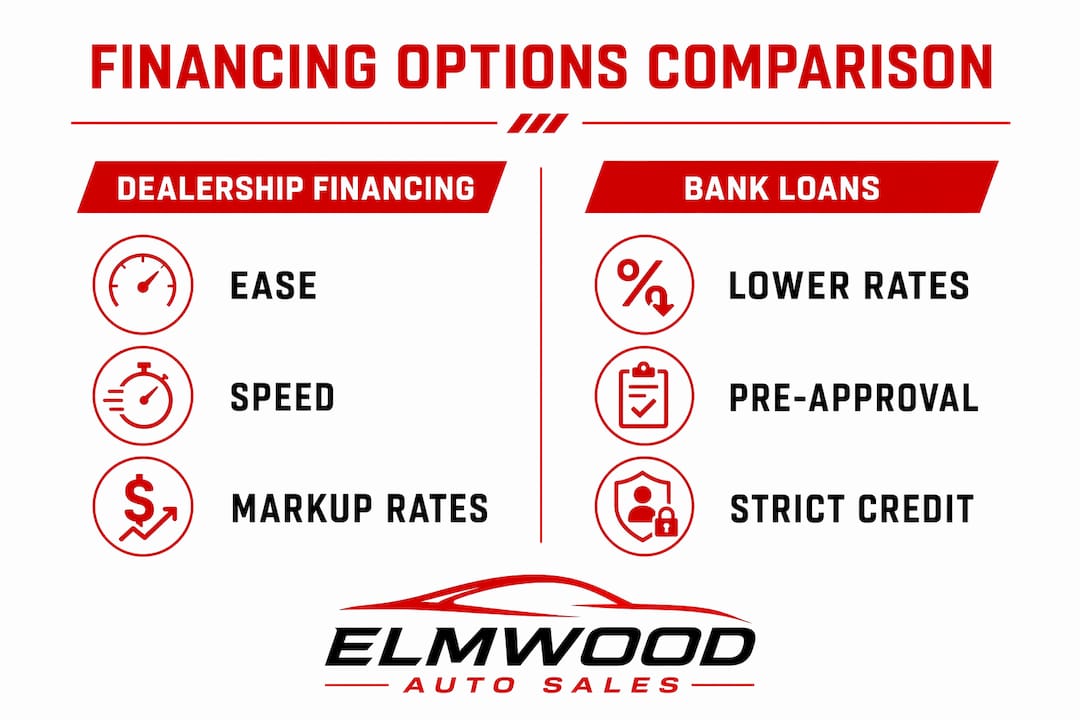
The trade-off is cost. Subprime lenders charge higher rates to offset their risk. A buyer with a 520 credit score approved through a dealer network might pay 18%–22% APR, compared to 8%–10% at a credit union for a buyer with a 680 score. The approval is easier, but the loan is significantly more expensive.
Rhode Island buyers with fair to poor credit should also look at buy here pay here options, where the dealership itself acts as the lender. These programs carry the highest rates but offer the most flexible approval criteria. They work best as a short-term solution while you rebuild your credit profile.
Key credit score thresholds to know:
- 760 and above: Qualifies for the best bank, credit union, and manufacturer promotional rates.
- 660–759: Banks and credit unions remain competitive. Dealer financing may still beat them with a promotional offer.
- 580–659: Bank options narrow. Dealer networks become more relevant. Credit unions may still offer better rates than dealers.
- 500–579: Traditional banks are largely unavailable. Dealer subprime networks and buy here pay here programs are the primary options.
- Below 500: Approval is difficult across all channels. A co-signer or larger down payment may be required.
What convenience and negotiation advantages does dealership financing offer?
Speed is the clearest advantage dealership financing holds over bank loans. Dealer loan approvals often happen in minutes, while bank loans can take several days to process. If you need a vehicle quickly, that time difference matters.
Dealers also offer one-stop shopping. You select the car, negotiate the price, and arrange financing all in the same visit. For buyers who find the loan application process stressful, that convenience has real value. The risk is that combining all three steps in one sitting gives the dealer more opportunities to shift your focus away from the total cost.
Dealers often bundle add-ons like GAP insurance and extended warranties into the financed loan. Rolling these costs into the loan increases the principal, which means you pay interest on them for the full loan term. GAP insurance, for example, is worth having on a new car, but buying it through your own insurer is almost always cheaper than financing it through the dealer.
The most effective negotiation approach follows these steps:
- Get pre-approved from a bank or credit union before visiting the dealership.
- Treat your pre-approval as your baseline rate. You are effectively a cash buyer.
- Negotiate the vehicle price first, completely separate from any financing discussion.
- Once the price is agreed upon, present your pre-approval and ask the dealer to beat it.
- Compare the dealer's offer on total cost, not monthly payment.
- If the dealer matches or beats your pre-approval rate, dealer financing becomes the better choice.
Pro Tip: Negotiating price and financing separately prevents a common tactic where dealers extend the loan term to lower your monthly payment while hiding a higher rate. Always ask for the total interest paid over the life of the loan, not just the monthly figure.
How should Rhode Island car buyers choose between dealership and bank financing?
The right choice depends on your credit profile, the vehicle type, and the current promotional environment. Pre-approval from a bank or credit union gives you negotiating power that dealerships cannot match. It transforms you from a financing customer into a cash buyer in the dealer's eyes.
Credit unions typically offer rates 1–2% lower than standard dealer financing rates without any markup. Rhode Island has several active credit unions that serve local buyers. Joining one before you shop costs little and can save you hundreds to thousands of dollars over a five-year loan.
Focusing solely on monthly payments masks the true cost of a loan. A dealer can make a high-rate loan look affordable by stretching the term to 72 or 84 months. Always calculate the total interest paid, not just whether the monthly number fits your budget.
For new vehicles with manufacturer promotional rates, dealer financing often wins outright. A 0% or 1.9% APR offer from a manufacturer beats any bank or credit union rate available. For used vehicles, where promotional rates do not apply, bank and credit union financing is usually the better starting point.
Rhode Island buyers should also consider local market factors. Rhode Island residents often favor dealer financing for its speed and accessibility, particularly for used vehicle purchases where bank processing times create delays. Understanding the full range of car financing options available in 2026 helps you enter any dealership with a clear plan.
Decision framework for Rhode Island buyers:
- Strong credit, new vehicle: Check manufacturer promotional rates first. If a 0% offer is available, take it.
- Strong credit, used vehicle: Get pre-approved at a credit union. Use it as leverage at the dealership.
- Fair credit (580–659): Apply at a credit union and compare with dealer network offers. The gap may be smaller than expected.
- Poor credit (below 580): Dealer subprime networks or buy here pay here programs are your most realistic path. Focus on rebuilding credit to refinance later.
Key Takeaways
Dealership financing wins on speed and promotional rates, but bank and credit union pre-approval gives Rhode Island buyers the negotiating power to get the best total cost on any vehicle purchase.
| Point | Details |
|---|---|
| Rate markup adds real cost | A 1–2 point dealer markup adds $1,200 or more to a $30,000 loan over five years. |
| Credit score determines your path | Banks require 660+ FICO; dealer networks approve scores as low as 500 at higher rates. |
| Pre-approval is your best tool | A bank or credit union pre-approval makes you a cash buyer and forces dealers to compete. |
| Promotional rates change the math | Manufacturer offers of 0%–4.9% APR beat bank rates for qualified buyers on new vehicles. |
| Total cost beats monthly payment | Always compare total interest paid, not monthly figures, to avoid hidden cost from extended loan terms. |
What I have learned from watching Rhode Island buyers finance cars
The biggest mistake I see Rhode Island buyers make is walking into a dealership without a pre-approval. They hand the dealer complete control over the financing conversation from the first minute. Dealers hold a clear informational advantage over buyers on loan terms and markup, and that advantage disappears the moment you show up with a competing offer in hand.
The second mistake is treating the monthly payment as the measure of affordability. A dealer can make almost any rate look reasonable by stretching the loan to 72 or 84 months. The total interest paid on an 84-month loan at 10% APR is roughly double what you would pay on a 48-month loan at 6%. Those numbers rarely get discussed unless you ask directly.
My honest recommendation: get pre-approved at a Rhode Island credit union before you visit any lot. Then walk in, negotiate the vehicle price first, and only then ask the dealer to beat your rate. If they can, take their offer. If they cannot, use your pre-approval. That process takes an extra day but routinely saves buyers $1,000–$2,000 over the life of the loan. The transparency you gain is worth every minute.
— Elmwood
Financing options available through Elmwoodautosalesri
Elmwoodautosalesri works with Rhode Island buyers across a wide range of credit profiles, from strong credit to buyers who need a more flexible path to approval.
At Elmwoodautosalesri, the financing process is straightforward and low-pressure. There are no commission-based sales tactics pushing you toward a specific loan product. Every vehicle goes through a thorough inspection before it reaches the lot, so you know the quality of what you are financing. Whether you are comparing a dealer offer to your bank pre-approval or need help finding a lender that fits your credit situation, the team at Elmwoodautosalesri is ready to walk you through your options honestly. Buyers with limited credit history or past credit challenges can also ask about flexible financing programs designed for Rhode Island residents.
FAQ
What is the main difference between dealership and bank financing?
Dealership financing uses the dealer as a middleman to secure your loan, often adding a markup of 1–2 percentage points. Bank financing gives you a direct loan with transparent terms and no dealer markup.
Is dealership financing better for buyers with bad credit?
Dealership financing is often the only accessible option for buyers with credit scores below 660, since dealer networks include subprime lenders that most banks do not work with. The approval is easier, but the interest rate is higher.
How do I use a pre-approval at a dealership?
Present your pre-approval after negotiating the vehicle price and ask the dealer to match or beat your rate. Pre-approved buyers effectively become cash buyers, which gives them stronger negotiating leverage.
Are 0% APR dealer offers worth taking?
A 0% APR manufacturer offer is almost always worth taking if you qualify, since no bank or credit union can match a zero-interest loan. The trade-off is that accepting the promotional rate typically means forfeiting a cash rebate, so calculate both scenarios before deciding.
Do credit unions offer better rates than dealerships in Rhode Island?
Credit unions typically offer rates 1–2% lower than standard dealer financing, with no markup. For used vehicle purchases where manufacturer promotional rates are not available, a Rhode Island credit union pre-approval is usually the strongest starting point.