
Get preapproved by a bank or credit union before you visit any dealership. That single step gives you a rate to compare against everything else you're offered. If preapproval isn't available to you because of thin or damaged credit, buy-here-pay-here can work as a last resort, but only if you get payment reporting in writing and treat refinancing as your exit plan.
TL;DR:
- Preapproving through a bank or credit union gives you a clear rate and leverage to spot dealer markups, especially compared to dealer-arranged financing.
- Buy-here-pay-here dealerships favor income verification over credit scores but charge high interest rates, often between 20% and 30%, and shorter loan terms.
- Having all required documents, such as proof of income, residence, and insurance, helps improve approval chances and ensures smoother financing processes.
- Increasing your down payment or securing a co-signer can significantly lower your interest rate and improve loan terms, especially for first-time buyers.
- Planning to refinance into a better rate after six to twelve months of on-time payments can save money and reduce long-term financing costs.
Table of Contents
- What Are Your Main Financing Options as a First-Time Buyer?
- How Does Buy-Here-Pay-Here Actually Work?
- What Documents Do You Need to Apply?
- How Can You Improve Your Approval Odds and Lower Your Rate?
- Printable Checklist: What to Bring and What to Ask
- Why Elmwood Built Its Financing Process Around First-Time Buyers
- How to Get Started With Elmwood Auto Sales
- Sources
- FAQ
What Are Your Main Financing Options as a First-Time Buyer?
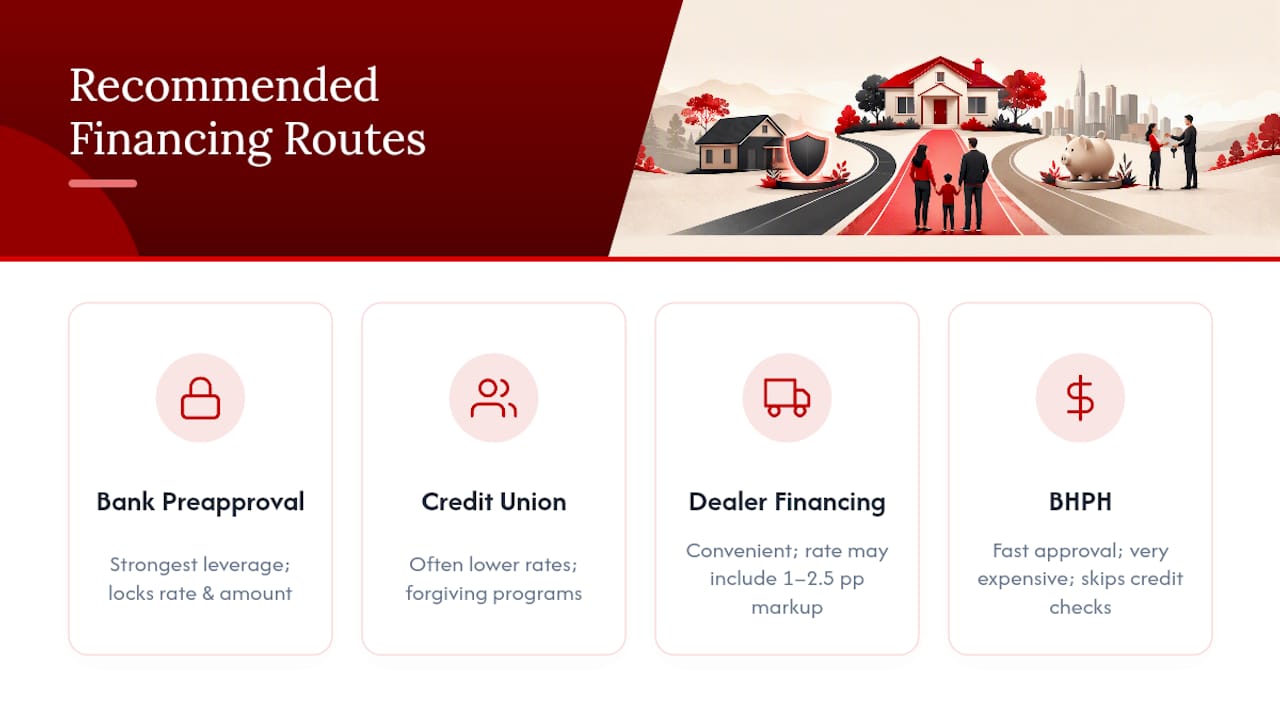
Most first-time buyers choose from four routes, and the order you try them in matters more than most people realize.
Bank preapproval puts you in the strongest position. You walk into a dealership already knowing your rate and loan amount, which turns you into something closer to a cash buyer. That leverage matters because dealer-arranged financing can carry a markup of 1 to 2.5 percentage points above what the lender actually offered the dealer. Without a preapproval to compare against, you have no way to spot that markup.
Credit unions often beat banks on rate, especially for members with limited credit history. Many run dedicated first-time buyer programs with more forgiving underwriting than a traditional bank would apply.
Dealer-arranged lending is convenient. The dealer shops your application to several lenders in one visit. The trade-off is that markup built into the rate, which is why it works best as your second stop, not your first.
Buy-here-pay-here (BHPH) skips traditional credit checks almost entirely. It's the fastest approval path and sometimes the only one available to someone with no credit file. It's also the most expensive, which is why it belongs at the bottom of this list rather than the top. You can compare the mechanics of each type of car financing before deciding which fits your situation.
How Does Buy-Here-Pay-Here Actually Work?
BHPH dealerships finance the car themselves instead of sending your application to a bank. Approval leans almost entirely on income and employment verification rather than a credit score, which is exactly why BHPH dealers often skip a hard credit check and approve buyers a bank would reject outright.
Here's roughly how the process unfolds:
- You prove income (pay stubs, bank statements, sometimes a work phone number for verification calls).
- You put money down, often more than a traditional lender would require.
- You agree to weekly or biweekly payments timed to your paycheck.
- Some lots install a GPS tracker or a payment-disabling device on the vehicle.
The cost of that convenience is steep. BHPH contracts commonly run between 20% and 30% APR, well above typical rates for a traditional auto loan, and terms are usually shorter, often 24 to 36 months instead of five or six years.
Watch for these red flags before signing anything: lack of written commitment to report payments to credit bureaus, required add-ons bundled into the loan, aggressive late fees, and "spot delivery" clauses that let the dealer reclaim the car and renegotiate terms after you've already driven off the lot.
Pro Tip: Ask the finance manager to write the credit-reporting promise directly into your contract, not just say it out loud. If they don't put it in writing, that tells you they don't actually do it.
If BHPH is genuinely your only option, still negotiate the price and down payment as hard as you would anywhere else, and plan from day one to refinance once your payment history improves. Read up on buy-here-pay-here mechanics in more depth before you commit.
What Documents Do You Need to Apply?
Lenders, whether a bank, credit union, or dealer, all ask for roughly the same paperwork. Progressive's breakdown of car loan documents confirms the standard list hasn't changed much over the years:
- A government-issued photo ID (driver's license or passport).
- Your Social Security number, for the credit pull and loan application.
- Proof of income, typically recent pay stubs, W-2s, or bank statements if you're self-employed.
- Proof of residence, such as a utility bill or lease agreement.
- Proof of insurance or, at minimum, an insurance binder showing coverage will start on the purchase date.
- Vehicle information, if you've already picked a car, including the VIN and purchase price.
Lenders use this paperwork to calculate more than whether you have a job. They're looking at debt-to-income ratio and payment-to-income ratio, and most expect your car payment to land around 15% to 20% of gross monthly income, with total debt-to-income staying under roughly 36% to 43%.
If you're self-employed, bring two years of tax returns or several months of bank statements instead of pay stubs. Call your insurance agent before you shop; most can issue a binder in minutes over the phone, which saves you from delaying signing day.
How Can You Improve Your Approval Odds and Lower Your Rate?
A few moves make a real difference in what you pay over the life of the loan, and they cost you nothing but a little time upfront.
- Get preapproved, and get more than one quote. Shopping multiple lenders within a short window counts as a single inquiry to most scoring models, so comparing three or four offers barely dents your credit score. Start with preapproval before you set foot on a lot.
- Consider a co-signer. A co-signer with strong credit can unlock a lower rate, but they're equally on the hook if you miss a payment, so only ask someone who understands that risk.
- Put more money down. A bigger down payment lowers your loan-to-value ratio, which lenders reward with better terms.
- Build credit before you need it. Even a few months of on-time payments on a secured card or credit-builder loan can shift you into a better rate tier.
Here's the number that should shape your whole strategy: refinancing a subprime loan into a credit-union loan after six to twelve months of on-time payments can meaningfully cut your monthly cost. That means the loan you sign today doesn't have to be the loan you carry for five years.
Try credit-union or bank preapproval first every time. Save BHPH for when nothing else clears, and read through bad credit car buying options if your file is thin.
Printable Checklist: What to Bring and What to Ask
Print this before you walk into any dealership or start an online application.
Bring:
- Photo ID and Social Security number
- Two recent pay stubs, or bank statements if self-employed
- A utility bill or lease showing your current address
- Proof of insurance or a binder
- Preapproval letter, if you have one
Ask at signing:
- What's the exact APR, and how does it compare to my preapproval?
- What's the total amount financed, including any add-ons?
- Will payments be reported to Experian, Equifax, or TransUnion, and can that be in writing?
- Are any add-ons required for approval, or are they optional?
Pro Tip: If a finance manager pressures you to decide fast, ask for the exact figures in writing and say you'll review them at home. A legitimate offer survives an overnight look.
Bring your preapproval letter even to a BHPH lot. It won't lower their rate, but it gives you a baseline to know exactly how much more you're paying for the convenience. For a document-specific rundown, see what speeds up BHPH approval.
Why Elmwood Built Its Financing Process Around First-Time Buyers
We built Elmwood Auto Sales around a low-pressure, commission-free model because we've watched too many first-time buyers get rushed into decisions they didn't understand. Every vehicle offered passes a thorough inspection before sale, and financing options include both in-house and third-party lenders to help buyers with various credit histories. If you want personalized help, apply online or schedule a test drive and bring your checklist.
— Elmwood
How to Get Started With Elmwood Auto Sales
This dealership works as a direct, local alternative to shopping among banks, credit unions, and BHPH lots. Instead of piecing together preapproval letters and dealer quotes from different places, you get tailored financing options, including in-house solutions for buyers who don't qualify through a traditional lender, all handled by a team that doesn't work on commission.
Every car on our lot goes through a thorough inspection before it's listed, so you're not choosing between financing risk and mechanical risk at the same time. If you're ready to move, apply for financing online with your documents in hand, use our Car Finder to narrow down inventory that fits your budget, or book a test drive to talk through your options with our team in person. Have a trade-in? Get a vehicle appraisal or trade in your car as part of the same visit, and ask us directly whether your financing option reports payments to credit bureaus before you sign anything.
Sources
FAQ
What Credit Score Do You Need for First-Time Car Financing?
There's no universal minimum. Banks and credit unions typically want a relatively good credit score for their best rates, while BHPH dealers focus on income verification instead of credit score. If you have no credit file at all, preapproval may still be worth trying since some lenders use alternative data.
Is Buy-Here-Pay-Here a Good Option for First-Time Buyers?
BHPH works as a last resort when traditional financing isn't available, not as a first choice. APRs commonly run 20% to 30%, so it's worth exhausting bank and credit union preapproval before considering it.
Does Elmwood Auto Sales Offer Financing for Buyers With Bad Credit?
Yes. Elmwood offers tailored financing that includes both in-house options and third-party lender partnerships for buyers across a range of credit histories. Pricing and approval details are handled case by case through the online financing application.
How Much Down Payment Do I Need as a First-Time Buyer?
There's no fixed amount, but a larger down payment lowers your loan-to-value ratio and typically earns a better rate.
Can I Refinance a High-Interest First-Time Car Loan Later?
Yes, and you should plan for it if you start with a subprime rate. Refinancing into a credit-union loan after six to twelve months of on-time payments can lower your rate significantly once your payment history builds up.