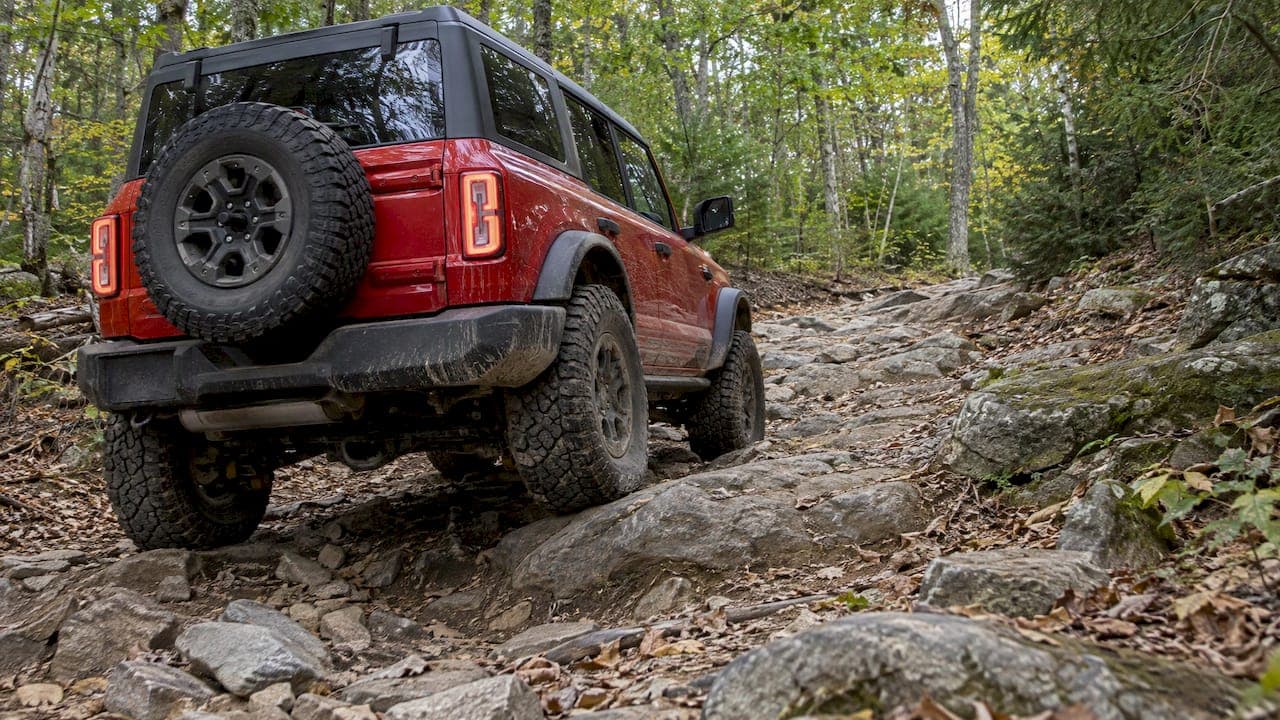
4H (four-wheel-drive high) is the setting for normal-speed driving on slippery or loose surfaces like snow, gravel or dirt roads. 4L (four-wheel-drive low) uses extra gear reduction to send more torque to the wheels at a crawl, so it belongs to steep grades, deep sand, mud, recovery and heavy pulling. Pick 4H when you need traction and still want to move at a reasonable speed. Pick 4L when you need power and control at walking pace.
TL;DR
- 4H gives locked four-wheel drive at normal gearing. Use it on snow, ice, mud, gravel and loose sand when you need to keep moving.
- 4L adds gear reduction for maximum torque at very low speed. Use it for steep climbs and descents, deep sand, getting unstuck and heavy towing at a crawl.
- Part-time 4WD is not for dry pavement. Locking the axles together on high-grip surfaces can bind the driveline and wear parts.
- Shifting differs by vehicle. 4H can often be selected at a stop or while moving, while 4L usually needs a near-stop and Neutral. Your owner's manual has the exact steps.
- Buying used? Check which 4x4 system the vehicle has before you commit, and ask for it to be inspected.
Table of Contents
- What is the difference between 4x4 high and 4x4 low?
- What do 2H, 4H, 4L and 4A mean?
- When should you use 4H?
- When should you use 4L?
- Should you drive in 4H or 4L in snow?
- How do you shift between 4H and 4L safely?
- What about lighting and gear for rough-road use?
- What should you check when buying a used 4x4?
- Do you actually need a 4x4 with low range?
- Find a used 4x4 or AWD vehicle in Providence
- FAQ
- Sources
What is the difference between 4x4 high and 4x4 low?
The difference comes down to gearing and speed. In 4H, the transfer case runs in its normal, higher range, so the vehicle keeps a useful speed range while the front and rear axles are linked for extra traction. In 4L, the transfer case switches to lower gearing. The wheels turn slowly, but more torque is available. Jeep's 4x4 glossary frames it this way: 4H suits faster travel on loose or slippery surfaces, while 4L is for steep grades, deep or difficult terrain and recovery, and Jeep advises keeping low-range speed at or below 25 mph.

A simple way to remember it: 4H is for traction, 4L is for torque. They solve different problems. A truck that is sliding around on a snowy road has a traction problem. A truck that cannot climb a rutted, steep trail at idle speed has a torque problem.
Why is it called 4x4, and is that the same as 4WD?
The two terms are used interchangeably. Nissan USA notes that 4x4 is commonly abbreviated 4WD, and that traditional 4x4 trucks may offer 2WD, 4H for lighter off-road use and 4LO for the most difficult off-road conditions. The "4x4" name means four wheels total, four of which are driven. So a vehicle labeled 4x4 or 4WD can send power to all four wheels, and the high and low settings are the driver's way of choosing how.
That is different from all-wheel drive (AWD), which typically works automatically and has no low range you select. If your dash has a dial or lever with 2H, 4H and 4L, you have a traditional 4x4 system.
What do 2H, 4H, 4L and 4A mean?
The labels vary a little by brand, but the common ones are:
| Mode | What it does | Typical use |
|---|---|---|
| 2H | Two-wheel drive, high range (usually rear wheels) | Dry pavement, everyday driving |
| 4H | Four-wheel drive, high range, axles locked together | Snow, ice, mud, gravel, loose sand at normal speeds |
| 4L (or 4LO) | Four-wheel drive, low range, extra gear reduction | Steep grades, deep sand or mud, recovery, slow heavy pulling |
| 4A (or Auto 4WD) | Automatic four-wheel drive that shifts power as needed | Mixed or changing conditions, on vehicles equipped with it |
Ford's owner manual describes its 4A mode as electronically delivering power to the front and rear wheels as required for traction, using road conditions, driver input and other sensors. Not every vehicle has this mode, so check what yours offers.
When should you use 4H?
Use 4H when traction is the problem and you still need to travel at a normal pace. Ford's owner guidance describes 4H as electronically locked four-wheel-drive power for severe winter or off-road conditions such as deep snow, ice or shallow sand. Ford's U.S. support page similarly lists deep snow, sand and mud for 4H.
Typical 4H situations:
- A snow-covered road or unplowed side street.
- Icy or slushy stretches where the tires keep slipping.
- Wet, muddy dirt or gravel roads.
- Loose or shallow sand at moderate speed.
One popular rule of thumb says that above roughly 25 mph you should be in 4H rather than 4L. That lines up with Jeep's guidance on keeping low range at or below 25 mph, though your manual's limits for your specific vehicle come first.
Can you use 4H on dry pavement?
No. This is the mistake that matters most. In a part-time 4WD system, 4H locks the front and rear driveshafts together so they turn at the same speed. When you turn a corner on dry, grippy pavement, the front and rear tires need to travel different distances, and with a locked system they cannot slip enough to make up the difference. Jeep warns that this can cause driveline binding, noise and premature component failure. Ford's manual likewise says 4H is not recommended on dry pavement because it can increase noise and tire wear or damage drive components.
Signs of binding include a jerky or hopping feel in tight turns, a groaning sound from the drivetrain and a steering wheel that feels stiff. If you notice any of those, get back to 2H on a clear, safe surface, and have the vehicle looked at if the feeling persists.

When should you use 4L?
Use 4L when you need to move slowly with as much torque as possible. Ford describes 4L as locked four-wheel drive with additional gear reduction for increased torque, intended for extreme situations like deep sand, steep slopes or pulling heavy objects at low speeds. AutoZone's explainer adds that 4L is a very slow, controlled mode for rough terrain or places where the vehicle may get stuck, including steep inclines and descents.
Good 4L situations:
- Climbing a steep, loose or rocky trail where you want to crawl at idle speed.
- Descending a steep grade with engine braking helping control your speed.
- Pulling out of deep sand, mud or a snowbank.
- Pulling a heavy load up a slick boat ramp.
Because low range multiplies torque and cuts speed, you will not be going far fast. If you find yourself pushing past about 25 mph, you are in the wrong range.
Does 4L give you more grip?
Not by itself. Jeep's FAQ points out that low range does not automatically create more tire traction. It supplies more low-speed torque, and too much torque can still make the tires spin on slippery snow, ice or mud. Gentle throttle matters as much as the setting. If the wheels are spinning in 4L, ease off rather than adding throttle.
Should you drive in 4H or 4L in snow?
For most snowy roads, 4H is the answer. Jeep advises high range for snow or ice when you need to travel faster than low range allows. Low range is for the tougher spots, such as getting out of a stuck position or climbing steep terrain, and Jeep notes you can shift to low range in heavy snow if necessary.
Here is how that looks around Providence and the rest of Rhode Island, where winter usually means a mix of plowed main roads, packed side streets and the occasional unplowed driveway:
- Plowed roads with patches of ice or slush: stay in 2H if the road is mostly clear and grippy, or use 4H if the surface is slick enough that the tires are slipping. Switch back to 2H when the pavement clears.
- Snow-packed side streets and parking lots: 4H.
- Deep snow in a driveway or a stuck vehicle: 4L for a slow, steady pull, with minimal throttle so the tires do not spin.
- Dry pavement after the storm: back to 2H.
Keep in mind that four-wheel drive helps you get going and keep moving. It does not shorten stopping distances. Slow down on ice, leave extra room, and keep good tires on the vehicle.
How do you shift between 4H and 4L safely?
The exact process depends on the make, model and whether the system uses a lever or a dial, so follow your owner's manual. Ford's guidance says the exact procedure varies by vehicle, but selecting 4L generally requires placing the transmission in Neutral and following the instructions the vehicle displays or the manual gives.
As a general pattern from Ford's owner manual:
- 2H to 4H: you can shift at a stop or while driving.
- 4H to 4L: slow to 3 mph or less, shift the transmission to Neutral, then select 4L.
- If the shift is delayed: Ford says to move about 5 feet forward and return to Neutral.
- Returning to 2H: do it once you are back on dry or clear pavement.
Other brands have their own limits, so do not assume another make works the same way. If a dial shows a flashing indicator and the mode will not engage, stop and check the manual rather than forcing it.
What about lighting and gear for rough-road use?
If you take a 4x4 onto trails or unlit back roads, visibility becomes part of the plan, especially during short winter days. Many drivers add LED off-road work lights for work areas and trail use. Check local rules on where auxiliary lights may be used, since they are usually meant for off-road use rather than public roads. Beyond lighting, carry a tow strap, gloves, a shovel and a charged phone for winter drives.
Our perspective
At Elmwood Auto Sales, we talk with a lot of Rhode Island drivers who want a vehicle that can handle winter without surprises. Most of them do not need a rock crawler. They need to know which drivetrain they are buying and how to use it.
That is why we put every vehicle through a thorough inspection before it reaches the lot, and why we sell without commission pressure. When you ask whether a truck or SUV has 4H and 4L, we would rather walk you through what it has and how it behaves than push the nearest sticker price. Our approach is built around honest, straightforward conversations.
If you are not sure whether you want a traditional 4x4, an all-wheel-drive crossover or simply a front-wheel-drive car with good tires, tell us how you drive. We will point you toward vehicles that fit your commute, your family and your budget.
Elmwood
What should you check when buying a used 4x4?
The 4H and 4L settings are only useful if the hardware behind them is healthy. Before you buy a used truck or SUV with a selectable system, work through these points:
- Does it shift? Ask to see 2H, 4H and 4L engage, following the owner's manual procedure. The indicator should confirm each mode.
- Listen for noises. Whining, clunking or grinding in any mode deserves a closer look.
- Look for leaks. Transfer case and differential seals are worth checking on a vehicle that has seen rough use.
- Check the tires. Mismatched sizes or uneven wear can strain a four-wheel-drive system. Our guide on tire matching and inspection for AWD explains why this matters for drivetrain upkeep.
- Ask about the differential. Some 4x4s have locking differentials that add capability in low traction. See what we cover in our locking differential guide.
- Review service records and the vehicle history report. Maintenance on fluids and drivetrain parts tells you a lot.
If you are comparing body styles, our pieces on family-ready used trucks and how truck cab configurations differ help you narrow down seating and cargo needs. If an SUV is the better fit, the used SUV buying checklist for families covers what to look at on the lot.
Do you actually need a 4x4 with low range?
It depends on how you use the vehicle. If your driving is mostly paved roads with occasional snow, an all-wheel-drive SUV or a vehicle with 2H and 4H may be plenty. A low range makes the most sense if you tow heavy loads, drive steep or unmaintained roads, or head off-road regularly. Nissan's overview notes that traditional 4x4 trucks typically offer 4H for lighter off-road use and 4LO for the most difficult conditions, so low range is a specialist tool rather than a daily setting.
Think through three questions: Where do you drive in winter? What do you tow or haul? How much do you want to spend on fuel and upkeep? A traditional 4x4 usually has more drivetrain parts to maintain, which is worth weighing against what you will use it for.
Find a used 4x4 or AWD vehicle in Providence
If you are shopping for a truck or SUV that can handle Rhode Island winters, start with our used trucks, SUVs and cars in stock. Not seeing what you want? Our Car Finder can help us look for a specific drivetrain, body style or budget.
We offer tailored financing options, including buy here, pay here, for a range of credit histories, and you can start with our online financing application. Have a vehicle to move on? You can trade in or sell your car as part of the same visit.
FAQ
Should I drive a 4x4 in high or low?
Use high for most situations where you need extra traction at normal speeds, like snow, gravel or mud. Use low only when you need to crawl with maximum torque, for example on steep terrain or when you are stuck. If you are moving faster than about 25 mph, you should be in high range.
Can I switch from 4H to 4L while driving?
Usually not at speed. Ford's manual says to roll at 3 mph or less, shift to Neutral and then select 4L. Procedures vary by vehicle, so follow your owner's manual for the exact steps.
Is 4 high or 4 low better for snow?
4H is the usual choice, because snow typically calls for traction at moving speeds. Switch to 4L in heavy snow or when you are stuck and need slow, strong torque. Keep the throttle gentle, since low range alone does not guarantee grip.
What is the difference between 4x4 and 4WD?
There is no practical difference in everyday use. Nissan USA notes that 4x4 is commonly abbreviated 4WD. Both terms describe a vehicle that can drive all four wheels, and on traditional systems you choose between settings like 2H, 4H and 4L.
Can I leave my truck in 4H all the time?
Not on dry pavement. Part-time 4WD locks the axles together, which can cause binding, noise and extra wear on high-traction surfaces. Use 4H on slippery or loose ground, then return to 2H when conditions clear. If your vehicle has an automatic 4WD mode, the owner's manual explains when it is suitable for regular driving.
Sources
- Jeep 4x4 FAQ and Glossary
- Ford owner manual: Four-Wheel Drive, Using Four-Wheel Drive
- Ford support: Drive with Four Wheels
- AutoZone: What Are 2H, 4H, and 4L on 4x4?
- Nissan USA: AWD vs. 4WD vs. 2WD