Word-of-mouth is the most credible marketing channel available to car dealerships, directly shaping buyer trust before a single conversation takes place. 63% of car buyers evaluate a dealership based on its reviews before ever visiting or submitting an inquiry. That number alone explains why referral marketing and reputation management are not optional extras. They are the foundation of sustainable dealership growth. Understanding why word-of-mouth matters for dealerships means understanding how trust, reviews, and referrals work together to drive sales at a fraction of the cost of paid advertising.
Why word-of-mouth matters for dealerships more than paid ads
Word-of-mouth marketing, known in academic research as electronic word-of-mouth (eWOM) when it occurs online, is defined as any unpaid communication between customers that influences buying decisions. For dealerships, this includes Google reviews, Facebook recommendations, and direct referrals from past buyers. The distinction matters because eWOM scales far beyond what a single satisfied customer can do in person.
Referral leads convert at 15–25%, which is three to five times higher than cold internet leads. That conversion gap is not a coincidence. A referred buyer arrives with pre-built trust, a shorter decision cycle, and a stronger likelihood of accepting financing and add-ons. Paid digital leads, by contrast, cost between $100 and $625 per sale and arrive with skepticism baked in.

The relationship between customer experience and referral volume is direct and measurable. Dealerships that treat word-of-mouth as a formal channel, not a happy accident, consistently outperform those that rely on ad spend alone. Elmwoodautosalesri operates on exactly this principle, building its reputation in Providence, RI, through transparent interactions and thorough vehicle inspections rather than commission-driven pressure tactics.
How do online reviews build trust with car buyers?
Online reviews are the digital equivalent of a neighbor's recommendation, but they reach thousands of buyers simultaneously. Consumer trust mediates between reading online feedback and making a purchase decision, with a strong effect size of β=0.56. That is a statistically significant influence, meaning reviews do not just nudge buyers. They often decide the outcome.
Review quantity and quality both matter. A dealership with 200 reviews averaging 4.2 stars will outperform one with 20 reviews averaging 4.8 stars in most buyer evaluations. Volume signals consistency. Quality signals reliability. Buyers read both signals simultaneously when assessing dealership reputation.
Three factors determine whether your reviews build or erode trust:
- Response speed: 63% of customers expect a review response within a week. Responding to negative reviews within 24 hours, with a personalized reply rather than a generic template, signals public accountability.
- Specificity: Reviews that mention specific employees by name carry more weight than vague praise. Coaching satisfied customers to name their salesperson increases the credibility of each review.
- Reach: Online reviews travel faster and reach more potential buyers than traditional human referrals, making digital engagement a non-negotiable part of reputation management.
Pro Tip: Ask customers to leave a review immediately after the delivery, while their satisfaction is highest. A text message with a direct Google review link sent within two hours of vehicle pickup produces significantly higher response rates than a follow-up email sent days later.
Why do referral leads convert better and cost less?
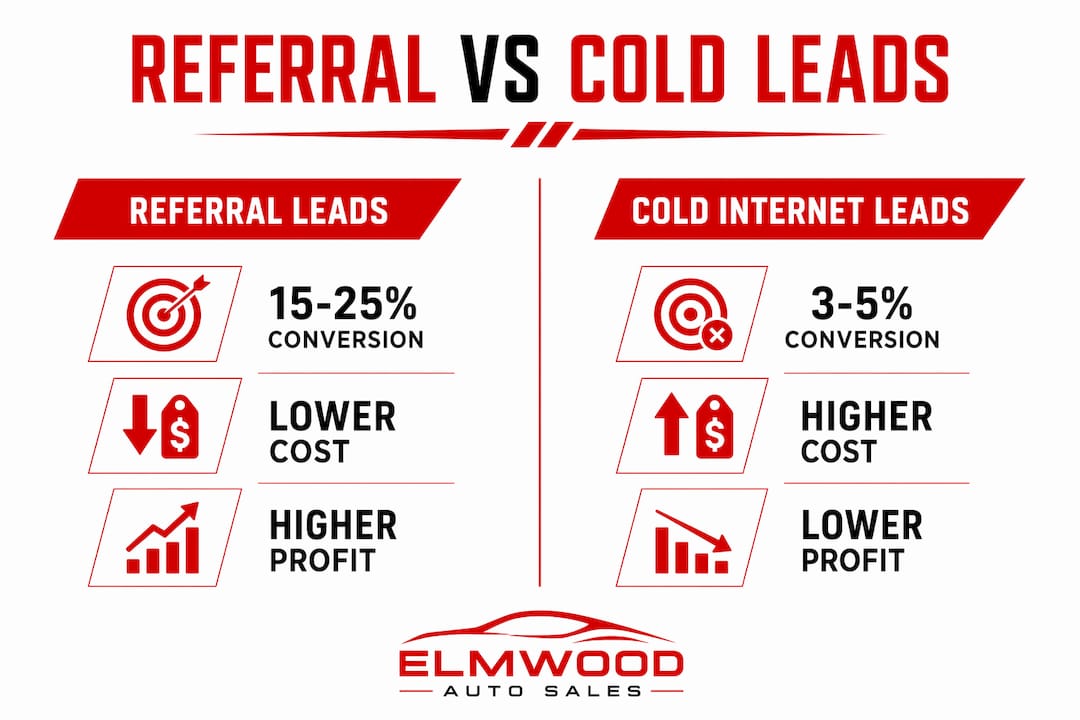
Referral leads are the most profitable lead source available to dealerships, and most stores underinvest in generating them. The conversion rate of 15–25% for referrals versus the 3–5% typical of cold internet leads represents a fundamental difference in buyer psychology. A referred customer has already had their objections addressed by the person who sent them.
The cost advantage is equally clear. Traditional digital lead generation costs between $100 and $625 per closed sale, depending on the channel and market. A referral from a satisfied customer costs a fraction of that, typically limited to the incentive paid out under a formal referral program. Dealerships that tier referral payouts based on customer lifetime value, rather than offering a flat bonus for every referral, generate more profitable customer acquisition over time.
The table below compares the two lead types across key performance dimensions:
| Dimension | Referral leads | Cold internet leads |
|---|---|---|
| Conversion rate | 15–25% | 3–5% |
| Cost per sale | Low (incentive only) | $100–$625 |
| Buyer trust on arrival | High (pre-built) | Low (skeptical) |
| Lifetime value potential | Higher | Lower |
| Show rate | High | Variable |
Most dealerships fail to capture this advantage because they treat referral requests as casual asks rather than a formal system. A salesperson saying "send your friends our way" at the end of a delivery is not a referral program. It is a missed opportunity.
Pro Tip: Assign one person in your store ownership of the referral program. Without a named owner tracking sources, following up, and paying out incentives on time, the program will collapse within 90 days regardless of how well it starts.
How does customer experience drive referral volume?
Customer experience is the engine behind word-of-mouth volume. Dealerships implementing structured customer experience programs see 25–30% higher customer lifetime value, and customers who rate their experience 9 or 10 out of 10 generate 2.5 times more referrals than those who rate it 6 or 7. That gap is not about perfection. It is about the difference between a forgettable transaction and a memorable one.
The multi-department reality of dealership reviews is one of the most underappreciated factors in reputation management. A negative touchpoint in F&I or service can overshadow a positive sales experience and depress overall review ratings. Buyers do not separate departments in their minds. They rate the dealership as a whole. A smooth sales process followed by a high-pressure finance office produces a 3-star review, not a 5-star one.
Four experience factors that directly affect referral volume:
- Sales process transparency: Buyers who feel informed, not pressured, are far more likely to refer friends. Low-pressure environments like the one Elmwoodautosalesri maintains in Providence produce referrals organically.
- F&I experience: A clear, honest finance presentation builds confidence. A confusing or pushy one destroys the goodwill built during the sale.
- Service department quality: Post-sale service interactions are the most common trigger for both positive and negative reviews. Read more about the service department's role in shaping long-term customer perception.
- Follow-up communication: A personal call or text after delivery, checking that everything is going well, costs nothing and generates significant goodwill.
Pro Tip: Survey customers at the 30-day mark after purchase, not just at delivery. Buyers who are still happy a month later are your best referral sources. They have had time to tell their story to friends and family.
What are the best practices for a dealership referral program?
A referral program that actually produces results requires structure, ownership, tracking, and incentives aligned with customer value. Referral generation treated as an operational system with clear accountability consistently outperforms casual, ad-hoc approaches. The following steps build a program that pays for itself.
- Seed the ask early. Mention the referral program during the sales process, not just at delivery. Buyers who know about it before they sign are more likely to act on it.
- Ask at peak happiness. The moment of vehicle delivery is the highest point of customer satisfaction. That is the right time to make a direct, personal ask for referrals.
- Make sharing easy. Provide a direct link, a referral card, or a simple text template the customer can forward. Friction kills follow-through.
- Follow up within 48 hours. A thank-you message that reinforces the referral ask, sent while the excitement of the new vehicle is still fresh, doubles response rates.
- Close the loop. When a referred customer buys, notify the referring customer immediately. Transparency about outcomes builds loyalty and encourages repeat referrals.
Tracking referral sources by quality, not just volume, separates high-performing programs from average ones. Smart dealerships tier their payouts by the lifetime value of the customers referred, paying more for buyers who finance, service, and return. A flat $100 bonus for every referral treats a cash buyer and a financed, service-loyal customer as equals. They are not.
Coaching customers to mention specific employees in their reviews is another underused tactic. Named reviews build individual reputations within the store, which supports both recruitment and retention. Salespeople who generate strong personal reviews develop their own referral networks, which shifts dealership profitability toward a relational model rather than a purely transactional one.
Pro Tip: Tie a portion of salesperson compensation to self-generated referrals and reviews. When staff have a financial stake in their own reputation, the quality of customer interactions rises across the board.
Key Takeaways
Word-of-mouth and referral marketing are the highest-return, lowest-cost customer acquisition channels available to dealerships, and both require deliberate systems to produce consistent results.
| Point | Details |
|---|---|
| Reviews drive buyer decisions | 63% of car buyers evaluate dealerships by reviews before visiting, making reputation management non-negotiable. |
| Referrals convert far higher | Referral leads convert at 15–25%, three to five times higher than cold internet leads, at a fraction of the cost. |
| Experience fuels referral volume | Customers rating their experience 9–10 generate 2.5x more referrals than those rating it 6–7. |
| Programs need formal structure | Casual referral asks fail. Assign ownership, track sources, and align incentives with customer lifetime value. |
| All departments affect reviews | A negative F&I or service experience can erase a positive sales interaction and lower overall review ratings. |
What I've learned about referral marketing after years in automotive retail
Most dealerships I've observed treat referrals as a bonus, something that happens when things go well. That framing is the core mistake. Referrals are not a byproduct of good service. They are a result of a deliberate system built around customer relationships.
The shift I've seen work consistently is moving away from measuring referral volume and toward measuring referral source quality. A single loyal customer who sends three financed buyers per year is worth more than ten casual referrers who send one-time cash buyers. Once you start tracking that distinction, your incentive structure changes, your follow-up changes, and your staff behavior changes.
The dealers who grow most reliably in 2026 are not the ones with the biggest ad budgets. They are the ones whose customers do their marketing for them. That requires earning trust at every touchpoint, from the first test drive to the third service visit. Elmwoodautosalesri's model in Providence, built on no-commission transparency and thorough vehicle inspection standards, reflects exactly this approach. When buyers feel respected, they talk. When they talk, the pipeline fills itself.
The uncomfortable truth is that most dealers know this and still do not act on it. They run one referral campaign, see modest results, and return to paid leads. The dealers who win treat referral generation the same way they treat inventory management: as a system with metrics, ownership, and continuous improvement.
— Elmwood
How Elmwoodautosalesri helps dealerships build on customer trust
Dealerships that understand the value of word-of-mouth still need the right tools to capture and convert that trust into sales. Elmwoodautosalesri's approach to digital retail connects the dots between a strong reputation and a frictionless buying experience.
At Elmwoodautosalesri, the focus is on reducing the barriers that turn interested buyers into lost leads. Transparent pricing, tailored financing options including buy here, pay here solutions, and thorough vehicle inspections give customers the confidence to act on a referral rather than second-guess it. When a referred buyer arrives already trusting the dealership, a clear and honest process closes the deal. That combination of reputation and process is what turns word-of-mouth into measurable revenue.
FAQ
Why does word-of-mouth matter more than paid advertising for dealerships?
Word-of-mouth delivers pre-built trust that paid ads cannot replicate. Referral leads convert at 15–25%, compared to 3–5% for cold internet leads, at a significantly lower cost per sale.
How do online reviews affect dealership sales?
63% of car buyers judge dealerships by their reviews before visiting, making review quality and volume a direct driver of inbound inquiry quality and sales volume.
What makes a dealership referral program effective?
Effective referral programs have a named owner, clear tracking metrics, and incentives tied to customer lifetime value rather than flat bonuses. Casual asks without structure consistently fail to produce results.
How quickly should dealerships respond to negative reviews?
Dealerships should respond to negative reviews within 24 hours with a personalized reply. Timely, specific responses build public accountability and reassure prospective buyers who read those exchanges.
Which departments most affect a dealership's word-of-mouth reputation?
Sales, F&I, and the service department all influence overall review scores. A negative experience in any one department can lower the dealership's average rating and reduce the quality of inbound referrals.