
Dealership inventory sourcing is the process by which used car dealers acquire vehicles through multiple channels, including customer trade-ins, wholesale auctions, off-lease returns, fleet purchases, and direct street acquisitions. Understanding how dealership inventory is sourced matters to you as a buyer because the channel a vehicle came from directly affects its price, condition, and history. Franchised dealers source about 50% of used inventory from trade-ins, while independent dealers lean heavily on wholesale auctions for up to 60% of their stock. In 2026, the dealership inventory sourcing process is shifting fast, with data-driven tools and service lane strategies replacing traditional auction dependency.
What are the main channels dealerships use to source used car inventory?
Dealerships draw from five primary acquisition channels, and each one carries distinct advantages, costs, and inventory quality profiles. Knowing these channels helps you understand why two dealerships can offer very different vehicles at very different prices.
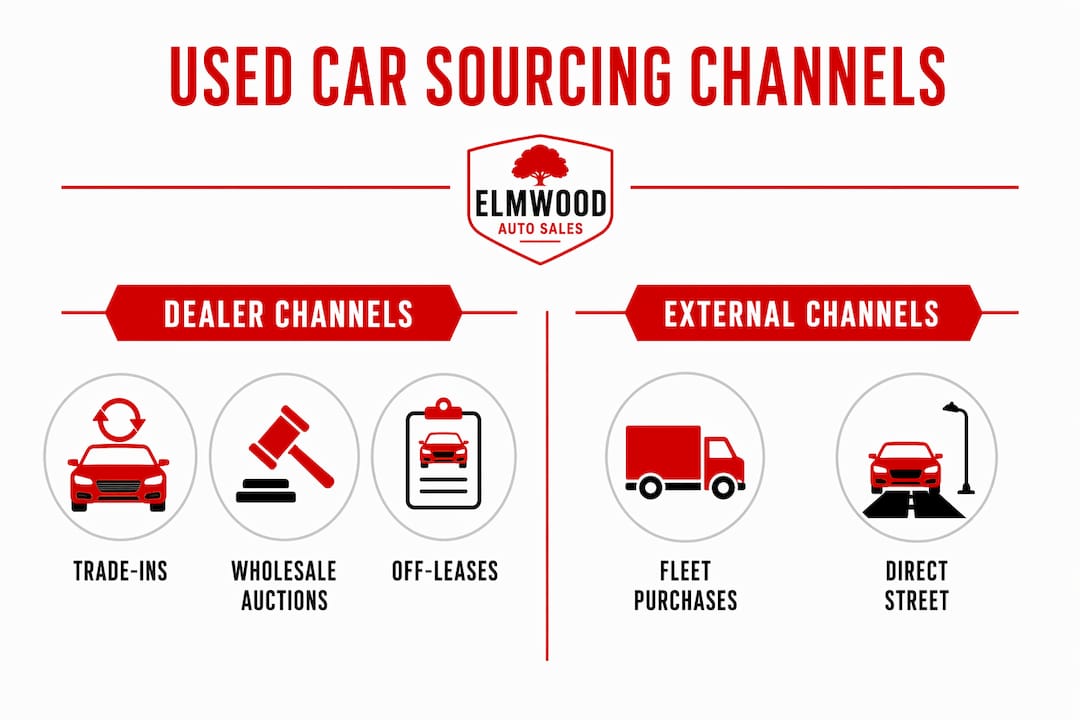
Customer trade-ins are the single largest source for franchised dealers. When a customer buys a new or newer vehicle, they often trade in their current car, giving the dealer direct access to a vehicle with a known service history and a predictable reconditioning cost. Trade-ins typically carry lower acquisition costs than auction vehicles, and dealers who service the vehicle before the trade already know its mechanical condition. The downside is that trade-in volume depends entirely on new car sales activity, which can fluctuate with interest rates and consumer confidence.
Wholesale auctions have historically been the backbone of independent dealer stock acquisition. Physical auction houses like Manheim and ADESA, along with digital platforms, allow dealers to bid on large volumes of vehicles quickly. However, auction share has dropped to around 18% of dealer used inventory in 2026, down from 27% in 2019. That decline reflects rising buyer's fees, transportation costs, and the risk of bidding on vehicles without a full inspection.
Off-lease and lease returns represent a premium sourcing channel. When a consumer lease ends, the vehicle returns to the manufacturer or captive finance company, often with low mileage and documented maintenance. These vehicles are strong candidates for certified pre-owned programs, which carry manufacturer-backed warranties and command higher retail prices. Supply from this channel fluctuates with production cycles, meaning a slow manufacturing year can reduce lease return volume two to three years later.
Fleet and rental company vehicles provide dealers with high-volume sourcing opportunities. Rental companies like Enterprise and Hertz cycle their fleets regularly, releasing large batches of vehicles at once. These cars often have higher mileage and require more reconditioning, but their pricing reflects that reality. Dealers who build direct relationships with fleet managers can access these vehicles before they reach public auction.
Direct street purchases, also called private party acquisitions, are the fastest-growing channel in 2026. Vehicles sourced directly from private sellers turn in 31 days compared to 43 days for auction purchases, and they generate $3,525 profit per unit versus $1,050 at auction. That gap is significant. Dealers who build systems to buy directly from the public bypass auction fees entirely and often acquire cleaner vehicles with better histories.
| Sourcing channel | Avg. days to sell | Approx. profit per unit |
|---|---|---|
| Direct street purchase | 31 days | $3,525 |
| Wholesale auction | 43 days | $1,050 |
| Trade-in | Varies by market | Moderate to high |
| Fleet/rental | Varies by condition | Low to moderate |
Pro Tip: When you visit a dealership, ask which channel a specific vehicle came from. A trade-in with a local service history is often a safer buy than an auction vehicle with limited documentation.
How do modern data-driven strategies and service lane integration improve dealership sourcing?
The dealership inventory sourcing process has moved from reactive buying to proactive, data-led acquisition. The dealers winning in 2026 are not waiting for customers to walk in with a trade. They are identifying acquisition opportunities weeks before a customer even starts shopping.
Here is how top-performing dealers build that system:
-
Equity mining through CRM data. CRM and equity mining tools analyze loan payoff amounts, current vehicle values, service history, and online shopping signals to flag customers who are likely to trade in within the next four to six weeks. AutoAlert is one platform dealers use to run this analysis at scale. The result is a prioritized outreach list that turns the service department into a sourcing engine.
-
Service lane acquisition. Every vehicle that enters a dealership's service drive is a potential acquisition target. Service advisors trained to flag high-equity vehicles can alert the sales team in real time. Wischnewsky Dodge reduced auction purchases by 70% after implementing a structured service-drive sourcing process. That is not a marginal improvement. It represents a fundamental shift in where inventory comes from.
-
Dedicated acquisition roles. Top dealerships create dedicated buyer roles such as Managed Buyers and Acquisition Coaches who focus exclusively on private party sourcing. These specialists use VIN-level data, market analysis tools, and defensible pricing models to make offers before contacting sellers. This removes guesswork and protects margins.
-
Data aggregation before seller contact. Before a buyer reaches out to a private seller, they pull market data on that specific vehicle, including comparable retail prices, days on market for similar units, and reconditioning estimates. This preparation means every offer is grounded in real numbers, not gut instinct.
-
Reduced auction dependency. Auction models are becoming inefficient due to fees and blind bidding risks. Dealers who shift sourcing toward service lanes and private parties preserve margins and acquire vehicles with cleaner histories.
Pro Tip: If a dealership mentions it uses equity mining or a service-drive acquisition program, that is a sign of operational sophistication. It usually means their used inventory is fresher and better documented than a dealer relying primarily on auctions.
What are the challenges and trade-offs among different sourcing methods?
No single acquisition channel is perfect. Each comes with real costs and operational risks that dealers must manage carefully.
-
Auction risks include buyer's fees, transportation costs, and the reality of blind bidding. A dealer buying at Manheim or ADESA cannot always inspect a vehicle thoroughly before bidding, which means reconditioning surprises can erase profit margins entirely. Older auction inventory also tends to carry more wear and less documentation.
-
Trade-in volume dependency ties directly to new car sales. When interest rates rise and new car sales slow, trade-in volume drops with it. Dealers who rely too heavily on trade-ins face inventory gaps during slow sales periods.
-
Lease return supply volatility is a structural challenge. Production cuts made during the COVID-19 period reduced the number of vehicles coming off lease in 2023 and 2024. That ripple effect continues to limit certified pre-owned supply for some manufacturers.
-
Reconditioning costs vary significantly by channel. Fleet and rental vehicles often require more mechanical work and cosmetic repairs before they are retail-ready. A vehicle that looks cheap at acquisition can become expensive after a full reconditioning pass.
-
Inventory aging risk is a constant pressure. A vehicle that sits on the lot for 60 or 90 days depreciates in value and ties up capital. Dealers adjust acquisition focus based on inventory levels, retailing more trade-ins when stock is lean and wholesaling excess trade-ins when overstocked to protect cash flow.
-
Geographic supply gaps push dealers to source nationally. Inventory management systems can trigger out-of-state transport to fill specific customer requests, using national dealer trade networks and professional transport services to move vehicles across state lines efficiently.
How do dealerships implement proactive sourcing strategies for competitive advantage?
The dealers with the strongest used car operations in 2026 treat vehicle sourcing as a formal system, not an ad hoc activity. Here is how the best operations build that system:
-
Diversify across multiple channels. No single sourcing channel suffices for a high-performing used car operation. Leading dealers weight auctions, trade-ins, dealer trades, and direct-to-consumer platforms based on current market conditions and inventory gaps.
-
Leverage direct-to-consumer acquisition platforms. Tools like VAN allow dealers to identify private sellers in their market and make data-backed offers before those vehicles reach auction. This bypasses fees and typically yields cleaner inventory.
-
Engage customers early with equity outreach. Using CRM data, dealers contact customers four to six weeks before they are likely to shop elsewhere. A proactive call or email offering a trade-in appraisal keeps the vehicle in the dealership's pipeline rather than losing it to a competitor or a private sale.
-
Operationalize the service lane. Integrating sales and service departments turns routine service visits into acquisition opportunities. A service advisor who flags a high-equity vehicle to the sales team creates a sourcing moment that costs the dealership nothing in fees.
-
Define a vehicle wishlist using acquisition analytics. Rather than buying whatever is available, top dealers use market data to identify the specific makes, models, trim levels, and mileage ranges that sell fastest in their local market. This focus reduces aging inventory and improves turn rates.
-
Assign clear ownership of acquisition responsibilities. Sourcing without accountability produces inconsistent results. Dealers who assign a dedicated acquisition role to a specific team member or department see measurable improvements in both volume and margin.
Pro Tip: Ask any dealership how they source their inventory. A dealer who can explain their process with specifics, such as service lane acquisition or equity mining, is operating with more transparency than one who simply says "we go to auctions."
Key takeaways
Dealership inventory sourcing relies on a mix of trade-ins, auctions, lease returns, fleet purchases, and direct street acquisitions, with data-driven and service lane strategies delivering the highest margins and fastest turnover in 2026.
| Point | Details |
|---|---|
| Five primary sourcing channels | Trade-ins, auctions, lease returns, fleet purchases, and direct street acquisitions each serve different inventory needs. |
| Direct sourcing outperforms auctions | Private party vehicles sell in 31 days and generate $3,525 profit per unit versus $1,050 at auction. |
| Auction share is declining | Auction inventory dropped from 27% to 18% of dealer stock between 2019 and 2026 due to rising costs. |
| Service lane integration works | Wischnewsky Dodge cut auction purchases by 70% by turning service visits into acquisition opportunities. |
| Diversification reduces risk | Leading dealers combine multiple channels and adjust their sourcing mix based on inventory levels and market conditions. |
What the shift away from auctions really means for buyers
From where I stand at Elmwoodautosalesri, the most meaningful change in used car sourcing over the past few years is not a technology upgrade. It is a mindset shift. For decades, auctions were the default answer to the question of where dealerships get their inventory. Dealers would load up at Manheim or ADESA, pay the fees, absorb the transport costs, and hope the vehicles checked out on the lot. That model worked when auction supply was deep and fees were manageable. Neither of those conditions holds today.
What I have seen work better is treating every customer interaction, especially service visits, as a potential acquisition conversation. A customer who brings in a 2019 Honda CR-V with 60,000 miles for an oil change is not just a service customer. That vehicle may be exactly what three buyers on our lot are looking for. Connecting those two realities is not complicated, but it requires intentional systems and honest communication with the customer about what their vehicle is worth.
The dealers who will win the next five years are the ones who build trust with their local communities, not just their auction accounts. Buyers benefit from this shift too. A vehicle sourced from a local owner with a documented service history is a fundamentally different product than an anonymous auction unit. That difference shows up in reliability, transparency, and long-term satisfaction.
— Elmwood
Find quality, well-sourced used vehicles at Elmwood Auto Sales

At Elmwoodautosalesri, every vehicle on the lot has gone through a thorough inspection process before it reaches you. The dealership's sourcing approach prioritizes vehicles with documented histories and reliable condition, so you are not guessing about what you are buying. Whether you are looking for a family sedan, a truck, or an SUV, the used car inventory at Elmwood Auto Sales reflects a commitment to quality over volume. Financing options are available for a range of credit histories, including buy here, pay here solutions. Visit Elmwood Auto Sales in Providence, RI, to explore current inventory and speak with a no-pressure sales team that puts transparency first.
FAQ
What are the main ways dealerships source used cars?
Dealerships source used vehicles through five primary channels: customer trade-ins, wholesale auctions, off-lease returns, fleet and rental purchases, and direct purchases from private sellers. Franchised dealers rely most heavily on trade-ins, which account for roughly 50% of their used inventory.
Why do some dealerships have better inventory than others?
Inventory quality depends directly on sourcing strategy. Dealers who use CRM equity mining, service lane acquisition, and direct-to-consumer platforms tend to stock cleaner vehicles with better histories than dealers who rely primarily on wholesale auctions.
How does auction sourcing affect the vehicles you buy?
Auction vehicles carry more uncertainty because dealers often cannot conduct full inspections before bidding. Rising buyer's fees and transportation costs also compress margins, which can affect pricing and reconditioning investment on the retail lot.
What is equity mining and how does it affect inventory?
Equity mining is a CRM-based process where dealers identify customers with positive equity in their current vehicle and reach out proactively before those customers shop elsewhere. It helps dealers acquire well-maintained local vehicles and reduces dependence on auction stock.
Can dealerships source vehicles from other states?
Yes. When local supply is insufficient, dealers use national dealer trade networks and professional transport services to fill specific inventory gaps. Inventory management systems can trigger cross-state sourcing to meet customer demand for particular makes, models, or trim levels.