
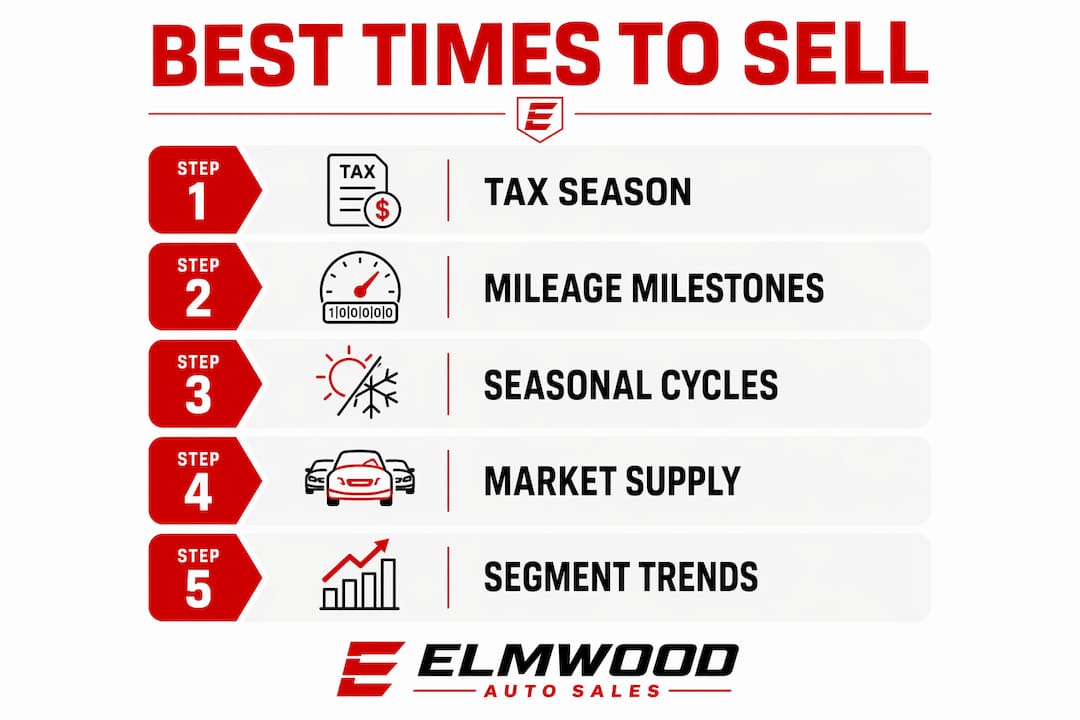
Timing is the single most controllable factor in how much money you walk away with when you sell a used car. Align your sale with peak buyer demand, and you face less negotiation pressure and stronger offers. Miss that window, and you compete against more listings, softer prices, and buyers who know they have options. This article breaks down the real timing factors in car sales: tax refund cycles, Market Days Supply, mileage milestones, and segment-specific trends that are shifting in 2026. Whether you plan a private sale or a dealer trade-in, knowing when to act protects your return.
Why timing matters when selling a used car
The used car market runs on predictable cycles, and sellers who understand those cycles consistently get better prices. Two forces drive most of the annual rhythm: buyer liquidity and inventory supply. When buyers have money and inventory is tight, sellers hold the leverage. When inventory piles up and buyers are scarce, prices soften and negotiations drag.
Tax refund season is the clearest example of buyer liquidity in action. Tax refunds create a liquidity surge from late february through april, pushing used car buyer activity and prices higher, especially for vehicles priced under $15,000. Early 2026 IRS data showed average refunds running roughly 10% higher than the prior year. That extra cash flows directly into the used car market, and dealers stock inventory in advance to meet the surge.

Mileage and vehicle condition add a second layer to timing. A car sitting at 58,000 miles is worth more today than it will be at 72,000 miles next spring. Depreciation does not pause while you wait for a better moment. Understanding both demand cycles and your vehicle's condition window is what separates sellers who maximize profit from those who leave money on the table.
How do seasonal cycles affect used car prices?
Spring is historically the strongest season for used car sellers, but the reason goes beyond weather. Buyers are more active, tax refunds are in hand, and the combination of liquidity and optimism drives faster decisions. The late february through april window is when listing preparation aligned with demand bursts like tax season improves both sale speed and final price.
The 2026 market extends this window slightly. Refund distributions are spread later into spring compared to prior years, which means the demand surge runs longer. Sellers who list in late march or early april in 2026 are still catching the tail end of that liquidity wave rather than missing it entirely.
Here is what the seasonal demand pattern looks like across a typical year:
- Late february through april: Peak buyer activity driven by tax refunds; strongest prices for vehicles under $20,000
- May through june: Demand stays solid; buyers shift toward trucks, SUVs, and family vehicles ahead of summer
- July through august: Activity slows for sedans; trucks and convertibles see a brief uptick
- September through october: Moderate demand; all-wheel-drive vehicles and crossovers gain interest ahead of winter
- November through january: Slowest period for most segments; buyers have less urgency and more negotiating leverage
Refund-driven buyers tend to concentrate in the lower price tiers. If your vehicle is priced between $8,000 and $18,000, the spring window is your strongest opportunity of the year. Dealers recognize this pattern and adjust their own inventory purchases accordingly, which means trade-in offers also tend to be more competitive during this period.
What is market days supply and why should sellers care?
Market Days Supply, commonly called MDS, is the industry metric that tells you how many days the current inventory of a specific vehicle would last at the current rate of sales. It translates raw supply and demand data into a single number that tells you whether you or the buyer holds the advantage.
An MDS of 73 days signals that supply exceeds demand, which prompts dealers to discount and offer incentives to move inventory. For a private seller, high MDS in your vehicle's segment means buyers have plenty of alternatives and will negotiate harder. Low MDS means the opposite: your car is scarce, buyers act faster, and you hold firmer on price.
| MDS Range | Market Condition | Seller Position | Buyer Position |
|---|---|---|---|
| Under 30 days | Strong seller's market | Firm pricing, fast sales | Limited options, less leverage |
| 30–60 days | Balanced market | Moderate negotiation | Fair competition |
| 60–90 days | Buyer's market | Price reductions likely | Strong negotiating power |
| Over 90 days | Oversupplied market | Significant discounts needed | Maximum leverage |
Dealers price vehicles based on expected inventory turnover speed, not just past sales history. That makes MDS a more reliable signal than seasonal folklore. You can track MDS for your specific make and model through platforms like CarGurus, which publishes segment-level supply data, or by monitoring how quickly similar listings move in your area.
Pro Tip: Check MDS for your exact vehicle segment, not just the general used car market. A Honda CR-V and a Chevrolet Malibu can have completely different MDS values in the same month, which means their optimal selling windows differ significantly.
How does mileage affect the best time to sell your car?
Car depreciation is most rapid between 10,000 and 60,000 miles, and mileage is often a more important value driver than the vehicle's age alone. This creates a clear timing signal: sell before you cross a mileage threshold that triggers a significant price drop in buyer perception.
Buyers mentally categorize vehicles by mileage bands. A car at 48,000 miles reads as "low mileage" to most buyers. The same car at 62,000 miles reads as "mid-range." That perception shift can cost you $1,000 or more in negotiation, even if the mechanical condition is identical. The transition from under 100,000 miles to over 100,000 miles is the steepest psychological cliff in the used car market.
Here is a practical sequence for timing your sale around mileage:
- Identify your current mileage band and estimate when you will cross the next threshold based on your monthly driving average.
- Check upcoming maintenance costs. A car approaching a timing belt replacement or major service interval will draw lower offers because buyers factor in that cost.
- Research your vehicle's value now using Kelley Blue Book or Edmunds, then estimate its value at the next mileage band to calculate the cost of waiting.
- Set a listing target date that keeps you below the next threshold, with enough lead time to prepare the vehicle and listing properly.
Delaying sale risks higher mileage, upcoming maintenance milestones, and accelerated depreciation. A survey found that 61% of drivers believe they could have received more money with better timing. That figure reflects a real pattern: most sellers wait too long and lose value they could have protected with earlier planning.
Pro Tip: If you are within 3,000 miles of a major threshold like 60,000 or 100,000 miles, list now. The price difference between selling at 97,000 miles versus 103,000 miles is almost always larger than any seasonal timing advantage you might gain by waiting.
Does generic "best time to sell" advice actually work in 2026?
Generic seasonal advice, such as "sell in spring for the best price," does not account for segment-level differences that are especially pronounced in 2026. Segment-specific supply and demand shifts mean sellers need to watch exact segment trends instead of relying on broad seasonal timing guidance.
In 2026, mainstream sedans and crossovers are priced below typical spring levels. A wave of lease returns has flooded that segment with supply, which pushes prices down even during what should be peak demand season. Trucks and luxury vehicles follow a different pattern entirely, with stronger pricing holding through late spring and into summer.
| Vehicle Segment | 2026 Spring Pricing Trend | Better Timing Window |
|---|---|---|
| Mainstream sedans | Below typical spring levels | Late summer, post-lease-return wave |
| Crossovers and SUVs | Soft due to lease returns | Fall, when supply tightens |
| Pickup trucks | Holding firm through spring | Spring and early summer |
| Luxury vehicles | Stable to strong | Spring, consistent with historical pattern |
| Electric vehicles | Volatile, segment-dependent | Monitor MDS closely |
Understanding how dealership inventory is sourced helps explain why these segment differences exist. Lease return waves, rental fleet liquidations, and new model year releases all inject supply into specific segments at predictable times. Sellers who understand their vehicle's segment supply cycle can avoid listing directly into a supply glut.
The practical takeaway is straightforward. Before you list, search your exact make, model, and trim on CarGurus or AutoTrader and count the competing listings in your region. If you see 40 similar vehicles listed within 100 miles, you are in a crowded market. If you see 8, you have real leverage.
Private sale vs. dealer trade-in: which timing strategy wins?
The selling method you choose changes how timing affects your outcome. Private sales and dealer trade-ins respond to different market forces, and the right choice depends on how much time you have and how much money you want to protect.
Selling privately yields higher profit but requires more time and preparation. Dealer trade-ins offer convenience with typically lower payouts. The timing sensitivity differs between the two routes in a meaningful way.
- Private sale timing: Retail demand drives your price. Listing during tax refund season or when MDS is low in your segment gives you the most buyer competition and the strongest negotiating position. Preparation matters: a listing with clean photos, a vehicle history report, and a recent state inspection will move faster and attract more serious buyers.
- Dealer trade-in timing: Wholesale inventory pacing drives the dealer's offer. Dealers need specific vehicles to fill gaps in their lot. If your vehicle fits a current gap, you may receive a stronger offer regardless of season. Visiting multiple dealers and getting competing offers is the most reliable way to improve a trade-in result.
- Hybrid approach: Kelley Blue Book recommends getting backup dealership offers even when pursuing a private sale. Those offers give you a floor price and real negotiating leverage with private buyers.
The used SUV vs new SUV demand dynamics also affect which route makes more sense for your specific vehicle. High-demand used SUVs often command strong private sale premiums, while slower-moving sedans may be better suited to a quick dealer trade-in during a busy season.
Key takeaways
Timing a used car sale around market demand, mileage milestones, and segment-specific supply cycles is the most reliable way to maximize your sale price and reduce negotiation pressure.
| Point | Details |
|---|---|
| Tax refund season is peak demand | List between late february and april to capture buyers with liquidity and fewer competing listings. |
| MDS below 60 days favors sellers | Low Market Days Supply signals scarcity in your segment, giving you firmer pricing and faster sales. |
| Mileage thresholds cost real money | Selling before crossing 60,000 or 100,000 miles protects significant value in buyer perception. |
| 2026 segment trends differ from history | Lease return waves have softened crossover and sedan prices in spring; trucks and luxury hold stronger. |
| Method changes timing strategy | Private sales benefit most from peak retail demand windows; dealer trade-ins respond to wholesale inventory gaps. |
What i have learned about timing a used car sale
Most sellers focus on the wrong question. They ask "what month should I sell?" when the better question is "what is happening in my vehicle's specific segment right now?" I have seen sellers wait through an entire spring convinced they were holding out for the best price, only to list in june into a market flooded with lease returns in their exact segment.
The data on MDS and segment supply cycles is available to anyone willing to spend 20 minutes on CarGurus or Edmunds. What separates sellers who use it from those who do not is simply the habit of checking before listing, not after. Waiting for an elusive perfect moment can backfire due to mileage buildup and diminishing buyer competition. Early planning consistently outperforms reactive selling.
My honest recommendation: set a target sell date six to eight weeks out, check MDS for your make and model weekly, and be ready to move when the window opens. Do not wait for conditions to be perfect. Wait for conditions to be favorable, then act. The difference between a good sale and a great one is usually preparation, not luck.
— Elmwood
Ready to sell? Elmwoodautosalesri makes it straightforward
Elmwoodautosalesri combines the market knowledge in this article with practical tools that make selling your used car simple and transparent. Whether you want a fast, no-pressure offer or prefer to explore your options before committing, the team at Elmwoodautosalesri is ready to help you act at the right moment.

Elmwoodautosalesri offers Instant Cash Offers and digital retail options that let you start the process from home and move quickly when your timing window opens. The team understands segment-level pricing trends in the Providence, RI market and can help you evaluate whether a trade-in or direct sale makes more sense for your vehicle right now. No commission pressure, no rushed decisions. Just clear information and a fair offer when you are ready.
FAQ
When is the best time to sell a used car?
Late february through april is the strongest window for most used car segments, driven by tax refund liquidity and concentrated buyer demand. In 2026, that window extends slightly later into spring due to delayed refund distributions.
What is market days supply and how does it help sellers?
Market Days Supply measures how long current inventory would last at the current sales pace. Values below 60 days signal a seller's market with firmer prices; values above 60 days indicate surplus inventory and more buyer leverage.
Does mileage matter more than season when timing a sale?
Mileage thresholds often matter more than seasonal timing. Depreciation is steepest between 10,000 and 60,000 miles, and crossing a major mileage band like 100,000 miles can cost more in value than any seasonal advantage gained by waiting.
Should i sell privately or trade in at a dealer?
Private sales typically yield higher returns but require more preparation and timing precision. Dealer trade-ins are faster and more convenient, though offers are generally lower. Getting competing dealer offers provides a price floor that strengthens your position in either route.
Are 2026 spring used car prices following normal patterns?
No. Atypical seasonal price patterns in 2026 have pushed mainstream sedan and crossover prices below typical spring levels due to lease return waves. Trucks and luxury vehicles are holding closer to historical spring pricing.