
A used car return guarantee is defined as a specific contractual provision or state-mandated right that allows a buyer to return a used vehicle under clearly defined conditions. This is not a universal consumer right. Most buyers assume they can return a car within a few days if they change their mind, but that assumption is wrong in most states. Understanding what is used car return guarantee territory versus what is legal myth protects you from costly surprises. This article breaks down your actual rights, how dealership policies work, and what steps give you the most protection before you sign anything.
What is a used car return guarantee, legally speaking?
No federal law grants an automatic right to return a used car after purchase. That means once you sign a sales contract at a dealership, the sale is legally final unless a written return clause exists in that contract or your state has a specific statute requiring one. This is the single most important fact first-time buyers overlook.
State laws vary significantly. California is one of the few states that requires dealers to offer a 2-day cancellation option for used cars priced under $40,000, but this option costs extra and must be purchased at the time of sale. Most other states offer no comparable protection. This means your return rights depend almost entirely on where you live and what your contract says.
Used car lemon laws add another layer of protection, but they are limited. Lemon laws generally apply only when a vehicle still carries an original manufacturer warranty and has a persistent defect that cannot be repaired after multiple attempts. Key conditions that typically trigger lemon law coverage include:
- The vehicle has a defect that substantially impairs its safety, use, or value
- The dealer has made at least two to three repair attempts without resolving the issue
- The vehicle has been out of service for a defined number of days (often 11 or more business days in states like Massachusetts)
- The car is still within the warranty period at the time of the defect
Implied warranties also matter. Even on an "as-is" sale, some states recognize an implied warranty of merchantability, meaning the car must be fit for basic transportation. Express warranties, those written into the Buyer's Guide or sales contract, are directly enforceable. The FTC Buyer's Guide disclosure becomes part of your contract, and any mismatch between what it states and what you were told verbally may indicate a legal problem.
How do dealership return policies and voluntary guarantees work?
Dealership return policies are marketing tools, not legal rights. They are offered voluntarily to attract buyers and build confidence, but they come with conditions that can be surprisingly strict. Understanding the difference between a genuine return window and a promotional promise is critical before you commit.

Return windows and their typical conditions vary widely across dealers:
| Policy type | Return window | Mileage cap | Restocking fee | Key condition |
|---|---|---|---|---|
| Standard dealer policy | 7 days | 250 to 500 miles | Varies | Vehicle returned as sold |
| Extended dealer policy | 10 days | 500 miles | Sometimes applied | No modifications |
| CarMax program | 30-day return | 1,500 miles | None stated | Vehicle in original condition |
| No policy (as-is) | None | N/A | N/A | Sale is final |
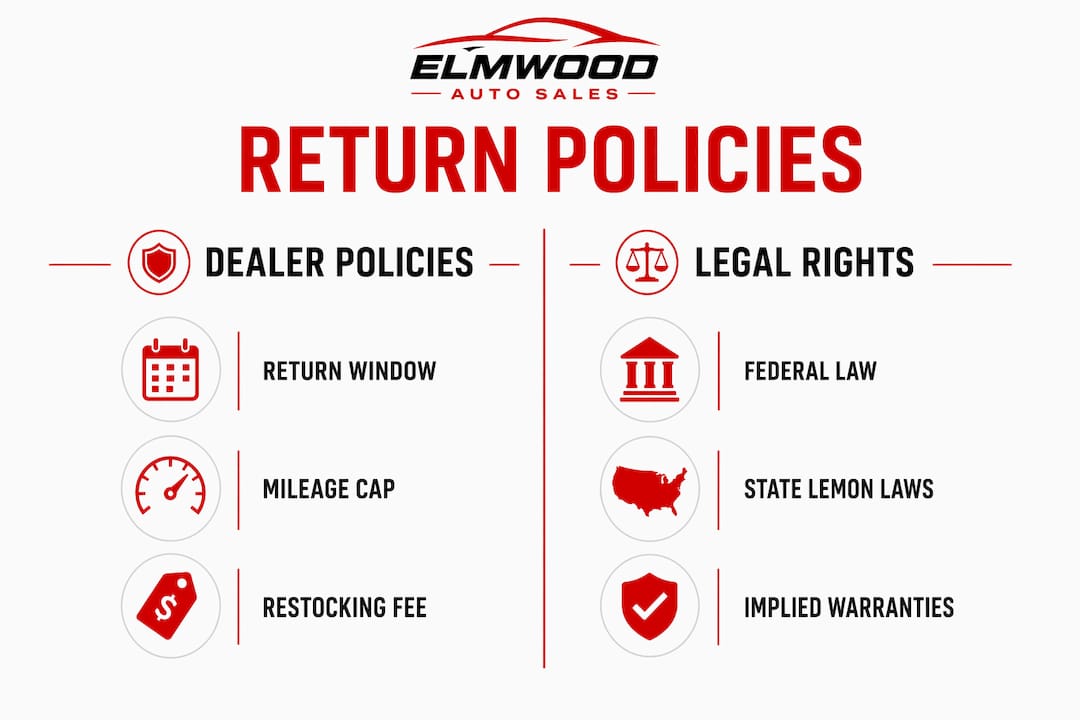
The conditions attached to these policies matter as much as the window itself. Return guarantees almost always require the vehicle to be returned in the same condition it was sold. Any modifications, added accessories, or damage discovered after purchase can disqualify your return entirely. Mileage caps are strictly enforced. If you drive 600 miles during a 500-mile cap policy, your return is void regardless of the reason.
Verbal promises carry zero legal weight. Dealer verbal assurances about return policies have no legal effect unless the exact terms appear in writing in your signed contract. A salesperson saying "don't worry, you can bring it back" is not a return policy. If it is not in the contract, it does not exist.
Pro Tip: Before signing, ask the dealer to show you the return policy clause in the actual sales contract. If they cannot point to it in writing, treat the vehicle as a final sale and make your decision accordingly.
What are the common misconceptions about cooling-off periods?
The cooling-off period myth is one of the most damaging misconceptions in used car buying. Many buyers believe a universal three-day return window applies to all major purchases, including cars. This belief is incorrect and leads buyers to skip thorough pre-purchase checks because they assume they can always return the car later.
The FTC Cooling-Off Rule applies only to sales made at locations other than the seller's permanent place of business, such as door-to-door sales or temporary trade show booths. Dealership sales are explicitly excluded. Once you sign a contract on a dealer's lot, the sale is final under federal law.
"The FTC Cooling-Off Rule does not apply to vehicles sold at a dealership. Once the sales contract is signed on the dealer's premises, the buyer has no automatic federal right to cancel." — LegalClarity
The three-day return myth persists because buyers confuse credit card dispute windows, door-to-door sale rules, and state-specific exceptions into a single imagined universal right. Dealerships are aware of this misconception about cooling-off and some rely on it to discourage buyers from asking hard questions before signing. The practical result is that buyers who believe they have a safety net often skip the vehicle history report, skip the independent inspection, and skip the contract review. Those are exactly the steps that would have protected them.
- Never assume a cooling-off period applies to a dealership purchase
- Never rely on a verbal promise as a substitute for a written return clause
- Never skip a pre-purchase inspection because you believe you can return the car later
- Always read the Buyer's Guide disclosure before signing any contract
How can buyers protect themselves before and after purchase?
Protecting yourself when buying a used car requires specific steps taken before the contract is signed. Industry experts consistently warn buyers never to depend on a return guarantee as their primary protection. Thorough due diligence before purchase is the most reliable safeguard.
Follow these steps to maximize your protection:
- Order a vehicle history report. Services like Carfax or AutoCheck reveal accident history, title issues, odometer discrepancies, and prior ownership. A clean report does not guarantee a perfect car, but a problematic report is a clear warning sign.
- Hire an independent mechanic for a pre-purchase inspection. A professional vehicle inspection before buying identifies mechanical issues the seller may not disclose. This single step eliminates most post-purchase regret.
- Read the Buyer's Guide carefully. The FTC-required Buyer's Guide discloses whether the car is sold as-is or with a warranty. It becomes part of your contract, so any discrepancy between what it says and what you were told is legally significant.
- Request the return policy in writing. Ask the dealer to include any return or exchange terms directly in the sales contract. If the dealer refuses or says it is not necessary, that tells you everything you need to know.
- Understand your state's lemon law coverage. Research whether your state's lemon law covers used vehicles and under what conditions. If the car qualifies, document every repair attempt from day one.
- Know your fallback options. If a return or refund is unavailable, your options include reselling the vehicle privately, filing a complaint with your state's attorney general, or pursuing arbitration if your warranty terms allow it.
Pro Tip: Take photos of the vehicle's condition at the time of purchase and keep copies of every document you sign. If a dispute arises later, this documentation is your strongest evidence.
How do state lemon laws affect used car return rights?
State lemon laws provide the most structured path to a refund or vehicle replacement, but their scope for used cars is narrower than most buyers expect. The table below summarizes how two states with notable used car protections handle warranty failures and return rights.
| State | Coverage threshold | Repair attempts required | Out-of-service days | Remedy available |
|---|---|---|---|---|
| Massachusetts | Under 25,000 miles; 90-day or 5,000-mile warranty | 3 attempts for same defect | 11 business days | Refund or replacement |
| Virginia | Under 18 months old or 18,000 miles | Reasonable number of attempts | 30 calendar days | Repurchase or replacement |
| California | Vehicles under original manufacturer warranty | 2 attempts for serious safety defect | 30 calendar days | Refund or replacement |
Massachusetts stands out as one of the stronger states for used car buyers. The state's lemon law covers vehicles with fewer than 25,000 miles and provides a warranty lasting 90 days or 5,000 miles, whichever comes first. If a defect impairs safety or use and cannot be fixed within the allowed repair attempts, the buyer is entitled to a refund or replacement vehicle.
Arbitration is available in many states when a dealer refuses to honor a buyback or refund obligation. State-sponsored arbitration programs can order a dealer to repurchase or replace a vehicle, and the process is typically faster and less expensive than civil litigation. Buyers should document every repair visit, keep all receipts, and request written repair orders from the dealer at each visit.
Lemon laws do not cover used cars sold without any warranty coverage. Vehicles sold as-is carry no lemon law protection in most states. This makes the Buyer's Guide disclosure and the warranty terms in your contract the two most critical documents in any used car transaction.
Key takeaways
A used car return guarantee is a contractual or state-mandated provision, not a universal right, and buyers who rely on due diligence before purchase are far better protected than those who depend on return policies after the fact.
| Point | Details |
|---|---|
| No federal return right | No automatic right to return a used car exists under federal law after contract signing. |
| State laws vary widely | California offers a 2-day cancellation option; most states provide no comparable protection. |
| Dealership policies are voluntary | Return windows like CarMax's 30-day program are marketing tools with strict conditions, not legal rights. |
| Cooling-off periods do not apply | The FTC Cooling-Off Rule excludes dealership sales; the three-day return myth has no legal basis. |
| Due diligence is your best protection | Independent inspections, written return clauses, and Buyer's Guide review protect you more than any return policy. |
What Elmwoodautosalesri has learned about return guarantees
After years of working with first-time buyers in Providence, RI, the pattern is consistent. Buyers who walk in asking about return guarantees are often the same buyers who have not yet inspected the vehicle, reviewed the contract, or checked the vehicle history. The guarantee question is the right instinct, but it is being asked at the wrong stage of the process.
Return guarantees are real and some dealers offer them genuinely. But treating a return policy as your primary safety net is a mistake. The conditions attached to these policies are designed to limit their use, not expand it. Mileage caps, condition requirements, and restocking fees exist precisely because dealers know most buyers will not qualify for a return once they have driven the car for a week.
The buyers who walk away most satisfied are the ones who did the work upfront. They got the independent inspection. They read every line of the Buyer's Guide. They asked for the return policy in writing and, when the dealer could not produce one, they either negotiated harder or walked away. That discipline is worth more than any 30-day return window.
Elmwoodautosalesri operates without commission-based sales pressure, which means the conversation about return policies, warranty terms, and contract details happens honestly. Buyers should demand that same transparency from every dealer they visit, regardless of location.
— Elmwood
How Elmwoodautosalesri supports confident used car buying
Elmwoodautosalesri is a Providence, RI dealership built around transparency, not pressure. Every vehicle goes through a thorough inspection before it reaches the lot, and the team is upfront about warranty terms, return policies, and financing options from the first conversation.
For buyers who want to understand their return and financing options before committing, Elmwoodautosalesri provides clear answers. The dealership offers tailored financing through Capital One digital retail, including buy here, pay here solutions for buyers across a range of credit histories. Whether you are buying your first car or replacing a vehicle, the team at Elmwoodautosalesri walks you through every document so you know exactly what you are signing. Visit the site to explore current inventory and get honest answers about your purchase protection options.
FAQ
What is a used car return guarantee?
A used car return guarantee is a written provision in a sales contract or a state law that allows a buyer to return a used vehicle under specific conditions. It is not a universal right and does not exist automatically in most states.
Can you return a used car after buying it?
In most states, you cannot return a used car after purchase unless the sales contract includes a written return policy or your state has a specific law requiring one. California is a notable exception with its 2-day cancellation option for qualifying vehicles.
Does the three-day cooling-off rule apply to car purchases?
No. The FTC Cooling-Off Rule applies only to off-site sales, not dealership purchases. Once you sign a sales contract at a dealership, the sale is final under federal law unless a written return clause exists in your contract.
What is a used vehicle satisfaction guarantee?
A used vehicle satisfaction guarantee is a voluntary dealer program, such as a 7-day or 30-day exchange window, that allows buyers to return or swap a vehicle under defined conditions. These programs are marketing incentives, not legal rights, and always include mileage caps and condition requirements.
When do lemon laws apply to used cars?
Lemon laws apply to used cars only when the vehicle is still covered by an original manufacturer warranty and has a defect that substantially impairs safety or use after multiple repair attempts. Vehicles sold as-is with no warranty are generally excluded from lemon law protection.