
Negative equity on a car means you owe more on your auto loan than the vehicle is currently worth. As the FTC explains, this gap creates real financial exposure the moment you try to sell, trade in, or refinance. Three things to do right now if you suspect you're in this position:
- Check your payoff amount. Call or log in to your lender's portal and request the exact loan payoff figure, not just your remaining balance.
- Check your car's market value. Get estimates from Kelley Blue Book (KBB), Edmunds, or NADA Guides. These three tools are the standard the FTC recommends for trade-in verification.
- Ask any dealer directly how they handle a shortfall. Get the answer in writing. A verbal promise to "pay off your loan" can mask a rollover into new financing, which leaves you deeper in debt.
Key Takeaways
Negative equity on a car loan is a widespread and manageable problem — but only if you understand the numbers before you trade, sell, or refinance.
| Point | Details |
|---|---|
| Definition | You owe more on the loan than the car is worth; the gap is your negative equity. |
| Calculate it first | Subtract your lender's payoff quote from KBB/Edmunds/NADA trade-in value to find your exact position. |
| Rollovers carry risk | Rolling negative equity into a new loan restarts the cycle and increases total interest paid. |
| Private sale often beats trade-in | Selling privately typically yields a higher price, which can reduce or eliminate the shortfall. |
| Gap insurance matters | If you're underwater and the car is totaled, gap coverage pays the difference your insurer won't. |
Table of Contents
- What does negative equity on a car loan actually mean?
- How do you calculate whether you have negative equity?
- Why does negative equity happen on a car loan?
- What does negative equity mean for trade-ins and total-loss events?
- How can you fix or manage negative equity?
- How long does it take to get back to positive equity?
- How do you avoid negative equity when buying a car?
- When is negative equity a serious financial risk?
- A note from Elmwoodautosalesri on transparent trade-in handling
- Sources
What does negative equity on a car loan actually mean?
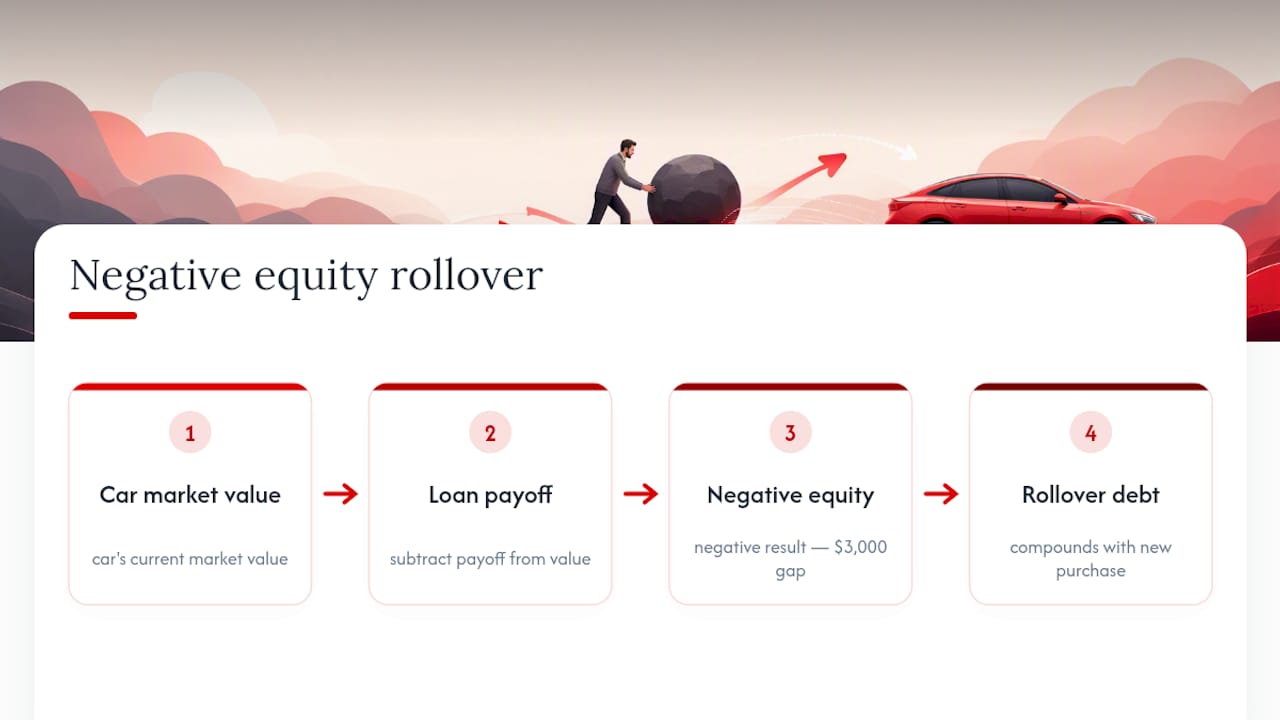
The terms "upside down" and "underwater" mean the same thing: your loan balance is larger than what the car would sell for today. Experian's guidance frames the calculation simply: subtract your loan payoff from the car's current market value. A negative result is your negative equity figure.
Here's a concrete example:
That $3,000 gap is what you'd need to cover out of pocket to sell or trade the car without carrying the debt forward. The number sounds manageable in isolation, but it compounds quickly when you factor in a new purchase.
How do you calculate whether you have negative equity?
Follow these four steps to get an accurate picture of where you stand:
- Request a formal payoff quote from your lender. This is different from your current balance. A payoff quote includes any accrued interest and fees through a specific date. Most lenders provide this online or by phone within minutes. Note the quote's expiration date — payoff amounts change daily.
- Get at least two independent market-value estimates. Use KBB, Edmunds, and NADA Guides for trade-in value and private-party value. The FTC recommends all three as reliable benchmarks. Trade-in value is typically lower than private-party value, so check both.
- Subtract the payoff from the market value. If the result is negative, you have negative equity. If it's positive, you have equity you can apply toward a new purchase.
- Account for timing and appraisal adjustments. Dealer appraisals often come in below online estimates, especially for high-mileage vehicles or cars with visible wear. Build in a buffer of a few hundred dollars when running your numbers.
For a deeper look at how dealer appraisals can differ from online estimates, Elmwoodautosalesri's guide on what the dealer appraisal process means for your trade-in walks through the details.
Why does negative equity happen on a car loan?
Car and Driver's analysis identifies depreciation, loan structure, and buyer behavior as the three main drivers.
The most common causes:
- Rapid early depreciation. The steepest value drop happens in the first one to three years. A car worth $30,000 at purchase may be worth $24,000 or less within 24 months.
- Low or no down payment. Starting with a small down payment means the loan balance stays high while the car's value falls quickly.
- Long loan terms (60–84+ months). Longer terms reduce monthly payments but slow the rate at which principal is paid down. Depreciation often outpaces principal reduction for the first several years.
- High mileage or damage. Vehicles driven above average mileage or with accident history depreciate faster than standard estimates suggest.
- Financing add-ons rolled into the loan. Extended warranties, GAP insurance, and dealer accessories added to the financed amount inflate the starting balance without adding to the car's resale value.
The core problem is a timing mismatch: amortization schedules front-load interest payments, so early monthly payments reduce principal slowly. Meanwhile, depreciation moves fast. That gap is where negative equity lives.
What does negative equity mean for trade-ins and total-loss events?
When you trade in a car with negative equity, you have three options: pay the shortfall in cash, roll it into a new loan, or sell the car privately and use the proceeds to pay off the loan.
Rolling over means the dealer adds your existing negative balance to the new loan amount. If you owe $3,000 more than your trade-in is worth, that $3,000 gets folded into the new financing. Your new loan starts at $3,000 more than the car you're buying is worth, and you're immediately underwater again.
FTC caution: Dealers who advertise "we'll pay off your loan no matter what you owe" are not always absorbing that cost. The FTC warns that these claims can be misleading — the shortfall is often added to the new loan's financed amount. Always read the installment contract and look at the "amount financed" line. If a dealer makes a verbal promise, get it written into the contract as a specific payoff or credit line item before you sign.
Total-loss events carry the same risk. If your car is totaled, your insurer pays the current market value, not what you owe. If you're underwater, you're still responsible for the remaining loan balance. Gap insurance covers that shortfall, which is why it's worth considering any time you finance with a small down payment or a long loan term.
How can you fix or manage negative equity?
The right path depends on how large the gap is and how urgently you need a different vehicle.
- Keep the car and pay down the loan. If you don't need to sell or trade, staying put and making regular payments is the lowest-risk option. Depreciation slows as the car ages, and the gap typically narrows over time.
- Make extra principal payments. Even modest additional payments each month accelerate principal reduction and can close the gap faster than the standard amortization schedule. Confirm with your lender that extra payments apply to principal, not future interest.
- Sell privately. NerdWallet's guidance notes that private-party sales consistently yield higher prices than dealer trade-ins. A higher sale price means a smaller shortfall to cover, or none at all.
- Refinance. If interest rates have dropped or your credit score has improved since you took the loan, refinancing to a lower rate reduces total interest paid. However, refinancing while underwater can be difficult — many lenders won't approve a loan that exceeds the vehicle's value.
- Roll into a new loan (with caution). This is a last resort. It solves the immediate problem but increases the new loan's principal and total interest, and it restarts the cycle.
- Gap insurance for total-loss protection. If you're currently underwater and can't pay down the loan quickly, gap coverage protects you from owing money on a car you no longer have.
Pro Tip: Selling privately often nets $1,000–$3,000 more than a dealer trade-in for the same vehicle. That difference can eliminate negative equity entirely or reduce the cash you need to bring to closing. See Elmwoodautosalesri's sell vs. trade-in comparison for a side-by-side breakdown.
How long does it take to get back to positive equity?
The timeline depends on four variables: your loan term, your interest rate, your initial down payment, and how fast your specific vehicle depreciates.
- Short-term loans (48–60 months) with a solid down payment typically reach positive equity within 12–24 months, because principal reduction outpaces depreciation relatively quickly.
- Long-term loans (72–84 months) with little down can keep you underwater for three to five years, sometimes longer, because the amortization schedule keeps early payments weighted toward interest.
- High-depreciation vehicles (luxury cars, certain domestic trucks in oversupplied markets) extend the timeline further, regardless of loan structure.
The scale of the problem is larger than most buyers expect. CNBC reporting citing JD Power data found that roughly 30.5% of trade-ins were underwater, with average underwater balances reaching record highs in late 2025. That means nearly one in three buyers trading in a vehicle carries some negative balance into their next purchase.
Stat to know: About 30.5% of trade-ins owed more than the car was worth, per JD Power data cited by CNBC — and average negative balances hit record levels in late 2025.
The fastest path back to positive equity is a combination of a shorter loan term, a larger down payment at origination, and choosing a vehicle with a slower depreciation curve.
How do you avoid negative equity when buying a car?
Prevention is far easier than recovery. These steps reduce the risk before you sign anything:
- Put down at least 10–20% of the purchase price. A larger down payment means a lower starting loan balance relative to the car's value.
- Keep the loan term at 48–60 months. Longer terms lower monthly payments but dramatically increase the time you spend underwater. Review Elmwoodautosalesri's financing guide for term and rate guidance specific to your credit profile.
- Avoid rolling add-ons into the loan. Financing an extended warranty or accessories inflates the principal without adding resale value.
- Choose models with slower depreciation. Trucks and SUVs from brands with strong resale histories tend to hold value better than luxury sedans or high-volume economy cars.
- Build in a cushion for first-year depreciation. Even with a solid down payment, plan for the car to lose value quickly in year one. A down payment that covers that initial drop keeps you above water from the start.
The simple financing rule: a smaller financed amount plus a shorter term equals lower negative-equity risk. Every dollar you borrow beyond the car's likely near-term value is a dollar of potential negative equity.
When is negative equity a serious financial risk?
Negative equity is a manageable inconvenience for most borrowers who plan to keep their vehicle. It becomes a genuine financial risk in specific situations:
- You need to replace the car soon due to mechanical failure, a growing family, or a job change. Rolling a large negative balance into a new loan starts a compounding cycle that's hard to break.
- You're experiencing payment strain. If monthly payments are already stretching your budget, negative equity limits your options: you can't sell without covering the gap, and refinancing may not be available.
- Your car is totaled and you don't have gap coverage. You'd owe the remaining loan balance on a car you no longer own.
- You've rolled negative equity into multiple consecutive loans. Each rollover adds to the principal, and the cycle accelerates.
At that level, the financial exposure from a total-loss event or a forced sale is significant. Refinancing becomes harder too — most lenders cap loan-to-value ratios, and a deeply underwater loan won't qualify for better terms without a cash contribution to reduce the balance.
A note from Elmwoodautosalesri on transparent trade-in handling
At Elmwoodautosalesri, we believe every customer deserves a clear picture of their trade-in numbers before they sign anything. When you bring a vehicle to us, we provide the trade-in appraisal in writing, show you exactly how any negative equity is itemized in the financing contract, and walk through the "amount financed" line so there are no surprises. We don't make verbal promises about loan payoffs and then bury the math in the contract.

Our recommendation: before visiting any dealer, pull your lender's payoff quote and at least two independent market-value estimates. Compare what a private sale might yield against the dealer trade-in offer. If there's a shortfall, ask us to show you the exact line item in the installment contract where it appears. That's the standard you should hold every dealer to.
You can start the trade-in process and get a fair, transparent appraisal at Elmwoodautosalesri's trade-in page.
Sources
These authoritative U.S. resources cover valuation, consumer protection, and reporting:
- Auto Trade-Ins and Negative Equity: When You Owe More than Your Car is Worth | Consumer Advice
- How do I know if I have positive or negative equity in my car? | Experian
- What Is Negative Equity on a Car Loan? - Car and Driver
- Is Your Car Loan Upside-Down? How to Handle Negative Equity - NerdWallet
- Negative equity on trade-ins affects nearly a third of car buyers | CNBC
This article is general information, not a substitute for advice from a qualified financial advisor. Consult a qualified financial professional about your own circumstances before acting on anything here.