A high-demand vehicle segment is one where buyer demand materially outpaces available supply, measured by three concrete signals: a low market day supply (days-to-turn), a sales share that exceeds the segment's share of active dealer inventory, and retail transaction prices running above MSRP. This is not just a marketing phrase. It is a measurable market condition that directly affects what you pay, how long you wait, and how much room you have to negotiate.
Three signals you can check before you shop:
- Market day supply (MDS): Total vehicles listed for sale divided by the average daily sales rate. CareEdge's MDS rankings show that anything under roughly 30 days signals a tight market with little room for discounts.
- Sales share vs. supply share: When a segment's share of monthly sales exceeds its share of active inventory, the market is undersupplied. AutoBridge data shows hatchbacks, for example, selling at roughly double their shelf share.
- Transaction price vs. MSRP: Vehicles in high-demand segments often sell at or above sticker price, with fewer dealer incentives attached.
Key Takeaways
A high-demand vehicle segment is defined by low market day supply, a sales share exceeding inventory share, and transaction prices at or above MSRP — signals that directly affect what you pay and how long you wait.
| Point | Details |
|---|---|
| Core definition | Demand outpaces supply when MDS is under 30 days and sales share exceeds inventory share. |
| Top signal to check | Market day supply is the fastest single metric; under 30 days means little room to negotiate. |
| Current high-demand segments | Hybrid SUVs and compact crossovers lead; non-luxury SUV consideration reached 71% in early 2026. |
| Resale advantage | High-demand segments tend to hold trade-in value better than oversupplied ones over three to five years. |
| Elmwoodautosalesri advantage | Inspected inventory, tailored financing, and daily stock monitoring help Providence buyers find high-demand vehicles without overpaying. |
Table of Contents
- What does a high-demand vehicle segment mean for how cars get grouped?
- Which vehicle segments will you see when shopping?
- How do U.S. classification systems (EPA, NHTSA, IIHS) define vehicle classes?
- What does "high demand" actually look like in market terms?
- Which U.S. segments are showing high demand right now?
- Why does segment demand affect your purchase?
- How should you shop when a segment is in high demand?
- Elmwood's perspective on high-demand segments in Providence
- Sources
What does a high-demand vehicle segment mean for how cars get grouped?
Before you can understand demand, you need to understand what a segment actually is. The automotive industry groups vehicles into segments, which are categories defined by a combination of size, body style, intended purpose, and price level. Manufacturers use segments for product planning. Regulators use them for fuel economy and emissions comparisons. Insurers use them for risk grouping. And buyers use them as shopping shorthand.
The criteria that define a segment vary by who is doing the classifying. Size is measured by exterior dimensions and interior passenger-plus-cargo volume. Weight matters too, particularly for regulatory purposes. Body style (sedan, SUV, pickup, hatchback) is the most visible dividing line for consumers. Intended use separates a work truck from a family crossover even when both share a similar footprint. Price and equipment level separate a base compact from a luxury compact. Powertrain type, specifically whether a vehicle is a hybrid or battery-electric, is increasingly used as a sub-label within existing segments rather than a standalone category.
The ChargeIQ segment explainer notes that EVs and hybrids are categorized within the same letter-based labels as their conventional counterparts, with range and charging infrastructure added as EV-specific considerations.
Which vehicle segments will you see when shopping?
The letter-based system originated in Europe but is widely referenced in U.S. automotive media and dealer listings. Here is a practical reference:
- A-segment (city car): Smallest production cars, optimized for urban parking and fuel economy. Rare in the U.S. market.
- B-segment (subcompact): Small, affordable cars. Think entry-level hatchbacks and budget sedans.
- C-segment (compact): The largest-selling passenger car class in the U.S. Compact sedans and hatchbacks, including many hybrid variants.
- D-segment (midsize): Larger sedans and crossovers with more interior room and a higher price point.
- E/F-segment (large/full-size): Full-size sedans and flagship models. Declining in U.S. sales volume.
- Sports/S-segment: Performance-focused coupes and roadsters across price ranges.
- Luxury: Overlaps with D through F and SUV segments; defined by price, brand, and equipment rather than size alone.
- Hatchbacks and wagons: Body style sub-labels that can appear across B through D segments.
- SUVs and crossovers: Subdivided into subcompact, compact, midsize, and full-size. The dominant body style in the current U.S. market.
- Pickup trucks: Light-duty (half-ton) and heavy-duty (three-quarter and one-ton) classes. Consistently among the top-selling segments in the U.S.
- Minivans: Family-hauling segment with limited but loyal demand.
Regional naming matters. U.S. buyers typically hear "subcompact," "compact," and "midsize" rather than B, C, and D. The letter labels appear more often in press releases and analyst reports than on dealer lots. Hybrids and plug-in hybrids appear most frequently in the compact and midsize SUV segments, which is where current demand is concentrated.
How do U.S. classification systems (EPA, NHTSA, IIHS) define vehicle classes?
Marketing segment labels and regulatory class definitions are not the same thing, and knowing the difference helps you interpret safety ratings, fuel economy data, and insurance costs accurately. The Wikipedia car classification article compiles all three U.S. systems and their measurement bases.
| Agency | Primary Measurement | What It Classifies | Why It Matters to Buyers |
|---|---|---|---|
| EPA | Interior passenger + cargo volume (cubic feet) | Passenger cars (minicompact, subcompact, compact, midsize, large) and light trucks | Fuel economy labels and emissions comparisons use EPA classes |
| NHTSA | Curb weight (lbs) | Passenger cars and light trucks by weight codes | Crash test groupings and safety standards are weight-based |
| IIHS/HLDI | Shadow area (footprint) and curb weight | Size groups for insurance loss comparisons | Insurance rates and safety award eligibility use IIHS groups |
The same vehicle can land in different class buckets depending on which system you consult. A compact crossover might be EPA-classified as a small SUV based on its cargo volume, NHTSA-classed as a light truck by curb weight, and placed in the IIHS "small SUV" group by footprint. Use the system that matches your question: EPA for fuel economy, NHTSA for crash safety, IIHS for insurance-relevant safety performance.
The FrenzyCars guide to cargo space measurement explains how interior volume is calculated, which is the foundation of EPA's passenger-car classification.
What does "high demand" actually look like in market terms?
High demand is not the same as high sales volume. A segment can sell millions of units and still have adequate supply. What makes a segment "high demand" in the market sense is the relationship between how fast vehicles sell and how many are available. Four metrics define that relationship:
- Market day supply (MDS): Calculated as total vehicles for sale divided by the average daily sales rate. Under 30 days is the threshold most analysts use to flag a tight market.
- Sales share vs. active supply share: When a segment accounts for a larger percentage of monthly sales than it does of active listings, it is undersupplied. AutoBridge's sell-through analysis uses exactly this comparison to identify where buyers face the most competition.
- Retail transaction price vs. MSRP: High-demand vehicles often sell at or above sticker. A segment where average transaction prices consistently exceed MSRP is one where buyers have little leverage.
- Dealer incentives and waitlists: Manufacturers reduce cash-back offers and financing deals when demand is strong. Waitlists or allocation limits at the dealer level are another visible signal.
One nuance worth understanding: low days-to-turn can have two different causes. It can reflect genuine buyer demand, or it can reflect constrained production. A limited-edition model with a small production run will show low MDS even if total buyer interest is modest. The combination of low MDS plus a transaction price above MSRP is the clearest signal of genuine demand pressure. Low MDS with heavy manufacturer incentives, by contrast, often signals a supply-managed special edition or a model being cleared ahead of a refresh.
Pro Tip: Ask the dealer for the model's current market day supply before negotiating. If MDS is under 30 days, expect to pay close to or above sticker. If it is above 60 days, you have real room to negotiate.
Which U.S. segments are showing high demand right now?
The clearest current signal in the U.S. market is the shift toward hybrid SUVs. Kelley Blue Book's Brand Watch for the first half of 2026 reported hybrid vehicle consideration at 22% of shoppers versus EV consideration at 10%, with non-luxury SUV consideration reaching a record high of 71%. Motor1's coverage of the same KBB data confirmed that hybrid SUVs are outpacing full EVs in shopper interest, a trend driven by fuel economy gains without the charging infrastructure tradeoffs of a battery-only vehicle.
Stat: Non-luxury SUV consideration hit 71% among shoppers in the first half of 2026, while hybrid consideration (22%) more than doubled EV consideration (10%), per KBB Brand Watch.
Beyond SUVs, the budget end of the used market is also tight. AutoBridge inventory data shows hatchbacks carrying an active supply share of 3.2% while accounting for 6.1% of June sales, meaning they sell at roughly double their shelf share. The sub-$10,000 price band shows similar undersupply patterns, with budget-tier vehicles clearing faster than dealers can restock them.
KBB Brand Watch also noted that affordability and fuel economy are rising priorities for shoppers in 2026, with only a handful of brands gaining meaningful consideration. That concentration of interest in a small number of models and segments is itself a demand signal: when buyers narrow their choices, the segments they favor face more competition per available unit.
For buyers, the practical picture looks like this. Compact and midsize hybrid SUVs are in high demand, with limited inventory and prices holding firm. Budget hatchbacks and used cars under $10,000 are clearing fast. Full-size sedans and oversupplied premium segments offer more negotiating room. The benefits of hybrid vehicles guide from FrenzyCars explains why hybrids appeal to today's cost-conscious buyers, which helps explain the demand concentration.
Why does segment demand affect your purchase?
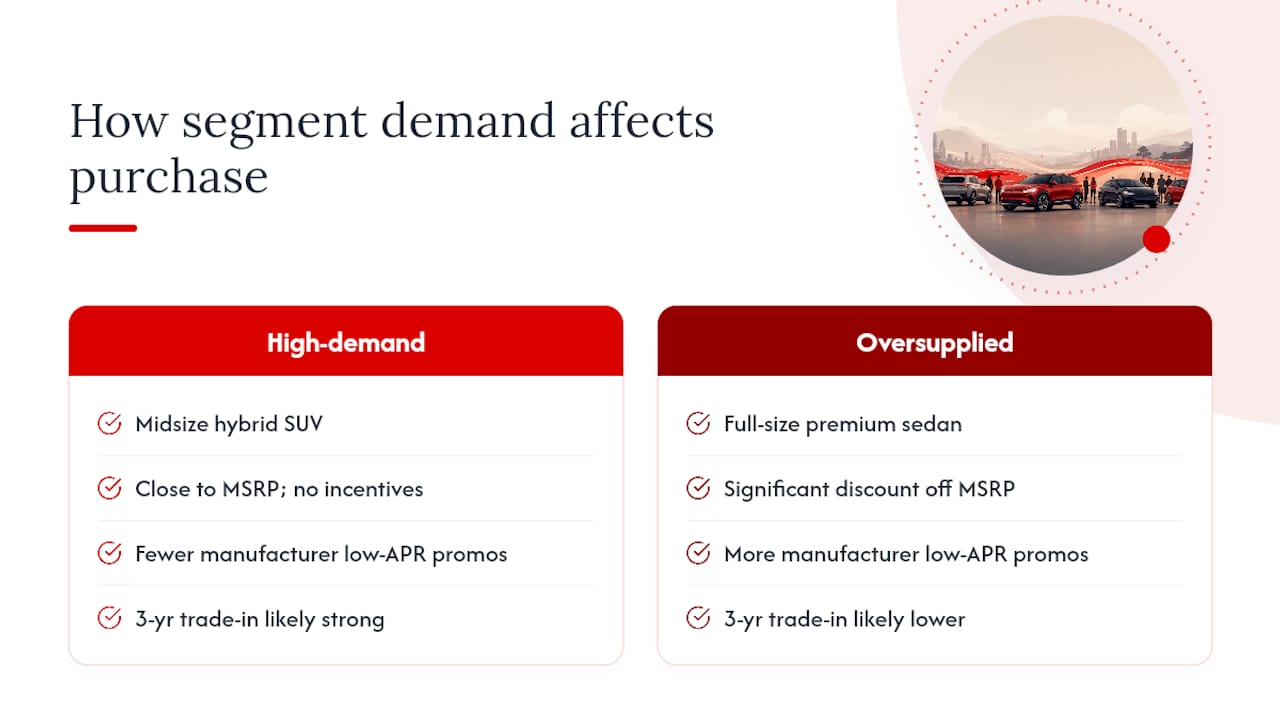
The consequences of buying in a high-demand segment are direct and financial. Higher transaction prices are the most immediate effect. When a segment's MDS is low and sales share exceeds supply share, dealers have no incentive to discount. You may also find fewer financing promotions, since manufacturers reserve low-APR deals for segments where they need to stimulate demand.
Resale value is the longer-term consideration. S&P Global Automotive Insights notes that four vehicle segments drive over half of U.S. new-vehicle sales, and that used-car buyers prioritize fit and functionality in those same popular segments. Vehicles in consistently high-demand segments tend to hold their value better because used-market demand mirrors new-market demand. That means a stronger trade-in value when you are ready to sell or upgrade.
Consider two buyers. One purchases a midsize hybrid SUV in a tight market, paying close to MSRP with no incentives. Three years later, used demand for that model remains strong, and the trade-in value reflects it. The second buyer purchases a full-size premium sedan in an oversupplied segment, negotiating a significant discount off MSRP. Three years later, that segment is still oversupplied, and the trade-in value has dropped proportionally. The upfront discount on the sedan did not offset the depreciation gap.
Low supply's effect on used car prices is a dynamic Elmwoodautosalesri covers in detail for Providence-area buyers, and it applies equally to new and used segments.
Pro Tip: Before committing to a high-demand segment, check trade-in value projections for that model at three and five years. Strong resale can offset a higher purchase price, but only if you plan to keep the vehicle long enough to benefit.
How should you shop when a segment is in high demand?
A tight market requires a different approach than a buyer's market. Here is a practical numbered checklist for U.S. buyers:
- Check market day supply first. Look up the model's MDS on CareEdge or ask the dealer directly. Under 30 days means limited negotiation room. Over 60 days means you have leverage.
- Compare transaction price to MSRP. Resources like Kelley Blue Book show average transaction prices by model. If the average is at or above MSRP, expect to pay sticker or close to it.
- Monitor dealer inventory and waitlists. Check multiple dealers in your region. Inventory changes daily in tight segments, so set up alerts if the platform allows it.
- Consider certified pre-owned (CPO) options. A CPO vehicle in a high-demand segment often costs less than a new one, comes with a manufacturer-backed warranty, and avoids the new-car markup. The used car warranty guide from Elmwoodautosalesri explains what CPO and extended warranty coverage actually includes.
- Expand your search radius. Inventory availability varies by region. A model that is sold out in Providence may be available at a dealer 50–100 miles away, sometimes at a lower price.
- Evaluate hybrid vs. EV based on your charging access. If you have home charging, an EV in a less-demanded segment may offer better value and negotiating room. If you do not, a hybrid SUV gives fuel economy gains without the infrastructure dependency. The FrenzyCars hybrid vs. EV decision guide walks through that tradeoff clearly.
- Time your purchase around model-year refreshes. When a new model year arrives, prior-year inventory often gets discounted even in high-demand segments. Watch for that window.
- Focus negotiation on value-added items. When price is firm, negotiate for service plans, extended warranties, or favorable financing terms instead of a cash discount.
For buyers considering an SUV specifically, the used SUV buying checklist from Elmwoodautosalesri covers the inspection and financing steps that apply whether the market is tight or not.
Pro Tip: At Elmwoodautosalesri, the team monitors incoming inventory daily and can flag vehicles in high-demand segments before they hit the main listing. Buyers who contact the dealership directly often find options that are not yet publicly listed. Schedule a test drive to discuss current availability with no sales pressure.
Elmwood's perspective on high-demand segments in Providence
The concept of a high-demand vehicle segment is not abstract when you are trying to help a family in Providence find a reliable used SUV at a fair price. At Elmwoodautosalesri, the team sees the effects of tight inventory directly: hybrid SUVs and compact crossovers move quickly, budget hatchbacks under $10,000 rarely stay on the lot long, and buyers who wait often pay more or settle for less.
What makes a difference locally is preparation. Every vehicle at Elmwoodautosalesri goes through a thorough inspection before it is listed, which removes the uncertainty that makes tight-market buying stressful. Tailored financing options, including in-house arrangements for buyers with a range of credit histories, mean that when the right vehicle appears, buyers can act without delay. In a high-demand segment, the ability to move quickly is a real advantage.
The broader lesson from the data is that understanding segment demand is not just useful for analysts. It is practical knowledge for anyone who wants to buy at the right time, negotiate from an informed position, and choose a vehicle that holds its value. Buyers who walk in knowing the MDS, the transaction price trend, and the resale history of their target segment are in a fundamentally stronger position than those who do not.
Sources
These are the primary sources referenced throughout this guide. Each one gives you a different lens on segment demand and classification:
- Kelley Blue Book Brand Watch: Hybrid and SUV Interest Reaches New Highs as Audi, Kia and Subaru Gain Shopper Consideration in First Half of 2026
- Sells Faster Than It's Stocked: Where Demand Outruns Supply | AutoBridge Data
- Car classification