
Yes, you can usually trade in a car with negative equity, but you typically remain responsible for that shortfall unless you pay it off directly or sell the car privately. Most dealers will roll the unpaid balance into your new loan, which raises the amount financed and the interest you'll pay over the life of the new contract. Paying down the difference, refinancing first, or selling the car yourself almost always costs less in the long run.
TL;DR:
- Most dealers will add your negative equity into your new auto loan, increasing your financed amount and overall interest paid over the loan term.
- Checking your exact payoff amount and multiple trade-in estimates helps you accurately determine your true shortfall and avoid undervaluation.
- Paying the shortfall in cash, selling privately to cover the gap, or refinancing are often less costly options than rolling negative equity into a new loan or lease.
- When dealers roll negative equity into a deal, they often hide it within the contract, making written confirmation and careful contract review essential.
- Choosing a shorter loan term accelerates equity recovery, but rolling large shortfalls into longer terms significantly raises costs and prolongs upside-down status.
Table of Contents
- How Negative Equity Works and How to Calculate Your Exact Amount
- What Are Your Options for Handling Negative Equity?
- How Do Dealers Handle Negative Equity, and What Should You Watch For?
- How Should You Structure Financing If You Roll Over Negative Equity?
- Should You Trade Now or Wait?
- How Elmwood Handles Trade-Ins With Negative Equity
- What Happens If You Can't Manage the Negative Equity?
- Are There Alternatives to Trading In With Negative Equity?
- How Does Negative Equity Affect Your Next Loan or Lease?
- How Can You Improve Your Trade-In Value Before Selling?
- What Are the Tax Implications of Trading In With Negative Equity?
- How Do You Negotiate the Best Deal With Negative Equity?
- The Real Problem Isn't the Math, It's the Paperwork
- Book a Trade-In Appraisal With Elmwood
- Where to Verify Your Numbers and Rights
- Sources
- FAQ
How Negative Equity Works and How to Calculate Your Exact Amount
Negative equity is simply the gap between what you owe on your car loan and what the car is actually worth. You can't manage that gap until you know the real number, and that starts with two separate figures you have to collect yourself.
Call your lender and request your exact payoff amount, not your current statement balance. Those two numbers are rarely the same, since a payoff quote includes interest accrued through a specific date and sometimes a small administrative fee. The Consumer Financial Protection Bureau recommends getting that payoff figure in writing before you ever set foot on a dealer lot.
Next, pull trade-in value estimates from more than one source. Relying on a single number, especially one a dealer hands you, tends to undervalue your car.
- Check NADA's consumer vehicle values for a market-based estimate.
- Run the same VIN and mileage through Kelley Blue Book and Edmunds.
- Scan local classified listings for comparable vehicles actually selling near you.
Subtract your loan payoff from the average trade-in estimate. If the result is negative, that's your shortfall. Remember that sales tax and dealer fees on the new purchase can shift your out-the-pocket number even after the trade-in credit applies, so run the math with your local tax rate before you assume the deal is fair. Once any deal closes, ask your old lender for written confirmation that the loan was paid in full. That paper trail matters more than most buyers realize.
What Are Your Options for Handling Negative Equity?
Once you know the shortfall, you have five real paths forward, and each fits a different situation.
- Pay the difference in cash. Confirm your exact payoff quote first, and ask your lender whether a prepayment penalty applies. Most standard auto loans don't carry one, but it's worth thirty seconds on the phone to check.
- Sell the car privately. A private sale, according to Experian, often nets more than a dealer trade-in, and that extra money can wipe out your shortfall before you ever finance a new vehicle. Coordinate the payoff directly with your lender so the buyer's payment goes toward retiring the loan, not into your pocket first.
- Refinance the current loan. If your credit has improved since you first financed the car, a refinance can lower your rate or your monthly payment. It won't erase negative equity by itself, but a lower rate means more of each payment reduces principal instead of interest.
- Delay the trade and pay extra toward principal. Ask your lender to apply extra payments to principal only, and get written confirmation that they did. Even an extra $50 to $100 a month can shave meaningful time off how long you stay upside down.
- Roll the negative equity into a new loan. This is the option dealers push hardest because it's the easiest to execute at the point of sale. It's tolerable only when the shortfall is small relative to the new loan and you commit to the shortest term you can afford.
Pro Tip: Before you accept any rollover, ask your lender or dealer to model the new loan with and without the negative equity included. Seeing the dollar difference in interest over the full term makes the real cost impossible to ignore.
How Do Dealers Handle Negative Equity, and What Should You Watch For?
Dealers routinely fold a trade-in shortfall into the new deal by increasing the "amount financed" line on your contract, sometimes without spelling out that they've done it. The Federal Trade Commission warns that some dealers promise to "pay off" your old loan verbally, then simply bury that balance inside your new financing instead. A verbal promise carries no weight if the paperwork says something different.
Before you sign anything, check these contract lines against what you were told at the negotiating table:
- Trade-in allowance: does it match the value the salesperson quoted you out loud?
- Amount financed: does it reflect only the new vehicle price, or has your old loan balance been added in?
- Down payment: is any of your trade-in equity being double-counted as cash you didn't actually put down?
- Taxes and fees: are they calculated on the new vehicle price after the trade-in credit, or before it?
- New loan amortization schedule: does the payment and term match what you agreed to verbally?
Ask the finance manager directly for the exact payoff figure they submitted to your old lender, and insist that figure appears in writing on the contract. After the sale, follow up with your previous lender within two weeks to confirm the old loan actually closed. If it wasn't paid off as promised, contact the lender immediately and file a complaint with the FTC.
How Should You Structure Financing If You Roll Over Negative Equity?
If you do roll negative equity into a new loan, term length decides how fast you dig out of the hole. A shorter term builds equity faster because more of each payment attacks principal from month one, even though the payment itself is higher.
A longer term feels easier on your monthly budget, but it stretches out the exact problem you're trying to solve. Chase advises choosing the shortest loan term you can realistically afford specifically because it shrinks the window where you're financing debt on a car you no longer own.
Rolling negative equity into a new loan increases both your APR exposure and your total amount financed, since interest now accrues on money that has nothing to do with the new car's actual value. Industry guidance generally points to the shortest affordable term as the fastest route back to positive equity, since a longer amortization schedule keeps you upside down for longer even at a decent rate.
If rates have improved since your original purchase, or your credit score has climbed, refinancing the new loan six to twelve months after the trade can still make sense. Lenders also apply carry limits, meaning they cap how much negative equity they'll finance relative to the new vehicle's value, and a lower credit score often means a larger required down payment to offset that risk.
Should You Trade Now or Wait?
Trading now makes sense when repair costs or a genuine safety issue on your current car outweigh the shortfall, or when a real life change (new job, growing family, a totaled vehicle) makes waiting impractical.
Holding off and pursuing a private sale or an aggressive paydown makes more sense when the shortfall represents a large share of the car's actual value. Run through this quick check before you decide:
- What would repairs cost if you kept the car another year?
- What percentage of the car's value does your shortfall represent?
- Can your monthly budget absorb a short loan term if you do roll the balance?
- How soon do you realistically need to trade again after this deal?
If the numbers point to a small shortfall and a tight timeline, a short-term loan with rolled equity is a reasonable trade-off. If they point to a large shortfall with no urgency, patience saves real money.
How Elmwood Handles Trade-Ins With Negative Equity
This dealer built its process around low-pressure appraisals, and that matters most when a customer already owes more than their car is worth. Sales staff work without commission, aiming to avoid pressure tactics like pushing rollovers just to close deals faster.
Every trade-in goes through a thorough inspection before an offer is made, and any condition-based adjustment to the number is explained in plain terms rather than buried in paperwork. Customers exploring negative equity get access to tailored financing options, including conversations about principal-only payments or a refinance before committing to a new loan.
- Appraisal process aims to be transparent and non-commission based for trade-ins
- Documented condition adjustments are explained before agreeing to a number
- Financing conversations include refinance and paydown options, not just rollover
- Blog resources covering what negative equity actually means and how to negotiate a trade-in offer
What Happens If You Can't Manage the Negative Equity?
Ignoring a shortfall you can't cover doesn't make it disappear. It usually accelerates toward default, and default on an auto loan carries consequences that outlast the car itself.
Missing payments triggers late fees first, then a drop in your credit score that can show up within thirty to sixty days of the missed payment. Continued nonpayment leads to repossession, and repossession doesn't erase the debt. Lenders sell the repossessed vehicle, often at auction for less than retail value, then bill you for the difference between what you owed and what the sale recovered. That leftover balance is called a deficiency balance, and it can follow you the same way any other unpaid debt does, including potential collections activity and further credit damage.
A repossession stays on your credit report for up to seven years, and it makes qualifying for your next auto loan significantly harder, often forcing you into higher rates or larger down payment requirements. If you're heading toward missed payments, contact your lender before you fall behind rather than after. Many lenders offer hardship deferments or modified payment plans, but those options shrink or disappear once an account is already delinquent. Waiting until the first missed payment to ask for help puts you in a much weaker negotiating position than calling while you're still current.
Are There Alternatives to Trading In With Negative Equity?
Trading in isn't the only path out of an upside-down loan, and two alternatives deserve a real look before you commit to a dealer deal.
Voluntary surrender means returning the car to your lender when you can no longer make payments, rather than waiting for repossession. It sounds similar to repossession because the practical outcome is close: the lender still sells the car and can still pursue you for a deficiency balance. The one advantage is that voluntary surrender shows a small amount of good faith and may be handled with slightly more flexibility on the deficiency terms, though it still damages your credit report.
Leasing your next vehicle is worth considering if your negative equity is manageable and you value predictable payments over ownership. Some leasing programs will absorb a limited amount of rolled negative equity into the lease's capitalized cost, similar to how a purchase loan absorbs it, but the practical ceiling is lower than most buyers expect. A large shortfall rolled into a lease inflates your monthly payment noticeably, since lease payments are already sensitive to capitalized cost changes.
Neither alternative erases the underlying math. Voluntary surrender still triggers a deficiency balance, and a lease with rolled equity still means paying for debt on a car you no longer drive. Both are worth understanding, but neither is a free pass around a shortfall you'll eventually have to settle one way or another.
How Does Negative Equity Affect Your Next Loan or Lease?
Carrying negative equity into a new deal changes both whether you qualify and what terms you're offered. Lenders look at your new loan-to-value ratio, and rolled negative equity pushes that ratio higher from day one, sometimes past what a lender considers an acceptable risk.
A higher loan-to-value ratio often means a higher APR, since the lender is financing more relative to the collateral's actual worth. Some lenders cap how much negative equity they'll accept in a single deal, commonly somewhere in the range of a few thousand dollars, though the exact carry limit varies by lender and by your credit profile. A lower credit score compounds the problem, since weaker credit already pushes your rate up before negative equity gets added to the equation.
For leases, capitalized cost reductions work differently than a straight loan down payment, and rolled negative equity raises your monthly payment more noticeably on a lease than on a comparable purchase loan. Getting prequalified for financing before you visit a dealer, a step Chase specifically recommends, gives you a real benchmark rate to compare against whatever the dealer's finance office offers. Without that benchmark, you have no way to know if the rate they quote reflects your actual credit standing or simply the profit margin they're building in.
How Can You Improve Your Trade-In Value Before Selling?
A little preparation before you ever drive onto a lot can shrink your shortfall meaningfully. None of these steps eliminate negative equity, but they narrow the gap.
Fix small, obvious problems first: a cracked windshield, a burned-out headlight, or worn wiper blades all give an appraiser an easy excuse to knock down an offer. A thorough interior and exterior cleaning matters more than most owners expect, since a car that looks cared for reads as mechanically cared for too, even when that's not strictly true.

Gather your maintenance records if you have them. A documented oil change history and receipts for major services give a buyer or appraiser confidence that reduces their perceived risk, which often shows up in a better number. Timing matters as well: certain vehicle categories, like convertibles or trucks, see seasonal demand swings, and selling into the right season can add real value without spending a dollar on repairs.
If a repair estimate exceeds what it would add to your trade-in value, skip it. Appraisers value function over cosmetics for anything under the hood, and sinking money into a repair that won't move the needle on the offer is money you won't get back.
What Are the Tax Implications of Trading In With Negative Equity?
Most states calculate sales tax on a new vehicle purchase using the price after your trade-in credit is applied, which is the main tax advantage of trading in versus selling privately. That trade-in tax credit applies to the value of the car you're trading, not to your negative equity.
Here's the part that trips people up: your negative equity doesn't reduce the taxable amount, and it doesn't get taxed itself either. Say your new car costs $30,000, your trade-in is valued at $10,000, and you owe $14,000 on the trade-in loan. Most states tax you on $20,000 (the new price minus the trade-in value), not on $30,000 and not on some number adjusted for your $4,000 shortfall. The negative equity gets rolled into your financed amount separately, unaffected by the tax calculation.
A handful of states calculate the trade-in tax credit differently or cap it, so the exact math depends on where you live. Check your state's Department of Motor Vehicles or Department of Revenue guidance before you assume the standard trade-in credit applies to your deal. Elmwoodautosalesri's own breakdown of trade-in tax treatment walks through how that credit is applied at the point of sale.
How Do You Negotiate the Best Deal With Negative Equity?
Negotiating from an upside-down position takes more discipline than a standard trade-in, but the fundamentals don't change: get multiple numbers before you commit to one.
Start by getting your official payoff quote in writing from your lender, exactly as the CFPB recommends. That figure is your baseline for every conversation that follows. Then collect trade-in estimates from at least three sources: NADA, Kelley Blue Book, and Edmunds all use different data sets, and their numbers can vary by hundreds of dollars for the same vehicle.
Bring those written estimates to more than one dealer and let them compete for your trade-in, rather than accepting the first offer as final. Elmwoodautosalesri's own trade-in appraisal process is built around giving you a written offer you can compare against other dealers before committing to anything.
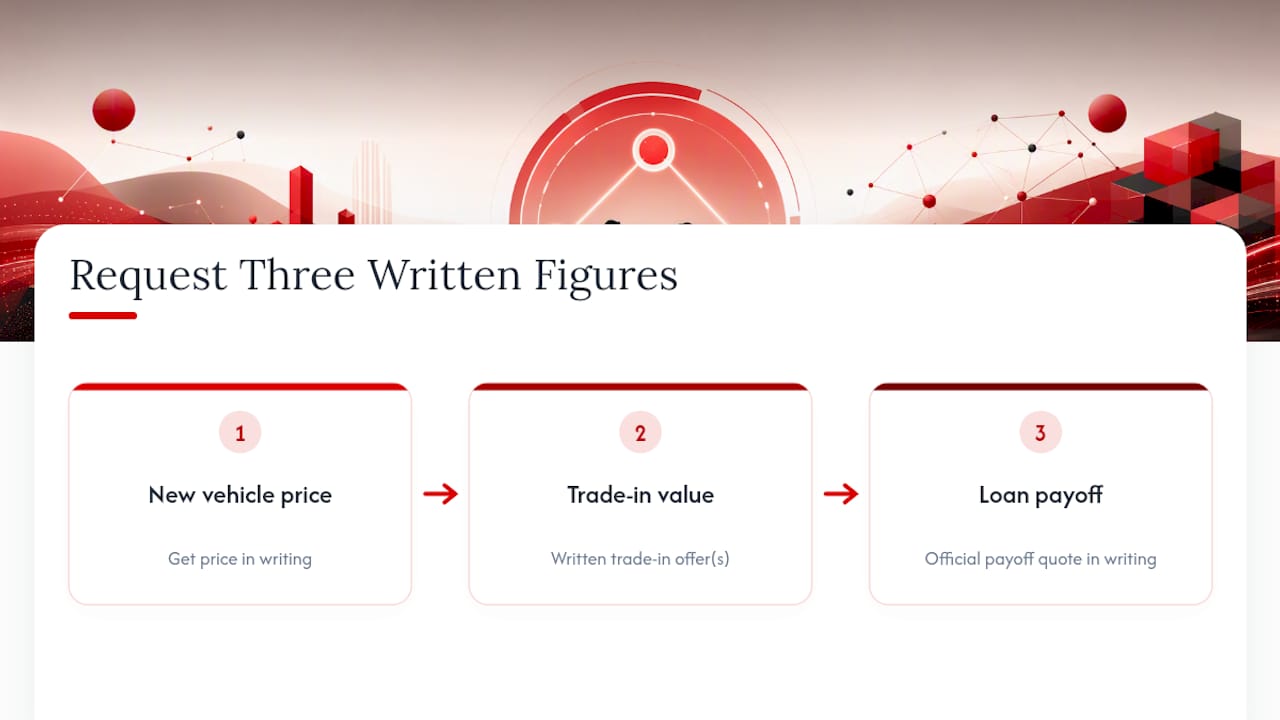
When you sit down at the negotiating table, separate the three numbers in the deal explicitly: new vehicle price, trade-in value, and your loan payoff. Dealers sometimes blend these into a single "monthly payment" conversation specifically to obscure where the negative equity is being absorbed. Ask for each number in writing, separately, before you discuss financing terms at all. If a salesperson resists breaking out the numbers, treat that resistance itself as information about how the deal is structured. Elmwoodautosalesri's guide on negotiating a trade-in offer walks through the specific language to use when a dealer tries to keep those figures blended together.
The Real Problem Isn't the Math, It's the Paperwork
Most negative equity advice online focuses heavily on the calculation, and the calculation genuinely matters. But the research behind this guide points to something conventional advice underplays: the actual risk to consumers isn't miscalculating their shortfall, it's trusting a verbal promise about how that shortfall gets handled. The FTC's own guidance exists specifically because dealers tell customers their old loan is "taken care of" while quietly folding it into the new amount financed.
That gap between what's said on the sales floor and what's written in the contract is where buyers lose real money. Getting your payoff quote right matters. Comparing NADA, Kelley Blue Book, and Edmunds values matters. But none of that protects you if you sign a contract without checking that the numbers you were told out loud match the numbers printed on the page.
Prioritize the written confirmation over everything else. Ask for the payoff figure in writing before you sign, and follow up with your old lender within two weeks to confirm it actually closed. A dealer confident in a fair deal has no reason to resist putting it on paper.
— Elmwood
Book a Trade-In Appraisal With Elmwood
Elmwoodautosalesri gives you a written trade-in offer and a transparent breakdown of exactly how any negative equity gets handled, before you sign anything. That's the concrete difference from a typical dealer visit: instead of a verbal payment number and a vague promise about your old loan, you get documentation showing the payoff amount, the trade-in allowance, and the amount financed as separate, itemized figures.
Bring your most recent loan statement and any title paperwork when you come in, and Elmwoodautosalesri's team will pull a free appraisal and walk you through your options, including whether a short paydown or a refinance makes more sense than rolling the balance into a new loan. If repairs, mileage, or an urgent need for a different vehicle have you ready to move, book a test drive and appraisal and get the numbers in writing before you decide anything.
Where to Verify Your Numbers and Rights
A few official resources are worth bookmarking before you start any trade-in conversation:
- CFPB guidance on trading in an unpaid car covers your rights and the payoff process.
- FTC's negative equity explainer breaks down how rollovers work and what disclosures dealers owe you.
- NADA's vehicle values tool, Kelley Blue Book, and Edmunds each give independent trade-in estimates worth comparing.
- Experian's guide to upside-down loans explains how refinancing and credit affect your options.
- FTC ReportFraud is where to file a complaint if a dealer misrepresents how your payoff was handled.
Sources
- Should I trade in my car if it’s not paid off? | Consumer Financial Protection Bureau
- Auto trade-ins and negative equity: When you owe more than your car is worth | FTC
- How to Trade In a Car With an Upside-Down Loan | Experian
- How to Trade in a Car with Negative Equity | Chase
- NADA consumer vehicle values
FAQ
What Is the $3,000 Rule for Cars?
There's no official rule by that name, but many buyers use it informally to mean negative equity above a certain threshold is worth pausing on. Beyond that point, paying down the balance or selling privately usually saves more money than rolling it into a new loan.
Can I Trade In My Car If I Still Owe $8,000 on It?
Yes. Your dealer pays off your loan using part of your trade-in allowance, and if the car's value is below that amount, the remaining shortfall either gets paid by you directly or rolled into your new financing.
Can I Trade In My Car With a 500 Credit Score?
It's possible, but a low credit score typically limits you to higher-APR financing and may require a larger down payment, especially if you're also carrying negative equity into the deal. Getting prequalified before visiting a dealer helps you see realistic terms upfront.
Can I Roll $20,000 of Negative Equity Into a Lease?
Most lenders and leasing programs cap how much negative equity they'll accept, and $20,000 is far above what most consider workable for a single deal. Rolling that much into a lease's capitalized cost would spike the monthly payment substantially, and a shortfall that large is almost always better handled through a paydown or private sale first.