
In most states, trading in your car reduces the sales tax you pay on your next vehicle because the dealer subtracts your trade-in value from the purchase price before calculating tax. That said, a handful of states cap the deduction, deny it altogether, or apply special rules that shrink the savings. Always ask your dealer to show you the tax computation, line by line, before you sign.
TL;DR:
- Only 28 out of 51 U.S. jurisdictions offer trade-in tax credits without restrictions, while some states cap or deny the benefit entirely.
- States like Michigan limit the deduction to a specific cap, which will be $12,000 in 2026, reducing potential tax savings on higher trade-in values.
- States that do not tax vehicle sales or exclude trade-in value from the tax base effectively eliminate the trade-in advantage, regardless of vehicle worth.
- Calculating exact tax savings requires knowing your state's sales tax rate, trade-in allowance, and any caps, to compare with private sale outcomes accurately.
- Always get written, itemized figures from the dealer, including trade-in allowance, taxable base, and applicable caps, before signing any purchase agreement.
Table of Contents
- What Is the Trade-In Tax Advantage, and How Does It Work?
- Which States Limit or Deny the Trade-In Tax Break?
- How Do You Calculate Your Actual Trade-In Tax Savings?
- Common Mistakes That Erase the Trade-In Tax Advantage
- How Elmwood Documents Trade-Ins and Verifies Your Tax Savings
- What Matters Most When You're Weighing a Trade-In
- Ready to See Your Trade-In Tax Savings in Writing?
- Sources
What Is the Trade-In Tax Advantage, and How Does It Work?
The mechanic behind the trade-in tax advantage is straightforward once you see it in writing. Instead of taxing the full sticker price of your new vehicle, most states tax only the "net price," meaning the purchase price minus whatever the dealer credits you for your trade-in.
Say a new car costs $35,000 and your trade-in is worth $10,000. In a net-price state, sales tax applies only to the purchase price minus the trade-in. At a typical rate, that difference can mean significant savings on your tax bill.
A few interactions trip people up:
- The trade-in and the purchase generally need to happen in the same transaction at the same dealer for the credit to apply.
- Manufacturer rebates typically don't reduce the taxable price the same way a trade-in does. Many states still tax the pre-rebate amount.
- Rolled-in negative equity (what you still owe on your old loan) usually gets added to your financing, not subtracted from your taxable base. It doesn't hurt you, but it doesn't help your tax bill either.
- If you own the vehicle through a business, the trade-in is treated as a separate sale and a separate purchase for federal income tax purposes, which affects gain, loss, and depreciation basis. That's a completely different calculation from state sales tax.
Here's the number that surprises most buyers: 43 of the 51 U.S. taxing jurisdictions offer some form of trade-in tax credit, but only 28 give it without strings attached. The other 15 apply conditions like caps or dealer-only requirements, and four states give no trade-in credit at all.
Which States Limit or Deny the Trade-In Tax Break?
Not every state treats trade-ins the same way, and assuming your neighbor's tax savings will match yours is a common, costly mistake.
Several states do not impose sales tax on vehicle purchases. In those states, the trade-in tax advantage does not apply since there is no sales tax to reduce. A separate group of jurisdictions collects vehicle sales tax but specifically excludes trade-in value from the calculation, so your trade-in still holds resale value but does nothing to your tax bill.
Other states cap the benefit instead of denying it outright:
- Michigan limits how much trade-in value you can deduct. The cap sits at $12,000 for 2026, with scheduled increases in later years. Trade in a $12,000 car and you get full credit. Trade in a $25,000 car and everything above the cap gets taxed anyway.
- South Carolina applies its Infrastructure Maintenance Fee with its own ceiling, which means the trade-in credit becomes largely irrelevant once you're buying a higher-priced vehicle, since the fee itself is capped regardless of trade-in value.
- Washington allows a full trade-in credit against the standard vehicle sales tax, but its luxury vehicle tax rules can interact with that credit in ways that increase total tax owed on high-value purchases. It's one of the rare cases where a trade-in can work against you.
Before you assume anything, look up the actual rule. Every state comptroller or department of revenue publishes vehicle tax guidance, and that's the only source worth trusting over a dealer's verbal promise or a forum post.
How Do You Calculate Your Actual Trade-In Tax Savings?
The formula is simple: (Purchase price − Trade-in allowance) × Sales tax rate = Tax owed. Compare that to what you'd owe without the trade-in credit, and the difference is your savings.
Before you run the numbers, get four figures from the dealer in writing: the purchase price, the trade-in allowance, your state's sales tax rate, and whether any caps apply to your trade-in amount.
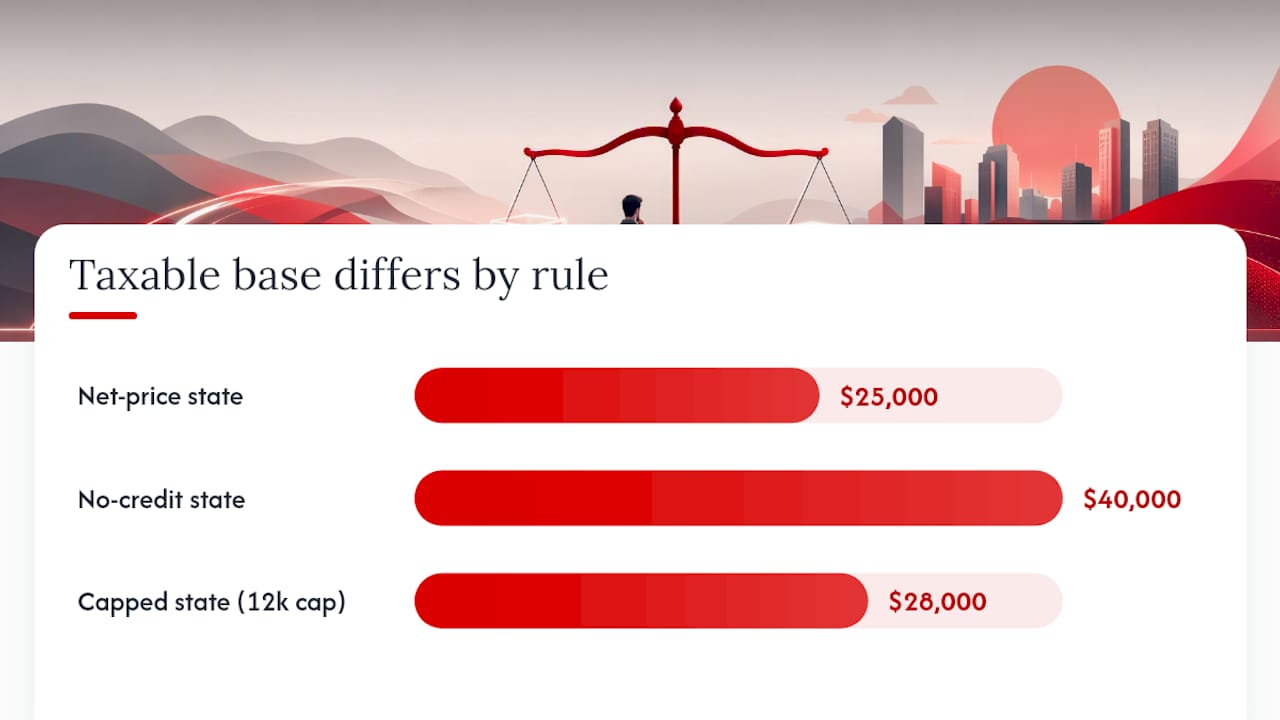
- Net-price state example. You buy a $40,000 vehicle and trade in a car worth $15,000. Your state taxes the net price, and the rate is 7%. Taxable base: $25,000. Tax owed: $1,750. Without the trade-in credit, you'd owe $2,800 on the full $40,000, a difference of $1,050 in your favor.
- No-credit state example. Same numbers, same $40,000 purchase and $15,000 trade-in, but you're in a jurisdiction that doesn't credit trade-ins against sales tax. You still owe tax on the full $40,000 at 7%, which is $2,800. The trade-in still saves you shopping time and hassle, but it saves you nothing on tax.
- Capped state example. You trade in a $20,000 vehicle in Michigan, where the deduction caps at $12,000. Only $12,000 reduces your taxable base. The remaining $8,000 of trade-in value gets taxed as if it were part of your new purchase price, even though it never should be in a true net-price system.
When you're at the finance desk, check the bill of sale for three specific line items: the stated trade-in allowance, the taxable base the tax is actually calculated on, and whether any rebate has been folded into that base incorrectly. If those numbers don't match what you were quoted verbally, ask before you sign.
Common Mistakes That Erase the Trade-In Tax Advantage
The most expensive mistake is doing the private-sale math wrong. A dealer's trade-in offer usually undercuts what you'd get selling the car yourself, sometimes because of common appraisal tactics built into the process. But once you factor in the tax savings, a lower trade-in offer can still beat a private sale, depending on your state's rate and your car's value. Run both numbers before deciding either way.

A second mistake: assuming you can sell your old car privately and still claim a trade-in credit at the dealership. In most states, the trade-in and purchase have to happen together, at the same dealer, in the same transaction. Split them, and you forfeit the tax benefit entirely, even if you get more money for the car itself.
Before you sign anything, confirm:
- You have a written trade-in offer, not a verbal estimate.
- The taxable base is shown clearly on the contract, not just the total price.
- You've checked whether your state caps the trade-in deduction.
- Rebates and trade-in credits are itemized separately, not lumped together.
Pro Tip: Before accepting a dealer's trade-in offer, calculate what a private-sale price would need to be to match the after-tax value of that offer. Divide your expected tax savings by (1 minus your state's tax rate), then add that to the dealer's offer. That's roughly the private-sale number you'd need to beat it.
How Elmwood Documents Trade-Ins and Verifies Your Tax Savings
Every trade-in at Elmwood Auto Sales starts with a written appraisal, not a verbal ballpark you have to take on faith. Because we don't run on commission-based sales tactics, our team has no incentive to obscure how the trade-in allowance affects your taxable price. We show you the computation on the contract itself.
Our trade-in offer page walks you through what to expect before you ever set foot in Providence. Combined with our inspection standards and tailored financing options, including buy-here-pay-here solutions, that transparency gives you an honest basis for comparing a trade-in against a private sale, tax implications included.
What Matters Most When You're Weighing a Trade-In
The conventional advice on trade-ins tends to stop at "you'll save on taxes," full stop. That's incomplete, and it costs people money. The real answer depends entirely on your state, your vehicle's value, and whether a cap or exception applies to your specific numbers.
What gets overlooked most often is the private-sale comparison. Buyers fixate on the tax savings and forget to check whether a stranger on Facebook Marketplace would pay enough more to offset what they'd lose on tax. Sometimes the trade-in wins outright. Sometimes it doesn't, especially in states with generous no-credit gaps between trade and sale value.
If you take one thing from this, prioritize getting the actual numbers in writing before you compare anything. Not an estimate, not a verbal quote. A contract that separates trade-in allowance, rebates, and taxable base into distinct lines. Everything else, the caps, the luxury tax quirks, the net-price formula, only matters once you have real figures to plug into it.
— Elmwood
Ready to See Your Trade-In Tax Savings in Writing?
If you're comparing a private sale against a dealer trade-in, the fastest way to know which one actually wins is to get real numbers, not guesses. Elmwood Auto Sales gives you a written trade-in offer with the tax computation shown directly on your contract, so you're not left estimating your net price after the fact.

When you book a test drive, bring your vehicle's title, registration, and loan payoff information if you're still financing it. We'll walk you through your trade-in appraisal, show you exactly how it affects your taxable purchase price, and outline financing options that fit your credit history through our online application. Run your private-sale math first if you want, then bring those numbers in and compare them against our offer side by side.
Sources
- Trade-In Tax Savings by State: Sales Tax Credit Guide (2026)
- Trade-Ins - Motor Vehicle Tax Guide - Texas.gov
- Michigan administrative rule references regarding trade-in caps
- What is the tax treatment for a business vehicle trade-in?