
Dealership reviews are a reliable pre-visit signal — but only when you read them strategically, not by star score alone. Before you visit any lot, open the dealer's Google Business Profile and scan reviews from the last 90 days. Then pull up their Better Business Bureau (BBB) record and check your state attorney general's complaint database. That two-minute check catches more red flags than any star rating.
Watch for these warning signs right away:
- A sudden cluster of 5-star reviews posted within the same week, with no transaction detail
- Repeated mentions of surprise fees, last-minute add-ons, or bait-and-switch pricing across multiple reviews
- Defensive or dismissive dealer responses that blame the customer rather than address the complaint
- A 4.0+ star average with fewer than 200 reviews on Google — use that as a minimum starting threshold, not a final verdict
Elmwoodautosalesri meets that threshold and then some, but the same checklist applies to every dealer you consider. A strong rating backed by recent, specific narratives is the combination worth trusting.
Table of Contents
- Where should you read dealership reviews first?
- How do you interpret what a review actually tells you?
- How can you spot fake or manipulated reviews quickly?
- Why does filtering reviews by department change everything?
- How should you weight reviews by recency, volume, and theme?
- What is the pre-visit checklist for choosing a dealer?
- Three review patterns and what they actually mean
- Key Takeaways
- The signal most buyers miss
- Transparent pricing and inspected vehicles at Elmwoodautosalesri
- Useful sources for your research
Where should you read dealership reviews first?
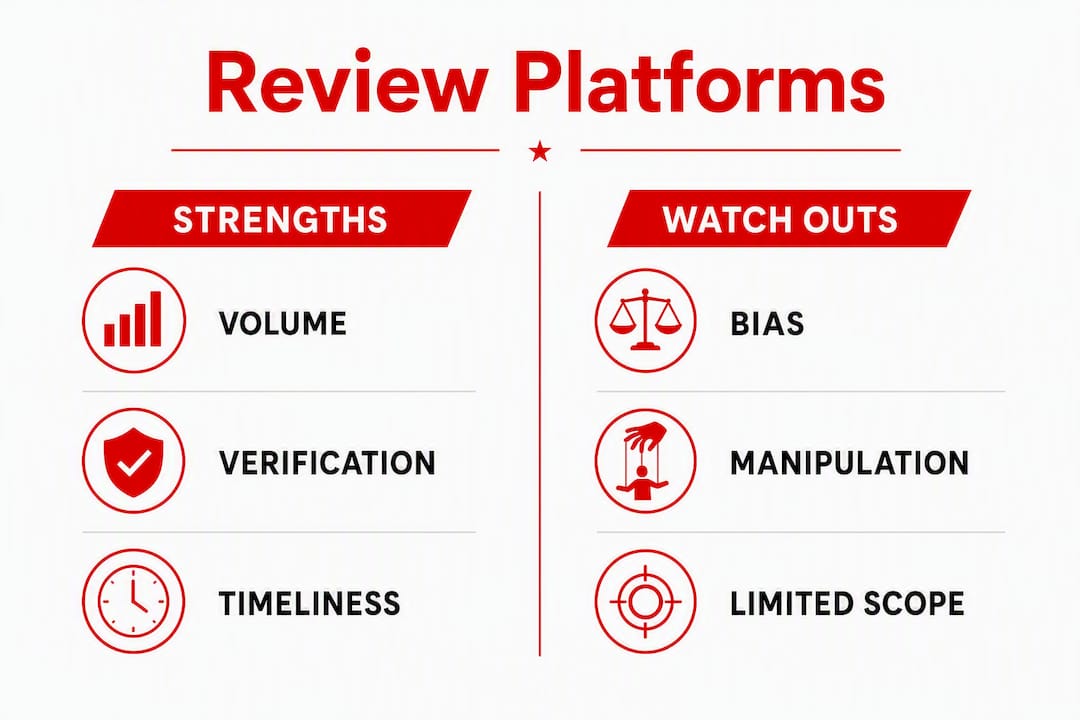
Not all review platforms show you the same picture. Each source has a distinct strength, and platform reliability varies significantly: Google typically delivers the highest volume and most recent activity, while Cars.com and Edmunds add marketplace context that helps buyers compare dealers side by side.
| Platform | Best For | Verification Approach | Watch Out For |
|---|---|---|---|
| Google Business Profile | Volume, recency, response patterns | Open platform; no purchase verification | Fake clusters; check reviewer history |
| Edmunds | Marketplace context, sales experience | Encourages verified buyers; editorial oversight | Older reviews may dominate |
| Cars.com | Sales and service combined | Open to any dealership customer | Curated dealer pages on their own site |
| AutoTrader | Inventory listings with ratings | Tied to listing activity | Thinner review counts on smaller dealers |
| CARFAX Dealer Reviews | Vehicle history context + dealer reputation | Linked to CARFAX vehicle reports | Smaller total review pool |
| DealerRater | Dealer-specific depth, staff ratings | Claims millions of reviews with fraud detection | Staff-level gaming possible |
One quick check that most buyers skip: click on a reviewer's profile before trusting their post. A Google account created last month with a single 5-star review for a dealership is a red flag. Accounts with a history of reviewing local businesses — restaurants, mechanics, shops — carry far more weight. On DealerRater, look for the "Verified Customer" badge, but still read the text for specifics.
Dealer-owned review pages are the least reliable source. Cross-check anything you read there against Google or DealerRater before drawing conclusions.
How do you interpret what a review actually tells you?
The most predictive review elements are specific transaction details: exact fees mentioned, staff names, delivery timelines, and whether the out-the-door price matched the advertised number. Verified-purchase badges, photos of invoices or work orders, and mentions of specific dates and fees materially increase a review's credibility. Generic praise, by contrast, tells you almost nothing.
Positive signals worth trusting:
- Named staff members with specific descriptions of their behavior ("Marcus walked me through every line on the contract")
- References to out-the-door pricing that matched the advertised figure
- Mentions of written commitments or documentation provided at delivery
- Honest disclosures, including minor imperfections the dealer pointed out proactively
Caution signs that should lower your confidence:
- Phrases like "great experience, highly recommend" with no supporting detail
- Multiple reviews in one week using similar sentence structures
- Repeated complaints about surprise add-ons at signing, inaccurate listing details, or long delays in title transfer
- Any pattern where the dealer's response deflects rather than resolves
Here is how the same review text reads differently depending on what you know to look for:
That review is high-signal. It names a specific vehicle, confirms mileage accuracy, references a documented fee, and gives a title timeline. Compare it to: "Amazing dealership, everyone was so friendly and helpful!" — which tells you nothing about the actual transaction.

Pro Tip: Never weight the headline star rating more than the recent narrative distribution. Read at least 10–15 reviews from the past 90 days before forming an opinion. A 4.6-star average built on reviews from three years ago may not reflect who is working the floor today.
Understanding how dealership review scores are calculated helps you put those averages in proper context.
How can you spot fake or manipulated reviews quickly?
Fake reviews follow recognizable patterns, and you can flag most of them in under 90 seconds with a few targeted checks.
Common manipulation patterns:
- Five or more 5-star reviews posted within the same 24–72 hour window
- Generic language with no vehicle type, staff name, or transaction reference
- Reviewer accounts with zero prior reviews and no profile photo
- Nearly identical phrasing across multiple reviews (copy a suspicious sentence into Google to check for exact matches on other platforms)
Quick verification checklist:
- Click the reviewer's profile — check account age and review history.
- Sort reviews by "Newest" on Google to spot temporal clustering.
- Copy a suspicious sentence into a search engine to see if it appears verbatim elsewhere.
- Count how many reviews mention a specific vehicle model or fee — low counts suggest generic seeding.
- Check whether the dealer's response rate drops sharply during the suspected fake cluster (real reviews usually get responses; planted ones often do not).
When multiple signals appear together — new accounts, identical timing, generic language, no dealer response — treat the cluster as likely manipulated. Discount those reviews entirely and focus on the remaining specific, dated narratives. Cross-referencing with a second platform like Edmunds or DealerRater usually confirms whether the pattern holds.
Why does filtering reviews by department change everything?
A dealer can be excellent at selling cars and genuinely poor at servicing them. Those are different teams, different managers, and different risk profiles depending on what you need. If you are buying and planning to use the dealer's service department for warranty work, a weak service record matters as much as a strong sales record.

Use keyword searches within review pages to isolate the experience you care about. On Google, type the dealer's name plus terms like "warranty," "loaner," "service department," "doc fee," "trade-in," or "title" into the search bar. On DealerRater, filter by department directly.
A trustworthy service review typically includes a timeline ("dropped off Monday, picked up Wednesday"), a description of what was diagnosed and repaired, and whether the loaner or shuttle policy worked as described. A service red flag sounds like: "They had my car for three weeks and never called me back" or "Warranty claim was denied without explanation."
The practical combination: strong sales reviews plus weak service reviews is acceptable only if you plan to use an independent mechanic for all post-purchase work. Understanding what the service department actually handles helps you weigh that trade-off accurately. If you are buying a vehicle with a remaining factory warranty or purchasing an extended warranty from the dealer, service reviews carry equal weight to sales reviews.
How should you weight reviews by recency, volume, and theme?
Experts recommend weighting reviews by recency: highest priority to reviews from the last 0–3 months, medium weight to reviews from 3–12 months ago, and minimal weight to anything older than 12 months. Staff turnover, ownership changes, and policy shifts happen frequently enough that a glowing review from two years ago may describe a dealership that no longer exists in the same form.
Volume matters, but it is not the whole story. In a dense metro market, a dealer with fewer than 50 Google reviews deserves extra scrutiny. In a smaller market, a dealer with 30 highly specific, recent reviews can be more trustworthy than a large group with 500 generic ones. Focus on detail and recency over raw count when the market is low-volume.
Pay close attention to bimodal distributions — many 5-star and many 1-star reviews with few in between. That pattern usually signals inconsistent processes rather than a neutral average. It means some buyers had a great experience and others had a terrible one, often depending on which salesperson or finance manager they worked with. That inconsistency is itself a risk.
When weighted signals point to repeated identical complaints — hidden fees, title delays, bait-and-switch listings — escalate to formal records. BBB grades and state attorney general complaint records reveal patterns of misconduct that review pages alone may not capture. Check your state AG's consumer protection portal alongside the BBB grade before visiting any dealer with recurring complaint themes. For more on interpreting BBB grades specifically, this breakdown of BBB ratings for car dealers is a practical reference.
What is the pre-visit checklist for choosing a dealer?
Turn your review research into a concrete workflow before you set foot on a lot.
Pre-visit steps:
- Shortlist three dealers with 4.0+ stars and at least 50 recent reviews.
- Note the top two recurring complaint themes for each dealer.
- Compare dealer response quality — do responses address the complaint specifically, or deflect?
- Prepare documentation: your trade-in title, proof of insurance, and any advertised price you plan to reference.
Live-test questions to call or message before visiting:
- "Can you send me an itemized out-the-door quote for [specific vehicle]?"
- "What is your typical timeline from signing to title transfer?"
- "How does your trade-in appraisal process work, and is the offer in writing?"
- "Will you confirm any verbal pricing commitments in writing before I sign?"
A dealer who provides a clear, prompt answer on the phone usually follows through in person. A vague or evasive response to a straightforward pricing question is itself a data point.
Walk-away criteria:
- More than two recent reviews citing last-minute fee additions at signing
- No response to any negative review in the past 90 days
- Evasion on the out-the-door quote question during your phone test
- Any open attorney general complaint filed within the past 12 months
Save screenshots of reviews that mention specific fees or commitments. If a dealer verbally matches a price you found in a review, ask for that confirmation in writing before you proceed.
Three review patterns and what they actually mean
Example A — High-signal positive review: "Picked up a 2020 Subaru Outback last Tuesday. Listed at 38,000 miles, confirmed on delivery. Finance manager showed me the full fee breakdown before I signed — $299 doc fee, nothing added. Got my title in 10 business days."
Interpretation: This review describes a complete transaction with verifiable details. The mileage claim, the specific fee, and the title timeline are all checkable. Recommended action: call the dealer and ask for the same itemized breakdown before visiting.
Example B — Low-signal suspicious cluster: "Best dealership ever! Super friendly staff, very professional, would definitely recommend to everyone!" — posted alongside six nearly identical reviews in the same week, all from accounts with no prior review history.
Interpretation: The temporal clustering and generic language are strong manipulation indicators. Discount this cluster entirely and look at reviews from outside that window. If the remaining reviews are sparse or older than 12 months, treat the dealer's reputation as unverified.
Example C — Critical review with a strong dealer response: "Service department took 10 days for a repair quoted at 3 days. No loaner offered." Dealer response: "We apologize for the delay — a parts backorder extended the timeline and we should have communicated that proactively. We've since updated our loaner policy. Please contact [manager name] directly at [contact] so we can make this right."
Interpretation: The complaint is legitimate, but the response is specific, accountable, and offers a remedy. A dealer who responds this way is practicing accountability. Follow up by calling the service department directly and asking about their current loaner policy before committing.
Key Takeaways
Reading dealership reviews strategically — prioritizing recency, specific transaction detail, and department-level signals — is more reliable than any star rating alone.
| Point | Details |
|---|---|
| Weight recency first | Prioritize reviews from the last 0–3 months; treat anything older than 12 months as low-weight background context. |
| Read narratives, not stars | Specific transaction details — fees, timelines, staff names — are far more predictive than a headline rating. |
| Filter by department | Separate sales and service reviews; a strong sales record with weak service reviews is a risk if you plan to use the dealer's shop. |
| Spot fake clusters | Flag temporal clustering, generic language, and single-review accounts; cross-check suspicious text across platforms. |
| Elmwoodautosalesri as a benchmark | Elmwoodautosalesri publishes recent, detailed customer reviews and provides transparent out-the-door pricing — apply the same checklist to confirm. |
The signal most buyers miss
Most car buyers treat a star rating as a verdict. They see 4.7 stars and stop reading. The real signal is buried in the written reviews from the last 90 days, and specifically in what those reviews do not say. A review that mentions no surprises at signing, a title that arrived on time, and a salesperson who answered questions directly — that absence of complaint is the most trustworthy pattern of all.
The department-filtering step is where most buyers leave money on the table. A dealer with outstanding sales reviews and a service department that routinely delays warranty work is not a 4.7-star dealer for someone buying a vehicle with a remaining warranty. It is a 4.7-star sales experience and a 2-star service experience, and those are two different decisions.
Dealer responses deserve more credit than they get. A response that names the customer's concern, explains what changed, and offers a direct contact is a stronger trust signal than ten generic 5-star reviews. It tells you the ownership is paying attention and willing to be held accountable publicly. Spotting an honest used car dealer comes down to exactly that kind of accountability, whether in a review response or on the lot.
Transparent pricing and inspected vehicles at Elmwoodautosalesri
Buyers who work through this checklist often ask the same question at the end: where do you actually find a dealer that holds up to this kind of scrutiny? Elmwoodautosalesri in Providence, RI is built around the exact standards this guide describes. Every vehicle goes through a thorough inspection before it reaches the lot. Pricing is transparent, with out-the-door figures provided upfront — no surprise add-ons at signing. The sales team works without commission-based pressure, which means the conversation stays focused on what fits your needs and budget.
Financing options include tailored in-house arrangements and third-party lenders, with buy-here-pay-here solutions available for buyers across the full range of credit histories. Recent customer reviews reflect the same specifics this guide tells you to look for: named staff, confirmed pricing, documented delivery timelines. Still, apply the checklist. Independent verification is always the right call — check Google, check the BBB, and run the phone test. Then schedule a test drive and see whether the in-person experience matches what the reviews describe.
Useful sources for your research
These resources cover different parts of the review-reading process. Use them in combination rather than relying on any single source.
| Source | Best Use Case | When to Open It |
|---|---|---|
| Google Business Profile | Volume, recency, response patterns | First stop — check before any other platform |
| DealerRater | Dealer-specific depth, staff-level ratings | After Google, to verify patterns and read department filters |
| Cars.com Dealer Reviews | Sales and service combined, marketplace context | Cross-check when Google reviews seem thin or clustered |
| Edmunds | Marketplace context, editorial oversight | Useful for comparing dealers side by side during shortlisting |
| BBB Dealer Records | Formal complaint history, grade transparency | When weighted review signals point to recurring misconduct |
| State Attorney General Portal | Official consumer complaints | Final escalation check before visiting a flagged dealer |
| Elmwoodautosalesri | Inspected used vehicles, transparent pricing, Providence RI | When you are ready to visit a dealer that fits the checklist |
Start with Google for volume and recency. Move to DealerRater or Cars.com to cross-check patterns. If something looks off, pull the BBB grade and your state AG's complaint records before you make the trip.