
Most auto loans run between 24 and 84 months, with some lenders offering terms as long as 96 months for special cases. The average loan term has lengthened in recent years. The tradeoff behind every one of those numbers is the same: stretch the term and your monthly payment drops, but you pay more total interest and spend longer owing more than the car is worth.
TL;DR:
- Loan terms longer than 60 months significantly increase the total interest paid, with a potential rise of nearly $8,900 compared to shorter loans.
- Many lenders now offer average new car loan terms around 69 months and used car loans close to 68 months, driven by rising vehicle prices.
- Shorter loans (24 to 36 months) tend to have lower APRs and faster equity buildup, while longer loans (72 to 84 months) often come with higher rates and larger down payment requirements.
- Choosing a stretch of more than 60 months should be done cautiously, especially with variable-rate loans, as longer durations increase exposure to interest rate fluctuations.
- Prioritizing affordable monthly payments over the shortest possible term can lead to paying more interest and being financially tied to a vehicle well past its value.
Table of Contents
- What Auto Loan Term Lengths Are Available Today?
- How Does Loan Length Change Your Payment and Total Interest?
- Short vs. Long Terms: Weighing the Tradeoffs
- How Do You Actually Choose the Right Term?
- Do Used Cars, Credit Scores, and Down Payments Change the Math?
- How Elmwood Auto Sales Helps You Choose the Right Term
- What's the Smartest Default If You're Not Sure?
- Ready to See These Numbers on a Real Car?
- Sources
What Auto Loan Term Lengths Are Available Today?
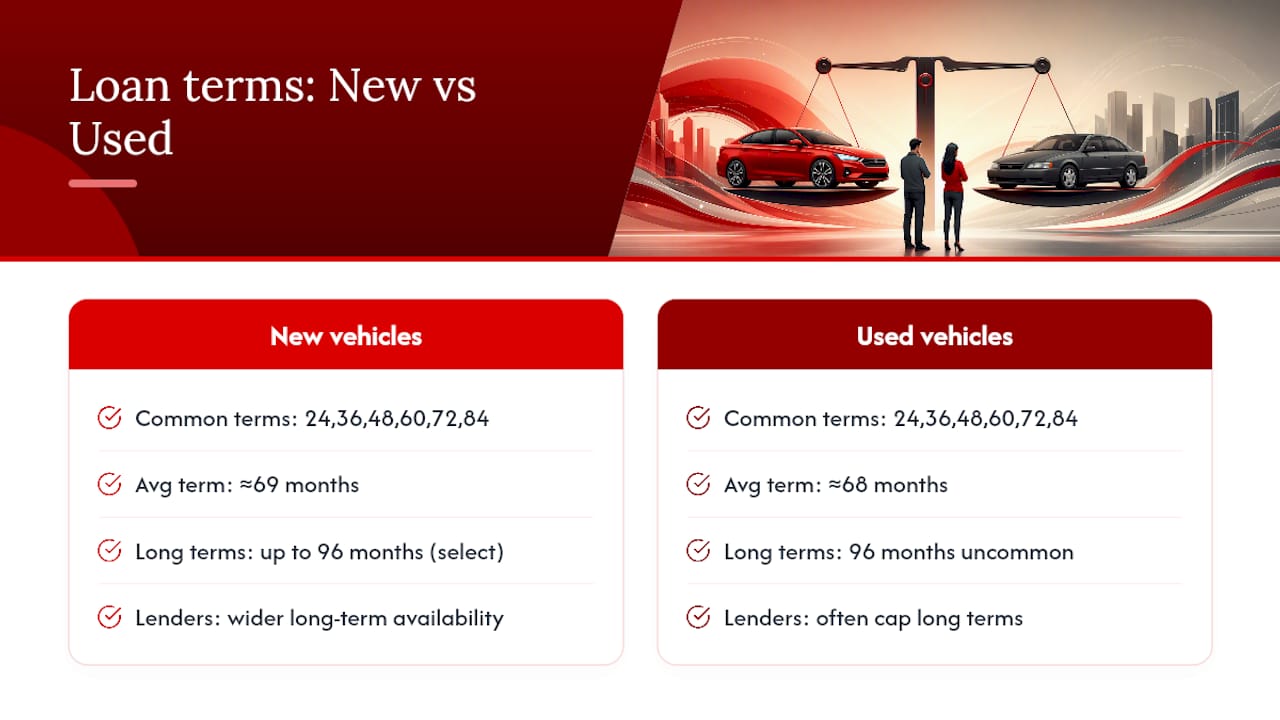
Lenders build their financing menus around a handful of standard increments, and almost every dealership or bank offers the same core set: 24, 36, 48, 60, 72, and 84 months. Some lenders offer longer terms for buyers with strong credit or larger loan amounts, occasionally extending up to 96 months, though such options are less common and come with additional considerations.
Common loan terms include 24, 36, 48, 60, 72, and 84 months. Longer terms such as 96 months are offered selectively and come with additional tradeoffs.
The center of gravity has moved firmly toward the long end of that scale. Experian's data put the average new car loan term at roughly 69 months and the average used car loan at close to 68 months, both up from where they sat just a few years ago. Vehicle prices are the main driver. When the sticker price climbs faster than paychecks, a longer term becomes the tool buyers reach for to keep payments feeling affordable. It works, but it changes the shape of the loan in ways that catch a lot of buyers off guard.
Used car buyers should also expect fewer options at the long end. Many lenders cap used vehicle terms lower than new vehicle terms, partly because older cars depreciate faster and carry more mechanical risk over a long payoff window.
How Does Loan Length Change Your Payment and Total Interest?
The math here isn't complicated, but seeing it laid out changes how most people think about their financing choice. A longer term spreads the same loan amount over more payments, so each individual payment shrinks. What doesn't shrink, and actually grows, is the total interest you hand over by the time the loan is paid off.
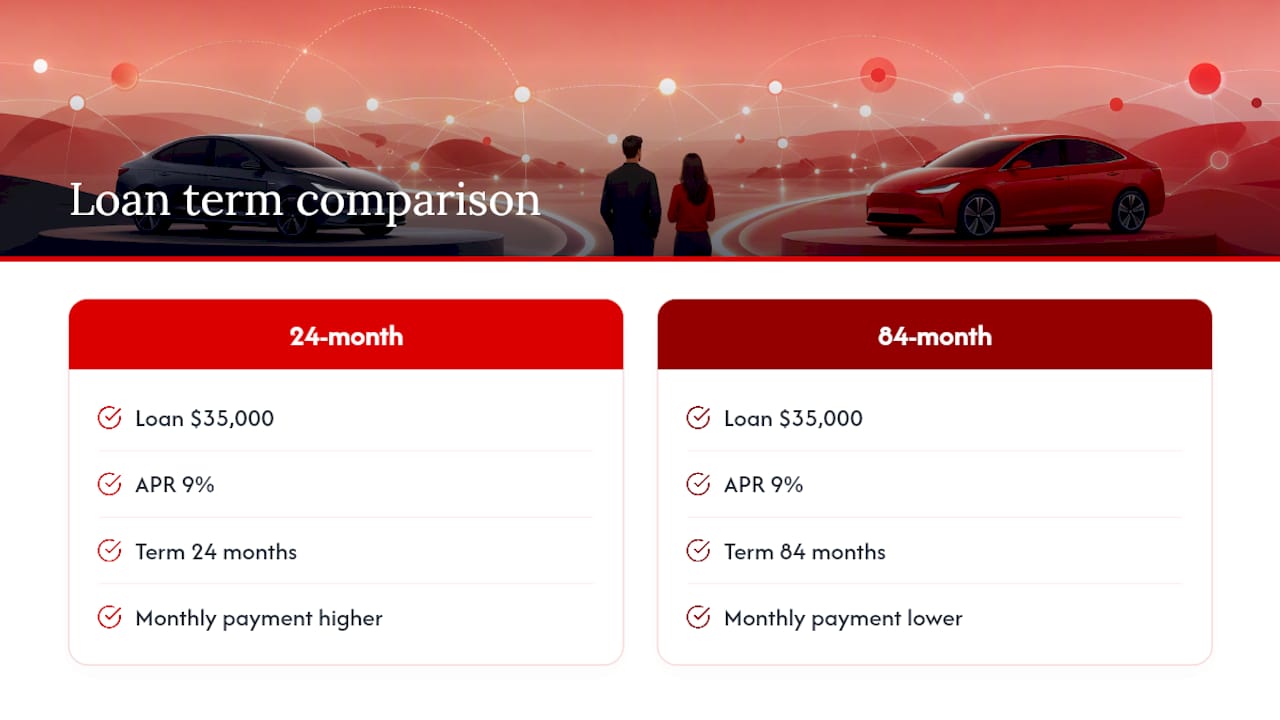
NerdWallet's example models this cleanly using a $35,000 loan at 9% APR across the standard term lengths:
The gap between the 24 month and 84 month columns is nearly $8,900 in extra interest, on the exact same loan amount and rate. That's the core mechanic of amortization: interest accrues on the remaining balance, and a longer schedule means more months where a meaningful balance is still sitting there generating interest charges. The payment gets smaller, but you're financing the car for years longer, and every one of those extra months costs you.
There's a second layer of risk worth flagging. The CFPB notes that loan term length matters even more on variable-rate loans, since a longer repayment window gives interest rate changes more time to work against you. Most auto loans are fixed-rate, but if you're offered a variable-rate product, a long term multiplies that exposure.
Short vs. Long Terms: Weighing the Tradeoffs
Every term length has a natural pull and a natural cost. Shorter terms build equity fast and close out the interest bill quickly, but they demand a payment your budget has to absorb every single month without fail. Longer terms ease that monthly pressure, but they keep you financially tied to the car for years past the point where its value has dropped well below what you owe.
A few patterns show up consistently across lenders:
- Short terms (24 to 36 months) typically carry the lowest APRs and the fastest path to full ownership.
- Long terms (72 to 84 months) often come with higher APRs than shorter terms at the same lender, since the lender is taking on more risk over more time.
- Many lenders require larger down payments before approving 72-month-plus loans. CNBC reports down payments averaging around 13% or more are common on extended terms.
- Used vehicles frequently face mileage and model-year restrictions that limit how long a term a lender will approve.
Pro Tip: If you're leaning toward a term longer than 60 months, ask about gap insurance before you sign. It covers the difference between what you owe and what the car is worth if it's totaled or stolen, which matters most in exactly the scenario a long term creates.
How Do You Actually Choose the Right Term?
Picking a term isn't about finding the lowest payment that fits your budget. It's about balancing what you can pay monthly against what the loan will actually cost you by the time it's paid off. Here's a framework that works whether you're financing through a dealership, a bank, or a credit union.
-
Set a real payment ceiling first. Look at your monthly budget and decide what you can pay without touching your emergency fund. Don't build the number around what a longer term makes possible. Build it around what's sustainable if your income dips for a month or two.
-
Model two or three term scenarios side by side. Use a monthly payment calculator to compare 48, 60, and 72 months on the same loan amount. Look at the total interest column, not just the payment column. The difference often runs into the thousands.
-
Ask the lender about prepayment penalties. Some loans let you pay extra toward principal with no fee, which means you could take a 72-month term for payment flexibility but pay it off closer to 48 months if your finances allow. Others penalize early payoff, which erases that flexibility entirely.
-
Confirm the down payment and vehicle restrictions upfront. Long terms often require larger down payments and may not be available on older or higher-mileage used vehicles. Know this before you fall in love with a specific car.
-
Watch for the red flag of a payment that only "works" because the term got longer. If a 72-month term is the only way a car fits your budget, that's usually a sign to look at a less expensive vehicle rather than a longer loan.
Before you commit, review what to know before financing a car so you're not caught off guard by add-ons or fine print during the paperwork stage.
Do Used Cars, Credit Scores, and Down Payments Change the Math?
Term length isn't a single number that applies equally to every buyer. It shifts depending on the vehicle, your credit profile, and how much cash you put down at signing.
Used cars typically come with shorter maximum terms and higher APRs than new cars. Lenders view older vehicles as more likely to need costly repairs or lose value faster, so they're more cautious about extending credit over a long window on a car that's already depreciated. A term that looks reasonable on a new SUV might not even be offered on a five-year-old sedan.
Credit tier plays a bigger role than most buyers expect. LendingTree's data shows super-prime borrowers tend to land shorter average terms, often because they qualify for rates low enough that a shorter payoff stays affordable. Borrowers in nonprime tiers frequently end up with longer terms and higher rates, a combination that compounds the total interest problem discussed earlier.
Down payment size directly affects negative equity risk, which is why it matters so much on long-term loans:
- A larger down payment shrinks the loan amount, which shrinks the total interest and speeds up the point where you owe less than the car is worth.
- Many lenders require a bigger down payment specifically to approve a 72-month-plus term, treating it as a built-in equity cushion.
- Even a modest increase in your down payment can shift you from an 84-month term down to 60 or 72 months without changing your monthly payment much.
If you take a long term now and your credit or income improves later, refinancing is a legitimate path to shorten the remaining payoff window and cut the interest you'll pay from that point forward. Avoiding common used car financing mistakes upfront makes that refinance conversation much easier down the road.
How Elmwood Auto Sales Helps You Choose the Right Term
Every vehicle at Elmwood Auto Sales passes a thorough inspection before it reaches the lot, so the term conversation starts from a car you can trust, not one hiding future repair bills. Our financing team walks buyers through multiple term scenarios side by side, showing the real payment and total interest difference before you decide, not after. For buyers with a range of credit histories, we offer tailored options including buy here, pay here financing, and we factor trade-in value and down payment directly into the numbers we show you. Our financing options guide and negative equity explainer are good starting points if you want to dig deeper before your visit.
What's the Smartest Default If You're Not Sure?
If you're torn between terms, aim for the shortest one your budget genuinely supports. That usually means 60 months or less for a new car and something shorter, often 36 to 48 months, for a used one. Get prequalified, run the payment scenarios on two or three terms, and negotiate your APR before you lock in a term length. A lower rate does more for your total cost than most people assume. Come talk to our team if you want help modeling the numbers against a specific vehicle.
— Elmwood
Ready to See These Numbers on a Real Car?
Elmwood Auto Sales is the alternative to guessing your way through a loan calculator alone. We sit down with you, run your actual numbers against a specific inspected vehicle, and show you exactly what a 48 month term costs versus a 72 month term before you sign anything.
Every car on our lot has passed a full inspection, and our financing conversations stay straightforward, no commission-driven pressure to stretch you into a longer term than you need. Whether your credit is strong or you need a buy here, pay here option, we'll walk through the real tradeoffs together. Book a test drive and financing consult and get answers on your specific numbers this week.
Sources
- What Is the Average Car Loan Length? | Experian
- Auto loan answers | Consumer Financial Protection Bureau
- What’s the Average Car Loan Length? - NerdWallet
- Average car loan length and what it means for your wallet | CNBC Select