
A responsibly structured auto loan that reports to all three major credit bureaus can materially help rebuild your credit after bankruptcy, but many offers marketed as "guaranteed" carry high APRs, steep fees, or limited bureau reporting that undercut that recovery. The core mechanism is straightforward: a secured auto loan creates a new installment account, and each on-time payment gets reported to Experian, TransUnion, and Equifax, gradually improving your payment history, which is the single largest factor in most credit scores. That's why guaranteed auto loans help bankruptcy recovery when structured correctly, and why the wrong deal can leave you paying a premium without the credit benefit you need.
Before you sign anything, confirm in writing that the lender reports positive payments to all three bureaus. A loan that only reports delinquencies, or doesn't report at all, gives you the debt without the reward.
Pro Tip: Ask every lender one direct question before discussing price: "Do you report on-time payments to Experian, TransUnion, and Equifax?" If the answer is vague or conditional, treat that as a red flag.
Quick trust signals worth verifying: written itemized fees, a clearly stated APR and loan term, and, if you are currently in Chapter 13, it's important to have documented court permission to take on new debt. Elmwood Auto Sales in Providence offers transparent, in-house and third-party financing options with no commission-based pressure, making it a practical starting point for anyone navigating post-bankruptcy financing in Rhode Island.
Key Takeaways
A properly reported auto loan is one of the most practical credit-rebuilding tools available after bankruptcy, provided you verify bureau reporting, understand the costs, and plan to refinance once your score improves.
| Point | Details |
|---|---|
| Verify bureau reporting first | Confirm in writing that the lender reports on-time payments to Experian, TransUnion, and Equifax before signing. |
| Down payment target: 10–15% or more | A larger down payment lowers your loan-to-value ratio, improves approval odds, and often reduces your APR. Buyers who save 15% or more typically receive meaningfully better terms post-bankruptcy. |
| "Guaranteed" is a marketing term | Offers using this language warrant scrutiny for high fees, short repossession cure windows, and limited reporting. |
| Refinance at 12–24 months | Consistent on-time payments over 12–24 months typically move borrowers into a better credit tier and make refinancing viable. |
| Elmwood Auto Sales | Offers transparent, itemized financing in Providence with access to credit unions and in-house options for post-bankruptcy buyers. |
Table of Contents
- How do bankruptcy-friendly auto loans actually work?
- What concrete benefits does a reported auto loan deliver?
- Why do many "guaranteed" offers deserve serious caution?
- When can you apply? Chapter 7 vs. Chapter 13 timing
- Step-by-step checklist to get a safer auto loan after bankruptcy
- Which lender types should you consider after bankruptcy?
- What do on-time payments actually do to your credit, and when should you refinance?
- Elmwood Auto Sales makes post-bankruptcy financing transparent
- What Elmwood's team has seen work for buyers rebuilding after bankruptcy
- Sources
How do bankruptcy-friendly auto loans actually work?
An auto loan is a secured debt, meaning the vehicle itself serves as collateral. If you stop paying, the lender can repossess the car. That collateral reduces the lender's risk compared to an unsecured personal loan, which is why auto financing is often the first credit product available to borrowers after bankruptcy, even before credit cards with meaningful limits.
The phrase "guaranteed approval" in auto lending rarely means what it sounds like. In practice, it usually signals conditional approval: you'll be approved if you meet income requirements, provide a sufficient down payment, and show a debt-to-income ratio the lender finds acceptable. Lenders advertising "no credit check" programs are a different category entirely, and they are frequently associated with predatory practices, very high interest rates, and large fees. Legitimate lenders, even those who specialize in post-bankruptcy borrowers, still evaluate your current income and your ability to repay.
Post-bankruptcy underwriting typically weighs five factors: steady verifiable income, debt-to-income ratio, time elapsed since discharge, the age and value of the vehicle being financed, and whether a qualified cosigner is present. The type of bankruptcy matters too, and the timing differences between Chapter 7 and Chapter 13 are covered in a later section.
Reporting practices vary significantly by lender type, and that variation directly affects how much credit-rebuilding value you get from the loan.
| Loan Type | Reports to All 3 Bureaus | Typical Down Payment | Notes |
|---|---|---|---|
| Secured auto loan (specialty/credit union) | Yes, typically | 10–15% | Best for credit rebuilding; higher APR post-bankruptcy |
| Buy-here-pay-here (BHPH) in-house financing | Inconsistent; may report only delinquencies | Varies, often higher | Easier approval but weaker credit-rebuilding value |
Buy-here-pay-here dealers often provide easy approval but may not report on-time payments to all bureaus, which makes them less effective for credit rebuilding unless the dealer explicitly confirms full positive reporting. Understanding this distinction before you walk onto any lot is one of the most practical steps you can take.
What concrete benefits does a reported auto loan deliver?
Getting a car loan after bankruptcy is possible, but the benefits depend entirely on how the loan is structured and whether it reports consistently. When it does, the advantages compound over time.
-
Rebuild payment history quickly. Payment history accounts for the largest share of most credit scores. Each on-time monthly payment adds a positive data point to your file. A new installment loan is one of the fastest credit-rebuilding tools available because it directly supplies that positive history to scoring models when payments are timely.
-
Improve your credit mix. Credit scoring models reward borrowers who manage different types of accounts responsibly. If your post-bankruptcy file consists only of a secured credit card, adding an installment loan like an auto loan broadens your mix and can lift your score independently of payment history.
-
Shorten the path to refinancing. Starting with a high-APR loan doesn't mean staying there. Borrowers who build 12–24 months of on-time payments and see score improvement can refinance into a lower-rate loan, reducing total interest paid over the life of the financing.
-
Restore practical stability. Reliable transportation affects employment, childcare, medical appointments, and dozens of other financial obligations. A dependable vehicle reduces the risk of cascading financial disruptions that can derail a recovery plan.
A realistic progression looks like this. At six months, your score may show modest improvement from consistent payments, and some lenders will begin to view you as a lower risk. At twelve months, you're approaching the threshold where refinance conversations become worth having, particularly if you've kept your credit utilization low elsewhere. At twenty-four months, a clean payment record and an aging bankruptcy notation can move you into a meaningfully better credit tier, with access to lenders and rates that weren't available at discharge.
Why do many "guaranteed" offers deserve serious caution?
The word "guaranteed" in auto financing is a marketing term, not a legal one. Offers built around that language often come with costs that can slow your recovery rather than support it.
Red flags to watch for include "no credit check" marketing, unusually high origination or administrative fees, interest-only payment structures, bi-weekly payment schedules that obscure the true APR, and lenders who don't report positive payments to the bureaus. Some post-bankruptcy loans carry origination or administrative fees that can run into the thousands of dollars, and saving a larger down payment of 15% or more improves approval odds while reducing your loan-to-value exposure and limiting how much of those fees get rolled into the financed amount.
Deep-subprime auto loan APRs, which apply to borrowers with severely damaged credit, can reach well into the double digits. At those rates, a modest loan balance generates substantial interest charges over a 48- or 60-month term. The total cost of the vehicle can end up far exceeding its market value, which is a real problem if you need to sell or trade in before the loan is paid off.
Pro Tip: Before signing, request a written itemized fee schedule and a sample final contract. If a dealer or lender refuses to provide either, that refusal is the clearest signal to walk away.
Predatory BHPH operations tend to share a recognizable pattern: the vehicle is priced above market, the APR is high, the repossession cure window is unusually short (sometimes as little as a few days after a missed payment), and reporting to the bureaus is either absent or limited to negative entries. Lenders advertising "guaranteed" or "no credit check" programs are worth scrutinizing against all of these criteria before you commit. For a deeper look at how to spot problematic clauses in financing documents, the consumer protection guide for auto buyers covers your rights in detail.
When can you apply? Chapter 7 vs. Chapter 13 timing
Timing affects both your eligibility and the terms you'll receive, and the two main bankruptcy chapters work differently.
Chapter 7 discharges most unsecured debts and typically concludes about four months after filing. Once you receive your discharge, most lenders will consider your application. Waiting a few additional months after discharge, rather than applying immediately, can help: the bankruptcy notation is still recent, but you have a small window to establish other positive account activity and save a larger down payment, both of which improve your terms. A bankruptcy can remain on your credit report for 7–10 years, but lenders weigh recent payment behavior more heavily as time passes, so the notation's practical impact on your rate diminishes steadily.
Chapter 13 is a multi-year repayment plan, typically three to five years. Taking on new debt while your plan is active generally requires court approval or a modification to the plan. Skipping that step can jeopardize your bankruptcy case. Always speak with your bankruptcy attorney before applying for any new credit while a Chapter 13 plan is active, and document any court permission you receive in writing before approaching a lender.
Why waiting helps in both cases: older bankruptcy notations carry less scoring weight, and a longer positive payment track record gives you more leverage when refinancing. Borrowers who apply the day after discharge often pay significantly higher rates than those who wait six to twelve months and build even a thin positive file first. After discharge, credit unions, specialty lenders, and online sellers are among the most accessible options, and each has different timing flexibility.
Step-by-step checklist to get a safer auto loan after bankruptcy
Following a structured approach before you apply reduces both the cost of the loan and the risk of a predatory deal. These steps work whether you're approaching Elmwood Auto Sales, a credit union, or an online marketplace.
-
Check and correct your credit reports. Pull free reports from all three bureaus. Reviewing and disputing errors after bankruptcy is a critical early step, since some discharged debts still appear incorrectly as unpaid and drag your score down.
-
Save a meaningful down payment. Target 10–15% of the vehicle's purchase price at minimum. A larger down payment lowers your loan-to-value ratio, reduces the amount you finance, and signals financial stability to lenders.
-
Gather proof of steady income. Recent pay stubs, bank statements, or tax returns demonstrate your ability to repay. Calculate your debt-to-income ratio before applying so you know where you stand.
-
Seek soft prequalification from multiple lenders. Using an online loan marketplace lets you compare offers and preview rates without hard credit inquiries that lower your score. Shop at least three lenders before committing.
-
Confirm bureau reporting in writing. Ask directly: "Do you report on-time payments to Experian, TransUnion, and Equifax?" Get the answer in writing before you proceed.
-
Request an itemized fee estimate and a sample contract. Review origination fees, administrative fees, and any add-on products before you're at the signing table.
-
Consider a well-qualified cosigner. Adding a cosigner with strong credit is one of the most effective levers for lowering your APR and improving approval odds. Make sure the cosigner understands their full liability.
-
Plan to refinance. Enter the loan with a refinance target in mind. Once you've built 12–24 months of on-time payments and your score improves, refinancing can reduce your rate and total interest cost substantially.
Questions to ask any lender or dealer:
- Do you report to all three bureaus?
- What fees will I pay at signing, itemized?
- What is the repossession cure period?
- Can I prequalify with a soft pull?
- Are there prepayment penalties?
For a full breakdown of what to prepare before applying, the car financing checklist covers documents and key decision points in detail.
Which lender types should you consider after bankruptcy?
Not every lender is the right fit for every borrower, and the right choice depends on your priorities: rebuilding credit as fast as possible, minimizing cost, or securing a vehicle quickly.
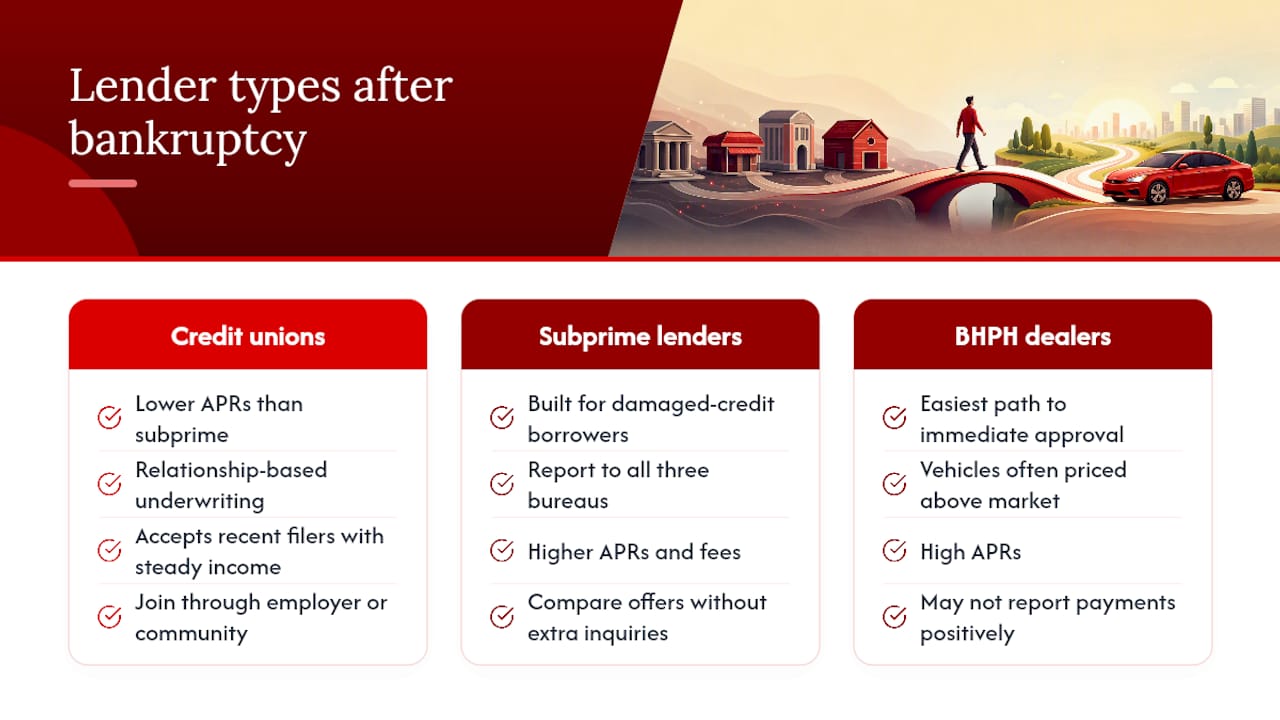
Credit unions typically offer lower APRs than specialty subprime lenders and take a more relationship-based approach to underwriting. If your income is steady and your discharge is recent, a credit union that you already belong to, or one you can join through an employer or community affiliation, is worth approaching first. They may accept recent bankruptcy filers when income is solid. Elmwood Auto Sales works directly with local credit unions and can help facilitate that connection for Providence-area buyers.
Specialty subprime lenders and online marketplaces are built specifically for damaged-credit borrowers. They typically report to all three bureaus, which makes them genuinely useful for credit rebuilding, but they charge higher APRs and fees to offset their risk. Shopping multiple lenders through an online marketplace is a practical way to compare these offers side by side without multiple hard inquiries. For a broader view of financing types, the types of car financing options guide explains how each product is structured.
Buy-here-pay-here (BHPH) dealers offer the easiest path to immediate approval, which matters when you need transportation urgently. The trade-offs are real, though. Vehicles are often priced above market, APRs tend to be high, and BHPH dealers sometimes report only delinquencies or don't report at all, which makes BHPH financing a poor credit-rebuilding tool unless the dealer explicitly confirms full positive reporting to all three bureaus. If you go this route, get that reporting confirmation in writing.
Pro Tip: Before finalizing any loan, ask whether the lender allows early payoff without a prepayment penalty. If you plan to refinance in 12–24 months, a prepayment penalty can eliminate the savings you'd gain from the lower rate.
What do on-time payments actually do to your credit, and when should you refinance?
Credit scoring models treat payment history as the dominant factor in your score. Each month you pay on time, that positive data point is added to your file at all three bureaus, and the cumulative effect builds over time. The bankruptcy notation doesn't disappear, but its weight in scoring decreases as your recent history grows cleaner.

Here's a realistic milestone framework, keeping in mind that individual results vary based on starting score, total debt load, and other account activity:
| Milestone | Typical Outcome | Action to Consider |
|---|---|---|
| 6 months of on-time payments | Modest score improvement; bankruptcy notation still prominent | Review credit reports for accuracy; maintain low utilization on any other accounts |
| 12 months of on-time payments | Meaningful score gains; some lenders begin offering better terms | Start shopping refinance offers; check credit score tiers to understand your new tier |
| 24 months of on-time payments | Significant improvement; bankruptcy notation aging; refinance often viable | Refinance if rate improvement is material; consider applying for other credit products |
Refinancing within 12–24 months is a common pathway to reduce total interest expense once consistent payments and other credit improvements move a borrower into a better scoring tier. The practical trigger for shopping refinance offers is a combination of score improvement and at least 12 months of clean payment history on the current loan. When you're ready to check where you stand, pull a soft-inquiry rate quote from at least two lenders before committing to a refinance application.
Elmwood Auto Sales makes post-bankruptcy financing transparent
Rebuilding credit after bankruptcy requires a lender who is upfront about fees, reporting, and terms from the first conversation. Elmwood Auto Sales in Providence does exactly that: no commission-based sales pressure, itemized financing disclosures, and access to both in-house and third-party lenders, including local credit unions, so you can compare real options rather than accept the first offer on the table.
Every vehicle on the lot goes through a thorough inspection before it's offered for sale, which means you're not taking on a reliability risk on top of a financial one. Elmwood's team can walk you through preapproval options, explain exactly what your loan will report to the bureaus, and, for Chapter 13 filers, help you understand what documentation you'll need before approaching a lender. Providence and surrounding Rhode Island communities are the focus, and the consultations are genuinely low-pressure.
Schedule a test drive or financing consultation to review a real, itemized offer and ask every question on your checklist in person.
What Elmwood's team has seen work for buyers rebuilding after bankruptcy
Transparency about bureau reporting is the single issue that separates a useful loan from an expensive one. When a buyer comes in after bankruptcy, the first thing worth confirming is whether the financing being offered reports positive payments to all three bureaus. Without that, the monthly payment builds no credit history, and the buyer is essentially renting money at a high rate with nothing to show for it on their credit file.
A larger down payment changes the conversation in two ways. It lowers the loan-to-value ratio, which reduces lender risk and often translates directly into a lower APR offer. It also reduces the financed amount, which means less total interest paid even if the rate stays the same. Buyers who arrive with 15% or more saved tend to leave with meaningfully better terms than those who put down the minimum.
Predatory clauses in financing contracts are often buried in the fine print. Short repossession cure windows, mandatory arbitration clauses that limit your legal options, and add-on products rolled into the loan without clear disclosure are the ones to watch for. Elmwood reviews every contract with buyers before signing, so nothing gets missed.
Sources
The following sources were used to build this article and are worth bookmarking for your own research:
- Getting a loan after bankruptcy | SoFi Learn
- Getting a car loan after bankruptcy: what to expect | Bankrate
- Can I get a car loan after bankruptcy? | Experian
- Getting a car loan after Chapter 7 or Chapter 13 bankruptcy | LendingTree
- Can I get a car loan after bankruptcy? | NerdWallet
- Can I get a car loan after bankruptcy? | Capital One Cars (learn center)
This article is general information, not a substitute for advice from a qualified financial advisor. Consult a qualified financial professional about your own circumstances before acting on anything here.