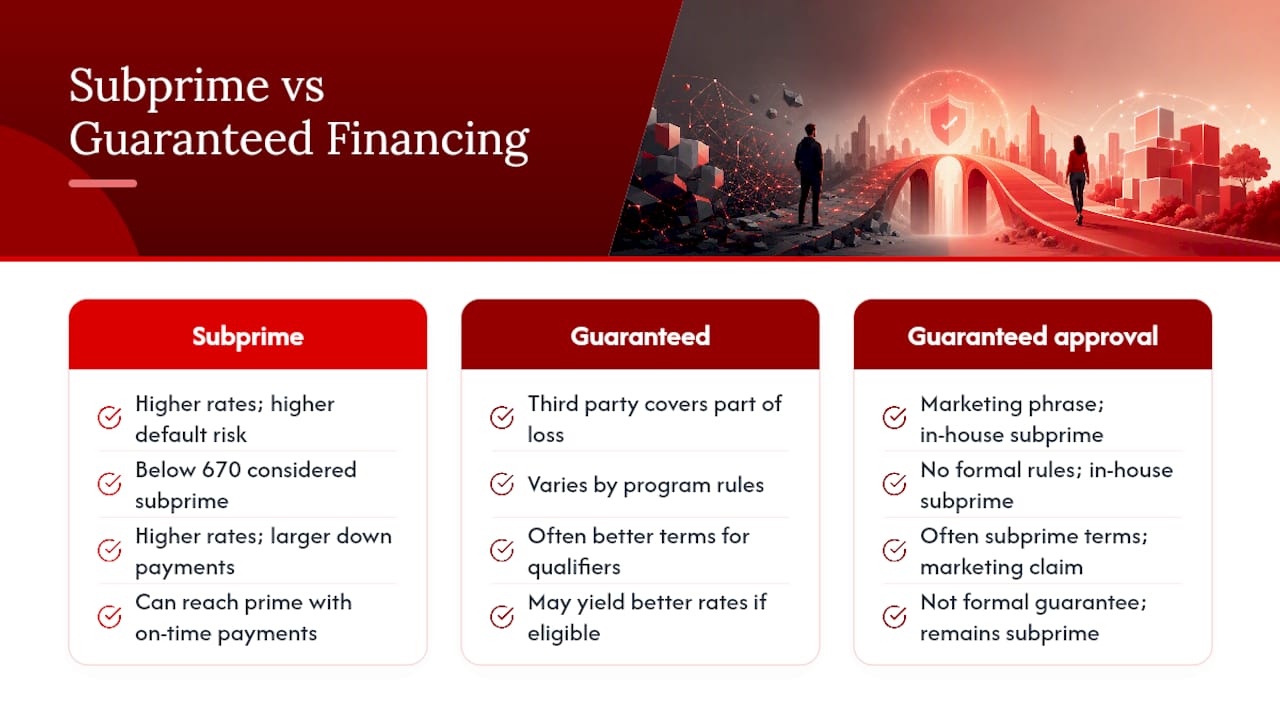
The core difference comes down to who takes on the risk. Subprime financing means a lender charges you more because your credit profile signals a higher chance of default. Guaranteed financing means a third party, often a government agency, agrees to cover part of the lender's loss if you can't pay, which lowers the lender's risk and can open the door to better terms.
Here's the one-line takeaway: guarantee programs like those from the Small Business Administration or USDA Rural Development can reduce cost and risk for qualified borrowers, while subprime products give you access to credit but almost always at a steeper price. Below, we walk through the score ranges that separate these categories, what each option actually costs, and how this plays out when you're standing on a car lot trying to figure out which financing offer makes sense.
Key Takeaways
Subprime financing prices risk into a higher rate, while guaranteed financing shifts risk to a third party and often lowers cost for borrowers who qualify.
| Point | Details |
|---|---|
| Core distinction | Subprime means risk-based pricing for higher-risk borrowers; guaranteed financing shifts risk to a backing agency. |
| Score thresholds matter | FICO scores below 670 generally fall into subprime territory, with under 620 facing the steepest rates. |
| Compare total cost | Always calculate total interest and fees over the full term, not just the monthly payment. |
| Watch the marketing language | "Guaranteed approval" ads usually mean in-house subprime financing, not a formal government guarantee. |
| Elmwood works with all credit profiles | Elmwood Auto Sales offers inspected vehicles and tailored financing, including buy here, pay here, for a range of credit histories. |
Table of Contents
- What Is Subprime Financing?
- What Does Guaranteed Financing Mean?
- What Fico Score Counts as Subprime?
- How Do Lenders Set Rates for Each Option?
- Subprime vs Guaranteed Financing Side by Side
- Which Option Fits Your Situation?
- How This Plays Out When Buying a Car
- Getting Financing at Elmwood Auto Sales
- Where to Verify These Details
- Frequently Asked Questions
- Sources
What Is Subprime Financing?
Subprime financing is credit extended to borrowers with lower credit scores, thin credit files, or recent negative marks like late payments or a bankruptcy. Because lenders view these borrowers as statistically more likely to default, they price the loan higher to offset that risk. This is called risk-based pricing, and it shows up in nearly every corner of consumer lending, from auto loans to mortgages to personal loans.
Subprime loans typically share a few traits:
- Higher APRs than prime borrowers receive for the same loan type
- Larger down payment requirements on secured loans, sometimes 10% to 25% for auto or mortgage products
- Stricter repayment terms and more fees built into the contract
- Shorter grace periods and steeper penalties for missed payments
The gap in cost can be dramatic. Subprime auto loan rates can run significantly higher than what super-prime borrowers pay, and subprime mortgages often ask for down payments of 25% or more, compared to as little as 3% for prime buyers.
Pro Tip: Don't judge a loan by its monthly payment alone. Multiply the payment by the number of months, then subtract the loan amount. That's your total interest cost, and it often tells a very different story than the payment on the sticker.
What Does Guaranteed Financing Mean?
A loan guarantee means a third party, usually a government agency, promises to repay a lender some or all of the outstanding balance if the borrower defaults. That guarantee changes how lenders behave. Because their downside risk shrinks, they can extend financing to borrowers or projects they might otherwise turn away, often with more competitive terms.
Three programs illustrate how this works in practice:
- USDA Section 502 Guaranteed Loan Program: Helps eligible rural households get up to 100% mortgage financing by having USDA back the loan note.
- SBA loans: Guarantee a portion of small-business loans, which gives lenders confidence to offer longer terms and more flexible collateral requirements.
- EXIM (Export-Import Bank): Guarantees up to 85% of certain transactions, letting lenders finance foreign buyers of U.S. capital goods.
Guarantees usually come with real limits: a capped percentage of loss covered, defined eligible uses, and specific borrower or business qualifications you have to meet.
"Guaranteed approval" in a dealership ad and a formal government guarantee are not the same animal. One shifts risk to a federal agency with rules and oversight. The other usually just means the seller will finance you in-house, often at a subprime rate, regardless of your credit history.
That distinction matters when you're comparing offers, because the word "guaranteed" gets used loosely in retail marketing in a way it never is in SBA or USDA paperwork.
What Fico Score Counts as Subprime?
Credit scoring models draw fairly consistent lines. FICO guidance commonly places borrowers below 670 in subprime territory, with prime generally starting at 670 and climbing from there.
A rough breakdown looks like this:
- Super-prime: 720 to 850, the best rates available
- Prime: 660 to 719, solid terms with modest rate premiums
- Near-prime: 620 to 659, a transitional zone with mixed pricing
- Subprime: below 620, higher rates and larger down payments across most loan types
Here's where it gets practical: an auto lender and a mortgage lender don't apply these bands identically. A borrower with a 640 score might get a reasonable auto loan rate but land squarely in subprime territory for a mortgage, where underwriting standards run tighter. If you're not sure where you stand, pull your score through a free annual credit report or a service like myFICO before you shop, so you're not caught off guard at the finance desk.
How Do Lenders Set Rates for Each Option?
Risk-based pricing runs on a formula. Lenders weigh your credit score, income, debt-to-income ratio, and any collateral you're offering, then set the rate accordingly. The lower your perceived risk, the less you pay, and guarantees factor into that calculation the same way a high score does. They tell the lender someone else has your back.
The spread between prime and subprime pricing can be enormous. Subprime auto rates have been reported to exceed 29% in some cases, a figure that would sound absurd to a prime buyer paying half that or less.
When you're comparing loan offers, look past the monthly payment and check:
- The APR, not just the interest rate
- Total interest paid over the full term
- Down payment or collateral required
- Prepayment penalties
- Late fees and how they compound
Pro Tip: A longer loan term shrinks your monthly payment but stretches out interest charges. Run the total cost at 48, 60, and 72 months before you sign anything. The difference in total interest paid can be substantial, even when the monthly number looks manageable.
Subprime vs Guaranteed Financing Side by Side
Once you line the two up across the factors that actually matter, the trade-off becomes clear.
| Factor | Subprime Financing | Guaranteed Financing |
|---|---|---|
| Interest rate / APR | Higher, sometimes significantly above prime rates | Often lower, since lender risk is reduced |
| Credit-score thresholds | Often below 620 | Varies by program; some accept lower scores with other qualifying factors |
| Who bears the risk | Lender absorbs risk, priced into the rate | Third party (government agency) covers a share of losses |
| Common loan types | Auto, mortgage, personal, in-house dealer loans | Mortgages (USDA), small-business loans (SBA), trade finance (EXIM) |
| Down payment / collateral | Often 10% to 25% or more on secured loans | Can be very low for eligible USDA borrowers |
| Fees and penalties | Higher fees, stricter prepayment penalties | Program fees exist but are typically standardized and disclosed |
| Best for | Borrowers who need access now despite credit challenges | Borrowers or businesses who meet program eligibility and want lower long-term cost |
The practical trade-off: subprime financing buys you access today, while guaranteed financing buys you lower cost tomorrow, if you qualify for it.
Which Option Fits Your Situation?
Subprime financing tends to be the realistic option if you have a recent bankruptcy, a thin credit file, or a score that hasn't recovered from a rough financial stretch. Guaranteed programs work better when you meet specific eligibility rules, like buying a home in an eligible rural area under USDA Section 502 or running a small business that qualifies for an SBA-backed loan.
Watch for these red flags before you sign anything:
- "Guaranteed approval" ads with no APR listed anywhere
- Payments quoted without a total cost or amortization schedule
- Prepayment penalties disguised in dense fine print
- Pressure to sign the same day without time to compare offers
Before committing to any loan, ask the lender these questions:
- What is the total cost of this loan, not just the monthly payment?
- Who guarantees or backs this loan, if anyone?
- What documentation do you need from me, and why?
- What alternatives exist if I don't qualify for your best rate?
How This Plays Out When Buying a Car
Picture three financing paths for the same used car. A buy-here-pay-here dealer offers in-house financing regardless of credit, but the rate reflects subprime risk pricing and the down payment tends to run higher. A bank or credit union offers a prime loan to a borrower with strong credit, usually at a noticeably lower APR and with less cash due upfront. A dealer working with outside lenders may arrange a guaranteed or near-prime offer for buyers who fall in between.

The differences show up in the paperwork: down payment size, loan term length, and how much documentation the lender wants to verify income and residency.
Pro Tip: Before you agree to anything, ask for a written amortization schedule that breaks down every payment. Compare the total financed amount and the APR together, not the monthly payment in isolation. For a deeper look at how this works, our guide on how dealer financing works walks through the mechanics step by step.
What a Finance Advisor Wants You to Know
Buyers with credit challenges deserve the same clarity as anyone else. When I walk someone through their options, I compare total cost side by side, not just the payment that fits their budget, and I push for preapproval shopping before they walk into any lot. On-time payments on a subprime loan can rebuild your credit over time, but only if the rate doesn't strangle your budget first. That's the trap worth avoiding.
Getting Financing at Elmwood Auto Sales
Elmwood Auto Sales works with buyers across the credit spectrum, not just those with pristine scores. We don't run on commission-based sales tactics, so the financing conversation stays focused on what actually fits your budget rather than what earns someone a bigger check. Every vehicle on our lot goes through a thorough inspection before it's offered for sale, and our tailored financing options, including buy here, pay here solutions, are built for buyers who might not qualify for a traditional bank loan.
If you're ready to see where you stand, two paths make sense. Get preapproved so you know your rate range before you fall in love with a car, or come see the inventory in person. Our team works behind the scenes with multiple lender options to find terms that fit your situation, whether that means a near-prime rate or a straightforward in-house plan. You can book a test drive today and talk financing face to face, no pressure attached.
Where to Verify These Details
Program rules and score guidance change, so it's worth confirming specifics directly with the source before you sign anything.
- USDA Section 502 Guaranteed Loan Program: Official terms for rural mortgage guarantees.
- SBA Loans: Current eligibility rules and loan program details for small businesses.
- EXIM Loan Guarantee: Terms for export financing guarantees.
- Experian's subprime borrower guide: Plain-language score guidance and consumer tips.
- CFPB subprime mortgage explainer: Consumer protection context for mortgage borrowers.
Frequently Asked Questions
What is subprime vs guaranteed financing in simple terms?
Subprime financing charges higher rates reflecting the borrower's higher perceived default risk. Guaranteed financing involves a third party, often a government agency, agreeing to cover part of a lender's loss, which may result in better terms for qualifying borrowers.
What FICO score is considered subprime?
Most lenders and credit bureaus treat scores below 670 as subprime, with scores under 620 typically facing the highest rates and largest down payment requirements.
Are guaranteed approval offers the same as guaranteed financing programs?
No. "Guaranteed approval" is a marketing phrase that usually signals in-house subprime financing with no formal risk-sharing agency involved. Programs like SBA or USDA guarantees involve a documented third-party guarantee with specific eligibility rules.
Can subprime borrowers eventually qualify for prime rates?
Yes, consistent on-time payments over time can rebuild a credit profile enough to qualify for better rates on future loans. It requires affording the higher subprime payments in the meantime without missing due dates.
Does a guaranteed loan mean lower interest for the borrower?
Often, yes, because the lender's risk is reduced by the guarantee. But guaranteed doesn't automatically mean cheap. Rate still depends on the specific program, the borrower's qualifications, and current market conditions.
This article is general information, not a substitute for advice from a qualified financial advisor. Consult a qualified financial professional about your own circumstances before acting on anything here.
Sources
- What is the difference between a prime loan and a subprime loan? | Experian
- Single Family Housing Guaranteed Loan Program | Rural Development
- Loans | U.S. Small Business Administration
- Loan guarantee | EXIM
- Prime vs. Subprime Loans: How Are They Different? | myFICO