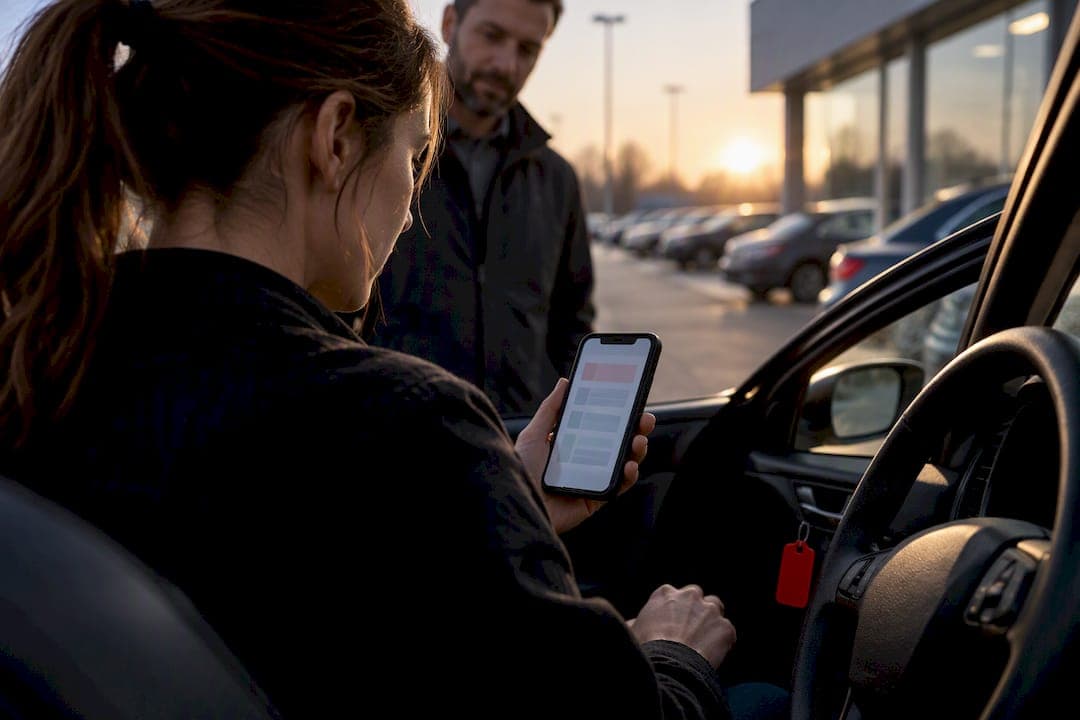
Start with the engine cold. Confirm it hasn't been warmed up before you arrived, listen for rough idle or smoke on startup, then take the car on a planned drive of at least 30 minutes across varied roads. Before that, check the VIN against the title and ask the seller directly about the cold start. After the drive, pull a vehicle history report, run an NHTSA recall check, and book an independent pre-purchase inspection before you sign anything.
TL;DR:
- A cold-start engine check is crucial to identify hesitation, smoke, or oil issues that could signal major internal problems before further inspection.
- You should confirm that the seller allows independent inspections and ask about the vehicle’s trim, engine, and test drive conditions upfront.
- Inspect the exterior for mismatched paint, uneven panel gaps, and signs of previous damage or flood exposure to uncover possible structural or water-related issues.
- During the drive, listen for unusual noises, check steering and braking response, and evaluate noise levels with the radio off to detect hidden mechanical problems.
- Always review the vehicle history report, check for open recalls, and get a mechanic’s detailed pre-purchase inspection to verify the car's safety and condition before buying.
Table of Contents
- How to Prepare Before Your Used Car Test Drive
- Exterior Inspection: What to Check Before You Turn the Key
- What Should You Check Inside a Used Car Before Driving?
- Engine Bay and Cold-Start Checks That Reveal Hidden Problems
- On-Road Test Protocol: Maneuvers, Roads, and What to Listen For
- Red Flags, Vehicle History, and What Comes After the Drive
- Elmwood's Perspective: Transparent, Mechanic-Grade Test Drives
- Book a Transparent Test Drive at Elmwood
- Sources
- FAQ
How to Prepare Before Your Used Car Test Drive
A used car test drive works best when you've done the boring parts first. Bring your driver's license (most sellers require it before handing over keys), your phone with a notes app or checklist ready, and if possible, a friend or a mechanic you trust who can ride along and catch things you might miss.
Before you arrive, ask the seller three things: whether you can drive the car alone or with your own mechanic, whether they'll allow an independent pre-purchase inspection afterward, and what trim and engine the car actually has. A seller who hedges on any of those questions is telling you something.
Plan your route in advance rather than winging it. You want:
- A parking lot or quiet side street for slow-speed maneuvers
- A stretch of rough or patched pavement to test the suspension
- A highway on-ramp for sustained speed and passing power
If you're comparing multiple cars, schedule them back to back on the same day. Driving two or three vehicles within a few hours makes differences in ride quality and noise far easier to notice than if you drive them a week apart.
Exterior Inspection: What to Check Before You Turn the Key
Walk the car in daylight before you ever sit in it. Cosmetic details often point to mechanical or structural history that a seller won't volunteer.
- Check panel gaps and paint match. Uneven gaps between doors, hood, and fenders, along with slightly mismatched paint color between panels, often signal prior collision repair. A small magnet run along a fender or door (fiberglass body filler won't hold a magnet the way steel does) can reveal hidden bodywork.
- Inspect the tires. Look at brand consistency across all four (mismatched brands can mean a tire was replaced after damage), tread depth, and wear patterns. Uneven wear on one side often points to alignment or suspension problems.
- Look underneath. Get low and check for fluid drips, fresh undercoating in only one spot, or visible welding that looks newer than the rest of the frame.
- Search for water damage clues. Water lines inside the wheel wells, rust in unusual spots, or a musty smell near the trunk seal can indicate flood exposure, which is a much bigger problem than it sounds.
These cosmetic signals matter because uneven panel gaps and mismatched paint often trace back to deeper structural or flood-related issues that a quick glance from inside the car would never catch.
What Should You Check Inside a Used Car Before Driving?
The cabin tells you almost as much as the engine bay. Before you pull out of the driveway, run through these checks:
- Turn on the heat and the air conditioning, both at idle and again once you're moving, since a compressor can sound fine parked but struggle under load.
- Pair your phone with the infotainment system and confirm the touchscreen, backup camera, and radio all respond normally.
- Take a slow breath in. A musty or heavily perfumed smell (air fresheners are sometimes used to mask mildew) is one of the clearest signs of past water damage.
- Adjust the driver's seat, check sightlines out the mirrors and rear window, and if you have kids, test whether a car seat actually anchors properly in the back.
- Flip through dash warning lights during startup, buckle every seat belt, and test power windows and locks one by one.
Odor is worth taking seriously. A strong or persistent smell in the cabin often points to a source you can't see, whether that's mildew trapped in the carpet padding or an electrical short you'd rather not inherit.
Engine Bay and Cold-Start Checks That Reveal Hidden Problems
This is the step most buyers skip, and it's the one that separates a real inspection from a quick glance under the hood. Ask the seller not to start the car before you get there.
- Confirm the hood is cold to the touch and the engine has not been running.
- Have the seller start it while you stand outside the car and watch the exhaust and listen to the idle. A cold start often exposes rough idle, hesitation, or smoke that a pre-warmed engine will hide completely.
- Check the oil dipstick for color and texture. A milky or frothy appearance suggests coolant mixing with oil, a sign of a serious internal problem.
- Look at belts and hoses for cracking, check the battery terminals for corrosion, and scan the ground and engine block for fresh leaks.
- Squeeze the CV boots near the front wheels; grease residue or visible tears mean a repair is coming soon.
Pro Tip: If the seller insists on starting the car before you arrive "just to warm it up for you," treat that as a request to decline politely. A cold start is the single most useful thirty seconds of the entire visit.
If you see thick white or blue smoke at startup, hear knocking, or find milky oil, walk away. Those aren't negotiation points. They're the car telling you it needs an engine before it needs a buyer.

On-Road Test Protocol: Maneuvers, Roads, and What to Listen For
Once you're moving, work through the drive in a deliberate sequence rather than just cruising around the block.
- In the lot: Turn the wheel fully left and right at low speed and listen for clicking or grinding. Tap the brakes gently and check for pulling to one side or a soft, sinking pedal.
- In city traffic: Accelerate from a stop, brake at a normal light, and back into a parking space to test the steering's turning radius and your visibility out every window.
- Over rough pavement: Drive over a speed bump or patched road at a controlled speed. A well-maintained suspension absorbs the impact in one bounce; a worn one keeps bouncing.
- On the highway: Hold a steady 55 to 65 miles per hour, turn off the radio, close the windows, and just listen. Test how the transmission shifts and whether cruise control holds speed smoothly.
Turn the radio off entirely for at least five minutes of the drive. Cabin noise is one of the most overlooked parts of a test drive, yet it shapes how much you'll actually enjoy owning the car every single day.
A structured checklist covering startup, steering, braking, and noise gives you the best shot at catching problems a vehicle history report will never show, because history reports only document reported accidents and title changes, not the way a transmission actually feels under load. A grinding noise when turning usually points to a wheel bearing. A shudder under braking often means warped rotors. A delayed or slipping shift is one of the more expensive problems you can find on a test drive, and it's exactly the kind of thing a rushed five-minute loop around the block will miss entirely.
Red Flags, Vehicle History, and What Comes After the Drive
Some findings are simply deal-breakers. If a seller refuses to let you test drive the car at all, refuses an independent inspection, or gets defensive when you ask to see the VIN, stop the process there. Persistent exhaust smoke, a mismatched VIN between the dashboard and the title, or visible frame welding are not things to negotiate around.
Before you commit to anything, pull a vehicle history report and run the VIN through the NHTSA recall lookup tool to check for any open safety recalls, which are repaired free of charge at authorized service centers regardless of the car's age. Dealers are also required to post a Buyer's Guide on the window stating whether the car is sold "as is" or with a warranty, so read it closely and ask the seller to confirm anything verbally promised in writing.
From there, arrange an independent pre-purchase inspection. A PPI typically costs $100 to $150 and usually includes a lift inspection of the undercarriage that can catch frame repairs or welding a lot inspection would miss. A proper mechanic's report should include the VIN, lift photos, a prioritized list of defects with repair cost estimates, and a clear statement on whether the car is safe to drive as-is. Use that report as your negotiating leverage, and get any seller promises in writing before you finalize the deal.
| Step | What it verifies | Typical cost |
|---|---|---|
| Vehicle history report | Accident and title history | Varies by provider |
| NHTSA recall lookup | Open safety recalls | Free |
| Independent PPI | Mechanical and structural condition | $100 to $150 |
Elmwood's Perspective: Transparent, Mechanic-Grade Test Drives
We built our process around one idea: you shouldn't have to fight for the right to inspect a car you might spend thousands of dollars on. Every vehicle on our lot goes through a thorough inspection before it's listed, and we welcome an independent PPI on top of that. Ask us for a signed inspection report, and we'll walk you through it. No commission-based pressure, no rushed test drives, just a straightforward look at what you're buying.
— Elmwood
Book a Transparent Test Drive at Elmwood
Most dealerships rush you through a test drive and hope you don't ask too many questions about a pre-purchase inspection. Elmwood does the opposite: every car is inspected before it hits the lot, and we make room for you to bring your own mechanic or schedule an outside PPI without any pushback.
When you book with us, you get access to:
- A full inventory of inspected used cars, trucks, SUVs, and vans
- Flexible scheduling for a real, unhurried test drive
- Support arranging or accommodating an independent inspection
- Financing options, including credit-flexible programs
If you already know what you're looking for, try our Car Finder tool to narrow the search before you even step onto the lot. When you're ready to see a car in person, schedule your test drive and bring your checklist, your questions, and your own mechanic if you'd like one. We'll have the keys and the inspection report ready.
Sources
- How To Test Drive A Used Car: Video and Checklist - iSeeCars
- How to Test-Drive a New or Used Car - Consumer Reports
FAQ
What's the best way to test drive a used car?
The best approach combines a cold-start check with a planned drive of at least 30 minutes covering city streets, rough pavement, and highway speed. Turn off the radio during part of the drive so you can actually hear the transmission, brakes, and any unusual noise.
What is the $3,000 rule for cars?
There's no official or universal repair cost rule in used car buying. It's typically informal advice suggesting buyers set aside a cushion for unexpected repairs after purchase, though the right amount depends heavily on the vehicle's age, mileage, and inspection findings.
How much does it cost to test drive a car?
Test driving a car itself is free at nearly every dealership, including Elmwood. The cost worth planning for is the optional pre-purchase inspection afterward, typically $100 to $150, which is a small price relative to the repairs it can help you avoid.
Can I just walk in to test drive a car?
At most dealerships, yes, though you'll need a valid driver's license and sometimes proof of insurance before they hand over the keys. Private sellers vary more, so it's worth calling ahead to confirm they'll allow a solo drive or an independent inspection afterward.