
Dealership fees fall into three buckets: government pass-throughs (sales tax, title, registration), manufacturer charges (destination/freight), and dealer-controlled fees (doc fee, prep, add-ons, market adjustments). The first two are non-negotiable. The third bucket is where dealers build margin, and it's where you have real leverage. Before you walk into the finance and insurance (F&I) office, demand a written, itemized out-the-door (OTD) price and compare it against your target total. That single step shifts the entire conversation in your favor.
- Government pass-throughs: set by state law, paid to the DMV or revenue department, not negotiable.
- Manufacturer charges: destination/freight set by the automaker, appears on the window sticker, not negotiable.
- Dealer-controlled fees: doc fee, prep, add-ons, market adjustments — all negotiable to some degree.
Table of Contents
- What does a dealership fees breakdown actually include?
- Which fees are negotiable and which ones are you stuck with?
- What are the typical dollar ranges for dealership fees?
- How do you calculate the out-the-door price step by step?
- How do you negotiate dealership fees effectively?
- How do you tell optional add-ons from required fees?
- What should you check on the paperwork before you sign?
- How do state laws change what dealers can charge?
- How does an honest dealer handle fees?
- Key Takeaways
- Why fee transparency matters more than most buyers realize
- Transparent pricing at Elmwood Auto Sales in Providence, RI
- Useful sources to verify fees and state caps
What does a dealership fees breakdown actually include?
Every line on a buyer's order fits one of those three buckets. Bumper's fee guide groups them clearly, and the table below follows that same logic. Knowing who sets each charge tells you immediately whether to accept it, verify the math, or push back.
Manufacturer charges
- Destination/freight charge: Set by the automaker and printed on the window sticker. Covers shipping from the factory to the dealer. Ranges from roughly $1,000 to over $1,800 for most vehicles. You cannot negotiate this off a new car.
Dealer-controlled fees
This is the bucket that varies most and where your negotiation energy belongs.
- Documentation (doc) fee: The dealer's charge for preparing paperwork. Capped by law in some states, uncapped in others. CarEdge's analysis of 54,814 verified OTD quotes puts the national average at $486, but individual dealers in uncapped states charge considerably more.
Pro Tip: Ask the dealer to separate every fee into its bucket before you sit down in F&I. A dealer who refuses to categorize fees verbally is a dealer who wants you confused.
Which fees are negotiable and which ones are you stuck with?
CarSavr's breakdown estimates that on average a new-car buyer sees roughly $1,800 in fees beyond the negotiated price, with about 40% of that being dealer-controlled and at least partially negotiable. The table below gives a quick verdict for each common fee.
| Fee | Who Sets It | Negotiable? | Notes |
|---|---|---|---|
| Sales tax | State/local government | No | Verify the rate and taxable base yourself |
| Title fee | State DMV | No | Check your state DMV for the exact amount |
| Registration | State DMV | No | Varies by state; verify against DMV schedule |
| Destination/freight | Manufacturer | No | Printed on window sticker; same for all buyers |
| Doc fee | Dealer (state may cap) | Sometimes | Capped in CA, NY, MN, and others; uncapped states = negotiable |
| Dealer prep | Dealer | Yes | Often removable on new cars; ask for itemized reconditioning on used |
| Advertising fee | Dealer/franchise | Sometimes | Ask for written justification; push for removal or credit |
| Market adjustment | Dealer | Yes | Walk away or negotiate hard; no legal basis for refusing to remove |
| VIN etching | Dealer | Yes | Refuse or ask for a price credit equal to the charge |
| Paint/fabric protection | Dealer | Yes | Decline unless you want it; buy aftermarket if you do |
| Nitrogen fill | Dealer | Yes | Decline; standard air works fine |
| GAP insurance | Dealer/lender | Yes | Compare with your auto insurer before accepting dealer price |
| Extended warranty/VSC | Dealer | Yes | Negotiate price; you can often buy after the sale |
| Dealer-installed accessories | Dealer | Yes | Refuse items you did not request; demand removal or credit |
| Inspection/emissions | State | No | Fixed government fee |
| E-filing/tag agency | Dealer/third party | Sometimes | A small fee is normal; a large one is worth questioning |
A common dealer tactic is to print negotiable fees on the buyer's order as though they are fixed charges, using language like "required" or "standard." CarWhere's state doc-fee research confirms that in states with no cap, doc fees function as dealership margin. When you see a fee labeled "required" that sits in the dealer-controlled bucket, ask the dealer to show you the state law that mandates it. Most cannot.
What are the typical dollar ranges for dealership fees?
Knowing realistic ranges lets you spot outliers before you sign anything. The figures below reflect national patterns from verified quote data and consumer research.
- Doc fee: — National average of $486 per CarEdge's 2026 dataset. California caps the doc fee at about $85; Florida has no cap and dealers there often charge substantially more.
Sample out-the-door scenarios
Scenario A: New sedan, $28,000 MSRP, moderate-fee state
| Line item | Amount |
|---|---|
| Negotiated vehicle price | $28,000 |
| Destination/freight | $1,195 |
| Sales tax (6%) | $1,800 |
| Title fee | $85 |
| Registration | $150 |
| Doc fee | $299 |
Scenario B: Used SUV, $18,500 asking price, uncapped-fee state
| Line item | Amount |
|---|---|
| Negotiated vehicle price | $18,500 |
| Sales tax (7%) | $1,343 |
| Title fee | $65 |
| Registration | $200 |
| Doc fee | $699 |
| VIN etching (added without consent) | $299 |
In Scenario B, $1,343 of the total above the negotiated price is dealer-controlled and at least partially removable. CheckoutReceipt's state cost tool shows how dramatically these totals shift by state, with Florida consistently among the highest due to uncapped doc fees.
How do you calculate the out-the-door price step by step?
The OTD price is the total amount you actually pay to drive the car home, including every tax, fee, and add-on. Focusing on OTD instead of monthly payment or sticker price is the single most effective way to keep total costs in check. A dealer fee calculator can help you verify the math, but the formula is straightforward enough to do by hand.
Step-by-step OTD calculation:
- Start with your negotiated vehicle price (not MSRP).
- Add destination/freight (new cars only; verify it matches the window sticker).
- Calculate sales tax on the taxable base. In most states, a trade-in reduces the taxable base — confirm your state's rule.
- Add title fee (verify against your state DMV schedule).
- Add registration fee (verify against your state DMV schedule).
- Add doc fee (check your state's cap; negotiate if uncapped).
- Add only the add-ons you agreed to in writing.
- Sum all lines. That total is your OTD price.
Worked example:
- Negotiated price: $22,000
- Destination: $1,195
- Sales tax at 6% on $22,000: $1,320
- Title: $65
- Registration: $150
- Doc fee: $299
- No add-ons accepted
- OTD total: $25,029
Checklist to bring to the dealership:
- Blank OTD worksheet with the eight lines above
- Your state's current DMV fee schedule (screenshot or printout)
- Your state's sales tax rate (state + county/city if applicable)
- The window sticker destination charge (for new cars)
- Any competing written OTD quote you have received
How do you negotiate dealership fees effectively?
The most effective move is procedural: get a written, itemized buyer's order at the sales desk before you ever walk into the F&I office. Once you are in F&I, the conversation shifts to monthly payments and add-on products, and fee questions become harder to isolate. Lock the vehicle price and the fee list first.
Staging the negotiation:
- Agree on the vehicle price at the sales desk before discussing financing.
- Ask for a printed buyer's order with every line itemized before moving to F&I.
- Never anchor the conversation to a monthly payment; always anchor to OTD total.
Short scripts to use:
- On the doc fee: "I see a $699 doc fee. My state doesn't cap this, so I'd like a $699 credit off the vehicle price to offset it. Can you make that work?"
- On dealer prep: "The prep fee is $495. Can you show me what's included that isn't already covered by the manufacturer's delivery allowance?"
- On a market adjustment: "I'm not paying above MSRP. If the market adjustment stays on the order, I'll need to look at other dealers. Can you remove it?"
- On add-ons you didn't request: "I didn't agree to VIN etching or paint protection. Please remove those lines or credit me the equivalent amount."
Red flags that mean you should walk:
- The dealer refuses to provide a written, itemized buyer's order before F&I.
- Line items are grouped as a single "dealer fee" with no breakdown.
- You are told add-ons are "already installed" and therefore non-removable (they can still be credited).
- Pressure to sign the buyer's order without time to review each line.
Pro Tip: Bring a competing written OTD quote from another dealer. Showing a lower itemized total from a competitor gives you a concrete number to reference and removes the abstract quality from the negotiation. Dealers respond to math.
For more negotiation tactics specific to used cars, first-time buyer negotiation tips walk through the full price conversation step by step.
How do you tell optional add-ons from required fees?
Required fees are those the government or lender mandates. Everything else is optional, regardless of how it appears on the buyer's order. Car and Driver's dealer fee guide notes that common add-ons like VIN etching, paint protection, and nitrogen fills carry high dealer margins and are typically priced at multiples of what the same product costs aftermarket.
According to CarEdge's verified quote data, when add-ons appear on a deal they average $1,209 combined. Most deals include no add-ons at all, which means the ones that do appear are almost always dealer-initiated, not buyer-requested.
Common add-ons and how to handle them:
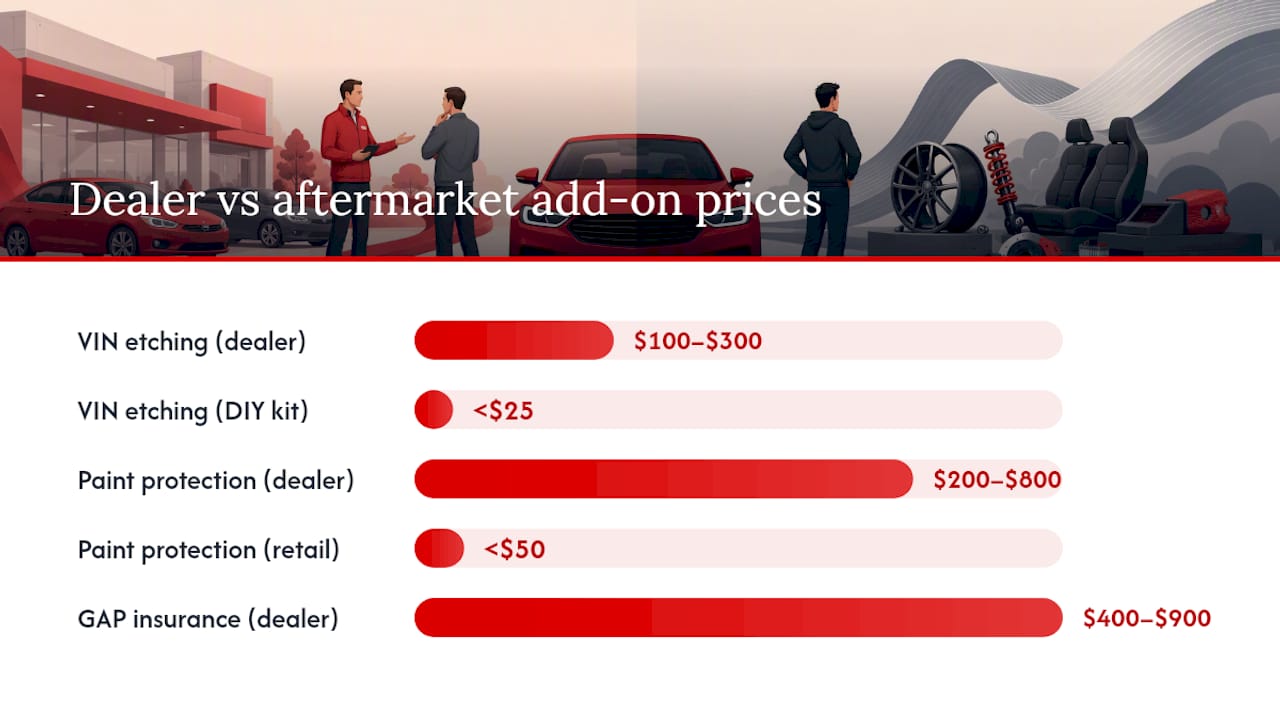
- VIN etching: Optional. Dealer price $100–$300; DIY kit under $25. Decline or ask for a price credit.
- Paint/fabric protection: Optional. Dealer price $200–$800; retail sealants under $50. Decline unless you specifically want it applied before delivery.
- Nitrogen tire fill: Optional. Minimal benefit over standard air. Decline.
- GAP insurance: Optional unless your lender requires it. Dealer price $400–$900; your auto insurer often offers equivalent coverage for far less annually. Get a quote from your insurer before accepting the dealer's price.
- Extended warranty/VSC: Optional on most deals. Dealer markup is often significant. You can usually purchase a VSC after the sale, so there is no urgency to decide in F&I. Ask for the contract terms in writing and compare with third-party providers. For a full breakdown of warranty types, dealership warranty options explained covers what to look for.
- Dealer-installed accessories: Optional. If items were installed without your prior agreement, ask for a credit equal to the charge.
Questions to ask before accepting any add-on: What exactly does this cover? Is there a deductible? Can I cancel it later for a refund? Can I buy this independently after the sale?
Understanding when reconditioning fees are legitimate versus duplicative is easier with context on why vehicle appraisal matters and what prep work actually costs a dealer.
What should you check on the paperwork before you sign?
Catching a fee error or an unauthorized add-on after you have signed is far harder than catching it before. Review every line on the buyer's order and the finance contract before you hand over a check or sign a financing agreement. Photograph every page before you leave the lot.
Buyer's order checklist:
- Confirm the negotiated vehicle price matches what you agreed to at the sales desk.
- Verify destination charge appears once and matches the window sticker (new cars).
- Check the doc fee against your state's cap (see Section 9 below).
- Verify the sales tax calculation: taxable base × your state's rate = tax line. Cross-check the rate against your state's revenue department.
- Confirm title and registration fees match your state DMV's published schedule.
- Review every add-on line. If you did not agree to it in writing, ask for it removed before signing.
- Check trade-in value matches the written trade-in offer you received.
- On the finance contract, confirm the amount financed equals OTD minus your down payment and trade-in credit.
Red-flag lines and responses:
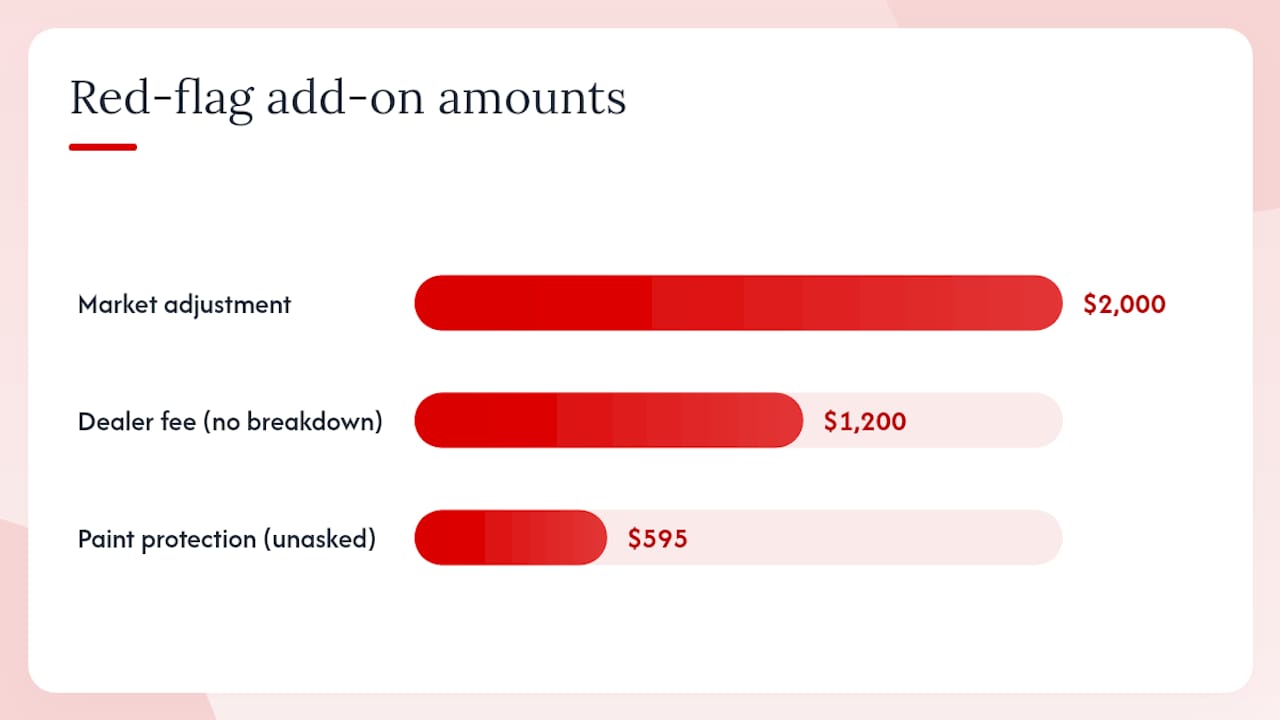
- "Dealer fee: $1,200" (no breakdown) — Response: "I need this itemized line by line before I sign."
- "Paint protection: $595 — installed" (you didn't request it) — Response: "Please remove this or credit me $595 off the vehicle price."
- "Market adjustment: $2,000" — Response: "I'm not accepting a market adjustment. Please remove it or I'll need to look elsewhere."
- Sales tax calculated on a higher base than your negotiated price — Response: "Can you show me how the taxable base was calculated? I want to confirm it reflects my state's trade-in deduction."
Photograph the buyer's order, the finance contract, and the window sticker before you leave the dealership. If a discrepancy surfaces later, you will have documentation. For a broader look at what to expect throughout the purchase process, what to expect at a used car dealership covers the full timeline.
How do state laws change what dealers can charge?
State law is the single biggest variable in your dealership fees breakdown. Doc fees, in particular, range from capped at $85 in California to completely uncapped in Florida, where dealers routinely charge $500–$1,000+. CarWhere's state doc-fee research documents how caps and legal treatment vary materially by state, and CheckoutReceipt's state cost tool lets you compare total all-in costs across states.
Example state doc-fee caps (verify current figures with your state DMV):
| State | Doc Fee Cap | Notes |
|---|---|---|
| California | $85 | Hard cap; dealer cannot exceed it |
| New York | $85 | Hard cap |
| Minnesota | $85 | Hard cap |
| Texas | $150 | Capped |
| Florida | No cap | High outlier; dealers charge $500–$1,000+ |
| Ohio | No cap | Negotiate as dealer margin |
| Illinois | No cap | Negotiate as dealer margin |
How to verify your state's rules:
- Search "[your state] DMV doc fee cap" or "[your state] dealer documentation fee law."
- Check your state's Department of Revenue or Motor Vehicles website directly.
- Look for language like "maximum documentation fee," "dealer processing fee cap," or "required fee disclosure."
If you discover a dealer charged more than your state's cap, contact your state's Attorney General consumer protection office or Department of Motor Vehicles. Most states treat overcharging on capped fees as a consumer protection violation.
Regional patterns: CarEdge's 2026 dataset shows strong state-by-state variance in both doc fees and add-on incidence. Buyers in uncapped states should treat the doc fee as negotiable dealer margin and request a corresponding price credit rather than a fee waiver, which dealers are more likely to accept.
How does an honest dealer handle fees?
Transparent dealers show their work. At Elmwoodautosalesri, every buyer receives an itemized OTD quote that separates government fees, any applicable doc fee, and optional products before the conversation moves to financing. Nothing appears on the buyer's order that the buyer did not review and agree to.
The no-hidden-fees policy at Elmwood Auto Sales means the price you discuss at the sales desk is the price that appears on the buyer's order, with each line labeled and explained. Inspected pre-owned vehicles come with a vehicle history report and a documented state inspection result, so reconditioning charges reflect real work rather than a line added for margin.
Transparency checklist to apply at any dealer:
- Does the dealer provide a written, itemized OTD quote before F&I?
- Are government fees listed separately from dealer-controlled fees?
- Are add-ons listed individually with prices, not bundled into a single "dealer fee"?
- Does the dealer explain which fees are required by law and which are optional?
- Can you see the vehicle inspection report and any reconditioning work performed?
- Are financing terms (APR, term, amount financed) disclosed in writing before signing?
Key Takeaways
Roughly 40% of the fees beyond your negotiated price are dealer-controlled and at least partially negotiable — knowing which bucket each fee falls into is the fastest way to reduce your total cost.
| Point | Details |
|---|---|
| Three fee buckets | Government, manufacturer, and dealer-controlled fees require different responses: verify, accept, or negotiate. |
| National average doc fee | CarEdge's 2026 dataset of 54,814 quotes puts the average doc fee at $486; state caps can limit this significantly. |
| Add-ons average $1,209 | When add-ons appear on a deal, they average $1,209 combined — decline any you did not request. |
| OTD arithmetic is your anchor | Calculate negotiated price + destination + tax + title/registration + agreed fees = OTD before entering F&I. |
| Elmwoodautosalesri's approach | Elmwood Auto Sales provides itemized OTD quotes with fees separated by category before financing discussions begin. |
Why fee transparency matters more than most buyers realize
Most buyers focus on the monthly payment or the sticker price and treat the fee section of the buyer's order as a formality. That's the exact assumption dealers in uncapped states rely on. The doc fee alone can represent $500–$1,000 in pure dealer margin in states with no cap. Add two or three uninvited add-ons and the gap between the price you negotiated and the price you actually paid can easily exceed $1,500.
The deeper issue is that the F&I office is specifically designed to separate fee decisions from price decisions. By the time you are sitting across from the finance manager, you have already agreed on the vehicle, you are emotionally committed, and the conversation is framed around monthly payments rather than total cost. Getting a written, itemized OTD quote at the sales desk is not just good advice. It is the structural move that keeps fee negotiations in the right room.
One more thing worth saying: the three-bucket framework is not just a mental model. It changes what you ask for. You do not argue with a government fee; you verify the math. You do not negotiate a destination charge; you confirm it matches the sticker. You do negotiate a doc fee, a prep charge, and every add-on you did not request. Knowing the difference before you walk in means you spend your energy where it actually produces results.
Transparent pricing at Elmwood Auto Sales in Providence, RI
Buyers who want a low-pressure experience with fees laid out clearly before the finance conversation have a straightforward option in Providence. Elmwoodautosalesri presents every buyer with an itemized OTD quote that separates required government fees from any dealer charges and optional products, so you know exactly what you are agreeing to before you sign.
The inventory at Elmwood Auto Sales covers inspected pre-owned sedans, SUVs, and trucks, with in-house and third-party financing available for a range of credit profiles. There are no commission-based sales tactics, which means the person helping you is focused on finding the right vehicle at a price that works, not on closing a deal at any cost.
Ready to see what an honest buyer's order looks like? Schedule a test drive or request a written OTD quote before your visit. The team at Elmwood Auto Sales in Providence, RI is available to walk through every line with you.
Useful sources to verify fees and state caps
These resources let you confirm state-specific caps, calculate all-in costs, and cross-check any fee a dealer presents.
- Dealer Fees Explained: Which Are Legitimate, Which Are Negotiable, and Which to Refuse | Bumper
- Dealer Fees Explained: Legitimate vs. Walk-Away Fees | CarSavr
- State of Dealer Fees 2026 — Analysis of 54,000+ OTD Quotes | CarEdge
- True Cost of a New Car by State (2026) | CheckoutReceipt
- Dealer fees research and state doc‑fee coverage | CarWhere
- Dealer fees when buying a car | Car and Driver
- Dealer fee calculator and explanation | MyCarCalc
- What car buying fees should you pay? | NerdWallet