
Alternative credit data expands the population lenders can score and adds predictive signal that works alongside FICO, not instead of it, to improve approval accuracy and pricing. The Federal Reserve estimates roughly 32 million U.S. adults are either credit invisible or thin-file, and the CFPB has spent years examining how cash-flow, rent, and utility data can responsibly close that gap. For lenders and underwriters, the role of alternative credit data loans play in a modern risk stack is straightforward: it surfaces "invisible prime" borrowers your bureau file can't see.
The practical takeaway for risk committees:
- First step: Pilot a permissioned cash-flow signal in parallel with your existing FICO-based decisioning before touching production cutoffs.
- Why it matters: Thin-file applicants who look risky on a bureau report often show stable income and low overdraft frequency in transaction data.
- What to watch: Consent capture, explainability, and fairness testing have to be built into the pilot from day one, not bolted on after launch.
Key Takeaways
Alternative credit data expands the scoreable population and improves risk precision only when lenders pair it with rigorous consent, validation, and fairness controls.
| Point | Details |
|---|---|
| Scoreable population gap | Roughly 32 million U.S. adults are thin-file or credit invisible, per Federal Reserve estimates. |
| Supplement, don't replace | Most lenders run alternative signals parallel to FICO before blending them into decisions. |
| Cash-flow leads | Transaction data is the strongest single predictor for small-dollar and short-term lending. |
| Compliance isn't optional | CFPB and GAO guidance require explainability, fairness testing, and clear consumer disclosure. |
| Pilot before you scale | Define success metrics and go/no-go gates before launching any holdout test. |
Table of Contents
- What Is the Role of Alternative Credit Data in Loans Versus Bureau Data?
- What Alternative Data Types Actually Predict Repayment?
- How Does Alternative Data Move Through Underwriting?
- What Benefits Do Lenders Actually See From Alternative Data?
- What Risks Does Alternative Credit Data Create for Lenders?
- How Should Lenders Evaluate and Pilot a Vendor?
- How Do You Validate and Monitor an Alternative-Data Model?
- What Does the Data Say About Alternative Credit Access?
- Where Should Lenders Draw the Line on Adoption?
- Frequently Asked Questions
- Sources
What Is the Role of Alternative Credit Data in Loans Versus Bureau Data?
Alternative credit data covers non-bureau financial information: permissioned bank transactions, rent and utility payment history, telecom and BNPL records, payroll deposits, and in some models, device metadata or psychometric assessments. The Congressional Research Service defines it as data used to assess creditworthiness specifically when traditional credit history is thin or absent. That distinction matters for underwriting design: this data doesn't replace the three national bureaus, it fills the gaps around them.
Traditional bureau data and alternative credit data behave differently in a decision engine.
| Dimension | Bureau data (Experian, Equifax, TransUnion) | Alternative credit data |
|---|---|---|
| Coverage | Excludes ~32 million thin-file or invisible adults | Reaches renters, gig workers, and cash-based earners |
| Timeliness | Updates monthly via furnisher reporting | Near real-time via API or open banking connection |
| Regulatory footprint | Governed by FCRA and bureau-specific rules | Also FCRA-regulated when used in credit decisions |
| Interpretability | Standardized scores (FICO, VantageScore) | Varies by vendor; requires explainability tooling |
| Best use case | Established borrowers with 2+ years of history | Thin-file, credit-invisible, and small-dollar applicants |
Two things underwriters should hold onto here:
- Most incumbent lenders layer alternative signals as a secondary input, not a bureau replacement, according to Plaid's lending research.
- Experian itself frames alternative data as a way to "expand visibility," language that signals supplementation rather than substitution.
What Alternative Data Types Actually Predict Repayment?
Not every signal earns its keep in a model. Here's what each category tends to tell you, and where it gets messy:
- Bank transaction/cash-flow data: Shows income stability and liquidity cushion; the strongest single predictor for small-dollar loans, but requires 60 to 90 days of history to smooth out noise.
- Rent payment history: Indicates consistent large-obligation repayment; strong for longer-tenor installment lending, though reporting coverage is still spotty across property managers.
- Utility and telecom payment records: Flags basic bill discipline; useful but weaker as a standalone predictor since amounts are small and grace periods are common.
- BNPL and nontraditional lending history: Reveals recent credit behavior for younger or newly banked borrowers; data quality varies widely by furnisher.
- Payroll and deposit patterns: Confirms employment continuity and income level, valuable for auto and installment underwriting.
- Device and geolocation metadata: Mainly a fraud and identity-verification signal, not a repayment-ability signal.
- Psychometric assessments: Used in some emerging-market models to proxy conscientiousness; largely unproven in U.S. consumer lending and worth approaching with skepticism.
For small-dollar unsecured loans, cash-flow data does most of the heavy lifting. For installment auto loans, a blend of payroll deposits and rent history tends to outperform any single signal alone.
How Does Alternative Data Move Through Underwriting?
The mechanics follow a consistent sequence, whether you're building in-house or buying from a vendor like Plaid or LexisNexis Risk Solutions:
- Consumer permission and consent. The borrower authorizes access to bank, payroll, or rent data, typically through an OAuth-based connection at point of application.
- Secure data ingestion. APIs or open banking rails pull transaction-level data, often through the same infrastructure covered under the CFPB's personal financial data rights rule.
- Model training and holdout validation. New features get tested against a held-out sample before touching live decisions.
- Score or decision integration. Lenders typically run alternative signals in parallel with FICO first, then move to blended scoring once validated.
- Decisioning and pricing action. Approved features feed into cutoffs, tiered pricing, or manual-review triggers.
Before any of that works, your integration checklist needs to cover:
- Consent recordkeeping that satisfies audit and dispute requirements
- Data minimization so you're only pulling what the model actually uses
- Clear mapping between new signals and existing decision rules
- A defined fallback path for applicants who decline to permission their data
Pro Tip: Build your fallback path first, not last. If 15 to 20 percent of applicants decline data-sharing permission, and you haven't decided how they're underwritten, you've built a pilot with a blind spot baked in.
Consumer-permissioned finance is what makes this whole flow viable at scale. It replaces manual pay stub and bank statement collection with a borrower-authorized digital handshake, cutting turnaround time significantly for applicants who might otherwise wait days for document review.

What Benefits Do Lenders Actually See From Alternative Data?
The financial inclusion of alternative credit access loans case is real, but the risk management case is what gets budget approved. Four benefits show up consistently across lender deployments:
- Expanded scoreable population: Cash-flow data can bring thin-file applicants into a decisionable range they'd never reach on bureau data alone.
- Invisible prime identification: Some borrowers with no bureau score show low default propensity once transaction history is factored in, a pattern the Federal Reserve has documented.
- Sharper risk segmentation: Blending signals lets you separate borderline applicants who'd otherwise land in the same bureau-score bucket.
- Faster, cheaper small-dollar underwriting: Automated cash-flow review makes loans that were previously too costly to underwrite manually economically viable.
By the numbers: Field experiments summarized in an NBER working paper found alternative-data scoring materially raised approval rates for applicants who were previously unscoreable under conventional models.
The clearest use cases: thin-file and credit-invisible applicants, small-dollar installment lending, auto loan underwriting in subprime and buy-here-pay-here segments, and BNPL portfolio oversight. Account management teams also use these signals for re-aging decisions and treatment segmentation on existing books, not just new originations.
What Risks Does Alternative Credit Data Create for Lenders?
Every benefit above comes with a corresponding exposure, and skipping this part is how pilots become enforcement actions. The CFPB has flagged privacy gaps, the risk of reinforcing structural bias, and the possibility that signals like prior payday loan usage correlate with worse outcomes for specific demographic groups without directly measuring creditworthiness.
Six risks deserve a permanent line item on your compliance checklist:
- Privacy and consent gaps: Permissioning that isn't granular enough exposes you to both regulatory and reputational risk.
- Data quality and provenance: Vendor data that isn't independently validated can silently degrade model performance.
- Structural bias reinforcement: Signals correlated with protected classes can smuggle discrimination into a facially neutral model.
- Opaque scoring: Vendor "black box" models make adverse action notices and dispute resolution difficult to defend.
- Sensitive attribute proxies: Geolocation and device metadata can act as unintentional proxies for race or income level.
- False positive correlations: Small-sample or short-history signals can generate spurious patterns that don't hold up out of sample.
The GAO's analysis of credit-scoring alternatives makes the trade-off explicit: widening access and protecting consumers from model-driven discrimination pull in different directions, and supervisory bodies expect lenders to show their work on both sides.
Regulatory attention here isn't new. The Federal Register's 2017 request for information on alternative data and modeling techniques set the tone that supervisors are still following today. Mitigation means data minimization, fairness-aware model development, robust holdout validation, clear consumer disclosure, and escalation triggers when a model shows adverse impact on a protected population.
How Should Lenders Evaluate and Pilot a Vendor?
Vendor selection determines whether your pilot produces a defensible answer or a mess of unvalidated claims. Run every candidate, whether it's Plaid, LexisNexis Risk Solutions, Experian, Equifax, or TransUnion, through the same six-point check:
- Data types supported: Confirm coverage across transactions, rent, utilities, and device signals, not just one category.
- Thin-file coverage: Ask for validation evidence specific to credit-invisible populations, not just their general customer base.
- API maturity and time-to-production: A vendor's sales deck timeline and your engineering team's actual integration timeline are rarely the same number.
- Consent and privacy features: Look for granular permissioning and data minimization built into the product, not added as a compliance afterthought.
- Explainability tools: If the vendor can't show you feature-level reason codes, your adverse action notices will be indefensible.
- Pricing model: Per-lookup, subscription, and revenue-share structures each shift your cost curve differently as volume scales.
Design your pilot around a defined population slice, a holdout group large enough to detect a meaningful approval-rate delta, and success metrics agreed upon before you see results, not after.
Pro Tip: Set your go/no-go gate before the pilot starts, in writing. Teams that wait to define success until they see promising numbers almost always talk themselves into a lower bar.
How Do You Validate and Monitor an Alternative-Data Model?
Validation doesn't end at launch. It's an ongoing discipline that separates a defensible program from a liability.
- Measure uplift directly: Track approval-rate delta, ROC-AUC or Gini improvement, and calibration accuracy by score band against your baseline model.
- Compare vintage loss rates: Match new originations against prior vintages underwritten without the alternative signal.
- Run subgroup performance tables: Check disparate impact ratios across protected classes at every model refresh.
- Track feature-importance drift: A signal that mattered at launch can lose predictive power as economic conditions shift.
- Set a monitoring cadence: Most lenders run champion-challenger testing quarterly, with a full holdout review at minimum annually.
Fairness and stability checks belong on the same schedule as performance checks, not a separate track that gets deprioritized when volume pressure hits.
What Does the Data Say About Alternative Credit Access?
The scale of the thin-file problem is what makes this more than a niche modeling exercise. The Federal Reserve's estimate of roughly 32 million unscoreable U.S. adults breaks down to about 7 million who are fully credit invisible and 25 million who carry a thin file too sparse to generate a reliable score.
| Metric | Estimate | Source |
|---|---|---|
| Credit invisible adults | ~7 million | Federal Reserve |
| Thin-file adults | ~25 million | Federal Reserve |
| Primary alternative data input | Transaction data | IFC |
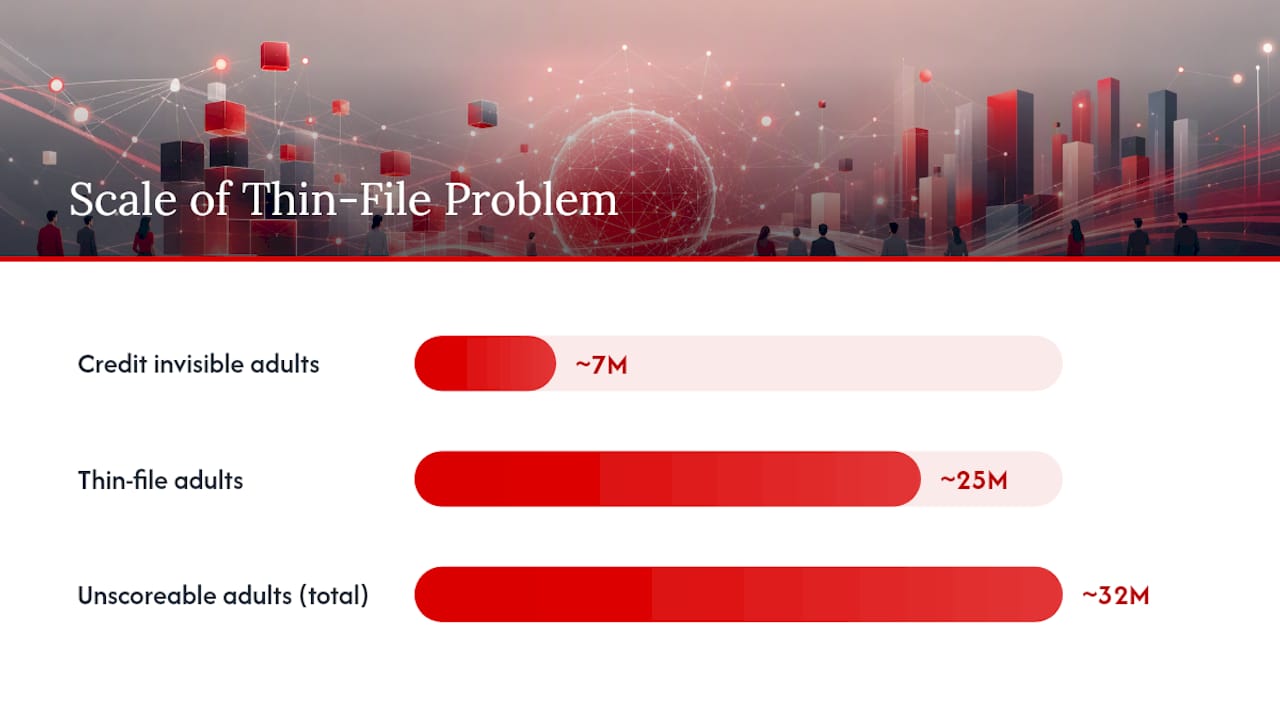
The IFC's research on alternative data and AI confirms transaction data drives most alternative-credit models today, with fully autonomous AI decisioning still rare. Field experiments cited in the NBER working paper back this up with real approval-rate gains. One caveat worth repeating to any board or investment committee: these figures come from specific market conditions and applicant pools, so run your own validation before assuming similar lift on your book.
Where Should Lenders Draw the Line on Adoption?
Staged adoption beats a full-scale rollout every time. Start with permissioned pilots run in parallel to your existing scoring, validate rigorously against a real holdout, and disclose to consumers exactly what data you're using and why. That sequencing protects you from the two failure modes that actually happen: a model that quietly discriminates, and a compliance team that finds out about a new data source after examiners do.
Three things belong on every governance agenda before scale-up:
- Require documented fairness testing before any alternative-data model touches production cutoffs.
- Track approval-rate and loss-rate lift by segment, not just in aggregate, so hidden trade-offs surface early.
- Build consumer disclosure and dispute processes into the launch plan, not a post-launch patch.
Pro Tip: If you're prioritizing signals, start with cash-flow data for small-dollar products and rent or utility history for longer-tenor lending, they map most cleanly to the repayment behavior each product actually depends on.
Frequently Asked Questions
What is the role of alternative credit data in loans for thin-file borrowers?
It gives lenders a way to evaluate repayment ability using cash-flow, rent, and utility history when a bureau file is too sparse to generate a reliable score, often surfacing applicants who'd otherwise be declined outright.
Does alternative credit data replace FICO scores?
No. Most production lending systems treat it as a supplementary layer that runs alongside bureau scores, not a replacement, according to Plaid's lending research.
Is alternative credit data regulated?
Yes. When used in consumer credit decisions, it typically falls under the FCRA, and the CFPB has issued specific guidance on privacy, bias, and disclosure obligations.
How much can alternative data improve loan approval rates?
Effects vary by market and applicant pool, but field experiments summarized in the NBER working paper found meaningful approval-rate gains for previously unscoreable applicants. Lenders should still validate results against their own portfolio before scaling.
What's the biggest implementation risk lenders overlook?
Skipping fairness testing during the pilot phase. A model that looks accurate in aggregate can still produce disparate outcomes across subgroups, and the CFPB has repeatedly flagged this as a supervisory priority.
If you're weighing financing options and wondering how alternative data factors into your own approval, our guide to no credit check car loans breaks down what Elmwoodautosalesri looks at beyond a bureau score. You can also schedule a test drive and talk through financing options with our team directly, no commission-driven pressure, just a straightforward look at what fits your situation.
This article is general information, not a substitute for advice from a qualified financial advisor. Consult a qualified financial professional about your own circumstances before acting on anything here.
Sources
- Federal Reserve: Alternative data and consumer credit context
- Using alternative data to evaluate creditworthiness — CFPB blog